
Why Does a Dog Spin in Circles? What’s Normal, What’s Not, and When to Worry

If your dog spins in circles, the first question is not “How do I stop it?” It is “What kind of circling is this?”
A brief turn or two before lying down is usually normal. Dogs may be checking the surface, settling the body, or following a deeply rooted nesting habit. But repetitive spinning, tight circling in one spot, or a sudden new pattern can point to pain, skin irritation, anxiety, compulsive behavior, or a neurological problem.
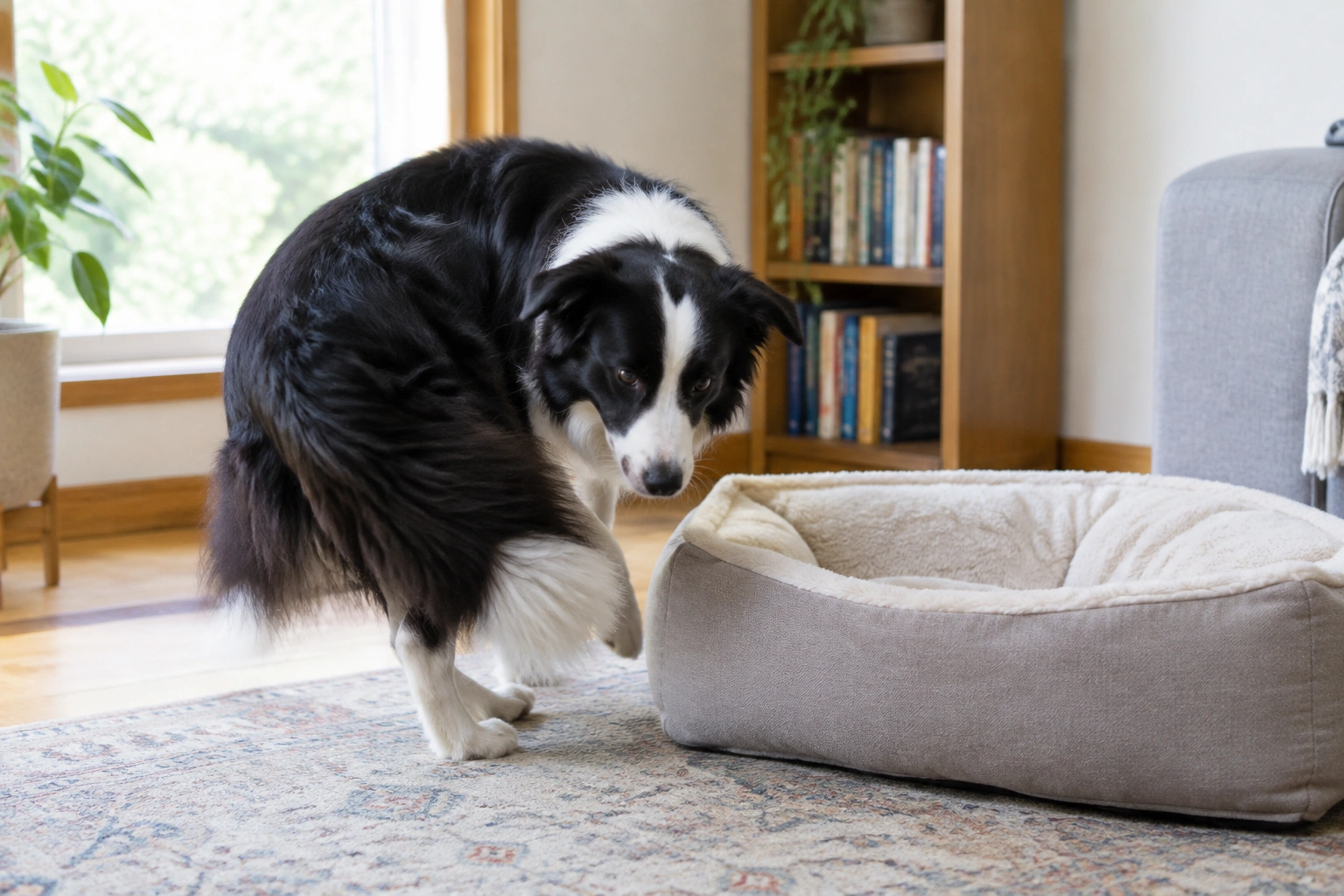
For Border Collie owners, that distinction matters even more. Border Collies are often quick, intense, and highly responsive dogs, and some individuals may circle more readily when excitement or arousal is high than a lower-energy breed. But breed tendency is not a free pass. If the spinning is new, frequent, hard to interrupt, or paired with other symptoms, treat it as a problem until proven otherwise.
Why dogs spin in circles: the short answer
Most dogs circle for one of three broad reasons:
- Normal settling behavior before resting or sleeping
- Arousal or emotion such as excitement, anticipation, or stress
- A medical or neurological issue if the circling is repetitive, sudden, or unusual
That means the behavior itself is not the problem. The pattern is the clue.
A dog that circles once, lies down, and relaxes is behaving very differently from a dog that keeps spinning, seems unable to settle, or circles in a tight loop as if they cannot figure out where to place their body. The first is usually harmless. The second deserves attention.
If you want a reliable benchmark, VCA Animal Hospitals explains that dogs in the wild made their own beds by patting down grass, moving debris, and even repositioning snowbanks, and that circling in colder climates could help them curl into a tighter ball to conserve heat. You can read that explanation in their article on why dogs turn around before lying down.
Normal circling before lying down: what it looks like and why dogs do it
A normal pre-rest circle is usually brief, smooth, and easy to interrupt. The dog turns once or twice, adjusts position, lowers themselves, and settles.
What normal looks like
You will usually see some combination of these signs:
- The circling happens right before resting
- It lasts only a few seconds
- The dog chooses a spot and then lies down
- There is no obvious distress
- The dog can be redirected without frustration
A Border Collie on a cool evening may turn twice on the sofa, tuck in, and sleep. That is not the same thing as a dog pacing the room for several minutes and never quite committing to a resting position.
Why dogs do it
The practical reason is comfort. Dogs do not have pillows and mattress toppers in nature, so turning before lying down likely helped them make the ground more usable. The instinct may also have helped them check for discomfort, debris, or uneven footing.
That does not mean every circle is “ancestral behavior,” and it does not mean every spinning dog is fine. It only means that circling before rest is common enough to be normal when the context fits.
When normal circling becomes less normal
A dog can have a normal habit and still cross into concern if the pattern changes. For example:
- The dog used to circle once, now circles many times
- The dog now circles at odd times, not just before sleep
- The dog seems restless after circling instead of relaxed
- The dog starts circling in one direction only
- The dog appears stiff, sore, itchy, or disoriented
The habit matters less than the change.
Normal circling vs. concerning spinning
This is the decision point most owners need. Use the comparison below as a practical filter.
| Pattern | What it usually looks like | Most likely meaning | What to do |
|---|---|---|---|
| Brief circling before lying down | 1–2 turns, then the dog settles | Normal resting behavior | Watch and note the pattern |
| Excited spinning | Appears before walks, meals, visitors, or play | Arousal, anticipation, or stress | Reduce intensity, add structure |
| Repetitive spinning | Many turns, hard to interrupt, happens often | Possible anxiety, compulsion, pain, or illness | Track it and consider a vet visit |
| Tight circling in one place | Small, repetitive loop, sometimes in one direction | More concerning for neurologic or balance issues | Book a vet exam promptly |
| Circling with other symptoms | Limping, head tilt, scratching, confusion, yelping | Medical cause more likely | Seek veterinary advice soon |
A useful rule: if the dog can settle normally afterward, the behavior is less concerning; if the dog cannot settle, the behavior deserves investigation.
Behavioral reasons dogs spin: excitement, anticipation, stress, and compulsive patterns
Not all spinning is medical. Some dogs spin because their nervous system is running hot.
Excitement and anticipation
Some dogs spin when they know something good is coming. A Border Collie may whirl before a walk, a ball session, or dinner. The behavior is usually brief and clearly linked to a trigger.
This type of spinning is often easy to recognize because the dog can usually stop once the event starts. The spinning is part of the buildup, not the whole story.
The trade-off here is simple: if the dog is only spinning for a few seconds before a predictable event, it may be harmless arousal. If the dog is spinning so hard that they cannot hear you, cannot settle, or begin doing it more often in daily life, the behavior is no longer just enthusiasm.
Stress and anxiety
Anxious dogs may circle because movement helps release tension. You may see this during thunderstorms, when visitors arrive, during crate time, or when the household routine changes.
The clue is context. Anxiety-based spinning tends to appear with other signs:
- Panting when it is not hot
- Whining
- Pacing
- Wide eyes
- Difficulty lying down
- Following you from room to room
If the spinning rises during predictable stressors, your job is not to “correct” it. Your job is to reduce the trigger, lower the arousal, and make the environment easier to cope with.
Compulsive patterns
Repetitive spinning can become compulsive when the dog seems driven to repeat it even without an obvious trigger. This is more likely when the behavior is frequent, hard to interrupt, and seems to provide temporary relief but quickly returns.

Compulsive patterns are not solved by punishment. Punishment may suppress the visible behavior for a moment, but it does nothing to address the underlying tension and can make the dog more anxious.
If the spinning looks ritualized or increasingly difficult to interrupt, that is a strong reason to involve your veterinarian and, if needed, a veterinary behaviorist.
Breed context: why Border Collies and other herding dogs may circle more
Border Collies are not automatically more likely to have a problem, but they may show intense, repetitive movement patterns when arousal is high.
That is partly because they are often:
- Highly responsive to motion
- Quick to build excitement
- Prone to pattern-based behavior
- Often under-stimulated if their needs are not met
A Border Collie that spins once before flopping down is probably just settling. A Border Collie that spins during every transition, every meal, and every moment of frustration may be telling you their arousal level is too high.
This is where owners can misread the breed. People see intense movement and assume it is “just Border Collie energy.” Sometimes it is. Sometimes it is the beginning of a behavior problem. The difference is whether the dog can switch off.
A well-run Border Collie still needs outlets, but more exercise is not always the first fix. If the dog is spinning because they are overstimulated, adding more excitement can make it worse. In those cases, calm structure and predictable routines often help more than bigger workouts.
Medical causes of repetitive spinning: pain, skin irritation, fleas, and other discomfort
When spinning is repetitive or new, a physical cause should stay high on the list.
Pain or stiffness
Dogs in pain may circle because they cannot get comfortable. Arthritis is a common example, especially in older dogs. The dog may circle, pause, lie down, stand up again, and repeat the sequence.
Look for related signs:
- Stiffness after rest
- Slower movement
- Reluctance to jump or climb stairs
- Yelping when touched
- A change in posture
If the spinning happens mostly at night or after exercise, pain is worth considering.
Skin irritation or fleas
Some dogs spin or repeatedly turn because something on their skin is bothering them. Fleas, allergies, hot spots, or irritated skin can create enough discomfort that the dog keeps shifting position.
You may also notice:
- Scratching
- Biting at the flank or tail base
- Red skin
- Hair loss
- Restlessness on the floor or bed
If the dog is spinning and scratching the same area, that is not a training issue. Check the coat and skin carefully and talk to your vet if you find redness, flea dirt, or persistent itching.
Ear disease or balance problems
Ear problems can affect balance and orientation. A dog with an ear infection or vestibular issue may seem off, tilt the head, or circle awkwardly. This is especially important if the dog seems unsteady or keeps leaning one way.
The combination of circling plus balance trouble should move the issue into veterinary territory quickly.
For a broader veterinary overview of circling causes, ASPCA and VCA Animal Hospitals both provide useful owner-facing health information on when unusual behavior can signal a medical problem.
Neurological and age-related causes: when circling signals something more serious
This is the category you do not want to miss.
Veterinary neurology sources note that brainstem disease can cause circling, and that the pattern may differ depending on where the problem is. A dog with forebrain involvement may walk in circles around the room, while a dog with brainstem involvement may tightly circle in one place. You can read that distinction in Southeast Veterinary Neurology’s explanation of dog walking in circles.
Signs that make a neurological cause more likely
Watch for:
- Sudden onset
- Tight circling in one direction
- Loss of balance
- Head tilt
- Disorientation
- Staring or confusion
- Falling
- Seizure-like episodes
- A change in vision or responsiveness
Older dogs deserve special attention. In senior dogs, circling can sometimes be associated with neurological disease, and an older dog that starts turning in circles and seems mentally “off” should not be assumed to be “just getting old.”
A dog that is circling and also seems lost in familiar places, slow to respond, or unable to navigate around furniture needs a vet exam.
Warning signs that mean you should call a veterinarian
Use this as your practical line in the sand.
Book a vet appointment soon if:
- The circling is new or clearly increasing
- It happens many times a day
- The dog cannot settle afterward
- You see limping, stiffness, scratching, or head shaking
- The dog seems anxious or restless without an obvious trigger
- The behavior is interfering with sleep or daily life
Seek prompt veterinary care if:
- The dog is circling tightly in one place
- The dog is off balance or falling
- There is a head tilt
- The dog seems disoriented or confused
- The behavior started suddenly
- The dog is older and this is new
Treat it as urgent if:
- There is sudden severe disorientation
- The dog cannot stand normally
- There are seizure signs
- The dog is vomiting, collapsing, or acting dramatically unwell
A useful rule: sudden, tight, one-direction circling is more concerning than casual turning before lying down.
What you can safely do at home before escalating
You do not need to guess. You need data.
Track the pattern for a few days
Write down:
- Time of day
- What happened right before the spinning
- How long it lasted
- Whether the dog could settle
- Any other symptoms
If you can, be even more specific. Note whether the dog spun before meals, after waking, during greetings, after exercise, or only at night. A short video clip can also help a vet see whether the movement is brief settling, excited arousal, or something more concerning.
This often makes the pattern obvious. A dog that spins only before meals is different from a dog that spins after waking, after exercise, and during the night.
Reduce obvious triggers
If the spinning happens during excitement, lower the intensity of the moment. Keep greetings calmer, use predictable routines, and avoid building the dog up right before the behavior appears.
For high-energy Border Collies, the goal is not to eliminate excitement entirely. The goal is to keep arousal from tipping into a repetitive loop.
Check for discomfort
Look for fleas, red skin, sore feet, ear odor, or stiffness. If the dog seems painful, do not push training first. Rule out the medical side.
Avoid punishment
Punishing a spinning dog is a poor trade. If the cause is pain, anxiety, or neurological, punishment adds stress without solving the problem. Even if the behavior is learned, punishment often increases arousal, which can make the spinning worse.
Add calmer structure, not just more activity
If boredom or under-stimulation seems involved, use structured enrichment rather than simply more chaos. Sniffing games, food puzzles, and short training sessions can help some dogs settle better than endless high-intensity play.
The key is balance. A dog that is mentally empty may spin from frustration. A dog that is overexcited may spin because they never get a chance to come back down.
How a veterinarian or veterinary behaviorist may evaluate the behavior
A good vet will not look only at the spinning. They will look at the whole dog.
Expect questions about:
- When the behavior started
- Whether it is getting worse
- Whether it happens in a specific context
- Whether the dog has pain, itching, balance issues, or confusion
- Whether the dog can settle normally
- Any changes in sleep, appetite, or mood
Depending on the case, your vet may start with a physical exam that includes the ears, eyes, skin, joints, gait, and basic neurological status. They may also assess pain, look for signs of infection or inflammation, and ask about any recent changes in behavior or mobility. If the exam suggests an internal or neurologic cause, bloodwork or imaging may be considered next.
If medical causes are not obvious and the pattern looks behavioral, a veterinary behaviorist may be the better next step.
That referral matters when the dog’s spinning seems compulsive, anxiety-driven, or tied to deeper emotional arousal. Training alone is rarely enough if the dog is struggling with a true behavior disorder.
When to see a veterinarian or certified trainer
If the spinning is brief, situational, and the dog settles normally, you can usually monitor at home.
If it is repetitive, increasing, hard to interrupt, or paired with pain, itching, balance trouble, or confusion, see a veterinarian.
If the dog is medically cleared but still spins from anxiety, arousal, or compulsive habits, a certified trainer or veterinary behaviorist can help you build a plan that fits the dog’s trigger pattern.
For Border Collies especially, the goal is not to suppress motion. It is to understand what the motion is telling you.
FAQ
Is it normal for a dog to spin in circles before lying down?
Yes, brief circling before resting is usually normal. It becomes more concerning if the dog cannot settle, or if the circling is repetitive, tight, sudden, or paired with other symptoms.
Why does my dog spin in circles when excited?
Some dogs spin when their arousal rises before a walk, meal, or play session. If the spinning is brief and stops once the event begins, it is often excitement rather than illness.
Could spinning be a sign of pain?
Yes. Arthritis, stiffness, skin irritation, fleas, ear disease, and other discomforts can all make a dog restless or unable to settle.
When is circling a neurological red flag?
When it starts suddenly, happens tightly in one place, or comes with head tilt, falling, confusion, or loss of balance.
Is this more common in Border Collies?
Border Collies may show more intense movement patterns because they are highly aroused, alert, and pattern-driven. That does not make all spinning normal, but it does mean context matters.
Should I try to train the behavior away?
Only after you have considered medical causes. If the dog is spinning because of pain or illness, training is the wrong first move.
How much spinning is too much?
There is no exact number. The practical threshold is whether the dog can settle normally, whether the behavior is new or worsening, and whether other symptoms are present.
When should I call the vet?
Call sooner if the spinning is new, frequent, hard to interrupt, or paired with itching, limping, head tilt, disorientation, or balance problems.
Can anxiety cause a dog to spin in circles?
Yes. Some dogs spin when stressed, overstimulated, or unable to cope with a situation. The behavior often appears with pacing, whining, or restlessness.
What should I do first if my dog starts spinning more than usual?
Track the pattern, check for discomfort, reduce obvious triggers, and book a vet visit if the behavior is new, increasing, or paired with other symptoms.
