
Why Does My Dog Sit in My Lap? A Practical Guide to What It Really Means

If your dog keeps climbing into your lap, the most likely explanation is also the simplest: they want closeness. Dogs commonly sit on people to seek affection, warmth, comfort, attention, or a sense of security. That can be completely normal.
But the context matters. A calm Border Collie settling against you during a quiet evening is very different from a dog that cannot relax unless it is touching you, follows you from room to room, or suddenly starts demanding lap time after a change in routine. The same behavior can mean bonding, habit, stress, or discomfort.
For Border Collie owners, this question comes up often because the breed tends to be highly people-focused, sensitive, and quick to form strong attachments. That does not mean every lap-sitter is anxious. It does mean you should read the whole picture, not just the cute part of the behavior.
Why Dogs Sit in Your Lap: The Most Common Meanings
Lap-sitting is usually a contact-seeking behavior. Dogs are social animals, and many enjoy physical closeness with their people. In practice, that closeness can serve several purposes at once.
Affection and bonding
A dog that climbs into your lap, relaxes, and stays soft in the body is often saying, “I like being near you.” That is especially common in dogs that already seek eye contact, follow their owners around, or lean into touch.
Lap-sitting is often social, not strategic. It is about contact.
Warmth and comfort
Some dogs choose laps because they are warm and steady. A lap can feel like a safe resting spot, especially on a cold day or after a busy walk. This is not unusual in smaller dogs, but bigger dogs do it too if the reward is strong enough.
Attention and interaction
Dogs learn quickly which behaviors get a response. If your dog climbs into your lap and instantly gets petting, talking, laughing, or eye contact, that behavior can become more frequent. Dogs may also use lap-sitting to seek attention or interaction.
That does not mean the dog is “being bad.” It means the behavior works.
Proximity-seeking
Some dogs simply prefer being close to their person. They may not want to be held, and they may not be distressed. They just want physical nearness. For many owners, that is the easiest explanation to accept because it fits what they see: the dog settles, stays calm, and seems content.
When Lap-Sitting Is Normal Affection vs. Neediness
The difference between affectionate closeness and attention-seeking is usually not the lap itself. It is the pattern around it.
A dog is more likely being affectionate if:
- it chooses your lap at relaxed times, such as after a walk or during quiet evening downtime
- it can settle elsewhere when asked
- it does not become upset if you move
- its body stays loose, soft, and unforced
A dog is more likely using lap-sitting as a demand for attention if:
- it repeatedly climbs up after you stop interacting
- it nudges, paws, or interrupts your tasks to get onto you
- it seems unable to self-settle
- it only wants your lap when you are busy, on a call, or trying to work
That distinction matters because the response should match the motive. Affection can be enjoyed. Demand behavior may need boundaries.
Body Language That Tells You Whether Your Dog Is Relaxed or Stressed
The lap-sitting itself tells you very little. The body around it tells you much more.
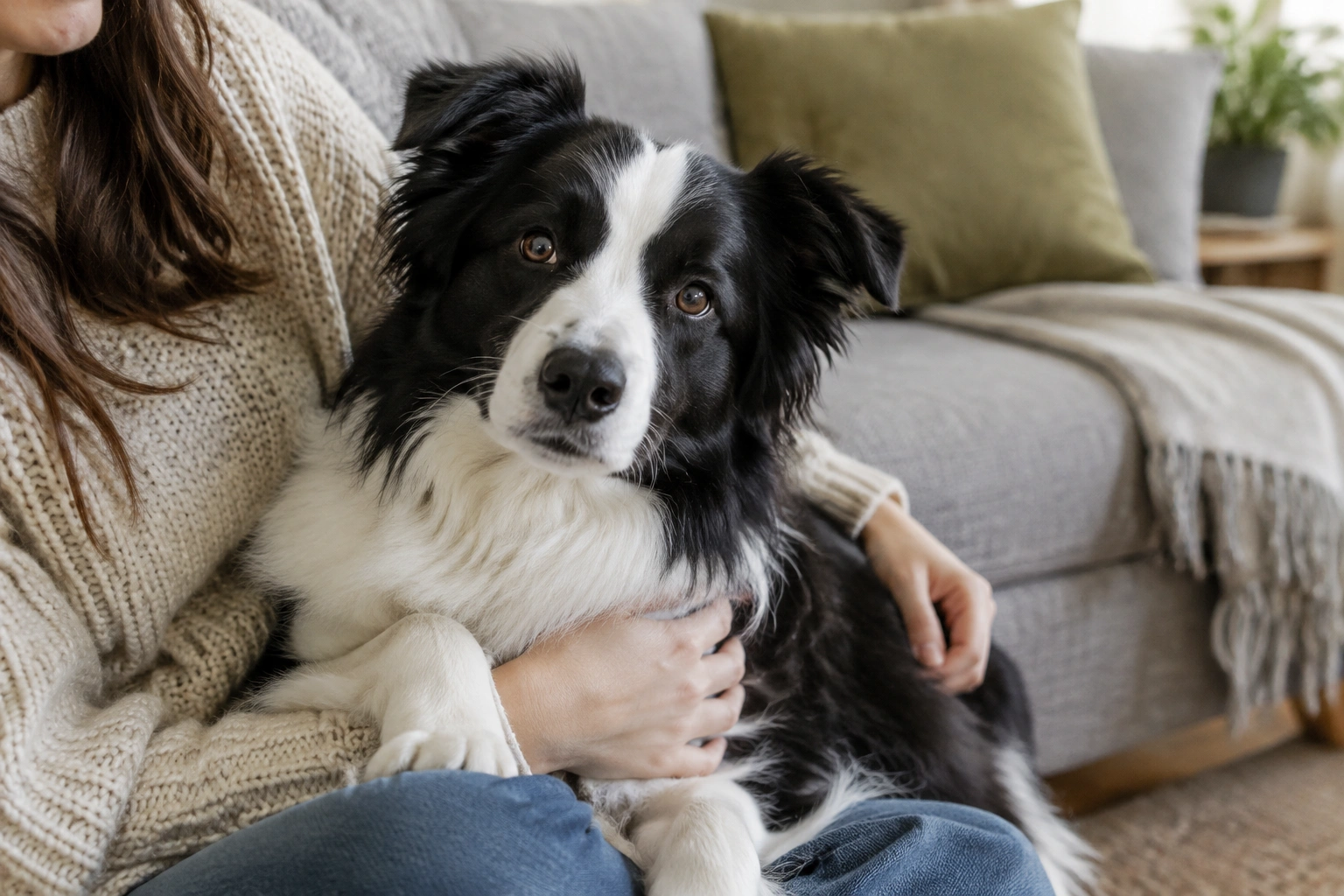
Signs the dog is relaxed
A relaxed dog usually shows:
- loose muscles
- a soft face
- normal breathing
- a settled posture
- the ability to shift off the lap without protest
Some dogs may sigh, rest their head on you, or half-close their eyes. That is the picture of comfort.
Signs the dog may be stressed or insecure
Watch more carefully if lap-sitting comes with:
- panting when the room is not hot
- trembling
- lip licking
- whale eye or wide, watchful eyes
- restlessness
- repeated repositioning
- clingy following from room to room
- whining or inability to lie down elsewhere
These signs do not prove anxiety on their own, but they raise the odds that the lap is functioning as a coping strategy rather than a simple cuddle spot.
A stressed dog may also use your lap as a shield. That can happen during thunderstorms, fireworks, visitors, or other situations the dog finds overwhelming. In those cases, the lap is not the problem; it is the refuge.
Why Border Collies and Other Sensitive Herding Breeds May Climb Into Laps
Border Collies often make this behavior more noticeable because they tend to be observant, responsive, and deeply tuned in to their people. Many are not “touchy” in a random way; they are selective. When they choose contact, they often mean it.
That sensitivity can work in two directions:
- It can create strong, affectionate attachment.
- It can also make the dog more likely to seek reassurance when the environment feels uncertain.
So when a Border Collie sits in your lap, the behavior may reflect breed temperament, not a problem. But the breed does not tell you the full story. A confident Border Collie that settles on you after exercise is different from a Border Collie that cannot relax unless it is glued to your side.
The useful question is not, “Is this a Border Collie thing?” It is, “What is this dog getting from the behavior?”
How Owner Reactions Can Accidentally Reinforce Lap-Sitting
Dogs repeat what pays. If your dog climbs into your lap and gets immediate praise, stroking, eye contact, and conversation, the behavior is being reinforced.
That matters because many owners accidentally train more lap-sitting than they intended. The pattern is easy to miss:
- Dog jumps up.
- Owner laughs and pets the dog.
- Dog stays longer.
- Next time, the dog tries sooner and more insistently.
This is not about dominance. It is about reinforcement.
If you like the behavior, that may be fine. If you do not want it to become constant or pushy, then be selective with your response. Calmly rewarding only the lap-sitting you actually want — such as when you invite the dog up — will usually shape the habit better than reacting every time the dog demands access.
Could Lap-Sitting Be Anxiety, Insecurity, or Separation-Related Behavior?
Yes, sometimes. The difference is in the pattern.
Anxiety-driven lap-sitting usually does not happen in isolation. It tends to appear alongside other signs of distress, such as:
- pacing
- following you constantly
- trouble settling when you leave the room
- whining or barking when separated
- increased clinginess after a stressful event
- sudden shadowing behavior
If the dog seeks your lap mainly when the environment becomes uncertain, the behavior may be functioning as self-soothing.
A Border Collie, in particular, may be prone to this if it has a strong attachment to one person and little practice being calm without direct contact. That does not mean the dog is broken. It means the dog may need more help learning how to settle independently.
A helpful comparison:
- Affection: “I like being with you.”
- Anxiety: “I need to be with you to feel okay.”
Those are very different experiences, even if the outward behavior looks similar.
For broader separation-related patterns, the ASPCA’s guidance on separation anxiety is a useful reference point.
When Lap-Sitting May Point to Pain, Illness, or Mobility Problems
A dog that suddenly starts sitting in your lap more often may be telling you something physical is wrong.
That is especially worth considering if the change is new and comes with:
- stiffness
- limping
- reluctance to jump or climb stairs
- sensitivity when touched
- slower movement
- unusual quietness
- changes in appetite or energy
Some medical causes can be subtle at first, so do not wait for obvious illness before paying attention. A dog in pain may choose your lap because it feels stable, warm, and safe. Or the dog may seek closer contact because moving around is uncomfortable. Either way, the behavior is not the real issue; the discomfort is.
Sudden change is the key red flag. If your dog used to prefer the floor and now insists on your lap, do not assume it is just extra affection. That shift deserves a veterinary check, even if the other symptoms seem mild.
If you want a general benchmark for when behavior changes may be medical rather than behavioral, VCA Hospitals’ dog behavior resources are a solid starting point, and they pair well with a vet exam when the change is abrupt.
How to Respond: Encourage Closeness Without Encouraging Pushy Behavior
You do not have to choose between “let the dog do whatever it wants” and “shut the dog out completely.” There is a middle ground.
If you are happy with some lap time
Let the dog up when the timing is good and the dog is calm. Then end the session before the dog becomes restless or demanding. That keeps the interaction pleasant and predictable.
A simple step-by-step example:
- Invite the dog up only when you want lap time.
- After a few calm minutes, say a cue such as “off” or “bed.”
- Lure or guide the dog to a nearby mat or bed.
- Reward the dog as soon as all four paws are on the mat or bed and it settles there.
- Wait a short stretch of calm behavior before inviting the dog back up, if you want to re-invite at all.
That way, you reward the calm redirection, not the repeated jumping.
If the dog is too persistent
Redirect to a designated spot rather than scolding. A mat, bed, or couch cushion near you can preserve closeness without putting the dog directly on your body.
What to avoid:
- pushing the dog off sharply
- yelling
- laughing and then giving in after repeated attempts
Those responses either create conflict or accidentally teach persistence.
If you want less lap-sitting overall
Be consistent. If the dog is sometimes allowed up and sometimes corrected harshly, the behavior often gets stronger because unpredictability keeps the dog trying.
A clearer system works better:
– invite lap time only at specific moments
– reward settling beside you just as much as settling on you
– do not reward climbing when you did not invite it
That approach preserves trust while reducing pushiness.
When to See a Veterinarian or Certified Trainer
Use this decision rule.
See a veterinarian if:
- lap-sitting starts suddenly
- the dog also shows stiffness, limping, trembling, or pain sensitivity
- the dog’s energy, appetite, or movement has changed
- the dog seems uncomfortable outside the lap too
Consult a certified trainer or behavior professional if:
- the dog cannot settle alone
- lap-sitting is tied to panic, pacing, or distress when separated
- the dog becomes controlling or hard to redirect
- the behavior is escalating despite calm boundaries
If the dog guards access to you, growls when moved, or shows other controlling behaviors around contact, get help sooner rather than later. That is no longer just “cuddly.”
The AKC’s dog behavior guidance is also worth a look if you want a training-focused perspective on managing clingy habits without creating conflict.
How to Decide Whether to Accept, Limit, or Retrain Lap-Sitting
Use this simple framework.
Accept it if:
- the dog is relaxed
- the behavior is occasional or context-based
- you enjoy it
- the dog can move off easily
Limit it if:
- it happens too often
- it interrupts work or daily routines
- the dog gets pushy about access
- you want closeness without constant contact
Retrain and investigate if:
- the behavior appeared suddenly
- the dog seems anxious or unable to relax alone
- there are signs of pain or illness
- the dog becomes demanding, distressed, or controlling
That framework keeps the decision practical. You are not trying to label the behavior forever. You are deciding whether it is harmless, habit-based, stress-related, or medical.
For Border Collie owners, the most useful mindset is this: observe first, react second. These dogs are often intensely social and very tuned in to their people. Lap-sitting may simply be one more way they stay connected. But if the behavior changes, intensifies, or comes with stress signals, treat it as information.
FAQ
Why does my dog sit in my lap all the time?
Usually because your dog finds your lap rewarding. That may mean affection, warmth, security, or attention. If the behavior is constant and hard to interrupt, look at the surrounding body language and routine.
Is my dog being affectionate or needy?
Affection tends to look relaxed and flexible. Neediness usually looks more urgent, persistent, or tied to your attention. A dog that can settle elsewhere is less likely to be driven by anxiety or demand.
Why does my Border Collie insist on sitting on me?
Border Collies are often highly people-focused and sensitive to their environment. That can make lap-sitting more likely, especially if your dog is seeking closeness or reassurance. Breed tendency explains the habit; it does not prove the motive.
Could lap-sitting mean separation anxiety?
Yes, if it appears alongside pacing, distress when you leave, constant following, or inability to settle alone. Lap-sitting by itself does not diagnose anxiety, but the pattern around it can point that way.
Should I stop my dog from sitting in my lap?
Only if it is causing problems for you, becoming pushy, or linked to anxiety or pain. Many dogs can enjoy lap time in a healthy way. The goal is usually to manage the habit, not eliminate closeness.
When should I worry about medical issues?
Worry if the behavior is new, sudden, or paired with stiffness, limping, sensitivity, or general discomfort. A vet visit is the right move when lap-sitting seems out of character, even if the other symptoms seem mild.
How do I stop my dog from constantly climbing into my lap?
Be consistent. Reward calm settling beside you, invite lap time only when you want it, and redirect to a nearby bed or mat when the dog climbs up uninvited. Harsh corrections usually make the problem worse, not better.
Is my dog trying to protect or claim me?
Sometimes dogs sit close because they feel bonded or want security. That is different from possessiveness. If the dog also guards you, growls, or controls access to you, bring in a behavior professional.
Can lap-sitting be harmless?
Yes. In a relaxed, healthy dog, it often is. The behavior becomes concerning when it is sudden, compulsive, stressful, or paired with pain or separation distress.
What if I like the cuddling but want boundaries?
That is the most common situation. Allow lap time on your terms, then end it before it becomes demanding. You can keep the affection without letting the habit run the household.
