
Why Is a Border Collie’s Coat So Dense?

Quick Answer
A Border Collie’s coat feels so dense because the breed has a weather-resistant double coat made of a soft insulating undercoat beneath protective outer guard hairs. Both rough-coated and smooth-coated Border Collies have this two-layer structure, which helped working dogs cope with changing outdoor conditions while herding livestock. The AKC’s double-coat guidance explains how these layers protect the skin and help insulate dogs.
Why the coat feels so thick
- Dense undercoat: Fine, soft hairs grow close to the skin and create much of the coat’s fullness.
- Protective guard hairs: Longer outer hairs help shield the skin from moisture, debris, sunlight, and everyday outdoor exposure.
- Working heritage: Border Collies were developed as outdoor herding dogs, so a practical weather-resistant coat was valuable.
- Seasonal changes: The undercoat can become noticeably fuller before colder weather and shed heavily as conditions change.
- Individual variation: Genetics, coat type, age, climate, and health can make one Border Collie feel much denser than another.
Quick check
- Part the coat with your fingers. You should usually see a softer layer underneath the longer outer hairs rather than one uniform layer of fur.
If you’ve ever pushed your fingers into a Border Collie’s coat and wondered where all that hair came from, you’re not imagining it. Even a Border Collie that looks fairly sleek can hide an impressive amount of undercoat.
I’ve found that owners often notice this for the first time during brushing or bath time. Once the outer hairs separate, the softer layer underneath suddenly becomes obvious.
In This Guide
- Why is a Border Collie’s coat naturally so dense?
- How does a Border Collie’s double coat work?
- Are rough Border Collies denser than smooth Border Collies?
- Why does the coat get thicker at certain times of year?
- What does such a dense coat protect a Border Collie from?
- How should you groom a dense Border Collie coat?
- When can a thick coat signal a grooming or skin problem?
- Frequently asked questions
- What should Border Collie owners remember?
Why Is a Border Collie’s Coat Naturally So Dense?
A Border Collie’s dense coat comes mainly from its double-coated structure and working-dog heritage. Generations of dogs worked outdoors while moving sheep through wind, wet grass, cool temperatures, mud, and changing weather.
The Border Collie originated as a practical herding breed rather than a dog bred mainly for appearance. A useful coat helped protect a working dog during long periods outdoors.
Density is more than visible hair length
People sometimes assume a rough Border Collie has a dense coat while a short-haired Border Collie does not. That’s misleading because coat length and coat density aren’t the same thing.
Coat density describes how much hair grows across an area of skin and how closely those hairs sit together. Length simply describes how long individual hairs grow.
- Rough coats have visibly longer hair and feathering.
- Smooth coats have shorter outer hair but still carry an undercoat.
- Both varieties are considered double-coated.
The American Kennel Club’s Border Collie guidance describes both rough and smooth varieties as having dense, weather-resistant double coats.
Genetics also influence individual density
Not every Border Collie feels identical. Some have an especially plush undercoat, while others feel flatter and lighter even when healthy.
Family lines, age, sex, climate, season, and overall coat condition can all affect what you feel under your hand. That’s why comparing one Border Collie directly with another can be misleading.
I’ve handled smooth-coated Borders that looked almost slick from several feet away. Once I ran a comb down to the skin, there was still a surprisingly thick cushion of soft hair underneath.
Section Takeaway: A Border Collie’s density comes primarily from having two coat layers, not simply from having long fur. Both rough and smooth Border Collies can carry substantial undercoat.
How Does a Border Collie’s Double Coat Work?
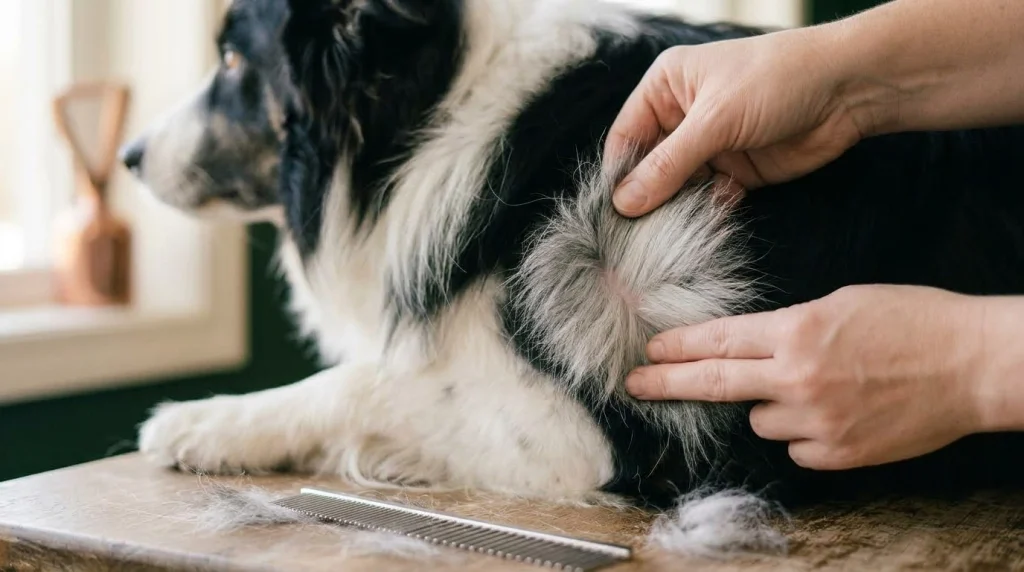
A Border Collie’s double coat is a haircoat consisting of two functional layers. The softer undercoat sits close to the skin, while longer outer hairs form a protective top layer.
The undercoat provides most of the softness
The undercoat contains fine hairs packed relatively closely together. When you part the outer coat, this is the fuzzy layer you feel near the skin.
That layer contributes insulation and makes the overall coat feel much thicker than it looks. It also produces much of the loose fluff you’ll remove during heavy shedding.
Guard hairs form the outer layer
The longer, coarser outer hairs are often called guard hairs. They help shield the softer undercoat and skin from the dog’s surroundings.
VCA Animal Hospitals explains that thick canine coats commonly combine outer guard hairs with a fine insulating undercoat. Their guide to healthy canine skin and coats also notes that coat condition can reflect general health.
- Undercoat: Soft, fine and insulating.
- Topcoat: Longer and more protective.
- Together: They create the dense feel owners notice during brushing and bathing.
Why doesn’t the coat feel the same everywhere?
Hair distribution isn’t completely uniform across the body. Areas around the neck, chest, rear quarters, and tail may feel fuller than sections with shorter, tighter hair.
Rough-coated dogs also develop feathering around parts of the body. That extra length makes certain areas look even more substantial.
Are Rough Border Collies Denser Than Smooth Border Collies?
Rough Border Collies usually look fuller, but smooth Border Collies can still have dense double coats. The major visible difference is outer-coat length and feathering rather than the presence or absence of an undercoat.
| Feature | Rough-Coated Border Collie | Smooth-Coated Border Collie |
|---|---|---|
| Outer hair | Medium to longer appearance | Shorter and closer to the body |
| Undercoat | Present | Present |
| Feathering | More noticeable on chest, legs, belly and tail | Much less pronounced |
| Mat risk | Higher in longer friction-prone areas | Usually lower, though packed undercoat can still occur |
| Routine brushing | Typically at least once or twice weekly | Typically at least once or twice weekly |
| Heavy shedding periods | More frequent brushing may be needed | More frequent brushing may be needed |
The visual difference can fool new owners. A smooth Border may shed far more soft undercoat than its sleek appearance suggests.
For that reason, choose grooming tools based on what you find in the coat rather than hair length alone. You need to reach loose undercoat without scraping the skin.
Why Does the Coat Get Thicker at Certain Times of Year?
Border Collie coat density can change through the year because the undercoat participates in seasonal shedding. Changes in daylight, environment, temperature, and the individual dog can influence how noticeable that cycle becomes.
Seasonal shedding can dramatically change how the coat feels
During heavier shedding, loose undercoat begins separating from the skin. Owners often describe this as their dog “blowing coat.”
You may find soft tufts coming out during petting or brushing. The rear legs, neck, sides, and rump can become especially productive grooming areas.
- Before a shed: The coat may feel unusually packed or plush.
- During a shed: Loose undercoat comes out in large amounts.
- After a shed: The coat can temporarily look flatter and feel lighter.
Indoor dogs may not follow a perfect calendar
Don’t expect every Border Collie to have two perfectly timed shedding events. Indoor lighting, controlled temperatures, climate, reproductive status, and individual genetics can blur the pattern.
As of 2026, practical grooming advice remains the same: watch the dog in front of you. Increase brushing when loose undercoat starts building rather than relying only on the calendar.
Section Takeaway: Border Collie coat density isn’t completely fixed. Seasonal undercoat changes can make the same dog feel dramatically thicker or lighter at different times of year.
What Does Such a Dense Coat Protect a Border Collie From?
The double coat gives a Border Collie a useful barrier between its skin and the outside environment. That made practical sense for a breed developed to work outdoors.
The undercoat adds insulation
Fine undercoat hairs trap air near the body. That layer helps buffer the dog from changing environmental conditions.
This doesn’t mean a Border Collie is immune to heat or cold. Dogs still need shade, water, shelter, and sensible activity management.
The outer coat helps shield the skin
Guard hairs add protection from ordinary outdoor exposure. They also help keep some moisture, dirt, vegetation, and sunlight from reaching the skin directly.
That’s one reason routinely shaving a healthy double coat is generally discouraged. The AKC’s guidance on shaving double-coated dogs explains that removing the outer layer can reduce natural skin protection and interfere with normal coat regrowth.
A dense coat doesn’t replace temperature safety
Owners sometimes hear that a double coat automatically keeps a Border Collie perfectly cool. That’s too simplistic.
The coat has protective functions, but dogs can still overheat. During warm conditions, manage exercise intensity and provide frequent access to water and cooler resting areas.
How Should You Groom a Dense Border Collie Coat?
For most Border Collies, regular brushing matters more than complicated grooming. Your goal is to remove loose hair and tangles while keeping the healthy outer coat intact.
Brush through the coat, not only across the surface
A few quick strokes over the top can make the dog look tidy while leaving loose undercoat underneath. I prefer working in small sections so I can see whether the brush is reaching deeper hair.
Pay extra attention to friction-prone areas. Rough-coated dogs often need closer checks where longer hair rubs together.
- Behind and below the ears
- Under the collar or harness
- Armpits
- Chest feathering
- Backs of the legs
- Rear quarters
- Tail furnishings
How often should you brush?
The AKC recommends brushing a Border Collie’s coat once or twice weekly under normal conditions. During heavier shedding, daily attention may be useful for removing loose hair before it packs together.
That isn’t a rigid schedule for every dog. A rough coat that tangles easily may need more work than a tight smooth coat.
Useful grooming tools
- Pin brush: Useful for routine brushing and longer coat areas.
- Slicker brush: Helpful for loose hair and light tangles when used gently.
- Metal comb: Excellent for checking whether you’ve completely removed tangles.
- Undercoat tool: Useful during shedding when chosen and used carefully.
A comb is one of my favorite final checks. If it glides through to the skin without catching, I know I haven’t just polished the surface.
Do Border Collies need shaving?
Routine full-body shaving isn’t normally part of Border Collie coat care. Medical procedures or severe matting may create special situations where clipping becomes necessary.
Never attack a badly packed or matted coat aggressively with sharp tools near the skin. A professional groomer or veterinarian can help when you’re unsure what’s safe.
Section Takeaway: Regular brushing that reaches the undercoat is the key to managing density. Don’t judge grooming success only by how smooth the surface looks.
When Can a Thick Coat Signal a Grooming or Skin Problem?
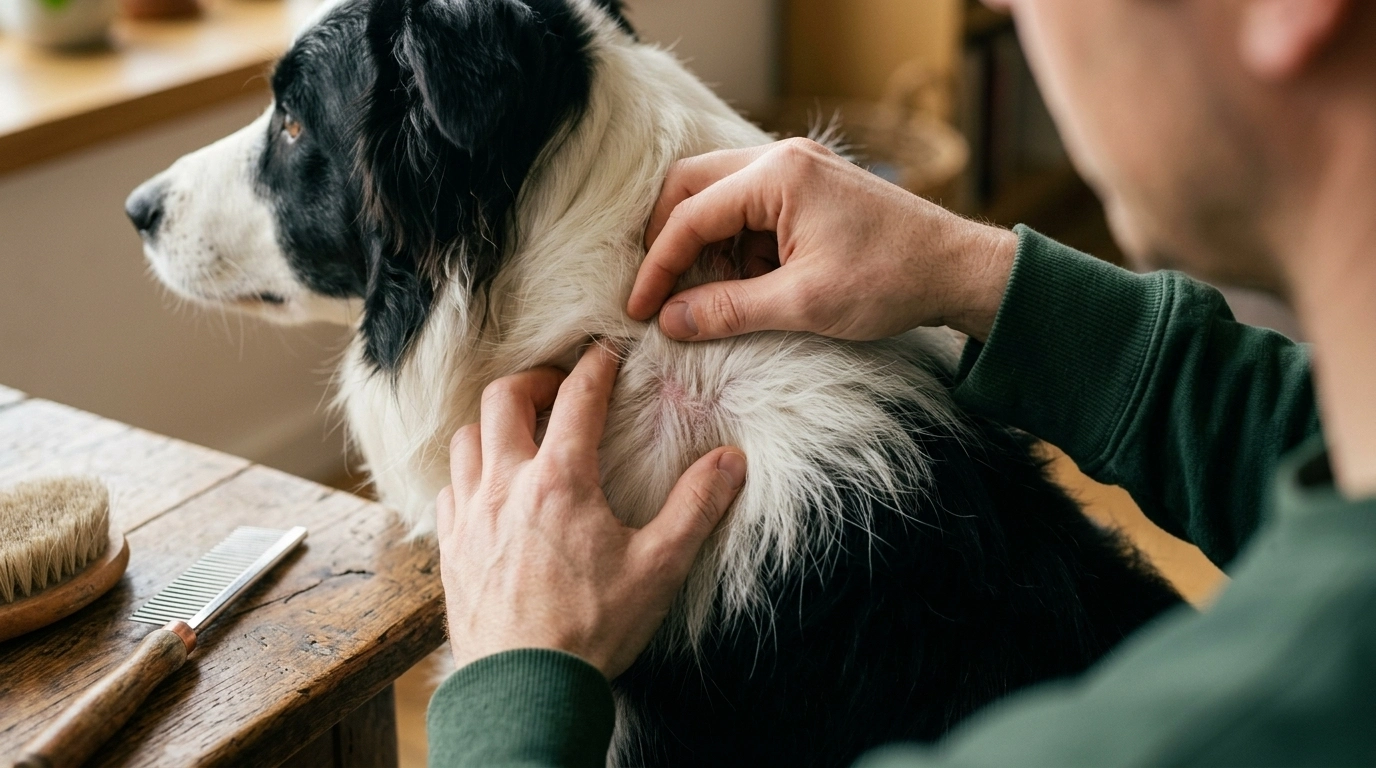
A naturally dense coat is normal, but a coat that suddenly feels compacted, greasy, painful, or dramatically different deserves closer inspection. Density itself isn’t the problem; the condition of the coat and skin matters.
Packed undercoat
Loose undercoat can become trapped rather than falling away cleanly. The coat may feel thick, lumpy, or difficult to part down to the skin.
Humidity and moisture can make neglected dense coats especially troublesome. Regular grooming helps remove dead hair and allows you to inspect the skin underneath.
Mats and tangles
Mats develop when hairs twist and compress together. Longer rough coats tend to make them easier to spot, but smooth dogs can still develop compacted hair.
Check any area where equipment or body movement creates friction. Don’t keep pulling if the dog shows pain.
Watch for changes beyond normal shedding
A healthy coat should not suddenly develop unexplained bald areas, significant scaling, sores, persistent redness, or a strong unusual odor. Constant itching also deserves attention.
- Sudden or patchy hair loss
- Red or inflamed skin
- Persistent scratching or chewing
- Crusts, sores, or unusual bumps
- Strong odor despite reasonable grooming
- A major unexplained change in coat texture
Vet note: Coat and skin changes can have many causes. If your Border Collie’s hair loss, itching, irritation, odor, or skin changes persist, ask your veterinarian rather than trying to diagnose the problem from the coat alone.
Section Takeaway: A thick Border Collie coat is normal, but painful matting, abnormal hair loss, skin irritation, or sudden texture changes aren’t something to ignore.
Frequently Asked Questions
Do all Border Collies have a double coat?
Border Collies are generally described as having weather-resistant double coats, including both rough and smooth varieties. Individual coat length, texture, and density vary, so one dog may look substantially fluffier than another.
Why is my smooth Border Collie’s coat still so thick?
A smooth coat refers mainly to shorter outer hair, not the absence of an undercoat. Smooth Border Collies can carry dense soft hair beneath their shorter guard coat, which becomes especially obvious during brushing and shedding.
Why is my Border Collie shedding so much?
Heavy shedding can occur when a Border Collie releases seasonal undercoat. More frequent brushing often helps, but sudden patchy loss, irritated skin, bald spots, or persistent itching should be discussed with a veterinarian.
Should I remove my Border Collie’s undercoat?
You should remove loose, dead undercoat through appropriate grooming rather than trying to strip out healthy attached coat. Gentle brushing during shedding helps prevent loose hair from packing together near the skin.
Can I shave my Border Collie in summer?
Routine shaving of a healthy double-coated Border Collie is generally not recommended. The guard coat helps protect the skin, and clipping both layers can change how the coat grows back.
How often should I brush a Border Collie’s dense coat?
Once or twice weekly is a useful routine for many Border Collies. During heavy seasonal shedding, some dogs benefit from daily brushing until the loose undercoat settles down.
Is a dense coat a sign that my Border Collie is healthy?
Density alone can’t tell you whether a dog is healthy. Look for clean, comfortable skin and a coat without unexplained baldness, severe matting, persistent odor, excessive scratching, or sudden changes in texture.
What Should Border Collie Owners Remember?
A Border Collie’s coat is dense because you’re feeling two functional layers of hair rather than one. The soft undercoat creates much of the fullness, while outer guard hairs add protection.
That structure reflects the Border Collie’s history as an active outdoor herding dog. Rough and smooth Border Collies simply present that double coat differently.
- Brush to the undercoat rather than only smoothing the surface.
- Expect coat density to change during seasonal shedding.
- Check rough-coated friction areas regularly for mats.
- Avoid routine full-body shaving of a healthy double coat.
- Watch the skin underneath the hair, not just the appearance of the fur.
Once you understand what’s underneath that deceptively neat outer coat, grooming makes much more sense. Keep the loose undercoat moving, protect the healthy guard hairs, and your Border Collie’s remarkable coat becomes much easier to manage.
