
Why Is My Dog Biting Her Tail? Causes, Warning Signs, and What to Do Next

If your dog is biting her tail, the first thing to know is this: tail biting is a symptom, not a diagnosis. Sometimes it comes from something simple, like a flea bite or a bit of irritation. Other times it points to pain, an allergy, an infected hot spot, anal gland trouble, or a stress-driven habit that has started to repeat on its own.
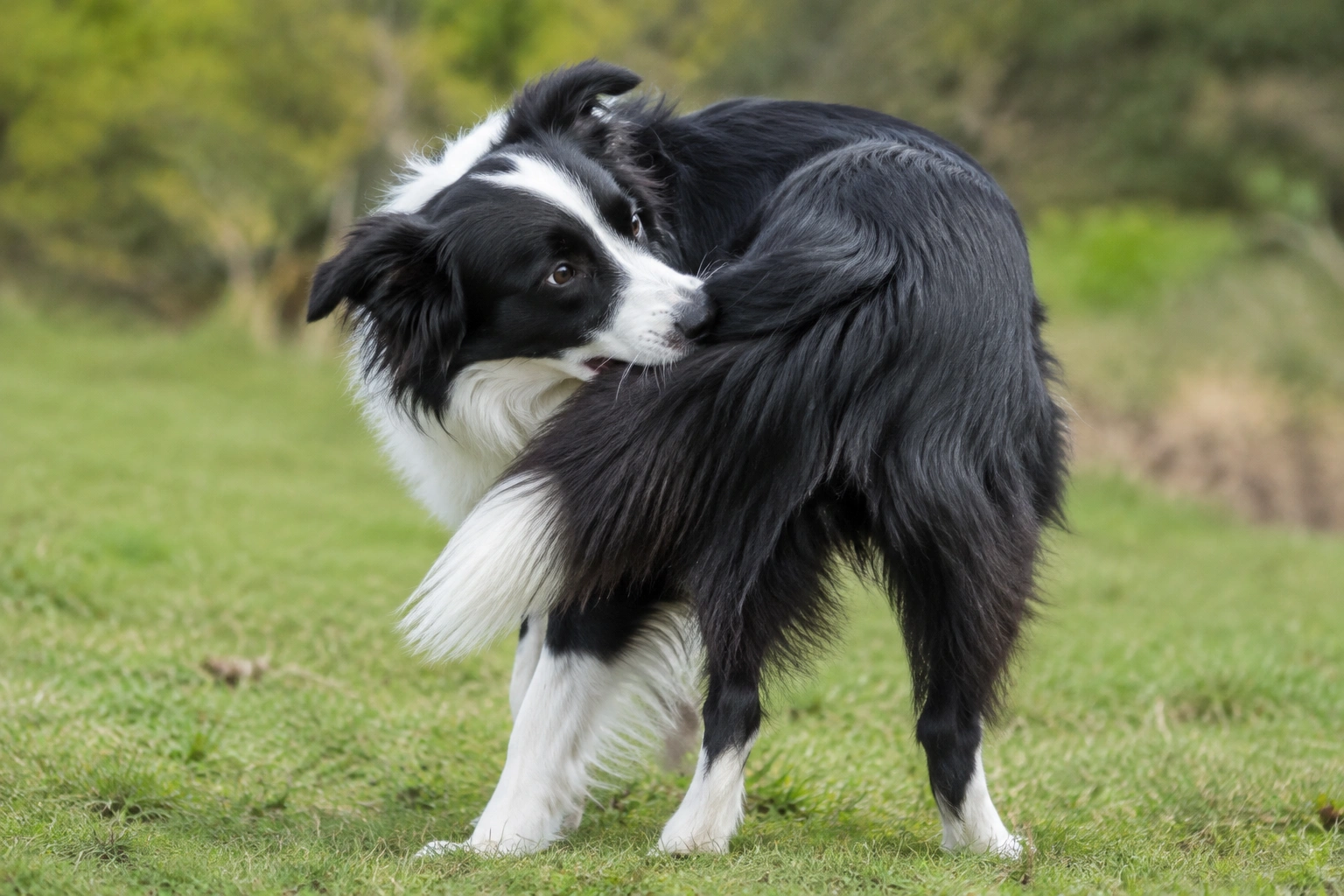
For Border Collie owners, this can be especially confusing because a high-energy, highly sensitive dog may nibble, lick, or fixate on a body part when something feels off. But the behavior itself tells you very little until you look at the skin, the context, and the dog’s comfort level.
Tail biting can mean very different things
A dog may bite her tail for three practical reasons:
- Something is irritating the skin
- Something hurts
- Something is driving a repetitive coping behavior
That is the decision tree to keep in mind. If the skin is red, itchy, scabby, smelly, or swollen, think medical first. If the dog flinches, avoids sitting, limps, or resists having the tail touched, think pain or injury. If the dog mainly does it when bored, stressed, or left alone, behavior may be part of the picture.
The challenge is that these causes can overlap. A dog with fleas may become anxious and obsessive about the area. A dog with pain may chew at the tail base because the discomfort is hard to localize. And a dog that started with a skin problem can keep biting long after the original trigger has improved.
Is this normal grooming, tail chasing/spinning, or a problem?
A little tail attention is not automatically abnormal. Some dogs briefly lick or nibble while grooming, especially if they stop easily and the skin looks normal afterward. That is very different from focused, repeated chewing.
It also helps to separate tail biting from tail chasing or spinning. Tail chasing/spinning is usually a dog turning in circles or trying to catch the tail as part of a repetitive motion. Tail biting is more of a direct, repeated chewing or nibbling action on the tail or tail base. Both can be repetitive behaviors, but they are not the same thing, and a dog may do one without the other.
A practical threshold: if your dog keeps returning to the same spot, seems hard to interrupt, or is creating redness, hair loss, scabs, or moisture on the skin, treat it as a problem. Once the behavior is causing damage, you are no longer looking at harmless grooming.
Here is the useful question: Does the dog choose to stop, or does she seem driven to continue?
- Likely normal grooming: brief, occasional, easy to interrupt, no skin change
- Likely a problem: repeated, intense, hard to interrupt, skin damage or distress
That distinction matters because the response is different. Normal grooming may need no intervention. Repetitive chewing needs a cause.
The most common medical reasons to rule out first
Medical causes deserve first attention because they are the ones most likely to worsen if you wait.
Fleas, ticks, and other parasites
Parasites can make a dog intensely uncomfortable, especially around the tail base and rear end. Fleas are a classic trigger because the bite area can itch even when you do not immediately spot the insect. Ticks and some other parasites can also cause irritation.
If you see scratching along the back, restlessness, or tiny black specks in the coat, check carefully for flea dirt and skin irritation. Even if you do not find much, parasites can still be involved.
For general flea-control guidance, the ASPCA’s pet care resources are a useful place to start, but if the skin is already damaged, a vet exam is the safer next step.
Allergies and dermatitis
Dogs can bite at their tails because the skin is itchy from allergies or dermatitis. That itch may come from food, environmental triggers, or contact irritation. The tail base is a common place for the dog to reach and keep worrying.
Clues that point this way include:
- Redness
- Recurrent scratching
- Hair thinning
- Dry or flaky skin
- Itching in more than one area
- Seasonal flare-ups
Allergies rarely stay completely quiet. If your dog is biting her tail and also licking paws, rubbing her face, or scratching other areas, skin irritation becomes more likely.
Hot spots and skin infection
Once a dog keeps licking or chewing the same area, the skin can break down. That can create a hot spot: a moist, inflamed patch that becomes more painful and itchy the more the dog touches it. Infection can follow, especially if the skin is open.
Warning signs include:
- Moist or sticky skin
- Foul odor
- Pus or discharge
- Rapidly spreading redness
- Hair loss around the spot
- Obvious tenderness
This is one reason tail biting should not be brushed off. A small problem can become a self-trauma cycle: irritation leads to chewing, chewing damages the skin, damaged skin becomes more irritated, and the cycle continues.
Anal gland discomfort
Some dogs bite or chew near the tail because the problem is actually lower down. Anal gland discomfort can make the rear end feel irritating or painful, and dogs may scoot, lick, or keep turning back to the area.
Clues that make anal gland trouble more plausible include:
- Scooting
- A strong fishy or foul smell
- Licking under the tail
- Difficulty settling
- Repeated attention to the rear end
This is not something to guess at for long. If the dog seems uncomfortable back there, a veterinarian should check it rather than assuming it is only a skin issue.
Injury or pain in the tail, back, or hips
Pain is easy to miss because a dog may still move around normally at first. But if the tail biting began suddenly, and especially if the dog is sensitive when touched, you should think about injury or deeper discomfort.
Watch for:
- Limping
- Stiffness
- Reluctance to jump
- Avoiding sitting
- Tail carried oddly
- Pain when the tail is lifted or handled
A dog may chew at a painful area because the sensation is confusing, not because the area is itchy. That is why pain and itch must be separated as early as possible.
How to tell whether it’s itch, pain, or stress
This comparison helps narrow the cause quickly.
| Clue | More likely itch/skin issue | More likely pain/injury | More likely stress/behavior |
|---|---|---|---|
| Redness, scabs, hair loss | Yes | Sometimes | Not usually primary |
| Odor, wet skin, discharge | Yes | Sometimes | No |
| Flinching when touched | Sometimes | Yes | Not typical |
| Limping or stiffness | No | Yes | No |
| Happens after being alone or under-stimulated | Sometimes | No | Yes |
| Dog keeps returning to the same spot | Yes | Yes | Yes |
| Other scratching or licking elsewhere | Yes | Sometimes | Sometimes |
| Dog seems otherwise distressed | Yes | Yes | Yes |
The most useful rule is this: skin changes point to a skin problem, sensitivity points to pain, and context-dependent repetition points toward behavior.
But behavior should not be the default assumption. A dog can be bored and also have fleas. A dog can be anxious and also have a hot spot. That is why the physical exam matters.
First 24 hours: what to do if you are not sure what’s causing it
If the tail biting is new or you are unsure of the cause, keep the first day simple and focused:
- Inspect the skin gently for redness, scabs, swelling, moisture, odor, fleas, or discharge.
- Prevent more chewing with a cone or similar barrier if the dog keeps going back to the spot.
- Book same-day vet care if you see pain, odor, swelling, bleeding, or discharge.
- Keep activity calm if the dog seems sore or the problem started after rough play, a jump, or a stumble.
- Avoid harsh treatments or repeated prodding while you wait for guidance.
If the skin is already broken, smelly, or clearly painful, the goal is not to “watch and wait.” It is to stop self-trauma and get the dog seen.
Red-flag symptoms that mean a vet visit now
Some signs should move you from observation to veterinary care without delay.
Seek prompt help if you see:
- Bleeding
- Swelling
- Pus or discharge
- Foul odor
- Open wounds
- Marked redness
- Hair loss with raw skin underneath
- Obvious pain
- Lethargy
- Limping
- A dog that cannot settle because the area seems so uncomfortable
- Strong reaction when the tail or rear end is touched
If the dog is drawing blood or the skin is already broken, do not wait to “see if it passes.” Once self-trauma starts, the area often gets worse before it gets better.
For a broader overview of common vet concerns around skin irritation and parasites, VCA Hospitals has reliable owner-focused information that can help you understand why a veterinary exam is often the right next move.
Safe short-term steps to stop self-trauma at home
While you are figuring out the cause, the immediate goal is to stop the dog from making the area worse.
Use a barrier if the dog will not stop
An Elizabethan collar or similar barrier can prevent more chewing. That does not solve the cause, but it can stop the damage from escalating while you arrange care or monitor the skin.
This is especially useful when the dog is repeatedly targeting one spot. If she can still reach the area, she can keep the cycle going.
Check the skin gently
Part the coat and look for:
- Fleas or flea dirt
- Redness
- Scabs
- Swelling
- Moist skin
- Cracks or open areas
- A bad smell
Be careful if the area seems painful. Do not keep prodding a sore tail or rear end just to “see what happens.”
Avoid harsh treatments
Do not use human creams, strong chemicals, or punishment-based deterrents without veterinary guidance. If the dog is biting because of pain, infection, or itch, punishment adds stress without fixing the problem. If the dog is already anxious, it can make the behavior more persistent.
Keep activity calm if injury seems possible
If the biting started after rough play, a jump, or a stumble, limit rough activity until your vet rules out deeper injury. You do not want to keep stressing a painful tail, back, or hip area.
When tail biting is more likely behavioral
Behavioral tail biting usually shows up as a pattern, not just a one-off event. It may happen:
- When the dog is left alone
- During long quiet periods
- When the dog is under-stimulated
- After a stressful change in the household
- When the dog has learned the behavior gets attention
That last point matters. Some dogs repeat tail biting because it reliably gets a reaction from the owner. Even negative attention can reinforce the habit if the dog has learned that tail biting makes people rush over.
Boredom, stress, and anxiety can all feed repetitive chewing. In some dogs, the behavior becomes self-soothing. In others, it becomes a learned pattern that keeps returning even after the original trigger fades.
The key trade-off here is simple: behavior work can help, but only after medical causes are addressed or ruled out.
Border Collie considerations: high energy, sensitivity, and fixation
Border Collies often bring extra intensity to this problem. They are highly responsive dogs, and when they are under-exercised, under-challenged, or stressed, repetitive behaviors can become more noticeable.
That does not mean tail biting is “just a Border Collie thing.” It means you should take the pattern seriously if your dog is:
- Quick to fixate
- Hard to settle
- Sensitive to changes in routine
- Prone to pacing, spinning, or other repetitive habits
- Not getting enough mental work or structured outlets
For this breed, a lack of stimulation can make an already-small irritation much harder to ignore. A flea bite that another dog would scratch once may become a fixation in a dog that is already wound up.
If your Border Collie is biting her tail and the vet has ruled out skin or medical causes, then structured enrichment, predictable routine, and calm mental work become more useful than simply adding more physical exercise. A dog who is mentally over-aroused may need better regulation, not just more miles.
What not to do while you’re figuring it out
A few common mistakes make this worse:
- Do not assume it is only behavioral. That delays treatment for fleas, infection, or pain.
- Do not punish the dog for biting. Punishment can increase stress and does nothing for itch or pain.
- Do not keep testing the sore area. Repeated handling can aggravate a painful tail or infected skin.
- Do not wait if the skin is broken or smelly. Those are signs the problem has moved beyond simple monitoring.
- Do not pile on enrichment as a substitute for a vet check when the dog shows signs of discomfort or skin damage.
Long-term prevention and treatment depends on the cause
The right fix depends on what is driving the behavior.
- Parasites: Your vet can guide flea and parasite control so the skin can calm down.
- Allergies or dermatitis: The plan may involve identifying triggers, managing itch, and protecting the skin.
- Hot spots or infection: These often need medical treatment and a way to stop further chewing.
- Anal gland problems: Your vet can assess whether the glands are irritated or impacted and recommend next steps.
- Pain or injury: Treatment should focus on the underlying injury, not just the chewing.
- Behavioral causes: Once medical issues are addressed, then you can work on reducing stress, improving routine, and giving the dog more appropriate outlets.
If you want a deeper look at the difference between a behavior problem and a safety problem, this guide on why a dog that bites should not automatically be put down can help you think more clearly about cause and response. And if the tail biting is part of a broader reactivity or safety issue, how to break a dog from biting strangers shows how management and reading warning signs fit into a bigger plan.
When to see a veterinarian or certified trainer
See a veterinarian first if the tail biting is new, persistent, painful, bloody, smelly, swollen, or paired with limping, lethargy, or sensitivity to touch.
A certified trainer or behavior professional becomes useful after medical causes are addressed, especially if the dog seems stressed, under-stimulated, or stuck in a repetitive habit. For Border Collies, that combination is common enough that it should be part of your thinking from the start.
The practical rule is this: if the skin looks bad or the dog seems uncomfortable, get the medical piece checked first. If the skin is fine and the behavior is tied to stress or inactivity, then behavior support matters.
FAQs
Why is my dog biting her tail suddenly?
A sudden change is more concerning than a mild, long-standing habit. Fleas, skin irritation, injury, or pain are common things to rule out first because sudden onset often means something changed physically.
Is tail biting a sign of fleas, allergies, or infection?
It can be. Fleas, allergies, dermatitis, hot spots, and skin infection are all plausible causes when the tail area is itchy, red, smelly, or moist.
Could this be anxiety or boredom?
Yes, especially if it happens when the dog is alone, under-stimulated, or stressed. But behavior should not be assumed until medical causes are checked.
When should I worry and call a vet?
Call promptly if you see bleeding, swelling, discharge, foul odor, open skin, limping, lethargy, or clear pain when the tail is touched.
How can I stop my dog from biting her tail at home?
Use a cone or other barrier to prevent more chewing, check the skin for fleas or obvious irritation, and avoid harsh treatments. Home management is temporary; it should not replace diagnosis if the behavior is persistent.
Is my dog biting her tail because of an injury or anal gland issue?
Possibly. Tail sensitivity, stiffness, limping, scooting, or a strong odor near the rear end can point toward pain or anal gland discomfort rather than simple itching.
How do I tell the difference between normal grooming and a problem?
Normal grooming is brief, occasional, and easy to interrupt. A problem is repetitive, focused, hard to stop, or causing redness, hair loss, scabs, or distress.
Can Border Collies be more prone to this kind of behavior?
They can be more likely to show stress-related or repetitive habits when they are under-stimulated or highly aroused. That does not change the need to rule out medical causes first.
