
Why One of Your Dog’s Eyes Is Red: Causes, Urgency, and What to Do Next

When one eye turns red, the first job is not to guess the diagnosis. It is to decide whether this is a minor irritation or a problem that could threaten vision. That distinction matters because some causes settle once the irritant is gone, while others — like a corneal ulcer, glaucoma, or uveitis — can worsen quickly.
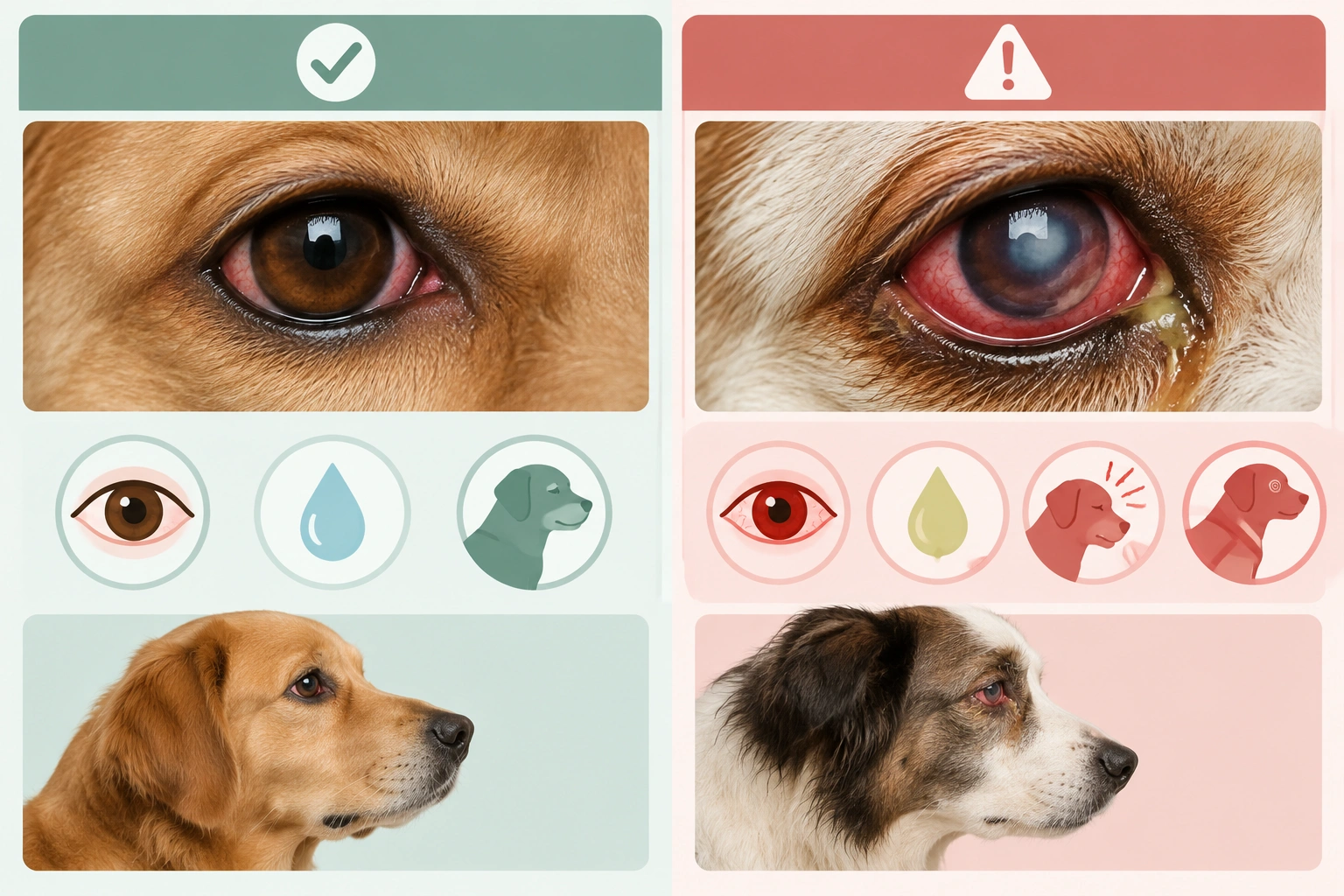
For Border Collie owners, this may show up after outdoor work, rough play, brush contact, dust, or a sudden bump to the face. A dog that was fine an hour ago and now has one red, watery eye is telling you something changed fast. The safest response is a quick triage check, not a wait-and-see approach that lasts all day.
Why one red eye is different from both eyes being red
One-sided redness usually points to a local problem in that eye: something stuck there, a scratch, a blow to the face, or a problem with the eyelid or tear film. Redness in both eyes more often fits allergies, environmental irritation, or a more general illness.
That does not mean one red eye is automatically worse, but it is more suspicious for injury or a problem that needs a closer look. If only one eye is red and the dog is squinting, pawing, or keeping that eye partly closed, think “pain or injury” before you think “mild irritation.”
A useful rule: if the redness is isolated, mild, and the dog is comfortable, you may have a short window to monitor. If the redness comes with pain signs, cloudiness, discharge, swelling, or a sudden change in the pupil, the clock is ticking.
Red flags that mean the eye needs same-day or emergency veterinary care
Some signs should move you straight past home monitoring.
Seek urgent veterinary care the same day if you see any of these:
– Squinting or holding the eye shut
– Pawing at the eye or rubbing the face
– Cloudiness or a bluish/white film on the eye
– Obvious swelling of the eyelids or tissues around the eye
– Thick yellow, green, or bloody discharge
– A visible scratch, cut, or object in the eye
– A suddenly different-looking pupil
– Sensitivity to light
– The eye seems larger, firmer, or more bulging than usual
– The dog seems painful, quiet, or unusually withdrawn
Go to an emergency vet now if the eye was hit hard, punctured, or exposed to a chemical, or if the dog seems unable to see normally. A sudden painful red eye with cloudiness or a changed pupil can be a pressure problem or inflammation inside the eye, and those are not “watch and wait” situations.
One practical point: dogs often hide eye pain better than people expect. A Border Collie that is restless, blinking hard, avoiding bright light, or refusing to let you near the face may be telling you more than the eye itself does.
Common causes of a red eye in dogs, ranked by urgency
Here is the broad pattern I use when thinking through one red eye.
| Possible cause | Typical clues | Urgency | Why it matters |
|---|---|---|---|
| Foreign body or irritant | Sudden redness, tearing, blinking, pawing | Same day if symptoms persist | Something may still be trapped under the lid |
| Eye injury or scratch | Squinting, pain, watery eye, possible cloudiness | Same day | Corneal damage can worsen fast |
| Conjunctivitis | Redness, discharge, irritation, sometimes both eyes | Same day if severe or painful | May be infectious, allergic, or secondary to another problem |
| Corneal ulcer | Squinting, pain, tearing, cloudiness | Same day / urgent | Can threaten the cornea and vision |
| Allergies | Both eyes more common, itching, watery discharge | Usually less urgent unless severe | Often uncomfortable but not usually vision-threatening by itself |
| Dry eye | Redness, thick mucus, irritation, dull surface | Vet visit soon | Tear deficiency can damage the cornea |
| Uveitis | Pain, light sensitivity, cloudy eye, small pupil | Urgent | Internal eye inflammation can affect vision |
| Glaucoma | Pain, cloudy eye, enlarged or hard eye, vision changes | Emergency | Pressure can damage vision quickly |
Foreign body or irritant
This is one of the most common practical explanations for a sudden one-sided red eye. Grass seeds, dust, dirt, plant material, or a bit of debris can lodge under the eyelid or on the surface of the eye. The eye gets red because it is irritated and trying to protect itself.
A Border Collie that has been running in tall grass or brush and comes back blinking hard is a plausible scenario. If the redness improves quickly after a gentle rinse and the dog stops rubbing, that supports irritation. If it does not improve, assume something may still be there or the surface may be scratched.
Eye injury or corneal scratch
A scratch, poke, or blunt impact can make one eye red very fast. These dogs often squint, tear heavily, and avoid touch. The eye may also look hazy.
This is where owners sometimes make things worse by assuming it is “just irritated” and using the wrong drops. A scratch on the cornea can become an ulcer, and ulcers need veterinary diagnosis and treatment.
Conjunctivitis
Conjunctivitis means inflammation of the tissues around the eye. It can happen with allergies, infection, or irritation. The eye may look pink or red, and there is often discharge.
If discharge is thick, yellow, or green, or if the dog is uncomfortable, it is not something to brush off as simple redness. Conjunctivitis can be the main problem, but it can also be a sign that another eye issue is underneath it.
Corneal ulcer
A corneal ulcer is a defect in the surface of the eye. It is a major reason not to delay care when redness comes with squinting or cloudiness. Dogs with ulcers usually look uncomfortable, and the eye may water a lot.
Because ulcers can worsen or become infected, they are one of the key reasons veterinarians take one red eye seriously.
Allergies
Allergies can cause red, watery eyes, but they more often affect both eyes. If one eye is red and the other is normal, allergy is possible but less convincing unless the dog clearly has other allergy signs like itching, sneezing, or seasonal flare-ups.
Allergy-related redness tends to be milder and less painful than injury or glaucoma. If the eye is painful, cloudy, or swollen, stop thinking “allergy” and get the dog examined.
Dry eye
Dry eye happens when a dog does not produce enough tears. The eye becomes irritated, red, and prone to discharge. Over time, the surface can become damaged because tears normally protect the cornea.
This is not a condition to manage casually at home. It needs veterinary testing and a treatment plan.
Uveitis or glaucoma
These are the problems I do not want owners to miss. Uveitis is inflammation inside the eye. Glaucoma involves increased pressure in the eye. Both can cause pain, redness, and vision changes.
If the eye is red and the dog is clearly uncomfortable, especially with cloudiness or a pupil that looks abnormal, these are serious possibilities. Glaucoma in particular can be an emergency.
How to tell irritation from infection, injury, or pressure problems
The details around the redness matter.
More like simple irritation
– Mild redness
– Watery tears
– Dog otherwise acting normal
– No squinting
– No cloudiness
– No thick discharge
– Symptoms began after wind, dust, or mild exposure
More like injury or a corneal problem
– Squinting or blinking repeatedly
– Pawing at the eye
– One eye closed more than the other
– Sensitivity to light
– Cloudy or bluish surface
– Sudden onset after rough play, brush, or a bump
More like infection or conjunctivitis
– Redness plus discharge
– Crust at the eyelids
– Eye looks irritated for more than a short period
– Often, but not always, both eyes are involved
More like glaucoma or uveitis
– Pain that seems deeper or more intense
– A cloudy eye
– A pupil that looks oddly small or large
– The eye may look enlarged or firm
– Dog avoids light or seems unusually subdued
A useful decision trick: redness plus comfort is usually less alarming than redness plus pain. Once pain appears, the chance of a more serious eye problem rises.
Safe first aid before the vet visit
If the dog is rubbing the eye, prevent that first. An Elizabethan collar is often the fastest way to stop self-trauma. Rubbing can turn a small irritation into a much bigger corneal problem.
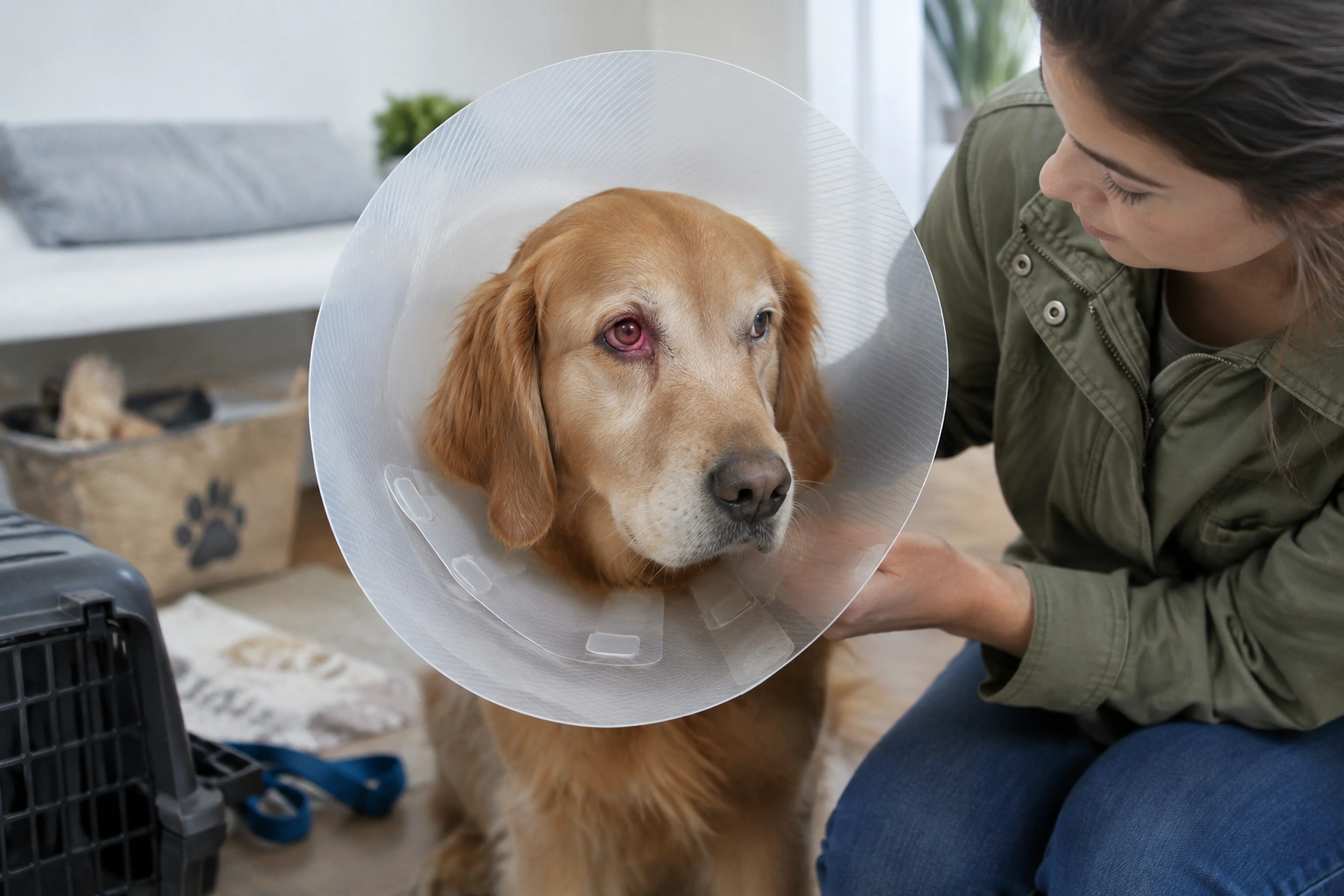
If you suspect debris, a gentle saline rinse may help wash away loose material. Use plain sterile saline made for eyes or contact lenses, and flush lightly. The goal is to rinse, not blast the eye.
Keep the dog calm and indoors if possible. Bright light can make a painful eye worse, and running around increases the chance of more rubbing or another bump to the face.
If the eye is painful, cloudy, swollen, or the dog resists being touched, skip repeated home checks. At that point, more handling usually means more irritation.
What not to put in a dog’s red eye
This is where well-meaning owners can cause harm.
Do not use:
– Human eye drops unless a veterinarian specifically told you to
– Leftover prescription drops from another pet or another problem
– Drops that contain steroid unless prescribed for this exact eye issue
– Herbal remedies, oils, or homemade mixtures
– Aggressive flushing if the eye looks injured, clouded, or very painful
The biggest risk with the wrong medication is that it can mask a serious problem or make a corneal ulcer worse. Human products are not automatically safe for dogs, and the eye is not a place to experiment.
How a veterinarian finds the cause of one red eye
A vet will usually start with a close exam of the eye and eyelids, then look for clues that separate surface irritation from deeper disease. Common steps may include checking for a foreign body, staining the cornea to look for an ulcer, and evaluating tear production or eye pressure when needed. Owners may also hear about fluorescein stain, tonometry to measure eye pressure, and tear testing.
That is why a red eye is not just a “looks a bit irritated” problem. Different causes can look similar from the outside, but the treatment may be completely different. A dog with dry eye needs a different plan than one with glaucoma or a scratch.
If the case is complex, recurrent, or vision-threatening, a veterinary ophthalmologist may be the right next step. That is especially true when the eye does not improve, the diagnosis is unclear, or specialized testing is needed.
Treatment options depend on the cause
Treatment follows the diagnosis, not the redness itself.
- Foreign body: removal, flushing, and sometimes medication if the surface was scratched
- Conjunctivitis: treatment depends on whether the cause is allergic, infectious, or irritant-related
- Corneal ulcer: eye medication and close rechecks; some cases need additional procedures
- Dry eye: long-term tear-support treatment and follow-up
- Uveitis: targeted treatment to reduce inflammation and pain
- Glaucoma: urgent pressure-lowering treatment and often specialist involvement
- Eyelid problems such as entropion or ectropion: may need surgical correction if the eyelid shape keeps irritating the eye
The key trade-off is simple: treating “redness” without knowing the cause can delay the right care. In eye cases, that delay is often the real danger.
When to see a veterinarian or veterinary ophthalmologist
For a red eye, a general veterinarian is the right first stop in most cases. They can decide whether the issue is minor, whether treatment can begin immediately, or whether a specialist should take over.
See a veterinary ophthalmologist sooner if:
– The eye problem keeps coming back
– Vision seems affected
– The eye is cloudy, painful, or abnormal in shape
– Initial treatment is not helping
– Your dog has a breed or history that raises suspicion for eye disease
Border Collies are not the most eye-problem-prone breed in the way some flat-faced breeds are, but active herding dogs do live a life that increases exposure to brush, dust, impact, and debris. That makes one-sided redness after outdoor work especially worth taking seriously. Breed-specific risk is less about guaranteed disease and more about how the dog actually lives.
For general eye care guidance, the American Kennel Club’s dog health resources and VCA Hospitals’ pet care library are useful starting points, but they do not replace a hands-on exam when a red eye is painful or changing quickly.
A practical decision path: monitor briefly, call today, or go now
Use this simple triage framework.
Monitor briefly at home if:
– The redness is mild
– There is no squinting or pawing
– The dog is comfortable
– There is no cloudiness or abnormal discharge
– The eye got mildly irritated by dust or wind and seems to be improving
Call a vet today if:
– The redness lasts more than a short period
– There is tearing, discharge, or repeated blinking
– The dog keeps rubbing the eye
– You suspect a scratch, foreign body, or conjunctivitis
– The eye looks different from the other one, even if the dog seems okay
Go now if:
– The eye is painful
– The cornea looks cloudy
– The pupil looks odd
– There was trauma
– The eye is bulging, very swollen, or suddenly worsening
– You think vision may be affected
If you want a broader look at tear-related symptoms too, my guide on why dogs’ eyes weep can help you separate watery irritation from discharge patterns that need a vet.
The bottom line is this: one red eye is a symptom, not a diagnosis. If the eye is comfortable and improving, you may have a little time. If it is painful, cloudy, swollen, or changing fast, treat it as urgent and get the dog seen.
Frequently Asked Questions
Why is only one of my dog’s eyes red?
One-sided redness often points to a local problem such as a foreign body, scratch, injury, or eyelid issue. Both eyes being red more often suggests allergies or a more general irritation.
Is a red eye in a dog an emergency?
Not always, but it can be. A red eye with squinting, cloudiness, swelling, discharge, or pain should be treated as same-day or urgent.
Can I flush my dog’s eye at home?
A gentle saline rinse can be appropriate if you suspect loose debris and the eye is not severely painful or injured. Do not force-flush a cloudy, very painful, or obviously injured eye.
Should I use human eye drops?
No, not unless your veterinarian specifically tells you to. The wrong product can make the problem worse or hide a serious eye disease.
How do I know if my dog is in pain?
Squinting, pawing, light sensitivity, hiding, restlessness, and refusing face contact are common pain clues. Dogs often show pain through behavior before they show dramatic swelling.
Could it just be allergies?
Possibly, but one red eye is less typical for allergies than both eyes being red. If the eye is painful or cloudy, do not assume it is allergy-related.
When should I see a specialist?
If the problem is recurrent, severe, not improving, or vision-threatening, a veterinary ophthalmologist is the right next step.
