
Why Your Dog Keeps Coughing and Gagging: Causes, Red Flags, and What to Do Next

If your dog keeps coughing and gagging, the first job is not to guess the diagnosis. It is to decide whether this is a mild throat irritation, a contagious respiratory problem, an airway issue, or something urgent like choking or breathing distress.
That distinction matters because dogs can sound dramatic with relatively minor problems, but they can also look “mostly fine” right up until they are not. Border Collies, especially active ones, can also make airway irritation more obvious because they breathe hard, pull on collars, and spend time around other dogs, dusty fields, or high-excitement environments.
The practical goal here is simple: help you tell what you are seeing, decide how urgent it is, and know what to do before the vet visit.

What coughing and gagging can mean in dogs
The words owners use are often not precise, and that is okay. What matters is the pattern.
A cough is usually a forceful expulsion of air from the chest or throat. It may sound dry, harsh, honking, or wet. A gag is more like a throat reflex, often with repeated swallowing, retching, or a motion that looks like the dog is trying to clear something from the back of the mouth. Retching looks like vomiting effort without bringing anything up. Vomiting usually involves abdominal heaving and may produce food, liquid, foam, or bile.
A dog can also do a mix of these in one episode. That is why a video is so useful for your veterinarian.
What to do if your dog is truly choking
If your dog cannot breathe normally, cannot swallow, is panicking, or seems like something is stuck in the throat, treat it as an emergency. Go to emergency veterinary care immediately. Do not offer food, water, honey, or any human remedy, and do not try to force the mouth open unless a vet has already instructed you to do so.
A quick comparison that helps in real life
| What you see | What it often sounds like | Typical body posture | Common triggers | Urgency |
|---|---|---|---|---|
| Coughing | Dry, honking, hacking, or wet cough | Neck stretched out, chest effort | Exercise, excitement, infections, irritation | Mild to urgent depending on breathing and frequency |
| Gagging | Repeated throat motions, retching, swallowing | Pawing at mouth, neck extended, distress | Throat irritation, kennel cough, foreign object, laryngeal problems | Urgent if persistent or if breathing/swallowing is affected |
| Retching | Vomit-like effort with little or nothing produced | Abdominal heaves | Nausea, throat irritation, obstruction | Urgent if repeated or paired with distress |
| Vomiting | Abdominal contraction, contents come up | Often crouched, nauseated | GI causes, toxins, motion sickness, infection | Depends on frequency and the dog’s overall condition |
If you are unsure whether it is coughing or gagging, watch the chest and belly. Coughing usually looks like a chest-driven effort. Vomiting is more belly-driven. Gagging often centers at the throat and mouth.
When it’s an emergency versus when it can wait
Some situations should not wait for a regular appointment.
Go to an emergency vet now if your dog has:
– trouble breathing
– blue, gray, or pale gums
– collapse or near-collapse
– persistent choking or inability to swallow
– coughing up blood
– severe lethargy
– repeated distress that does not settle
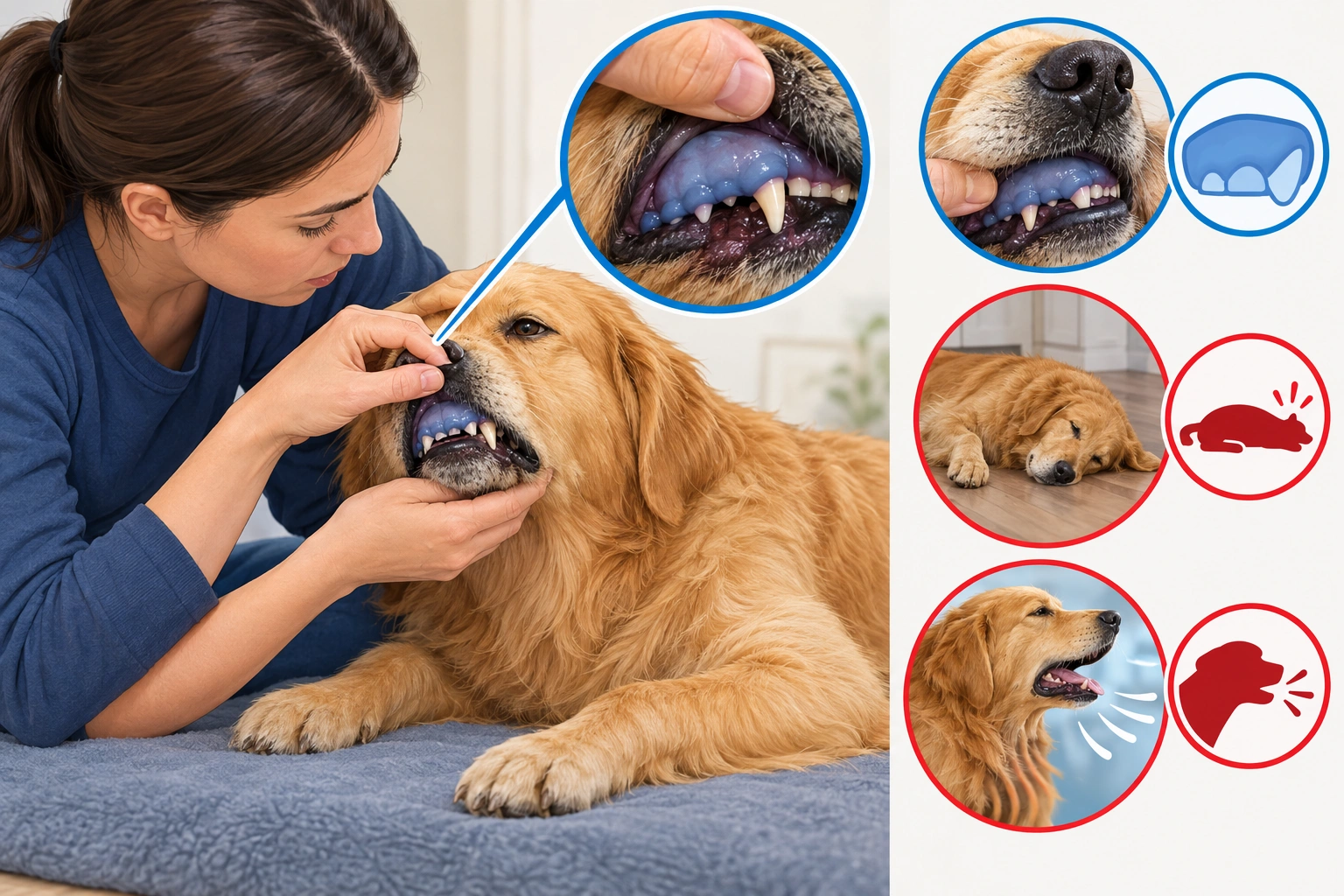
Those signs point to a problem that can become life-threatening quickly, especially if a foreign object is involved or the dog is not getting enough oxygen.
A same-day or urgent vet visit is appropriate if the coughing and gagging are frequent, getting worse, keeping your dog awake, or paired with fever, appetite loss, nasal discharge, or marked tiredness. Puppies, senior dogs, and dogs with existing health problems should be seen promptly if the cough is new or changing.
If your dog is breathing normally, acting like themselves, and the episode is brief and mild, you may be able to monitor for a short period while you gather information for the vet.
Common causes of repeated coughing and gagging
There are several likely categories, and they do not all look the same.
Kennel cough
Kennel cough is a common contagious respiratory infection. It often causes a harsh, honking, goose-like cough that may end in a gag. Dogs may seem otherwise fairly normal between episodes, which is why owners sometimes wait too long.
It spreads easily through close contact and shared environments. If your dog has been to daycare, boarding, grooming, a dog park, or any place with lots of dogs, isolate them from other dogs until you know what is going on.
Reverse sneezing
Reverse sneezing can sound alarming, but it is different from vomiting and often different from a true cough. Dogs usually make repeated snorting or inhaling sounds, stretch their neck, and then recover quickly. It may look dramatic and then pass in seconds.
The key clue is recovery. A dog with reverse sneezing usually snaps back to normal fairly fast. A dog with an airway problem or infection often does not.
Throat irritation or dry air
A dry or sore throat can cause a cough that sounds higher-pitched than usual and may look a little like gagging. This may happen after heavy panting, dust exposure, pulling on a collar, or time in very dry air. If it is brief and mild, rest and water may be enough while you watch closely.
If it lasts, worsens, or keeps returning, it needs veterinary attention because irritation can be the surface sign of something deeper.
Allergies
Allergies can irritate the airways and trigger coughing, especially when the dog is exposed to dust, pollen, smoke, or other airborne irritants. Allergy-related coughs can overlap with infection-related coughs, so the pattern matters. If the cough is seasonal, mild, and linked to a clear environmental trigger, allergies become more plausible. If there is fever, lethargy, or the dog seems unwell, infection moves higher on the list.
Collapsing trachea
A collapsing trachea can cause a dry, honking cough that may worsen with excitement, pulling, or exercise. It is more often discussed in smaller dogs, but the key point for any owner is that a cough that reliably appears with activity or pressure on the neck deserves a veterinary exam.
Heart disease
Heart disease can cause coughing, especially if fluid begins affecting the lungs or airways. The cough may be more noticeable at night, after exercise, or when the dog is resting. Exercise intolerance, tiring faster than usual, or breathing changes make this more concerning.
Heartworm
Heartworm can also cause coughing and reduced stamina. Because the signs can be subtle early on, a dog that coughs and is less willing to exercise than usual should not be dismissed as “just a kennel cough” without a vet check.
Intestinal parasites or lungworm
Some parasites can also play a role in coughing, depending on where they live in the body. Lungworm can irritate the airways and cause coughing or gagging, while intestinal parasites are more likely to cause vomiting, poor condition, or a general unwell look, though some dogs may have mixed signs. If your dog has coughing along with weight loss, digestive upset, a potbellied appearance, or a history of exposure to contaminated soil, wildlife, or raw prey, ask your vet whether parasite testing is appropriate.
Pneumonia or bronchitis
Respiratory infections lower in the lungs can cause coughing and gagging too. Pneumonia is more concerning when there is lethargy, fever, appetite change, or a wet-sounding cough. Chronic bronchitis is a long-term airway inflammation that can cause a persistent dry cough and sometimes gagging, especially with exercise or excitement.
Foreign object or airway obstruction
This is the one owners most need to take seriously. If your dog suddenly starts gagging, pawing at the mouth, panicking, drooling, or repeatedly trying to swallow, a foreign object or obstruction is possible. A small object, bone fragment, stick, or piece of toy can lodge in the throat or upper airway.
If the dog cannot settle, cannot swallow, or seems to be struggling for air, treat it as an emergency.
How to tell similar conditions apart
A few pattern checks can narrow things down.
Kennel cough vs reverse sneezing
Kennel cough usually sounds like a dry, harsh, hacking cough that may end in a gag. Reverse sneezing sounds more like repeated snorts or snuffling inward, not a true cough. Kennel cough often lasts longer and may spread to other dogs. Reverse sneezing often comes in short bursts and resolves quickly.
Coughing vs gagging vs retching vs vomiting
Coughing is usually chest-driven and forceful. Gagging is more throat-centered and may include repeated swallowing or pawing at the mouth. Retching looks like vomiting effort without much coming up. Vomiting is more belly-driven and usually brings up food, liquid, foam, or bile. If you can tell which pattern is happening, your vet can triage the problem faster.
Mild throat irritation vs airway obstruction
Irritation usually allows the dog to breathe, swallow, and settle between episodes. Obstruction tends to create panic, repeated distress, drooling, pawing at the mouth, and trouble swallowing. If your dog cannot get comfortable or seems unable to clear the problem, do not wait.
Allergy-related coughing vs infection-related coughing
Allergy-related coughing is more likely to track with environment, dust, pollen, or smoke and may not come with fever or major lethargy. Infection-related coughing is more likely to include a sick demeanor, nasal discharge, or worsening over time. That is not a perfect split, but it helps decide whether to watch or call.
What to observe before you call the vet
A good vet history can save time and point the exam in the right direction. Before the appointment, note:
- when the cough or gagging started
- how often it happens
- whether it is dry, honking, wet, or throat-based
- whether it happens at rest, after exercise, or at night
- whether your dog can breathe normally between episodes
- the color of the gums
- how hard your dog seems to be working to breathe, and how fast
- whether your dog can swallow water
- whether your dog can settle between episodes
- any exposure to other dogs
- any boarding, daycare, grooming, dog park, or training class visits
- appetite, energy, and bathroom changes
- nasal discharge, fever, or vomiting
- collar use versus harness use
- whether a video can capture the episode
If you can, record a short clip. A vet can learn a lot from sound, posture, and recovery time.
Safe home steps while you wait for care
If the dog is stable and you are waiting for an appointment, keep things calm and simple.
Use rest rather than exercise. Avoid anything that gets the dog winded, because exertion can make coughing worse and can also reveal whether the problem is airway-related or heart-related.
Switch from a collar to a harness if the dog tends to cough when pulled on leash. That reduces pressure on the neck and throat.
Keep the air clean. Avoid smoke, dust, strong sprays, and other irritants.
If kennel cough or another contagious respiratory issue is possible, separate your dog from other dogs. That is especially important after recent exposure to boarding, daycare, grooming, or dog parks.
What not to do at home
Do not give human cough medicine unless your veterinarian specifically tells you it is safe. Some human medications are dangerous for dogs, and even “simple” cough suppressants can mask worsening signs.
Do not give honey, decongestants, or over-the-counter cold medicines unless your vet approves them. Human remedies can be unsafe, and the wrong product can make breathing or swallowing problems worse.
Do not force food or water if you think your dog may be choking or cannot swallow normally. That can make the situation worse.
Do not assume that because your dog calms down between episodes, the problem is harmless. Some serious conditions are intermittent at first.
Do not keep exercising a dog that coughs harder with activity. That is useful information for the vet, but it is not something to push through.
How veterinarians usually diagnose the cause
A vet will usually start with the history and a physical exam, then listen to the heart and lungs. From there, the next step depends on what the dog sounds and looks like.
The pattern helps guide the workup. A dog with a honking cough, exposure to other dogs, and otherwise normal breathing may be evaluated differently from a dog that suddenly gags, drools, cannot swallow, or seems to have something stuck in the throat. If the issue sounds lower in the chest, a vet may lean toward chest X-rays to look at the lungs, heart, and airway. If the episode suggests choking, foreign material, or upper-airway trouble, the vet may focus first on airway or foreign-body evaluation.
Common next tests may include:
– chest X-rays
– parasite or heartworm testing
– throat or airway evaluation
– bloodwork if infection or systemic illness is suspected
– additional imaging if a foreign object or deeper airway issue is possible
This is why the sound matters so much. A dog with a honking cough after dog-daycare exposure is approached differently from a dog who suddenly gags, drools, and cannot swallow.
Border Collie and active dog considerations
Border Collies are often fit, driven, and quick to push through discomfort. That can hide the early pattern. If your dog coughs after hard running, pulls hard on a collar, or seems to cough more after dusty field work, pay attention rather than brushing it off as “just excitement.”
A dog that used to recover quickly from exercise but now coughs, gags, or tires sooner should be checked. In an active dog, a small decline in stamina can be one of the earliest clues that the problem is not just throat irritation.
When to follow up or seek a recheck
If your vet says the cause is likely mild irritation or a straightforward respiratory infection, follow up if the cough is not improving, becomes more frequent, or changes character. A cough that starts dry and becomes wet, or a dog that goes from bright and playful to tired and quiet, needs another look.
If the cough returns after seeming to improve, do not assume it is the same problem. Recurrent coughing and gagging can point to an airway disorder, heart issue, parasite-related disease, or ongoing exposure to an irritant.
The simplest rule is this: if your dog is worsening, not recovering, or no longer acting like themselves, recheck sooner rather than later.
FAQ
Why does my dog keep coughing and gagging but nothing comes up?
That pattern often points to throat irritation, kennel cough, reverse sneezing, airway inflammation, or sometimes a foreign object that is not fully blocking the airway. If it keeps happening, a vet exam is the right next step.
Should I keep my dog away from other dogs?
Yes, if kennel cough or another contagious respiratory illness is possible. Until you know more, limiting contact protects other dogs.
Can allergies cause coughing and gagging in dogs?
Yes, allergies can irritate the airways and cause coughing. If the dog is otherwise bright and the pattern fits environmental exposure, allergies are possible. If the dog seems sick or the cough is worsening, do not assume it is only allergies.
Can parasites cause coughing in dogs?
Yes. Heartworm can cause coughing, and lungworm or other parasite-related problems can also irritate the airways. Intestinal parasites are more likely to cause digestive signs, but they can still be relevant if your dog has mixed symptoms or poor overall condition.
When is coughing and gagging an emergency?
Treat it as an emergency if breathing is difficult, gums turn blue or pale, the dog collapses, cannot swallow, coughs up blood, or seems to be choking.
Is reverse sneezing dangerous?
Not usually, but it can look scary. The main clue is that the dog typically recovers quickly. If the episodes are frequent, prolonged, or the dog seems distressed, have a vet check it.
Can a Border Collie cough from pulling on a collar?
Yes. Neck pressure can irritate the throat and make coughing more noticeable. A harness is often a better walking setup while you are figuring out the cause.
If you want the shorter version, here it is: coughing and gagging can be minor, but they can also be the first sign of something urgent. Watch the breathing, the gums, the swallowing, and the recovery between episodes, then act on those clues rather than on how dramatic the sound is.
