
Will a Border Collie Protect You? What Owners Should Know

Quick Answer
A Border Collie may alert you to danger, bark at an unfamiliar person, or stay close when something feels wrong. However, Border Collies were bred primarily to control livestock, not to work as dedicated guard dogs, and the Border Collie’s typical temperament is better described as alert, loyal, intelligent, and sometimes reserved with strangers.
What protection can you reasonably expect?
- Early warning: Many Border Collies quickly notice unfamiliar people, sounds, vehicles, or unusual movement.
- Alert barking: Some will bark when a stranger approaches the house or property.
- Strong attachment: A closely bonded Border Collie may remain near you when you appear nervous or threatened.
- Individual response: One dog may stand its ground while another retreats or looks to you for direction.
- Not guaranteed defense: You should never depend on a Border Collie to physically confront an attacker.
Best approach
- Train calm alerting, recall, obedience, and confidence instead of encouraging uncontrolled aggression.
If you’re wondering whether a Border Collie will protect you, the answer needs more context than a simple yes or no. Their intelligence, loyalty, sensitivity, and intense awareness can certainly look protective.
What matters is understanding the difference between a useful watchdog, a defensive dog, and a true protection breed. I’ll break down what you can realistically expect and what you should train instead of aggression.
In This Guide
- Will a Border Collie protect you in real danger?
- Are Border Collies naturally protective or just alert?
- What will a Border Collie do when they sense danger?
- Can herding instinct look like protective behavior?
- Border Collie vs guard dogs: how do they compare?
- Can you train a Border Collie to protect you?
- When does protective behavior become a problem?
- Frequently asked questions
- Final takeaway
Will a Border Collie Protect You in Real Danger?
A Border Collie might try to protect you, but you can’t assume every dog will physically intervene. Their response depends on temperament, confidence, socialization, training, age, and the situation.
Most Border Collies are much more predictable as alert dogs than physical protectors. Their sharp awareness often means they notice a potential problem before you do.
Protection isn’t the breed’s original job
Border Collies were developed to gather, control, and move livestock while responding closely to their handler. Their famous intensity comes from working sheep, not confronting human threats.
That history still shapes the modern Border Collie in 2026. Even a family Border Collie who has never seen livestock may closely monitor movement around the home.
- Herding dogs: control movement and work closely with a handler.
- Watchdogs: alert owners when something unusual happens.
- Guard dogs: may deter or confront perceived threats.
- Protection dogs: receive specialized training to respond under precise control.
Definition: A Border Collie’s protective behavior is any alert, defensive, or proximity-seeking response directed toward a perceived threat to its person, home, or social group.
That doesn’t automatically mean aggression. A dog standing between you and a stranger may be cautious, uncertain, curious, or protective.
Loyalty can influence the response
Border Collies often build strong working relationships with their people. A dog that constantly watches your movements may also notice when your behavior suddenly changes.
If you tense up around someone, your dog may become more attentive. That awareness can be useful, but it isn’t proof the dog understands who is genuinely dangerous.
- A confident dog may remain close and bark.
- A cautious dog may back away while watching.
- An excitable dog may bark without approaching.
- A frightened dog may try to escape.
All four reactions can occur in normal dogs. Breed alone can’t guarantee which response you’ll get.
Are Border Collies Naturally Protective or Just Alert?
Border Collies are generally better described as alert and observant than naturally defensive guard dogs. Many are also somewhat reserved when meeting unfamiliar people.
Those traits can make a Border Collie a useful watchdog. They don’t automatically make the dog a reliable protector.
Why Border Collies notice so much
A working Border Collie must track movement, distance, livestock behavior, and handler signals. Selective breeding rewarded dogs that paid close attention to small changes.
This helps explain why household Border Collies can react to tiny environmental changes. A new vehicle outside may matter to them immediately.
- Footsteps near the door
- A gate opening
- An unfamiliar person entering the yard
- A strange nighttime noise
- Someone approaching you unusually quickly
That quick detection is one of the breed’s strongest practical security benefits. Think of it as an intelligent early-warning system rather than personal bodyguard training.
Reserved doesn’t mean aggressive
A Border Collie may hesitate before greeting a stranger. That can be normal breed behavior when the dog remains relaxed and responsive.
Problems begin when caution turns into persistent fear, lunging, snapping, or uncontrolled territorial behavior. The ASPCA’s dog aggression guidance explains that aggression can arise from several motivations, including fear, territory, protection, and resource guarding.
- Healthy alertness: notices the stranger, checks with you, then settles.
- Normal reserve: keeps some distance before warming up.
- Fearful behavior: retreats, freezes, trembles, or reacts defensively.
- Concerning aggression: repeatedly threatens or attempts to bite without safe control.
I prefer a Border Collie that notices everything but can disengage on cue. Control matters far more than dramatic barking.
What Will a Border Collie Do When They Sense Danger?
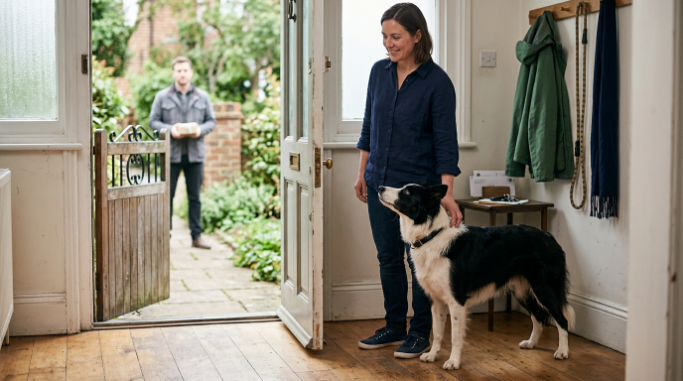
There is no single Border Collie response to danger. Some bark, some move closer to their owner, some investigate, and others create distance.
Your dog’s behavior before a crisis gives you better clues than breed stereotypes. Watch how they handle unfamiliar but safe situations.
Common responses you might see
- Alert barking: The dog may bark when someone unexpectedly approaches your home.
- Intense watching: A Border Collie may stare closely at unfamiliar movement or body language.
- Positioning: Some dogs naturally move closer to their owner or stand between two people.
- Following: The dog may stay beside you while monitoring the situation.
- Retreating: A less confident dog may increase distance rather than confront anything.
- Looking for direction: A well-trained dog may focus on you and wait for a familiar cue.
The last response is often the one I value most. A dog that stays responsive is safer and more useful than one making independent decisions about strangers.
Body language matters
Don’t judge protection by barking alone. Look at the entire body.
- Forward weight may show willingness to approach.
- A lowered body can indicate uncertainty or fear.
- A tucked tail often suggests discomfort.
- Stiff posture can signal rising tension.
- Repeated checking toward you may mean the dog wants guidance.
A loud dog isn’t necessarily a brave dog. Barking often creates distance, which means a nervous dog may bark intensely because it wants the person to leave.
Can Herding Instinct Look Like Protective Behavior?
Yes. Border Collie herding behaviors can sometimes look protective even when the dog’s main motivation is controlling movement.
This distinction matters around children, guests, runners, and other pets. A dog trying to stop movement isn’t necessarily trying to defend you.
The Border Collie’s famous “eye”
Border Collies often use an intense stare called eye while controlling livestock. They may lower their posture and closely track movement before responding.
That instinct can appear in ordinary family life. Some dogs begin monitoring anyone running through the house or yard.
- Staring at moving children
- Circling family members
- Blocking someone’s path
- Chasing bicycles or runners
- Nipping toward ankles
These behaviors require management, especially around children. They shouldn’t be encouraged as homemade protection training.
High arousal can create confusion
A Border Collie needs substantial physical activity and mental work. PetMD’s Border Collie guidance notes the breed’s high energy and strong need for exercise, training, and mental stimulation.
An under-stimulated dog may bark more, patrol windows, chase movement, or become overly focused on visitors. Owners can mistakenly interpret that frustration as loyalty or guarding instinct.
- Give young, healthy adults appropriate daily exercise.
- Use short obedience and problem-solving sessions.
- Practice settling after activity.
- Prevent repetitive fence running and window charging.
- Teach the dog to disengage from movement on cue.
A calm brain makes better decisions. Exhaustion alone isn’t the goal.
Border Collie vs Guard Dogs: How Do They Compare?
A Border Collie can be an excellent watchdog, but purpose-bred guardian breeds generally have stronger genetic tendencies toward protective work. That difference matters if personal protection is your main reason for choosing a breed.
Here’s a practical comparison with three other familiar working breeds.
| Breed | Historic emphasis | Typical stranger response | Watchdog potential | Protection suitability |
|---|---|---|---|---|
| Border Collie | Livestock herding and close handler cooperation | Often alert or reserved | Good in many individuals | Not primarily bred for it |
| Australian Shepherd | Herding and ranch work | Can be reserved and watchful | Moderate to good | Some protective tendency, but still a herder |
| German Shepherd Dog | Herding, guarding, service, and working roles | Often watchful and aloof | Strong | Commonly suited with correct temperament and training |
| Belgian Malinois | Herding plus demanding working and protection roles | Often reserved and highly vigilant | Strong | High potential in experienced hands |
This doesn’t make one breed “better.” Each breed was shaped for different work, and individuals vary considerably.
A German Shepherd or Belgian Malinois also isn’t automatically safe protection. Powerful guarding traits without excellent temperament, socialization, handling, and professional training can become a serious liability.
When a Border Collie makes more sense
If you mainly want an intelligent companion who notices visitors and alerts you, a Border Collie may already offer enough security. Their awareness can discourage casual trespass without requiring physical confrontation.
- You want an active companion first.
- You enjoy obedience, agility, or herding activities.
- You want alert barking rather than attack behavior.
- You can provide substantial mental stimulation.
- You prefer a highly handler-focused dog.
Choose a Border Collie because the breed fits your lifestyle. Protection should be a secondary benefit, not the primary purpose.
Can You Train a Border Collie to Protect You?
You can train a Border Collie to alert, stay near you, respond to cues, and behave confidently around unfamiliar situations. I don’t recommend trying to teach attack behavior yourself.
Good security training starts with control. A dog that recalls instantly and settles on command is far more useful than an uncontrolled dog that reacts aggressively.
Train these skills first
- Reliable recall: Your dog should return immediately despite distractions.
- Place: Teach the dog to go to a bed or designated location when visitors arrive.
- Quiet: Allow an alert bark, then teach a reliable cue to stop.
- Leave it: Use this to interrupt fixation on people, dogs, or moving objects.
- Heel: Keep the dog close and controlled in uncertain environments.
- Emergency U-turn: Practice turning away quickly when you need distance.
Keep training sessions around five to ten minutes when introducing demanding new skills. Border Collies learn quickly, but repeated drilling can create frustration or anticipation.
Socialization doesn’t ruin protection
Some owners worry that friendly exposure will make their dog incapable of recognizing danger. Good socialization does the opposite by teaching the dog what normal life looks like.
A dog familiar with delivery drivers, visitors, children, bicycles, hats, and unusual sounds has fewer reasons to panic. That makes genuinely unusual events easier to identify.
- Reward calm observation.
- Don’t force greetings.
- Create distance when the dog becomes overwhelmed.
- Reward checking back with you.
- Practice obedience in different environments.
For advanced protection work, use a qualified professional who evaluates temperament first. The AVMA’s pet-owner resources are also a sensible starting point for responsible animal-health and safety guidance.
When Does Protective Behavior Become a Problem?
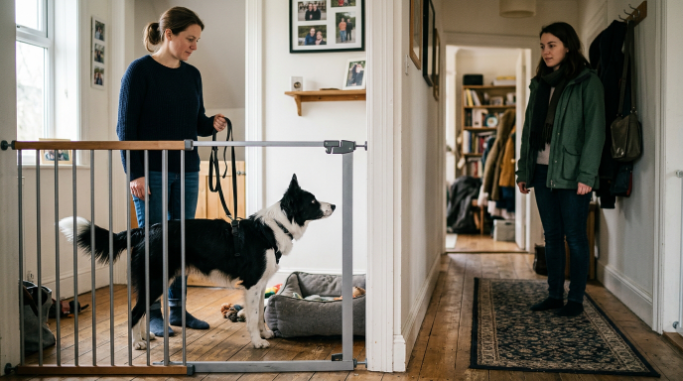
Protective-looking behavior becomes concerning when your Border Collie cannot relax, disengage, or respond to you. Frequent aggression toward ordinary visitors isn’t a desirable security feature.
Take changes seriously if a previously social dog suddenly becomes fearful or aggressive. Pain and medical problems can affect behavior.
Red flags to watch for
- Charging guests who aren’t threatening anyone
- Growling when friends approach you
- Blocking family members from reaching you
- Guarding your chair, bed, or personal space
- Lunging repeatedly at people outside windows
- Redirecting bites toward you when excited
- Becoming impossible to call away from a stranger
Resource guarding of a person can sometimes be mistaken for devotion. The dog may instead be treating access to that person as something valuable to control.
Don’t punish warning signals
Growling communicates discomfort. Punishing the growl without addressing its cause may remove a useful warning while leaving the dog’s underlying fear or conflict unchanged.
Increase distance and prevent another confrontation. Then seek qualified behavioral help if the behavior is repeated or escalating.
Vet note: Sudden aggression, unusual irritability, or major behavior changes deserve a veterinary assessment. Your veterinarian can check for pain or medical factors and help you find appropriate behavior support.
- Use gates, leashes, or separate rooms to prevent incidents.
- Avoid forcing the dog toward feared people.
- Don’t encourage threatening displays for entertainment.
- Supervise interactions with children.
- Get professional help before a bite occurs whenever possible.
The safest protective Border Collie is a dog that can think clearly. Reliability beats aggression every time.
Frequently Asked Questions
Will a Border Collie defend its owner from an attacker?
Some Border Collies might bark, approach, stay beside their owner, or physically intervene during a threatening situation. Others may retreat. Because the breed wasn’t developed primarily for human protection, you shouldn’t rely on a Border Collie to confront an attacker.
Are Border Collies good guard dogs?
Border Collies can make good watchdogs because they’re alert and sensitive to changes around them. They’re less predictable as guard dogs because livestock control, intelligence, and cooperation were historically more important to the breed than defensive protection.
Will a Border Collie bark at strangers?
Many Border Collies will bark when unfamiliar people approach, especially around their home. Individual temperament matters, though. A well-socialized Border Collie may simply watch a stranger quietly until the owner signals that everything is normal.
Are male Border Collies more protective than females?
Sex alone doesn’t reliably tell you how protective an individual Border Collie will be. Genetics, confidence, early experiences, socialization, training, and environment usually give you more useful information about how that particular dog responds to unfamiliar people.
Do Border Collies protect children?
A bonded Border Collie may stay close to children or react when something unusual happens. However, their herding instinct can also cause chasing, blocking, or ankle-directed nipping around running children, so adults should supervise interactions rather than assume the behavior is protection.
Will a Border Collie protect the house?
A Border Collie may notice people approaching the property and bark before you hear them. That makes many useful household watchdogs. Their presence and barking can deter someone, but physical property protection isn’t a behavior you should assume from the breed.
Should I train my Border Collie to be aggressive toward strangers?
No. Teaching uncontrolled aggression creates safety and liability problems. Focus on obedience, confident socialization, alert barking with a reliable quiet cue, recall, and controlled positioning. Specialized protection work should only be considered with an experienced professional who evaluates the individual dog.
Final Takeaway: Can You Count on a Border Collie for Protection?
A Border Collie may protect you in some situations, but protection isn’t the breed’s primary purpose. What you can expect more reliably is intelligence, alertness, loyalty, close observation, and strong awareness of unusual activity.
For most owners, those qualities are enough. A Border Collie that alerts you, stays responsive, and follows your directions offers far more practical value than one encouraged to behave aggressively.
- Expect a capable watchdog more than a dedicated guard dog.
- Don’t assume barking means the dog will physically defend you.
- Build confidence through thoughtful socialization.
- Prioritize recall, quiet, place, heel, and disengagement.
- Treat uncontrolled aggression as a behavior problem, not a protection skill.
If your Border Collie already becomes unusually defensive around you, visitors, or family members, work on management before the behavior escalates. Calm control should always be the goal.