
Why Dogs Get Yeast Infections in Their Ears: Causes, Signs, and What to Do Next

If you’re asking how dogs get yeast infections in their ears, the short answer is this: yeast usually overgrows when the ear environment changes in a way that favors it. The organism is often Malassezia, and it normally lives on the skin in small numbers. The problem starts when inflammation, moisture, wax buildup, allergies, or another underlying issue lets it multiply.
That last part matters. In many dogs, the yeast infection is not the root problem. It’s the result of something else irritating the ear canal first. If you only treat the yeast without finding the trigger, the infection often comes back.
For Border Collie owners, this comes up more often than people expect. Active dogs get wet, roll in grass, and pick up debris. If your dog also has allergies or sensitive skin, the ears can become a recurring weak spot.
What yeast is doing in the ear canal
A healthy dog ear has a balance of normal microbes, natural wax, and skin defenses. Yeast is part of that ecosystem. Trouble begins when the environment shifts.
Yeast tends to do well in dark, warm, humid spaces. A dog’s ear canal can become exactly that when it stays damp or inflamed. WebMD notes that the ear canal’s shape can also favor yeast growth because it slopes downward and then turns toward the head, which can trap moisture and debris.
That does not mean every damp ear will get infected. It means the ear has a built-in disadvantage when conditions are already irritated.
A useful way to think about it:
- Normal ear: small amounts of yeast, no irritation
- At-risk ear: moisture, wax, inflammation, or allergy
- Infected ear: yeast multiplies enough to cause itching, odor, redness, and discharge
[Image: Dog ear canal with yeast overgrowth explanation]
Common causes and risk factors
Most yeast ear infections are driven by a combination of factors rather than one single cause.
Allergies are a major trigger
Allergies are one of the most common reasons the ear canal becomes inflamed enough for yeast to take over. That can include food allergies and environmental allergies. When the ear lining stays irritated, yeast has an easier time multiplying.
Possible allergy triggers mentioned in veterinary sources include:
- pollen
- mold
- dust mites
- feathers
- cigarette smoke
- cleaning products
- certain foods
You do not need to assume your dog is allergic to all of these. The practical point is simpler: if the ears keep getting inflamed, allergies should be on your shortlist.
Moisture from swimming or bathing
Moisture is another common contributor. Trapped water after swimming or bathing can create a favorable environment for yeast, especially if the ear canal does not dry well on its own.
For a dog that swims often, the risk is not the occasional splash. The issue is repeated wetting without enough drying time in between. That is why some dogs do fine after one bath but start having ear trouble during a summer of frequent lake swims.
Ear anatomy and airflow
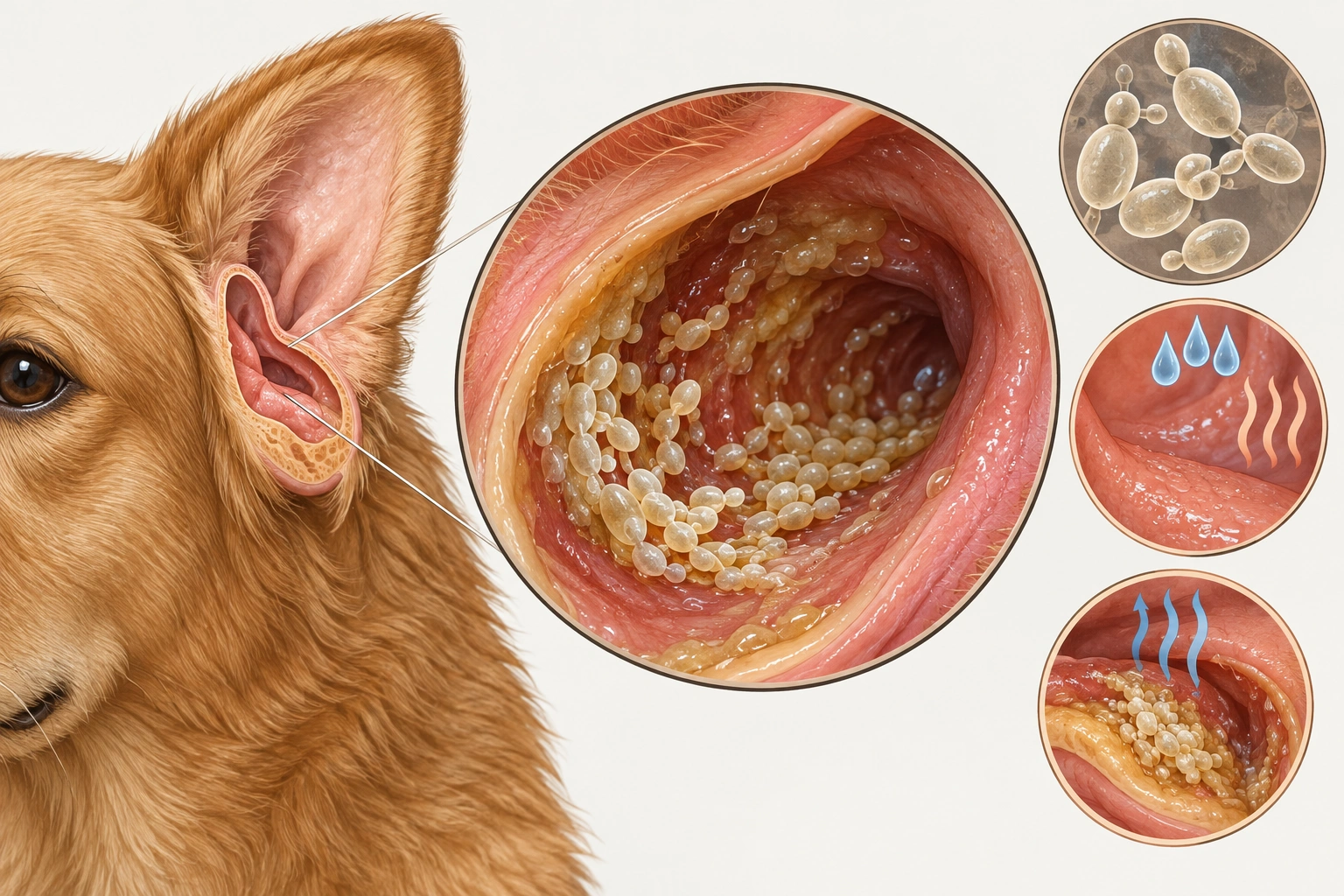
Some ear shapes make problems more likely. WebMD notes that the ear canal’s shape itself can favor yeast growth. Ears with less airflow, more trapped moisture, or more debris retention are simply harder to keep balanced.
This is not just about floppy ears, although those can contribute. It is really about how well the ear stays dry and ventilated after normal life—exercise, bathing, rain, and outdoor play.
Chronic skin inflammation and underlying disease
PetMD notes that yeast normally lives on the skin, but can overgrow when an underlying condition is present, such as allergies, hypothyroidism, or another issue that weakens the immune system.
That is why recurring infections deserve more attention than a one-off episode. If the ears keep flaring up, the yeast may be a symptom of a bigger pattern: chronic inflammation, skin disease, or an immune problem.
Lifestyle factors that matter for active dogs
Border Collies are not a special yeast breed, but their lifestyle can raise risk in practical ways:
- frequent outdoor activity
- running through wet grass
- swimming or hose-downs after exercise
- time in dusty or pollen-heavy environments
- occasional debris trapped in the ears
The dog does not need all of these. Even one or two can be enough if the ears are already sensitive.
Signs that point to a yeast ear infection
The classic pattern is usually a mix of smell, itch, and irritation.
Common signs include:
- strong, musty odor
- itching or pawing at the ear
- head shaking
- redness inside the ear
- dark waxy discharge
- discomfort when the ear is touched
- thickened or irritated-looking skin in the ear canal
Odor is often what owners notice first. The smell can be noticeably “yeasty” or musty. But odor alone is not enough to diagnose the problem. Bacterial infections can smell bad too, and mites can cause intense scratching.
A dog may also tilt its head or avoid being touched near the ear if the canal is painful. If the dog reacts strongly when you try to inspect the ear, that is a clue to stop guessing and get it examined.
Yeast infection vs. bacterial infection vs. ear mites
This is the comparison that saves a lot of frustration. These conditions can look similar from the outside, but they do not always respond to the same treatment.
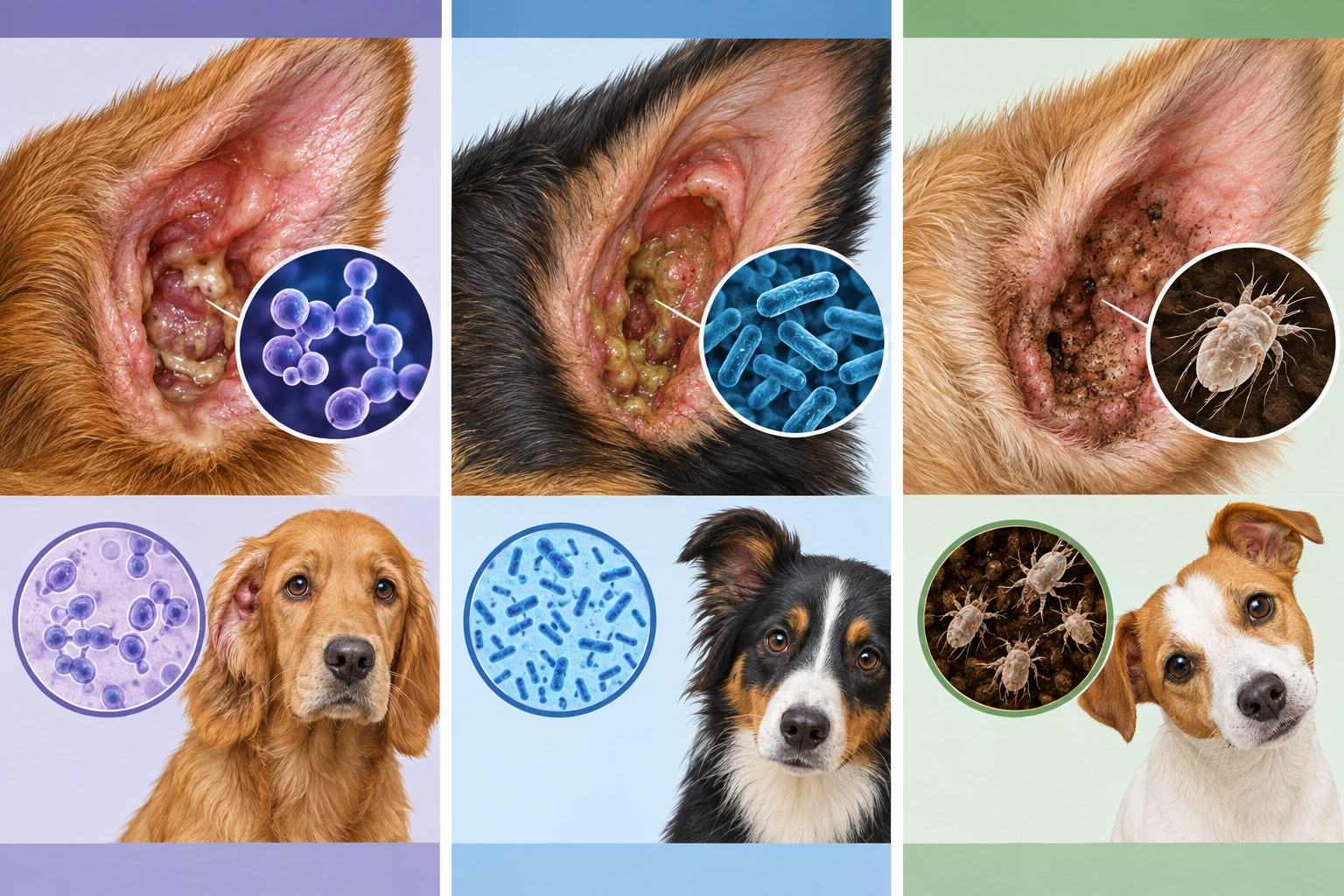
| Problem | Common clues | What tends to stand out | Why it matters |
|---|---|---|---|
| Yeast infection | Musty odor, itching, redness, dark waxy debris | Often a greasy or waxy feel, with irritation that can build gradually | Needs antifungal treatment and often a search for the trigger |
| Bacterial ear infection | More painful, may have stronger inflammation and discharge | Can look red, swollen, and very uncomfortable | Usually needs different medication than yeast |
| Ear mites | Intense scratching, debris that may look like coffee grounds | Often more common in younger dogs or dogs exposed to other pets | Needs specific mite treatment, not yeast medication |
The big mistake is treating based on appearance alone. A dark, dirty-looking ear is not automatically a yeast infection. And if the ear is very painful, the wrong cleaner or drop can make things worse.
If you want a broader practical guide to ear and skin yeast issues, my related article on how to get rid of a yeast infection in dogs covers the bigger picture.
When it is safe to monitor or gently clean at home
There is a narrow window where cautious home care can make sense: mild symptoms, no obvious pain, no swelling, and a dog that tolerates handling.
That means:
- a little wax or mild odor
- no head tilt
- no balance problems
- no visible swelling
- no yelping or flinching when the ear is touched
In that situation, a gentle ear cleaner made for dogs may help remove surface debris. The goal is not to “cure” the infection at home. The goal is to avoid making a mild issue worse while you watch for improvement.
Use this rule: if the ear looks mildly dirty but not painful, limited cleaning may be reasonable; if it looks inflamed or hurts, stop and call the vet.
Do not clean aggressively. Do not dig deep into the canal with cotton swabs. And do not keep cleaning repeatedly just because the smell returns for a day or two. Overcleaning can irritate the ear canal further and prolong the problem.
Do not clean the ear at home if the dog is in pain, the ear is very inflamed, there is heavy discharge, or a ruptured eardrum is possible. In those cases, do not use any ear cleaner until a veterinarian has examined the ear.
When to see a veterinarian
For ear yeast infections, a vet visit is the right move when symptoms are more than mild.
Get the ear checked if you notice:
- strong odor
- ongoing scratching or head shaking
- redness or swelling
- discharge that keeps coming back
- pain when touching the ear
- head tilt
- balance issues
- repeated infections in the same ear
- no improvement after gentle care
Balance issues or a head tilt are especially important. Those signs can mean the problem is more serious than a simple outer-ear issue.
Also, if your dog has recurring ear problems, do not treat each episode as a separate nuisance. Recurrence often points to allergies or another underlying issue that needs a real plan, not another round of guesswork.
How veterinarians confirm the cause
A proper diagnosis usually starts with an ear exam and cytology. Cytology means the vet looks at a sample from the ear under a microscope to see what is actually present—yeast, bacteria, or both.
That matters because the treatment changes depending on what is found.
A vet may also check for:
- ear mites
- foreign material
- severe inflammation
- a ruptured eardrum
- underlying skin disease or allergies
This is the part owners sometimes want to skip, especially if the ear looks “obviously” yeasty. But the visible symptoms can overlap. Confirming the cause avoids the common trap of using the wrong product and delaying recovery.
Treatment basics and why cleaning alone often fails
Cleaning can help remove debris, but it usually does not solve the root problem by itself.
If yeast has overgrown, treatment often needs to address two things:
- the yeast itself
- the reason it overgrew
That may include antifungal ear medication and, if needed, treatment for inflammation or allergies. If the ear is very painful, swollen, or packed with debris, the vet may need to clean it more thoroughly than you safely can at home.
The trade-off is straightforward:
- Cleaning alone may give short-term relief
- Proper diagnosis and treatment are more likely to stop the cycle
If the infection keeps returning, the real win is not another temporary clean ear. It is finding the trigger that keeps setting the problem off.
How to prevent yeast ear infections from coming back
Prevention works best when it matches the dog’s risk factors.
Keep ears dry after wet activity
If your dog swims or gets frequent baths, dry the ears afterward as part of the routine. You are not trying to scrub the ear clean every time. You are trying to reduce lingering moisture.
For many active dogs, this is the simplest preventive step with the highest payoff.
Use ear care that fits the dog
A gentle, dog-safe ear cleaner may be helpful for some dogs, especially those prone to wax buildup. But more is not better. If the ears are already inflamed, frequent cleaning can irritate them.
Use the dog’s ear type and history as your guide:
- A dog with occasional wax buildup: occasional maintenance may be enough
- A dog with recurring infections: vet-guided ear care is smarter than improvising
- A painful ear: do not keep cleaning it at home
Address recurring triggers
If infections keep returning, prevention has to go beyond the ear canal. That is where allergy management and chronic skin care come in. A dog with untreated allergies can have perfect ear cleaning technique and still keep getting infections.
A practical prevention plan often looks like this:
- reduce moisture exposure when possible
- inspect the ears after swimming or muddy outings
- avoid harsh or random ear products
- follow the vet’s plan if allergies are part of the picture
- recheck the ears early if symptoms return
Common mistakes that make ear yeast worse
A few errors show up again and again:
- treating by smell alone
- using the wrong medication
- cleaning too often
- using human remedies in the ear
- pushing deeper into the canal with swabs
- ignoring recurring infections
- assuming all ear infections are the same
The most damaging mistake is probably the simplest one: waiting too long because the problem seems minor. Ear infections can become much harder to manage once inflammation builds.
If the ear is painful, swollen, or keeps relapsing, the smartest move is to stop experimenting.
Bottom line
Dogs get yeast infections in their ears when yeast overgrows in a favorable environment. That environment is usually created by something else—most often allergies, moisture, inflammation, or another underlying issue. The visible infection is the result, not always the cause.
If the symptoms are mild, careful monitoring may be reasonable. If the ear is painful, smelly, swollen, or recurring, a vet exam is the right next step. That is the fastest route to a real answer and a treatment plan that lasts.
For more practical help with related ear and skin problems, see VCA Hospitals’ pet health library and the AKC guide to dog health basics. For general canine welfare and prevention resources, the ASPCA dog care pages are also useful.
FAQ
Can I treat a dog’s yeast ear infection at home?
Only in mild cases, and only if the ear is not painful, very inflamed, or possibly ruptured. If there is significant pain, swelling, heavy discharge, or a head tilt, a veterinarian should examine the ear first.
How do I know if it’s yeast or something else?
Yeast often causes a musty smell, itching, redness, and dark waxy debris. But bacterial infections and ear mites can look similar, so a vet exam is the safest way to tell the difference.
Why do yeast ear infections keep coming back?
Recurring infections usually mean there is an underlying trigger, such as allergies, moisture, chronic skin inflammation, or another health issue. Treating only the yeast may not stop the cycle.
Should I clean my dog’s ears after swimming?
Drying the ears after swimming can help, but avoid aggressive cleaning. If the ear is irritated or painful, do not use an ear cleaner at home until a vet has checked it.
When is a vet visit urgent?
Seek veterinary care promptly if your dog has a head tilt, balance problems, severe pain, marked swelling, or symptoms that keep returning.