
How to Tell If a Dog Has Been Poisoned: Warning Signs, Fast Action, and What to Do Next

If you think your dog may have been poisoned, treat it as a time-sensitive problem, not a wait-and-see one. The goal is not to diagnose the exact toxin at home. The goal is to recognize danger early, avoid making things worse, and get the right help fast.

That matters because poisoning can look like a simple stomach upset at first. A dog may seem only mildly off, then worsen quickly. In other cases, signs are delayed, so a dog that looks normal right after an exposure is not necessarily in the clear.
For Border Collie owners, this can feel especially stressful because these dogs are often quick, curious, and good at getting into things before you notice. But the same triage rules apply to every dog: look at the substance, the amount, the time since exposure, and the symptoms.
The first 5 to 15 minutes: what to do right now
If you suspect poisoning, act in this order:
- Move your dog away from the source.
- Remove the substance from reach if you can do so safely.
- Check for severe symptoms: collapse, seizures, trouble breathing, extreme weakness, or inability to stand.
- Call your veterinarian or an emergency clinic immediately.
- If the dog is stable, call a poison hotline for guidance while you prepare details.
Quick triage box
- Call a poison hotline if your dog is stable and you suspect or know there was an exposure.
- Go to the ER now if your dog has seizures, collapses, has trouble breathing, becomes unconscious, or is rapidly worsening.
- Call your regular vet only if they can give immediate same-day poison guidance; otherwise, use a poison hotline or emergency clinic.
The ASPCA Animal Poison Control Center and the Pet Poison Helpline are both commonly used resources for rapid guidance. AAHA also recommends calling an AAHA-accredited veterinarian or the Pet Poison Hotline at 855-764-7661.
If your dog is having seizures, struggling to breathe, or has collapsed, skip the online search and go straight to the emergency clinic.
How to tell poisoning apart from a routine upset stomach
A dog with a mild stomach bug may vomit once, seem a bit tired, then improve. Less concerning upset-stomach patterns often include a single vomit, brief soft stool, normal breathing, and a dog that still wants to drink, respond, and rest comfortably.
Poisoning is more suspicious when you see one or more of these patterns:
- A known exposure: pills, chocolate, gum, rodent bait, antifreeze, pesticides, mushrooms, or a toxic plant
- Sudden change after being normal: a dog that was fine an hour ago and now is shaky, drooling, or vomiting
- Neurologic signs: tremors, wobbliness, confusion, seizures, or unusual agitation
- Breathing changes: fast breathing, effortful breathing, or collapse
- More than one body system involved: vomiting plus weakness, diarrhea plus tremors, drooling plus behavior change
Routine upset stomach usually stays in the digestive lane. Poisoning often spreads beyond the gut.
The most common signs a dog has been poisoned
The warning signs vary by toxin, but the common ones are consistent enough to watch for.
Digestive signs
- Vomiting, sometimes with blood
- Diarrhea
- Drooling or foaming at the mouth
- Loss of appetite
- Nausea-like behavior, such as lip licking or gulping
Nervous system signs
- Tremors
- Seizures
- Staggering or unsteady walking
- Weakness
- Unusual agitation, restlessness, or hiding
- Sudden behavior changes
Breathing and circulation signs
- Breathing problems
- Pale gums
- Blue gums
- Very bright red gums
- Collapse or unconsciousness
- Racing heartbeat
Other clues
- Increased thirst or urination
- Pain or skin irritation after contact with a chemical or plant
- Lethargy or unusual tiredness
A dog does not need to show every sign to be in trouble. One strong red flag can be enough.
How fast poisoning symptoms can appear
Timing is one of the most useful clues you have.
Some toxins cause signs within minutes to a few hours. Others can take longer. Some toxins have delayed onset, which is why “my dog seems fine right now” is not reassuring enough on its own.
A practical way to think about it:
- Fast onset often suggests things like certain medications, xylitol, or some chemicals
- Delayed onset can happen with some rodenticides, kidney toxins, or liver toxins
- Skin contact or inhaled toxins may show up differently than swallowed toxins
Swallowed poisons may cause vomiting, diarrhea, agitation, or heart problems. Inhaled toxins may cause breathing trouble or loss of consciousness. Skin exposure may cause irritation, pain, or discomfort.
Common household toxins and poison sources for dogs
The most useful question is not “what poison is this?” but “what could my dog have gotten into?”
Common sources include:
- Human medications: pain relievers such as ibuprofen or acetaminophen, antidepressants, sleep aids, ADHD medications, and others
- Chocolate
- Xylitol-containing products: sugar-free gum, some peanut butters, baked goods, mints
- Grapes and raisins
- Rodenticides
- Antifreeze and other garage chemicals
- Pesticides and insecticides
- Toxic plants: including lilies in homes with cats, plus other dangerous houseplants and garden plants
- Slug and snail pellets
- Household cleaners
The exact danger depends on the substance, the amount, and the dog’s size. A small dog can be affected by a much smaller amount than a large dog. That is why “it was only a little” is a risky assumption.
If you want a broader household safety reference, the AKC’s dog poisoning guidance is a useful general starting point, but it should never replace a vet or poison hotline in an active emergency.
What to do in the first 5 to 15 minutes if you suspect poisoning
This is the decision framework I use for owners under pressure.
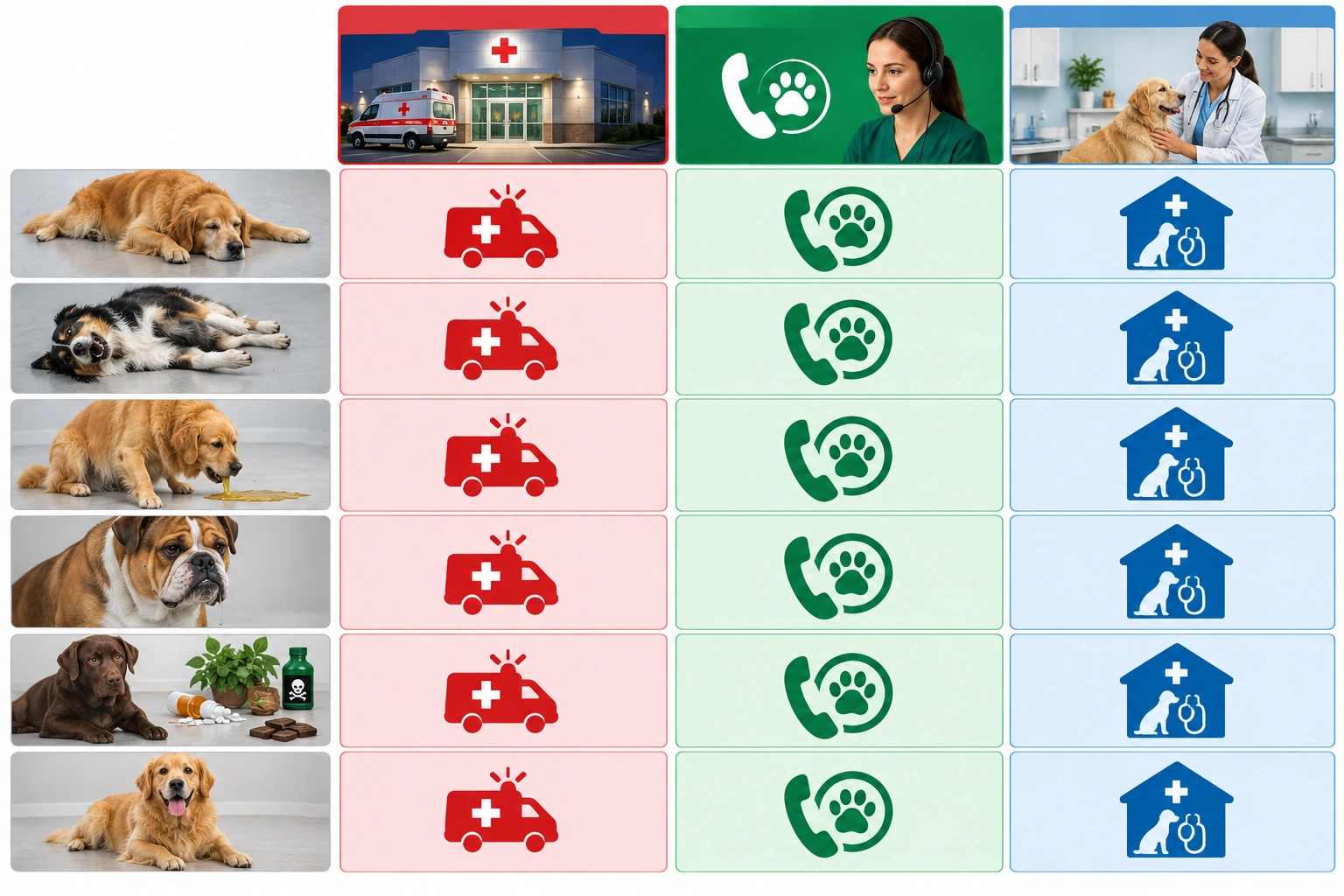
Go straight to the emergency clinic if:
- Your dog is collapsing
- Your dog has seizures or tremors
- Your dog is struggling to breathe
- Your dog is unconscious
- Your dog may have swallowed a corrosive substance or something that burns the mouth, throat, or stomach
- Your dog may have eaten a high-risk toxin that can require immediate treatment even before symptoms appear, such as xylitol, rodenticides, or certain medications
- Your dog is rapidly getting worse
Call a poison hotline or veterinarian immediately if:
- You know or strongly suspect the toxin
- Your dog is stable but symptomatic
- Your dog ate something risky, even if symptoms have not started yet
- You are not sure whether vomiting is safe
Watch only if a veterinarian tells you to
That is the important part. RSPCA guidance is blunt here: do not “watch and wait” if you think your dog has been poisoned. If you are unsure, make the call.
What not to do at home
This is where many well-meaning owners create a second problem.
Do not induce vomiting unless a veterinarian tells you to
Different poisons need different treatment. In some cases, inducing vomiting can make a dog sicker. That is especially true if the dog is unconscious, having seizures, struggling to breathe, or exposed to a corrosive substance.
Do not give food, milk, salt, oil, or random home remedies
These do not neutralize most toxins and can make assessment harder.
Do not delay care while searching the internet
If the dog is symptomatic, the clock matters more than the search results.
Do not assume a small exposure is harmless
Dose matters, but “small” is not a safety guarantee.
What information to gather before you call
The faster you can answer these questions, the faster a vet can decide what to do:
- What substance was involved?
- How much might have been eaten, licked, or contacted?
- When did it happen?
- How much does your dog weigh?
- What symptoms are you seeing now?
- Is the dog getting worse, staying the same, or improving?
- Do you have the packaging, label, plant sample, or photo?
A veterinary source recommends taking a photo of the product, plant, packaging, or label, writing down the time of exposure, possible amount, and symptoms, and bringing the item or packaging with you if your dog needs care.
If you can do it safely, collect the evidence without slowing down the trip to the clinic.
How veterinarians confirm and treat suspected poisoning
Veterinarians often start treatment before they have perfect confirmation. That is because waiting can reduce the chance of removing or neutralizing the toxin.
Treatment may include:
- Decontamination to prevent more toxin absorption
- Activated charcoal in some cases
- Antidotes when one exists for the toxin involved
- Supportive care such as IV fluids, anti-nausea medication, seizure control, oxygen, or monitoring
- Testing to check blood sugar, organ function, clotting, or other effects depending on the suspected poison
AAHA notes that treatment plans focus on preventing absorption of the poison, giving antidotes if available, and providing supportive care.
That is why the packaging, the timing, and the symptom details matter so much. They help the vet choose the right path quickly.
Common edge cases that confuse owners
The dog seems normal after eating something risky
That does not rule out poisoning. Some toxins act later. Keep watching for changes and call for advice anyway.
The dog ate only a small amount
This can still be serious, especially for small dogs or high-risk toxins like xylitol, rodenticides, or certain medications.
You do not know what was eaten
Treat unknown exposures seriously. A photo of the area, the packaging, or the plant can still help.
The dog only licked the substance
Licking can be enough for some toxins, especially if the substance is concentrated or rapidly absorbed.
The dog has mild drooling and seems mostly okay
Mild signs can be the first stage of a bigger problem. If the exposure involved a toxin, call for guidance rather than waiting for worse symptoms.
When to see a veterinarian or certified trainer
For poisoning concerns, the right professional is usually a veterinarian or emergency clinic, not a trainer. A trainer is useful for prevention after the emergency is over, such as teaching a reliable “leave it” or improving management around trash, counters, and dropped items.
See a veterinarian immediately if:
– there is a known or suspected toxin exposure
– symptoms are present
– the dog is worsening
– you are unsure whether home monitoring is safe
If your dog has a habit of scavenging, counter surfing, or grabbing dropped items, that is worth addressing later from a training and management angle. But medical triage comes first.
A simple rule to remember
If you are asking yourself, “How do I know if my dog has been poisoned?” the answer is this: look for sudden symptoms plus a possible exposure, then act fast.
Vomiting alone may be a stomach upset. Vomiting plus tremors, collapse, trouble breathing, pale gums, or a known toxin exposure is a different situation. When in doubt, call the vet or poison hotline immediately and bring the packaging or a photo if you can do so safely.
For a related emergency guide, see our article on how to tell if your dog may have been poisoned and our guide on how to know if your dog has a blockage, since blockage and poisoning can sometimes look similar at first.
FAQs
Can a dog be poisoned without vomiting?
Yes. Some toxins cause weakness, tremors, breathing changes, collapse, or behavior changes before any stomach signs show up.
Should I make my dog throw up if I think it ate poison?
Not unless a veterinarian or poison hotline tells you to. Vomiting is unsafe in some situations and with some toxins.
How do I know if it’s poisoning or just an upset stomach?
Poisoning is more likely when symptoms come on suddenly, multiple body systems are involved, or you know your dog had access to a toxin. Mild upset stomach is more often limited to brief vomiting or soft stool with otherwise normal breathing, energy, and behavior.
What should I bring to the vet?
Bring the packaging, label, plant sample if safe, a photo of the product, and notes on time, amount, dog weight, and symptoms.
Can poisoning signs be delayed?
Yes. Some toxins cause signs quickly, while others can take longer to show up. Delayed signs are one reason not to assume your dog is fine just because it looks normal right away.