
How to Tell If Your Dog Is Overweight: A Practical Body-Check Guide

If you’re trying to work out whether your dog is carrying extra weight, ignore the guesswork and look at three things first: ribs, waist, and abdominal tuck. Those checks tell you far more than a number on the scale alone.
That matters because dogs can look “fine” at a glance and still carry too much fat under the coat. Border Collies are a good example. They’re active, athletic, and often look lean in motion, but a dog that runs a lot can still be overweight if the body shape has softened and the ribs have disappeared under fat.
The good news is that you can do a useful first-pass assessment at home in under a minute.
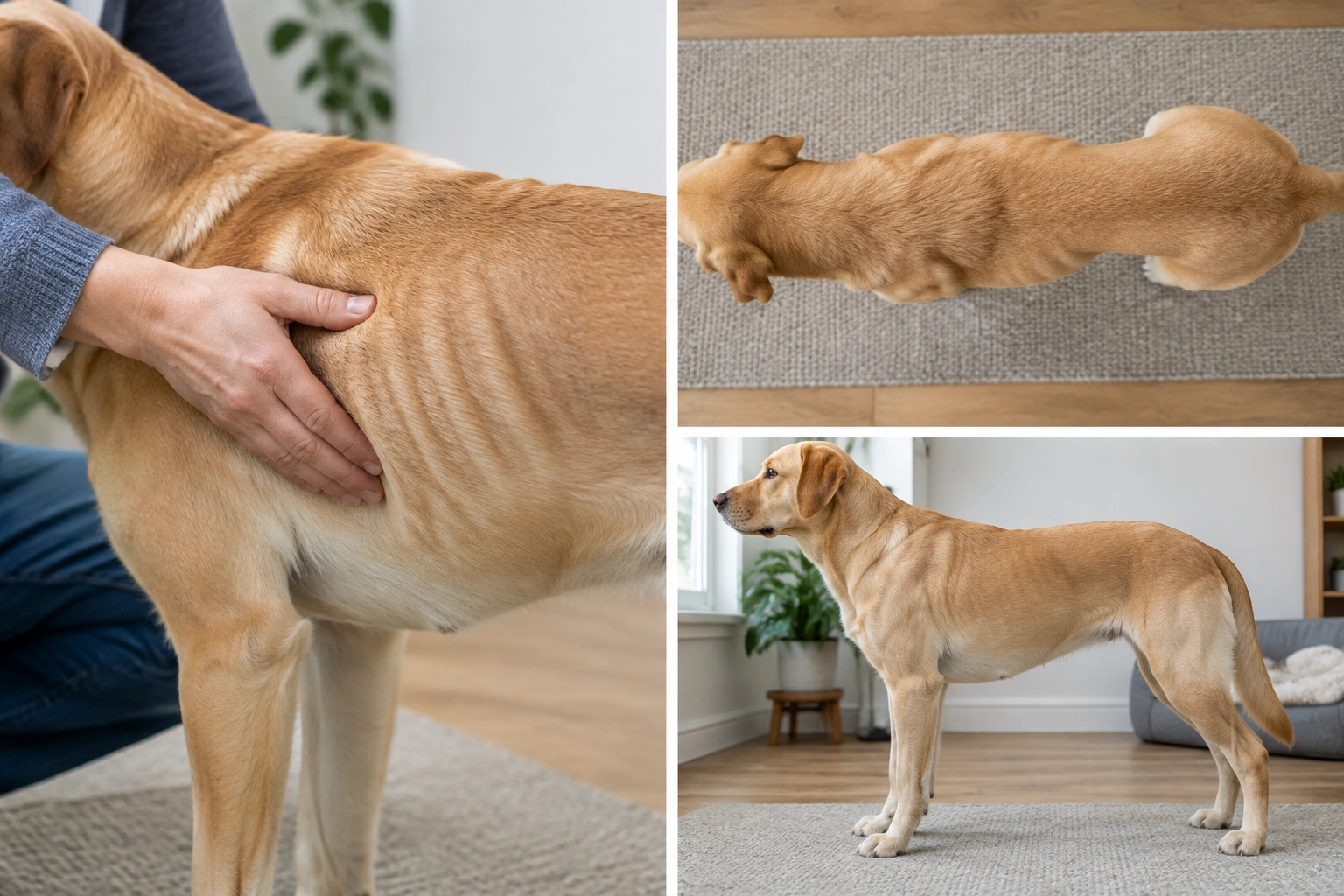
The quickest way to judge your dog’s weight
Use this simple rule:
- Ribs: you should be able to feel them with light pressure.
- Waist: viewed from above, there should usually be a visible narrowing behind the ribs.
- Abdominal tuck: viewed from the side, the belly should rise slightly behind the ribcage rather than hang straight down.
If those signs are present, your dog is more likely to be in a healthy range. If the ribs are hard to feel, the waist has disappeared, and the underside is straight or sagging, excess fat is likely.
That does not automatically mean “obese,” but it does mean you should keep checking and probably involve your veterinarian.
What a healthy dog body should look and feel like
A healthy adult dog usually has a body shape that feels firm, not padded. The ribs are there, but they are not poking out. When you run your hands along the ribcage, you should be able to feel the bones without digging through a thick layer of fat.
From above, a healthy dog usually narrows a little behind the ribs. From the side, the abdomen should tuck up after the ribcage instead of forming a straight line from chest to belly.
That shape is easy to miss in fluffy dogs because coat can hide definition. It’s also easy to misread in stockier dogs, because a broad frame is not the same thing as excess fat. The point is not to make your dog look “ripped.” The point is to feel and see a body that is lean enough for the ribs and waist to be identifiable.
How to check your dog at home: ribs, waist, spine, and tuck
This is the hands-on method I trust most, especially for dogs with dense coats.
1) Check the ribs
Place your hands on both sides of the chest and slide them lightly over the ribcage. You should be able to feel the ribs without pressing hard. If you need to push in to find them, fat is probably covering the ribcage.
A useful way to think about it: the ribs should feel present, but not sharp. If they feel buried, the dog may be overweight.
2) Look at the waist from above
Stand over your dog and look down at the body behind the ribs. In a healthy dog, the body usually narrows a bit before widening again at the hips. If the shape is more like a tube or an oval with no narrowing, that is a warning sign.
3) Look at the side profile
From the side, the underside should rise gently after the ribcage. A belly that hangs down, stays level, or looks rounded may indicate excess fat.
4) Feel along the spine and body line
You do not need the spine to stand out. But if you cannot easily feel the body outline under the coat, or if the whole trunk feels soft and padded rather than firm, the dog may be carrying too much weight.
5) Compare both sides over time
One check is useful; a trend is better. If you notice the ribs getting harder to feel or the waist slowly disappearing over a few months, that matters more than a single “good” day.
What BCS 6, 7, 8, and 9 generally mean
Veterinarians often use Body Condition Score, or BCS, to judge whether a dog is too thin, ideal, overweight, or obese. A common scale runs from 1 to 9, and a score around 4 to 5 is generally considered ideal.
For readers trying to judge severity in plain language:
- BCS 6: slightly overweight; the dog is usually carrying a bit more fat than ideal, but the shape may still look fairly close to normal
- BCS 7: clearly overweight; the ribs are harder to feel, the waist is reduced, and extra fat is easier to notice
- BCS 8: very overweight; the waist is usually gone, the belly is rounded, and fat cover is obvious
- BCS 9: severely overweight or obese; the body is heavily padded, and the ribs and waist are difficult to assess without firm pressure
BCS is more useful than scale weight alone because it looks at body fat coverage, waist shape, and abdominal tuck. That means two dogs can weigh the same and still have very different body condition.
For home use, you do not need to memorize the whole scale. Use it as a decision tool:
- Likely ideal: ribs easy to feel, visible waist, abdominal tuck present
- Likely overweight: ribs difficult to feel, waist reduced, tuck reduced
- Likely obese: ribs hard to feel, no waist, no tuck, body looks rounded
If you want a clear veterinary explanation of why BCS beats scale weight alone, the American Animal Hospital Association’s body condition guide is a solid reference.
Why scale weight alone can mislead you
A scale tells you how much your dog weighs. It does not tell you what that weight is made of.
That matters because muscle, bone structure, coat, and fat distribution all change the picture. A broad-chested dog may weigh more than a finer-framed dog without being overweight. A very fluffy dog may look bigger than they really are. And an active dog can still carry too much fat if food intake has crept up over time.
This is why the scale is best used as a tracking tool, not the final answer. If your dog weighs the same as last year but the waist has gone and the ribs are harder to feel, the body condition has changed even if the number has not.
Breed, build, coat, and age: what changes the judgment and what does not
Border Collies, in particular, can be tricky to assess because many are lean, athletic, and covered in enough coat to hide the body line. That makes hands-on checking especially important.
What changes the judgment
- Coat thickness: a dense coat can hide a waist and soften the look of the body
- Build: stockier dogs may have a broader frame
- Age: older dogs may move less, lose muscle, or gain fat more easily
- Activity level: a dog can be lively and still carry extra fat
What does not change
Even with all those differences, the same basic signs still matter. You still want to feel the ribs, see some waist from above, and find an abdominal tuck from the side.
That is the part owners sometimes miss with Border Collies. A dog that can sprint, herd, or hike may look “fit” because it is energetic. But energy is not the same as body condition.
How to tell how serious the extra weight is
A little extra weight and obvious obesity are not the same thing.
- Slightly overweight: the ribs may be a bit harder to feel, and the waist may be less obvious, but the dog still has some body shape
- Clearly overweight: the ribs are difficult to feel, the waist is reduced or missing, and the belly line is flatter
- Likely obese: the body looks rounded, the waist is gone, and the ribcage feels buried under fat
If you are seeing only mild changes, home monitoring may be enough at first. If the dog looks clearly overweight, or if you are unsure whether the change is mild or more significant, a veterinary assessment is the better next step.
How to tell if your dog is muscular or stocky rather than overweight
This is where many owners get stuck. A muscular dog feels firm. An overweight dog feels padded.
Here is the practical difference:
- Muscular or stocky dog: broad frame, but ribs are still easy to feel; waist is present, even if subtle; body feels firm under the coat
- Overweight dog: ribs are harder to feel; waist is flattened; belly is straighter or rounded; there is a soft layer over the trunk
A stocky dog may never look as narrow as a fine-boned dog. That is normal. But stocky does not mean “no waist at all.”
If you are comparing two dogs, the better question is not “Which one looks bigger?” It is “Which one has more fat covering the ribs and waist?”
A simple comparison table you can use at home
| Check | Healthy range | Possible overweight sign | Borderline case to watch |
|---|---|---|---|
| Ribs | Easy to feel with light pressure | Hard to feel unless you press | Thick coat hides feel, so check with hands |
| Waist from above | Visible narrowing behind ribs | Little or no narrowing | Broad frame but still some waist |
| Side profile | Gentle abdominal tuck | Straight or sagging underside | Athletic dog with heavy coat |
| Body feel | Firm, lean, defined | Soft, padded, covered | Muscular dog with strong build |
| BCS | Around 4–5 on a 9-point scale | 6 or higher suggests extra fat | Borderline dogs need repeat checks |
If you want a veterinary perspective on the 1–9 scale and the ideal range, VCA Animal Hospitals explains obesity in dogs clearly.
Signs extra weight may already be affecting health
Sometimes the body shape is the first clue. Sometimes the behavior is.
Watch for these practical signs:
- reluctance to jump, climb, or go for long walks
- tiring faster than usual
- moving stiffly after rest
- breathing harder during mild exercise
- less interest in play
- obvious strain getting up from lying down
These signs do not prove weight is the only issue. Pain, arthritis, and other medical problems can look similar. But if your dog is carrying extra fat and also moving less comfortably, the weight is no longer just a cosmetic concern.
When to see a veterinarian
If the weight change is sudden, unexplained, or paired with changes in appetite, energy, or mobility, book a vet visit. A veterinarian can weigh your dog, examine body condition properly, and interpret the result in light of breed and build.
That step matters because extra weight can sometimes be linked to an underlying health issue, and it can also make joint pain and diabetes more likely. A dog that suddenly gains weight without a clear reason deserves more than a home guess.
If you are unsure whether the issue is weight, pain, or both, ask for a formal body condition assessment. This is especially useful for dogs with dense coats, unusual frames, or a history of weight swings.
For a quick owner-facing reminder of when to call the vet, Sun Valley Animal Center’s guide on overweight dogs aligns with standard veterinary advice.
What to do next if your dog seems overweight
If your dog looks borderline or clearly overweight, keep the next steps calm and practical.
Measure food, don’t guess
Measure each meal with a proper scoop or kitchen scale instead of estimating by eye. Small overfeeds add up quickly.
Count treats as part of the day
Treats count too, and they can quietly undo an otherwise sensible plan. If your dog gets training rewards or table scraps, include them in the daily total and cut back the main meal if needed.
Decide whether home monitoring is enough
If the dog is only slightly overweight, the waist is still partly visible, and the ribs are still easy to find with light pressure, you can often start with careful home monitoring. If the dog is clearly overweight, the ribs are difficult to feel, or the waist has disappeared, schedule a veterinary appointment.
Set a recheck timeline
Recheck body shape at home on a set schedule, such as every 2 to 4 weeks, so you can tell whether the plan is working. Use the same rib, waist, and tuck checks each time.
Keep exercise steady, not extreme
A gradual increase in daily movement is safer than a sudden burst of activity, especially if your dog is already carrying extra weight or seems stiff. The goal is consistency.
Get veterinary guidance if progress stalls
If the dog is not changing shape, or if weight keeps rising despite careful feeding, the plan may need a medical review.
The bottom line
The most reliable way to know if your dog is overweight is to combine three checks: ribs, waist, and abdominal tuck. If the ribs are hard to feel, the waist has disappeared, and the belly no longer tucks up, extra fat is likely. Scale weight helps, but body condition tells the real story.
If you want to keep reading, the next most useful step is a deeper look at how to tell if your dog is overweight using the same practical checks.
FAQ
How do I know if my dog is slightly overweight or truly overweight?
If the ribs are still easy to feel and the waist is only a little less obvious, the dog may be only slightly overweight. If the ribs are difficult to feel and the waist is mostly gone, the dog is more clearly overweight.
Can I tell by looking alone?
Not reliably. Coat, build, and stance can hide extra fat, so the hands-on rib check matters.
Should I wait and watch at home or book a vet visit?
Home monitoring is reasonable for mild borderline cases. If the change is clear, sudden, or linked with stiffness, tiredness, or appetite changes, book a vet visit.
How often should I recheck my dog?
Every 2 to 4 weeks is a practical home schedule for tracking body shape changes.