How to Tell If Your Dog Is Overweight: A Practical Body-Check Guide

If you’re asking, “how do i tell if my dog is overweight,” the fastest reliable answer is this: look at the body, not just the scale. A dog can weigh “normal” for their size and still be carrying too much fat, especially if they have a thick coat or a naturally broad chest. The goal is to judge body shape, feel, and movement together.
For Border Collies in particular, this matters because their athletic outline can hide gradual weight gain. A dog that still runs, plays, and looks “fine” from across the room may already have lost their waistline and be carrying extra fat over the ribs and belly.
Here’s the short version: if you can’t easily feel the ribs, can’t see a waist from above, and the belly doesn’t tuck up from the side, your dog is probably overweight and should be assessed more carefully.
How to Tell If Your Dog Is Overweight at a Glance
Use this first-pass rule:
- Ribs: you should be able to feel them without pressing hard.
- Waist: there should usually be a visible narrowing behind the ribs when viewed from above.
- Belly line: there should usually be an upward tuck from the chest toward the back legs when viewed from the side.
If all three are missing, excess body fat is likely. If only one is unclear, your dog may be close to ideal or only mildly overweight. If the ribs are hard to find and the body looks round or oval, the concern is stronger.
A practical note: a fluffy coat can hide shape, so don’t trust outline alone. Run your hands over the body and check the silhouette in good light. Breed build can also change the outline, so use the full BCS check and the hands-on rib check rather than any single visual cue.
Use Body Condition Score Instead of Guessing by Weight Alone
Veterinarians use Body Condition Score (BCS) because scale weight by itself doesn’t tell the whole story. A muscular dog can weigh more than expected without being fat. A small dog can weigh “fine” and still carry too much body fat. BCS looks at fat coverage over the ribs, waist, and abdomen.
That is why BCS is more useful at home than a bathroom scale alone. It helps you judge composition, not just size.
The common 9-point system is simple enough for owners to use:
- BCS 4–5/9: ideal
- BCS 6–7/9: overweight
- BCS 8–9/9: obese
FEDIAF describes BCS 4–5/9 as optimal, with 6–7/9 overweight and 8–9/9 obese. That gives you a useful sense of scale without pretending the estimate is exact. You can read more about the scoring approach in FEDIAF’s healthy-weight guide for dogs and Cornell’s obesity and weight loss guide.
Check Three Things: Ribs, Waist, and Abdominal Tuck
This is the home check I’d trust first.
1) Feel the ribs
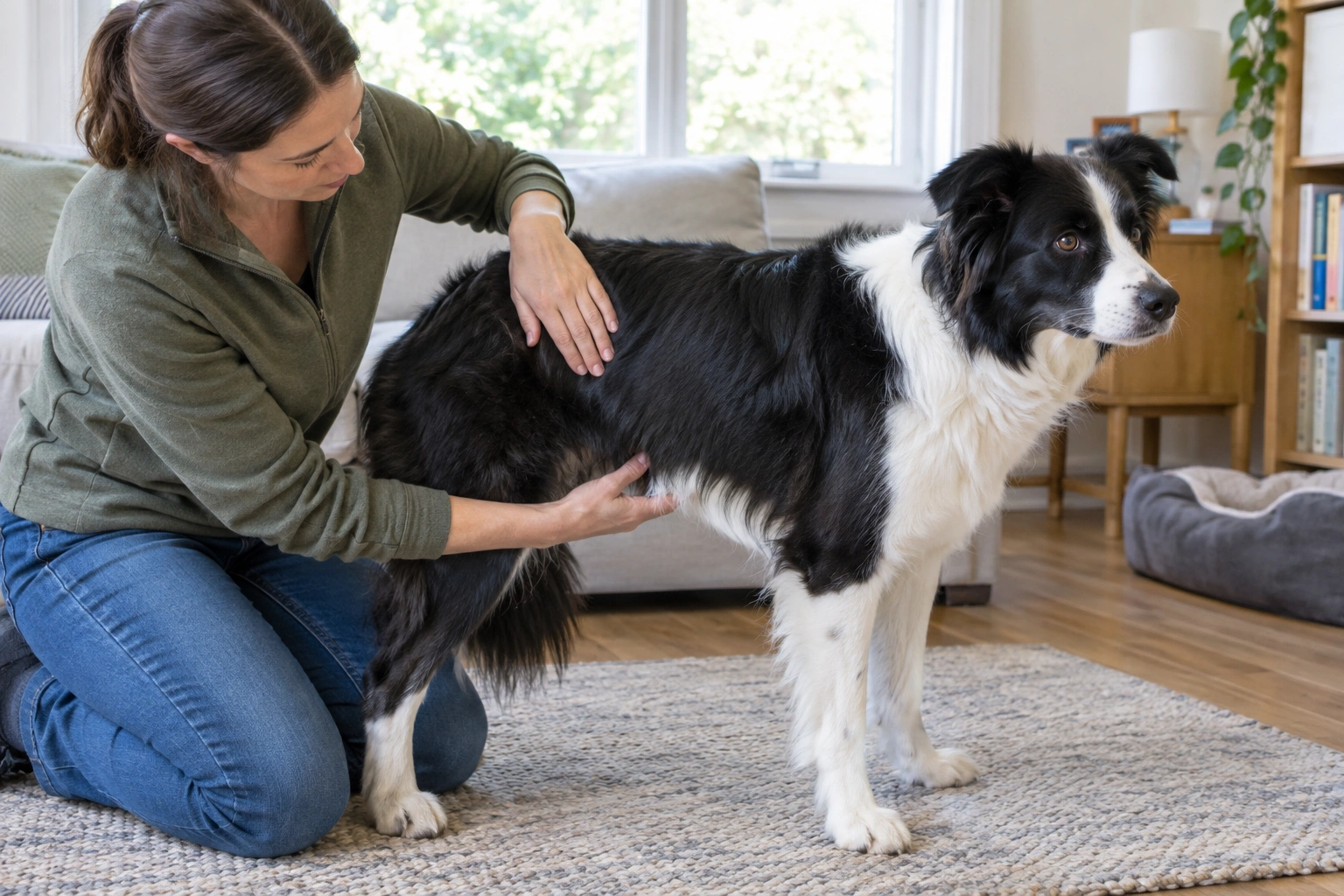
Slide your hands along the ribcage with light, even pressure. You should be able to feel the ribs beneath a thin layer of fat. If you have to press hard to find them, that is a strong sign of excess body fat.
The point is not to count every rib easily from across the room. It’s to feel a clear ribcage without digging through a thick fat layer.
2) Look for a waist from above
Stand over your dog and look down from the top. At a healthy weight, there is usually a visible narrowing behind the ribs. The body should not look straight-sided all the way from ribcage to hips.
If the waist has disappeared and the body looks more like an oval or barrel, that’s a warning sign. A dog that looks broad through the middle may simply be well-muscled, but if the waist is gone and the ribs are harder to feel, extra fat is the more likely explanation.
3) Check the abdominal tuck from the side
From the side, the belly should rise slightly after the ribcage rather than hanging in a straight line. A visible tuck is a common sign of a healthy body condition.
If the underside of the dog looks level or sagging, especially alongside a missing waist, overweight becomes more likely.
What a Healthy Dog Body Shape Looks Like
A healthy dog is not supposed to look skinny. The ideal shape is balanced:
- ribs are easy to feel, but not sharply visible in most dogs
- there is a waist behind the ribs when viewed from above
- the abdomen tucks up from the side
- the body looks athletic, not round
For many dogs, especially active breeds like Border Collies, a healthy silhouette has a clear hourglass shape from above. Purina describes this as a visible waist behind the ribs in a healthy-weight dog. That is a helpful visual reference, but use it with the hands-on rib check rather than on appearance alone.
The key difference between healthy and overweight is subtle at first. Healthy dogs still have shape. Overweight dogs start to lose the narrowing around the middle.
Healthy, Overweight, and Obese: A Quick Comparison
| Body area | Healthy weight | Overweight | Obese |
|---|---|---|---|
| Ribs | Easy to feel with light pressure | Felt, but with more fat cover | Hard to feel without pressing firmly |
| Waist | Visible from above | Reduced or hard to see | Usually absent |
| Abdominal tuck | Clear from the side | Less defined | Often missing |
| Body outline | Athletic, balanced shape | Rounder, broader midsection | Obvious fat deposits, barrel-like shape |
| Coat/build caveat | Coat may still hide detail | Thick coat can mask change | Shape changes are usually noticeable even through coat |
This is where the distinction between overweight and obese matters. VCA notes that dogs are generally considered overweight at about 10% to 20% above ideal body weight and obese above 20% above ideal. That’s not a home measurement, but it gives useful context: overweight is the early warning stage, obese is the more serious stage.
How Coat Type, Breed Build, and Muscle Can Hide Extra Fat
Border Collies are a good example of why owners get fooled. Their coats can make them look leaner than they are, especially if the fur is long, dense, or blown out after brushing. A dog can still have a “fit” appearance while slowly losing the waist and collecting fat over the ribs.
Broad-chested dogs can also confuse the eye. A strong front end does not rule out excess fat behind the ribs. And a well-conditioned dog may look muscular, but muscle should still sit under a defined waist and abdominal tuck.
Here’s the useful trade-off: if you rely only on appearance, you’ll miss mild weight gain. If you rely only on feel, you may worry unnecessarily about a heavily coated but healthy dog. The best check combines both.
A good real-world test is this: part the coat, feel the ribs, and then step back and look from above. If the body is still round after the coat is out of the way, the coat was hiding the problem rather than causing it.
Overweight vs. Obese vs. Underweight: How to Tell the Difference
These categories are worth separating because they affect urgency.
Mildly overweight
The ribs are still palpable, but there’s a noticeable fat layer. The waist is fading, and the abdominal tuck is less obvious. This is the stage where small changes in feeding and activity often help most.
Obese
The ribs are difficult to feel, the waist is gone, and the body shape is clearly rounded. Fat may gather around the chest, base of the tail, or abdomen. This usually needs a more deliberate plan and often a veterinary weight-loss discussion.
Underweight
The opposite pattern shows up here: ribs, spine, or hip bones may be too prominent, and there may be little muscle or body fat. That is a different problem and should not be managed by simply feeding more without understanding why.
The practical distinction is this: mild overweight can often be addressed early, while obesity is more likely to need a vet-guided plan because the dog may have other health issues, lower exercise tolerance, or a longer road back to ideal condition.
When Weight Gain May Signal a Medical Problem
Not all weight gain is a feeding problem.
If your dog gains weight suddenly, seems swollen rather than evenly padded, or is also acting unwell, a vet visit should come before diet changes. Weight gain can also be linked with reduced activity, hormone problems, fluid buildup, or other medical issues.
Watch for these red flags:
- rapid gain over a short period
- a swollen or distended abdomen
- lethargy or unusual fatigue
- reluctance to exercise that is new or worsening
- changes in appetite, thirst, or bathroom habits
- obvious discomfort when moving
A dog that tires quickly may be struggling with excess weight, but sudden loss of stamina can also point to illness. That’s why the context matters. If the change is gradual and the dog is otherwise well, overfeeding is more likely. If the change is sudden or comes with other symptoms, treat it as a health issue first.
What to Do If Your Dog Is Overweight
If the body check suggests extra fat, the next step is usually simple in principle and careful in practice: reduce calories a little, increase movement a little, and reassess regularly.
Audit the food first
Measure meals instead of eyeballing them. Many dogs gain weight because portions drift upward over time. Use a gram scale for the most consistent results, or measure with the same cup every time so portions don’t vary from one meal to the next. Treats count too; track them for a few days so you can see how much they’re adding.
Increase activity gradually
More walking, sniffing, and controlled play can help, but exercise alone usually isn’t enough if portions stay too large. Food intake is the bigger lever for most overweight dogs.
Keep changes moderate
Avoid a dramatic cut in food. That can be hard to sustain and may create nutritional problems if the diet becomes too restricted. A steady, measurable adjustment is usually safer and easier to maintain.
Recheck the body condition
Use the same three-point check every couple of weeks: ribs, waist, and tuck. You’re looking for small improvements in shape, not overnight transformation.
If your dog is only mildly overweight, a standard diet with controlled portions may be enough. If your dog is clearly obese, a weight-loss diet recommended by a veterinarian may be more appropriate. Set the target weight and the pace of loss with your vet so the plan is safe and realistic.
When to See a Veterinarian or Certified Trainer
Book a veterinary visit before changing food if:
- the weight gain was sudden or unexplained
- your dog seems lethargic, painful, or unusually thirsty
- the abdomen looks swollen rather than generally padded
- your dog is very overweight or obese
- there’s a known medical condition
- you’re unsure whether the dog is overweight or underweight
A veterinarian can confirm whether the issue is body fat, fluid, muscle loss, or something else. That matters because the right plan depends on the cause. If the issue is mostly feeding habits, a veterinarian can help you choose between portion control on the current diet and a weight-loss diet.
A Simple Home Check You Can Repeat This Week
If you want one practical routine, use this:
- Feel the ribs with light pressure.
- Look down from above for a waist.
- Check from the side for an abdominal tuck.
- Compare what you see with the BCS 4–5 ideal range.
- If the ribs are hard to feel, the waist is missing, or the belly is straight or sagging, treat the dog as likely overweight and plan a vet check if the gain was sudden or the dog seems unwell.
That’s the most useful way to answer the question of how do i tell if my dog is overweight without guessing. It gives you a repeatable method, not a vague impression.
For related warning-sign reading, you may also find our guides on how to tell if your dog has a blockage and how to tell if your dog is dying useful when a weight change is part of a broader health concern.
FAQs
How do I know if my dog is overweight or just fluffy?
Part the coat and check the body with your hands. If the ribs are easy to feel, the waist is visible, and the belly tucks up, the dog may simply be fluffy. If the waist has disappeared and the ribs are harder to feel, extra fat is more likely.
Should I be able to feel my dog’s ribs?
Yes, you should be able to feel the ribs without pressing hard. If you have to push firmly through a thick fat layer, that suggests overweight status.
Is a belly tuck really supposed to be there?
Usually, yes. A healthy dog often has an abdominal tuck when viewed from the side. If the underside is straight or hanging, that can point to excess weight.
Can an active dog still be overweight?
Absolutely. Activity helps, but it does not cancel out too many calories. Some dogs stay energetic while still carrying extra fat.
When should I call the vet about weight gain?
Call sooner if the gain was sudden, the belly looks swollen, or your dog seems unwell. Also check with your vet if your dog is very overweight or has a medical condition.
What’s the safest first change if my dog is overweight?
Measure meals accurately and review treats first. That usually gives the clearest, safest starting point before making bigger changes.
Can body condition score replace a vet exam?
No. It’s a useful screening tool, not a diagnosis. It helps you spot a problem early, but a veterinarian should confirm concerns, especially if the weight change is sudden or severe.
