
What Age Do Dogs Calm Down? A Practical Guide for Border Collie Owners

If you’re asking what age do dogs calm down, the honest answer is: there isn’t one magic birthday.
Most dogs become noticeably easier to live with somewhere between 1 and 3 years old, but that change is gradual. Some dogs start settling after adolescence. Others stay intense well into adulthood. Border Collies, especially, often keep a strong work drive long after puppyhood ends.
A useful way to think about it is this:
- Puppies are busy because they are immature, curious, and still learning regulation.
- Adolescents are often the hardest stage because they have energy, confidence, and not much impulse control.
- Adult dogs usually settle more, but “calm” depends on breed, training, routine, and temperament.
If you want the short version for a Border Collie household: many dogs begin to look calmer somewhere in the second year of life, but a Border Collie often needs more time, more structure, and more mental work than a lower-energy breed before that calm becomes reliable.
Quick answer: when dogs usually calm down
For most dogs, calmness develops in layers rather than all at once.
A simple rule of thumb is:
- Under 6 months: expect a lot of puppy chaos.
- 6 to 18 months: expect the adolescent “teenage dog” phase, which often feels worse than puppyhood.
- 1 to 3 years: many dogs begin to settle into adult behavior.
- 3 years and up: a lot of dogs seem more predictable and easier to manage, though they may still be energetic.
Breed matters a lot here. Smaller dogs often mature earlier, while larger and working breeds usually take longer. Some guides place small breeds around 10 to 12 months, medium breeds around 12 to 15 months, large breeds around 16 to 18 months, and extra-large breeds around 18 to 24 months before they start to calm in a more obvious way. That is a useful rough generalization, not a guarantee for any individual dog. Temperament, line, and training can all shift the timeline.
The best question is not “Has my dog hit the calm age yet?” It is “Is my dog’s energy changing in the direction I’d expect for its age and breed?”
Why there is no single age when all dogs calm down
People often mix up three different kinds of maturity:
Physical maturity
This is when the body has mostly finished growing. A dog can look adult long before it behaves like one.
Behavioral maturity
This is when impulse control improves, routines make sense, and the dog stops acting like every experience is a crisis or a party.
Emotional maturity
This is the quieter, less visible part. The dog is less reactive, less frantic, and better able to recover after excitement.
Those timelines do not always match. A dog may be physically adult at 12 months but still emotionally adolescent at 18 months or 2 years. That is especially true in intelligent, high-drive breeds that were selected to keep working rather than to be naturally sedate.
This is why “my dog is one year old and still wild” is not automatically a problem. One year is often still very young, especially for Border Collies and other active breeds.
Puppy vs. adolescent vs. adult dog energy
The stage your dog is in matters more than the exact calendar date.
| Life stage | What is normal | What usually helps |
|---|---|---|
| Puppy | Short bursts of energy, then sleep; biting, zoomies, and poor focus | Sleep, routine, gentle training, management |
| Adolescent dog | Bigger energy, testing limits, selective listening, more excitement in familiar situations | Structure, calmness practice, enrichment, consistency |
| Adult dog | More predictable energy, better recovery after excitement, longer settle periods | Maintenance training, exercise, mental work, rest |
| Senior dog | Often calmer overall, though some remain active; changes can also signal health issues | Vet checks, adjusted exercise, comfort, routine |
A common mistake is expecting a puppy to “tire itself out” through play alone. Many puppies get more frantic when they are overtired or overstimulated. Another mistake is assuming adolescence is just “extra energy.” In reality, adolescents often have plenty of energy but poor self-control, which is why they can seem more difficult than younger puppies.
A 14-month-old dog that is silly, bouncy, and easily distracted may still be perfectly normal. A dog that cannot rest, paces constantly, or destroys the house every day may need more than time.
How breed affects when dogs settle down
Breed does not decide everything, but it changes your expectations.
Lower-energy breeds often reach a “good enough” calm sooner because they were never built to work at a high intensity for long periods. High-energy breeds, especially working breeds, often need more time before they look settled in a typical home environment.
Border Collies are a clear example. Many are not difficult because they are “badly behaved.” They are difficult because their default setting is alert, responsive, and ready to do something. That is useful on livestock. It is exhausting in a living room.
With Border Collies, the goal is usually not to make them naturally low-energy. The goal is to teach them how to switch off, recover, and live in a human household without inventing their own job every minute of the day.
That means a Border Collie can be:
– physically mature,
– mentally sharp,
– and still not naturally calm.
Those dogs often improve a lot with age, but they rarely become couch ornaments. Working-line Border Collies may stay more intense and task-focused than pet-line dogs, even at the same age, so line and training matter as much as breed name alone.
For a broader breed comparison, the American Kennel Club is a useful place to look when you want breed-level context rather than one-size-fits-all advice.
What training, exercise, and mental stimulation can and cannot fix
This is where many owners get stuck. They increase exercise, but the dog still seems wild. Or they add training, but the dog still cannot settle. Usually, the issue is not one missing ingredient. It is the balance.
Exercise helps, but only up to a point
A walk, run, or play session can reduce excess energy. That matters. But more physical exercise is not always better. Some dogs become more aroused if every day is a nonstop cycle of movement, excitement, and noise. They do not learn calmness; they learn to live in a higher gear.
Mental stimulation often does more than people expect
Puzzle feeding, scent work, short training sessions, and problem-solving can be more tiring than another round of fetch. That is especially true for Border Collies, who are often mentally hungry as much as physically active.
Training teaches the dog what calm looks like
A dog does not automatically discover relaxation just because it grows older. Calm behavior has to be reinforced. That means rewarding the dog for lying down, staying on a mat, or choosing to disengage from stimulation.
A practical example:
– A 10-month-old Border Collie that gets a 40-minute walk, then a 5-minute “settle on mat” session, then a food puzzle, may be easier to live with than one that gets a long off-leash blast with no downshift afterward.
The point is not to exhaust the dog. The point is to build a dog that can recover.
For general settling and behavior guidance, VCA Hospitals has solid veterinary-reviewed information you can use as a baseline.
Signs your dog’s energy is normal versus a problem
Not all hyper behavior means the same thing.
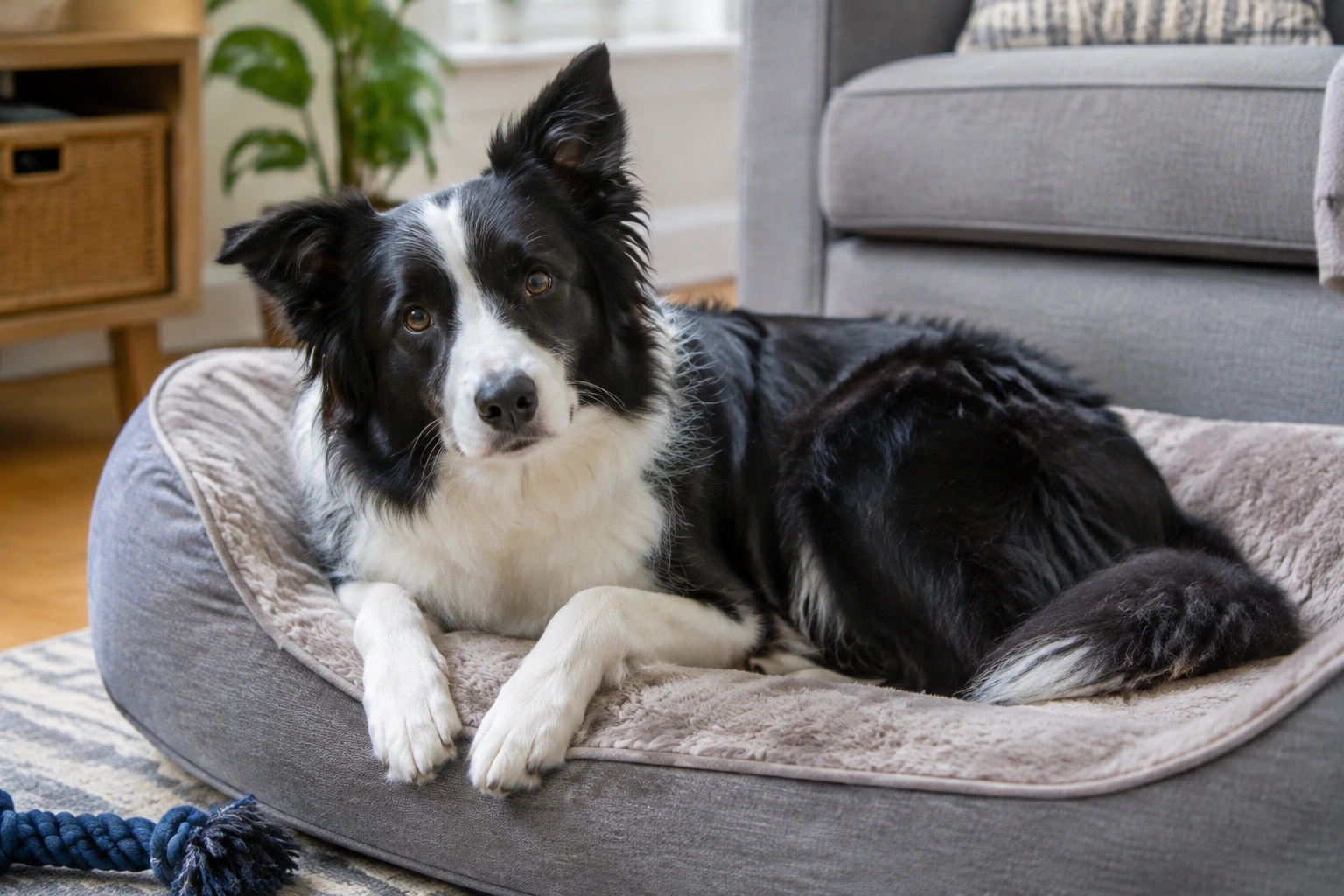
Normal youthful energy often looks like:
- zoomies after rest or excitement
- brief bursts of wild play
- jumping when greetings are highly stimulating
- difficulty settling after an active day
- improved calmness after sleep, routine, and training
More concerning behavior can look like:
- constant pacing with no recovery
- inability to lie down even when tired
- destructive behavior paired with panic or distress
- frantic barking, whining, or shadowing that does not ease
- sudden changes in energy level or behavior
- repeated restlessness even after exercise and enrichment
The biggest clue is recovery. A normal energetic dog eventually comes down. A dog with a problem often cannot.
Also pay attention to context. A dog that is wild at 6 p.m. because everyone just got home may simply be excited. A dog that is restless all day, every day, and cannot settle even in a quiet room may be showing anxiety, frustration, pain, or another issue.
When to see a veterinarian or certified trainer
This is the point where waiting for age alone is the wrong plan.
See a veterinarian if your dog:
– suddenly becomes restless after previously being calm
– pants, paces, or whines without an obvious reason
– seems unable to settle even after exercise and rest
– shows changes in appetite, sleep, or bathroom habits
– appears uncomfortable, stiff, or sensitive to touch
See a certified trainer or behavior professional if your dog:
– never learned how to relax indoors
– becomes overstimulated very easily
– turns every interaction into frantic behavior
– is stuck in a cycle of barking, jumping, or destructive activity
If the behavior looks compulsive, painful, or anxious, training alone may not solve it. The right next step is to rule out medical causes first and then build a behavior plan.
Does spaying or neutering make dogs calmer?
Sometimes people expect surgery to “take the edge off” a dog. That can happen for some hormone-linked behaviors, but it is not a guaranteed fix for general energy.
Spaying or neutering may help with:
– roaming tied to mating behavior
– some types of marking
– some hormone-driven frustration
It can reduce some hormone-related behaviors, but it usually does not lower a dog’s core energy, drive, or need for exercise and mental stimulation.
That matters for Border Collies. A neutered Border Collie can still be intense, alert, fast, and highly responsive. The dog may be easier in some situations, but the core drive often remains.
If you are thinking about timing, it is worth reading a practical guide like Can Dogs Be Neutered at Any Age? so you can weigh the decision with your vet instead of assuming it will solve behavior problems.
Practical ways to help a dog learn to settle
If your dog is old enough to be calmer but still acts wired, build calmness on purpose.
1. Protect sleep
Overtired dogs often look hyper, not sleepy. Make sure your dog has actual downtime, not just periods of being physically indoors.
2. Reward stillness
Catch the dog lying down, relaxing on a bed, or choosing to disengage. Calm behavior gets stronger when it pays.
3. Use structured routines
Dogs settle faster when the day is predictable. Meals, potty breaks, training, and rest should follow a rhythm.
4. Mix exercise with downshifting
Do not end every activity at full speed. After play or training, build in a quiet period so the dog learns how to come back down.
5. Give the brain a job
Use sniffing, short training games, and food puzzles. A dog that uses its brain well is often easier to settle than one that only burns off energy physically.
6. Keep sessions short
Long training sessions can backfire in excitable dogs. Short, successful repetitions are usually more useful than a long battle.
These steps do not change breed traits. They change habits. That distinction matters. A Border Collie may always be keen, but it can still learn to be manageable.
Border Collie-specific expectations and decision rules
If you own a Border Collie, use this as your reality check:
Probably normal
- still very active at 8 to 18 months
- quick to alert, chase, herd, or fixate
- needs more than a standard walk to feel satisfied
- improves when training is structured and consistent
Probably under-stimulated
- restless after every routine day
- invents jobs like shadowing, barking, or pacing
- gets worse when the household is less structured
- seems bored rather than just energetic
Possibly something deeper
- cannot settle even with exercise, training, and rest
- behavior has changed suddenly
- pacing, whining, or destructive behavior looks anxious or compulsive
- the dog seems uncomfortable or unable to relax physically
A Border Collie that is still intense at 2 years old is not automatically abnormal. A Border Collie that cannot switch off at all is telling you something important.
The decision rule I use is simple: if the dog is getting older, getting better, and recovering more quickly after stimulation, you are probably on the right track. If the dog is getting older but not gaining any self-control, look harder at training, routine, and health.
Bottom line
Dogs do not calm down on one fixed schedule. Most start to become easier somewhere between 1 and 3 years old, and many are noticeably steadier by around 3 years, but breed, size, maturity, training, and daily management all shape the timeline.
For Border Collies, patience matters, but so does structure. These dogs usually do not “grow out of” high energy on their own. They learn calmness through repetition, rest, and clear expectations.
If your dog is still wild, the first question is not “Why isn’t my dog calm yet?” It is “Is this age-appropriate, or is my dog missing the support needed to settle?”