
Why Is My Dog Walking in Circles? What Border Collie Owners Need to Know

If your dog keeps walking in circles, the first job is not to guess — it is to separate a normal settling habit from a sign of pain, balance trouble, or a neurological problem. Dogs do circle for harmless reasons sometimes. They also circle when something is wrong.
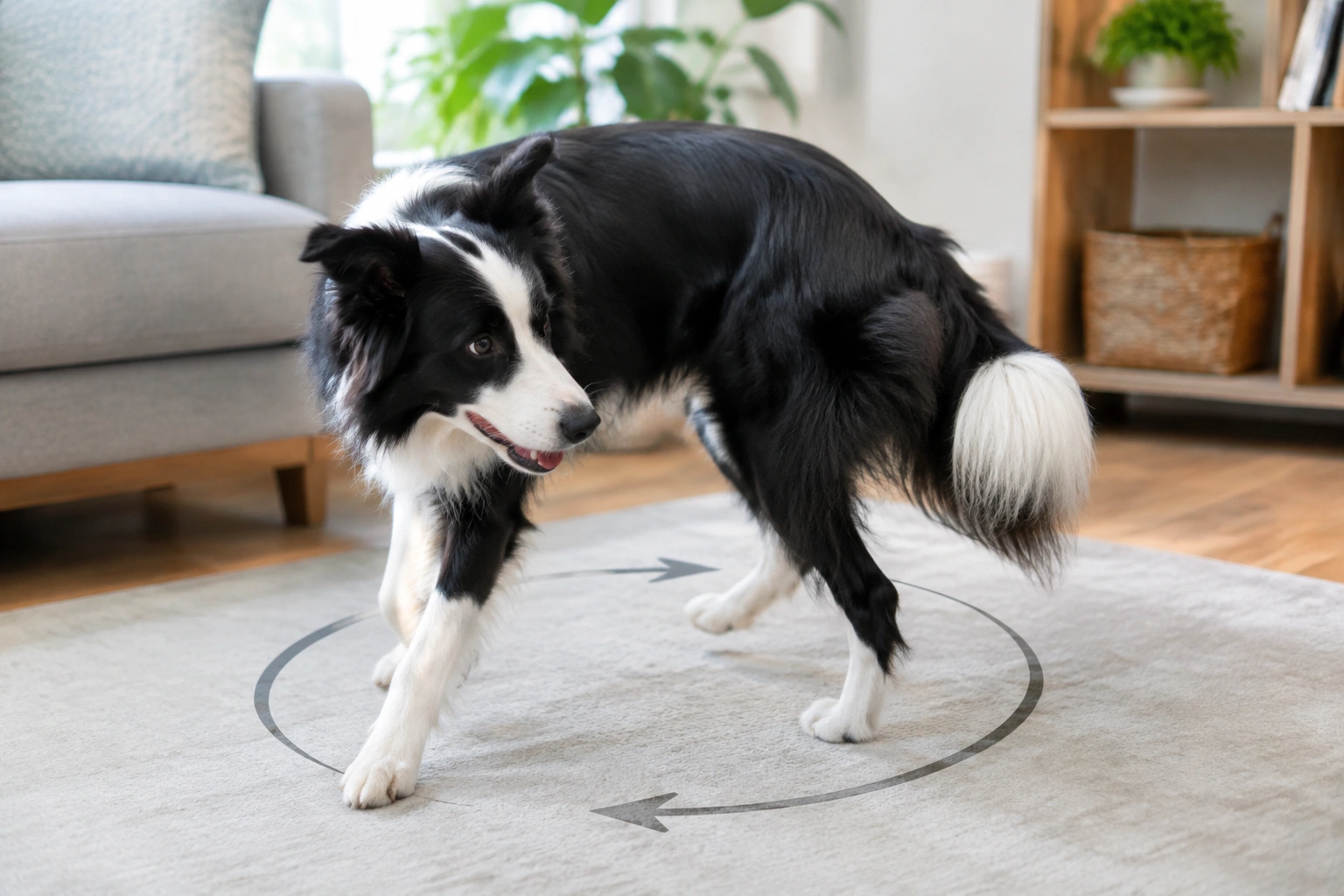
Border Collies can make this harder to read because they are intense, pattern-driven dogs. A Border Collie that spins before play, circles in anticipation, or paces when overstimulated may look “weird” but still be fine. A Border Collie that suddenly starts circling, leans to one side, seems confused, or cannot walk straight is a different situation.
The practical question is simple: is the circling brief and context-based, or repetitive and hard to interrupt? That answer shapes what you do next.
What normal circling looks like in dogs
A little circling before lying down can be normal. Many dogs do it as part of settling: they make a few turns, adjust their position, and then lie down. In that case, the behavior is brief, purposeful, and ends quickly.
Normal circling usually has these features:
- It happens right before resting or sleeping.
- It lasts only a few turns, not long looping sessions.
- The dog can stop easily if you call them or redirect them.
- The dog otherwise moves normally and seems comfortable.
A practical threshold: if the dog circles briefly, settles, and does not repeat the pattern over and over, that is usually closer to normal. If the circling keeps going, happens throughout the day, or looks hard to interrupt, it is more likely to be a problem.
That kind of circling is different from a dog that wanders in tight loops, repeats the pattern over and over, or seems unable to settle.
Some dogs also circle when they are excited or eager, such as before mealtime, a walk, or play. That tends to be obvious from the context. The dog is alert, responsive, and otherwise coordinated.
For a Border Collie, brief circling before a nap or a burst of excited spinning before an activity can be part of the package. What matters is whether it is predictable, short-lived, and not accompanied by other symptoms.
When circling is a red flag
Use this rule: sudden circling, repeated circling, or circling with other abnormal signs deserves veterinary attention. If the dog also seems disoriented, wobbly, painful, or unable to walk straight, do not wait and see for long.
Quick red-flag checklist
| Situation | What it may mean | What to do |
|---|---|---|
| Brief circling before lying down, then normal rest | Often normal settling behavior | Monitor |
| Circling only with excitement or anticipation, dog otherwise coordinated | Often behavioral | Monitor and manage arousal |
| Repeated circling, but dog is alert and stable | Could be pain, anxiety, ear disease, vision issues, or another medical problem | Call the vet promptly |
| Circling with head tilt, wobbling, vomiting, weakness, confusion, or eye flicking | Could be vestibular or neurological disease | Prompt veterinary attention; same-day if possible |
| Sudden circling with collapse, seizure, severe disorientation, or inability to stand | Emergency-level concern | Seek emergency care now |
Signs that make circling more concerning
Call a veterinarian promptly, or seek urgent care if you see circling along with:
- head tilt
- stumbling or loss of balance
- vomiting
- obvious confusion
- weakness
- inability to walk in a straight line
- eye flicking or rapid eye movements
- pain or reluctance to move
Seek emergency care right away if the circling is paired with collapse, a seizure, severe disorientation, or the inability to stand or walk safely.
One-sided circling is especially important to note. A dog that repeatedly turns the same direction, bumps into things, or seems “pulled” into a loop may have a medical issue that needs an exam.
If the circling starts suddenly, assume it is medical until proven otherwise. Habits usually build gradually. Sudden change is what raises the stakes.
Medical causes of repetitive circling
When circling is not just a settling ritual, the cause is often physical. The challenge is that the circling itself is only the symptom. The real problem may be in the ears, balance system, brain, joints, spine, or vision.
Vestibular disease and balance problems
Vestibular disease affects balance. Dogs may circle, lean, fall, or appear drunk because their sense of orientation is off. Head tilt and nausea often travel with it.
A dog with vestibular signs may seem unable to place its feet correctly or may veer strongly in one direction. That is not the same as a dog choosing to circle because it is excited. It looks clumsy, not deliberate.
Ear disease
Ear infections and other ear problems can also affect balance and make a dog circle. If you see circling plus head shaking, scratching at one ear, odor, discharge, or pain when the ear is touched, the ear deserves attention.
This is one of the reasons I do not like owners to dismiss circling as “just a quirk” when the dog also seems uncomfortable. Ear pain can be easy to miss until the dog starts acting off-balance.
Pain and discomfort
Pain can change the way a dog moves and rests. A dog with arthritis, a spinal problem, hip pain, or another injury may circle because lowering itself is uncomfortable. The dog may try several positions before lying down.
That pattern often looks different from neurological circling. The painful dog may move slowly, hesitate to sit or lie down, or stiffen after getting up. Circling here is usually part of a broader picture of discomfort.
Seizures and brain-related problems
Some dogs circle because of a neurological issue involving the brain. In general veterinary guidance, circling can show up in a few different ways: as a warning sign before a seizure, as part of a focal seizure, or as an abnormal behavior after a seizure. Sudden circling can also be a sign that something is wrong in the nervous system, especially if the dog seems mentally “off.”
Brain inflammation is one possible cause, but that discussion is best kept general unless a specific source is being cited. In some dogs, circling may also occur with hydrocephalus or other brain disorders.
The practical point is not to diagnose the exact brain problem at home. It is to recognize that sudden circling with other neurological signs needs a proper exam.
Canine cognitive dysfunction in senior dogs
Older dogs may circle because of cognitive decline. They can seem confused, restless, or stuck in repetitive patterns, especially at night. Some also pace or walk in loops as part of a broader “sundowning” type of pattern.
If your senior dog is circling and also appears lost in familiar spaces, gets stuck in corners, or seems less aware of where they are, cognitive decline becomes more plausible. That does not rule out pain or neurological disease, though. Older dogs can have more than one problem at once.
Vision loss
Blind dogs may walk in circular paths because they are unsure where to go or because they are relying on familiar routes. They may also circle in open spaces that feel safe and known.
That said, not every blind dog circles. Some simply seem lost, hesitant, or stuck. If vision loss is part of the picture, the dog may also bump into objects or hesitate in new places.
Behavioral causes: anxiety, boredom, and compulsive patterns
Not every circling dog is sick. Some dogs circle because they are aroused, anxious, under-stimulated, or stuck in a repetitive habit.
This is more likely when:
- the circling happens in a specific context, like before meals or when a person returns home
- the dog is otherwise coordinated and responsive
- the behavior comes and goes rather than appearing suddenly and continuously
- there are no balance, pain, or neurological signs
A Border Collie is a breed where this section matters more than many owners expect. These dogs are built to notice movement, anticipate patterns, and stay mentally engaged. If they do not get enough useful work, they can invent their own jobs. Repetitive circling may become one of them.
Anxiety and stress
Anxious dogs often show repetitive movement. Circling can be part of that package, especially when the dog is waiting, frustrated, or uncertain. You may also see pacing, whining, scanning, or difficulty settling.
The key clue is context. If the dog circles most when left alone, when visitors arrive, or when the environment is busy, anxiety rises on the list.
Boredom and under-stimulation
A Border Collie with too little to do may create motion patterns to relieve pressure. Circling alone does not prove boredom, but boredom often comes with a broader picture: chasing shadows, fixating on movement, barking at nothing, or struggling to relax.
That matters because the fix is not “more exercise” in a blunt sense. Too much arousal can make the problem worse. The goal is useful mental work, not just more adrenaline.
Compulsive behavior
If circling becomes frequent, difficult to interrupt, and disconnected from a clear trigger, it may be drifting into compulsive behavior. That is not something to punish. It is a sign the dog’s nervous system has learned a loop.
Compulsive patterns often need both medical screening and behavior planning. I would not label a dog “compulsive” until medical causes have been considered first.
Why Border Collies may circle more often
Border Collies are not automatically abnormal if they circle more than other breeds. Their herding heritage matters.
These dogs are highly responsive to movement and pattern. They often work in tight, controlled arcs. That can spill into everyday life as spinning, looping, or pacing when aroused. A young Border Collie waiting for a ball throw may whirl in place. Another may circle the room before the leash comes out. Some may get “stuck on” movement, such as repeatedly tracking a toy, shadow, or person and then spiraling into repetitive pacing or circling.
The trade-off is this: what looks like “just Border Collie energy” can mask a real medical problem. Because the breed is so reactive and intense, owners sometimes normalize a change that should have been checked.
A helpful rule is to compare the dog to their own baseline. If the circling is new, stronger, more frequent, or harder to stop than usual, treat it seriously even if the breed has a tendency to be busy.
How age changes the likely cause
Age changes the odds.
| Age group | More likely causes | What stands out |
|---|---|---|
| Puppies | Excitement, play, settling behavior, immature impulse control | Brief, context-based circling is common; poor coordination or persistent tight looping is not |
| Adults | Anxiety, boredom, pain, ear disease, vestibular issues, sudden medical change | New circling in an adult is less likely to be a harmless phase |
| Seniors | Cognitive dysfunction, vision loss, vestibular disease, arthritis, other pain | Confusion, stiffness, unsteadiness, or nighttime restlessness raise concern |
Puppies
Puppies may circle during play, excitement, or when they are trying to settle. Their impulse control is still immature, so brief spinning or looping is not unusual. But a puppy that repeatedly circles in a tight pattern, seems unable to focus, or shows poor coordination still needs attention.
Adult dogs
In adults, I think first about context. Is the dog excited, anxious, or under-stimulated? Or did the behavior appear suddenly? New circling in an adult dog deserves a closer look because it is less likely to be “just a phase” than owners hope.
Senior dogs
In older dogs, I become more alert for pain, vision loss, vestibular disease, and cognitive decline. Senior dogs are less likely to start a brand-new repetitive habit without a reason. If an older dog is circling and seems confused, stiff, or unsteady, do not delay.
What to do at home before the vet visit
If the dog is stable and not showing emergency signs, gather useful information before the appointment. That helps the veterinarian sort out behavior from medical causes faster.
Record a short video
A clear video is one of the best tools you have. Film the circling from a safe distance and capture the dog’s whole body if possible. Do not chase the dog around or put yourself in danger to get the shot.
Write down the pattern
Note:
- when it happens
- how long it lasts
- whether it turns the same direction
- what happens right before it starts
- whether the dog can be interrupted
- any other symptoms, even small ones
A dog that circles only before meals is a different case from a dog that circles randomly in the yard and bumps a wall.
Keep the dog safe
If balance seems off, block stairs, prevent access to roads, and reduce jumping. A dog that is dizzy or disoriented can hurt itself quickly.
If the dog seems painful, keep activity calm and predictable. The goal is not to “test” the behavior repeatedly. The goal is to prevent injury while you collect useful information.
What a veterinarian may check or test
A veterinarian will usually start with a physical exam and a neurological or orthopedic assessment depending on the signs. They may look at the ears, eyes, gait, posture, and pain response.
Depending on what they find, the vet may recommend:
- an ear exam
- bloodwork
- imaging
- a neurological workup
- eye evaluation
- pain assessment
- further testing if cognitive decline, vestibular disease, or another condition is suspected
The exact workup depends on whether the dog looks more painful, more dizzy, more confused, or more neurologically abnormal. In many cases, the first visit starts with a general exam plus a targeted ear, orthopedic, and neurological check; if those findings point toward a nervous-system problem, the vet may then discuss whether a more advanced neurological workup makes sense.
For a routine wellness-style issue, the exam may be straightforward. For sudden circling with imbalance or confusion, the vet may move quickly toward a more advanced evaluation.
If you want a broader primer on abnormal spinning behavior, I also cover related patterns in Why Does a Dog Spin in Circles?
How to reduce circling safely
How you respond depends on the cause. That is why the first step is not random fixes. It is matching the response to the pattern.
If the circling looks behavioral
Reduce the triggers that ramp the dog up. For a Border Collie, that often means making arousal more predictable, not simply adding more stimulation. Give the dog a job that uses the brain without pushing excitement too high: searching for food, structured training, scent games, or calm pattern work.
Concrete examples that often help without overstimulating the dog include:
- scatter-feeding kibble in grass or on a snuffle mat
- short nose-work searches for a favorite toy or treat
- simple obedience reps with a calm release word
- “find it” games with a few pieces of food instead of a high-energy fetch session
- settle training on a mat after activity
If the dog circles when waiting for something, build a steadier routine. Short, clear cues and predictable reinforcement often help more than chaotic excitement. For Border Collies especially, it can help to alternate mental work with true decompression, such as quiet sniffing walks or calm mat time, rather than stacking high-arousal games back to back.
If pain seems likely
Do not try to “exercise through it.” A painful dog may circle because movement itself is uncomfortable. The right response is a veterinary exam, then a pain plan if the vet confirms one.
If balance or neurological signs are present
Safety comes first. Keep the dog confined to a low-risk area and get veterinary guidance quickly. Do not assume the dog is merely anxious if the body language says otherwise.
For owners who want to understand the broader difference between normal spinning and concerning repetitive movement, the AKC’s guidance on dog behavior is a useful general reference point, though it does not replace a vet exam.
When to see a veterinarian or certified trainer
See a veterinarian promptly if the circling is new, getting worse, or accompanied by pain, head tilt, vomiting, wobbling, confusion, or weakness.
See a veterinarian urgently if your dog cannot walk straight, collapses, has a seizure, or seems severely disoriented.
See a certified trainer only after medical causes are reasonably ruled out if the circling appears behavioral, context-based, and the dog is otherwise healthy. A trainer can help with arousal, routines, and compulsive patterns, but they should not be the first stop when the body language suggests illness.
If you are unsure, err on the side of the vet visit. A calm Border Collie that occasionally circles before lying down is one thing. A dog that suddenly starts looping, leaning, and acting lost is another.
For general guidance on when balance problems or ear issues need medical attention, VCA Hospitals is a solid veterinary resource.
FAQ
Is it normal for a dog to walk in circles before lying down?
Yes, brief circling before lying down can be normal. It usually looks purposeful, lasts only a few turns, and ends with the dog settling comfortably.
Why does my Border Collie circle more than other dogs?
Border Collies are intense, movement-sensitive, and pattern-driven. Some circle from excitement, anticipation, or arousal. That said, a new or worsening pattern still deserves a vet check.
What if my dog circles only one direction?
Repeated one-direction circling can be more concerning, especially if it is sudden or paired with imbalance, head tilt, or confusion. It does not prove a diagnosis, but it is worth reporting to a veterinarian.
Can ear infections make a dog walk in circles?
Yes. Ear problems can affect balance and make a dog seem off-center, tilted, or dizzy. Ear odor, discharge, scratching, and head shaking are useful clues.
Should I wait and see if the circling goes away?
Only if the circling is brief, familiar, and the dog otherwise seems normal. If the behavior started suddenly, is repetitive, or comes with other symptoms, do not wait long.
What should I bring to the vet?
Bring a video, a written timeline, and notes about triggers, direction of circling, appetite, balance, vomiting, head tilt, and any pain signs. That information often speeds up the exam.
Can anxiety cause a dog to circle?
Yes. Anxiety, boredom, and compulsive patterns can all lead to repetitive movement. The difference is that behavioral circling usually has a context and the dog remains otherwise coordinated.
A dog that walks in circles is telling you something. Sometimes the message is simple: “I’m excited,” or “I’m settling down.” Sometimes it is not simple at all. Your job is to read the pattern honestly, watch for the red flags, and get the right kind of help before the problem gets bigger.