
Which Dog Vaccines Are Absolutely Necessary for Your Dog?

If you want the short, practical answer: the vaccines most dogs actually need are the core vaccines — rabies, distemper, parvovirus, and adenovirus — with the exact schedule and any add-ons shaped by your dog’s age, location, and exposure risk.
That means there are two separate questions to answer:
- What is medically essential for nearly every dog?
- What becomes necessary because of where your dog goes and what your dog is exposed to?
For Border Collie owners, that distinction matters. A Border Collie living mostly indoors in the suburbs may need a different risk-based plan than a Collie that hikes, swims, visits dog parks, or spends time around wildlife, ticks, and standing water. The breed itself usually does not change the core vaccine list. Lifestyle does.
A useful rule of thumb: core vaccines are the baseline; non-core vaccines are added when the risk justifies them. That’s the cleanest way to think about it, and it keeps you from either over-vaccinating blindly or skipping protection that actually matters.
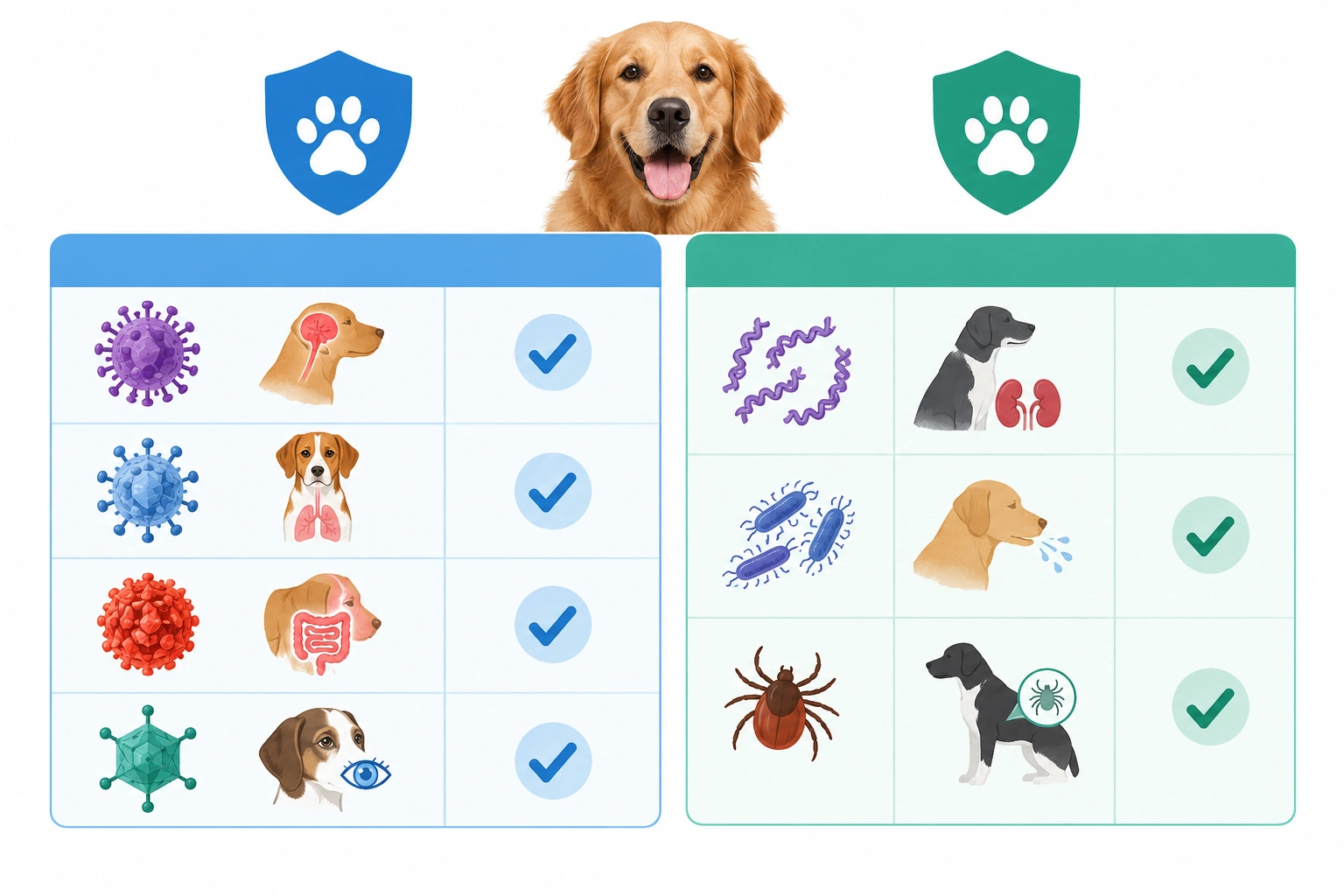
Core vs Non-Core Vaccines: The Decision Framework
Veterinary vaccine guidance generally divides dog vaccines into two groups:
- Core vaccines: recommended for essentially all dogs
- Non-core vaccines: recommended only when a dog’s exposure risk makes them worthwhile
That split exists for a reason. Core vaccines protect against diseases that are severe, widespread, highly contagious, or a public-health concern. Non-core vaccines protect against infections that are more location-dependent, lifestyle-dependent, or exposure-dependent.
A practical way to decide is to ask three questions:
- How serious is the disease?
- How likely is my dog to encounter it?
- Would this vaccine help in my dog’s real environment?
That framework is why a kennel dog and a couch dog may not need the same extras, even though both still need the core series.
The AAHA canine vaccination guidelines are a good reference point here because they emphasize that lifestyle-based vaccines may be just as important as core vaccines for some dogs. In other words, “optional” does not mean “unimportant.” It means “risk-based.”
The Core Dog Vaccines: What’s Usually Considered Essential
Here’s the simplest way to think about the vaccines that matter most.
| Vaccine | What it protects against | Usually needed for | Core or non-core? |
|---|---|---|---|
| Rabies | Rabies virus, a fatal disease that can spread to humans | Nearly all dogs; often required by law | Core |
| Distemper | Canine distemper virus | Nearly all dogs | Core |
| Parvovirus | Canine parvovirus, a serious and highly contagious GI disease | Nearly all dogs | Core |
| Adenovirus | Canine adenovirus, associated with infectious canine hepatitis | Nearly all dogs | Core |
The ASPCA lists canine parvovirus, distemper, canine hepatitis, and rabies as core vaccines for dogs, and that lines up with standard veterinary guidance. For a straightforward owner-facing summary, that’s the best place to begin: these are the vaccines you should treat as the foundation, not the extras.
Rabies: the one vaccine you cannot ignore
Rabies is the vaccine most people recognize first, and for good reason. It is a deadly disease, and rabies vaccination is required by law in many jurisdictions. The exact legal rule depends on where you live, so your veterinarian and local licensing office matter here.
Even when a state or county rule is the legal reason to vaccinate, the medical reason is still strong. Rabies is not a “maybe later” vaccine. If your dog is bitten, escapes, or has any contact with wildlife, being current on rabies can save you enormous trouble and, more importantly, protect public health.
Distemper, parvovirus, and adenovirus: the true core disease-prevention layer
These three are grouped together so often because they protect against diseases that can be devastating, especially in puppies and unprotected dogs.
- Distemper can affect the respiratory, gastrointestinal, and nervous systems.
- Parvovirus can cause severe vomiting, diarrhea, dehydration, and life-threatening illness.
- Adenovirus is tied to infectious canine hepatitis and is part of the standard vaccine foundation.
The DHPP combination vaccine is commonly used to cover distemper, hepatitis/adenovirus, parvovirus, and parainfluenza. In many clinics, this is the practical way core protection is delivered, especially in puppies.
If you want the minimum essential protection most dogs should have, this is it: rabies plus the distemper/parvovirus/adenovirus core series.
Puppy Vaccine Schedule: What Happens by Age
Puppies do not get full protection from one shot. That’s the mistake many new owners make.
Young puppies still carry maternal antibodies for a while, and those antibodies can interfere with early vaccines. The result is a protection gap: the puppy may look “started” on vaccines but still not be reliably protected yet. That’s why puppies need a series, not a single appointment.
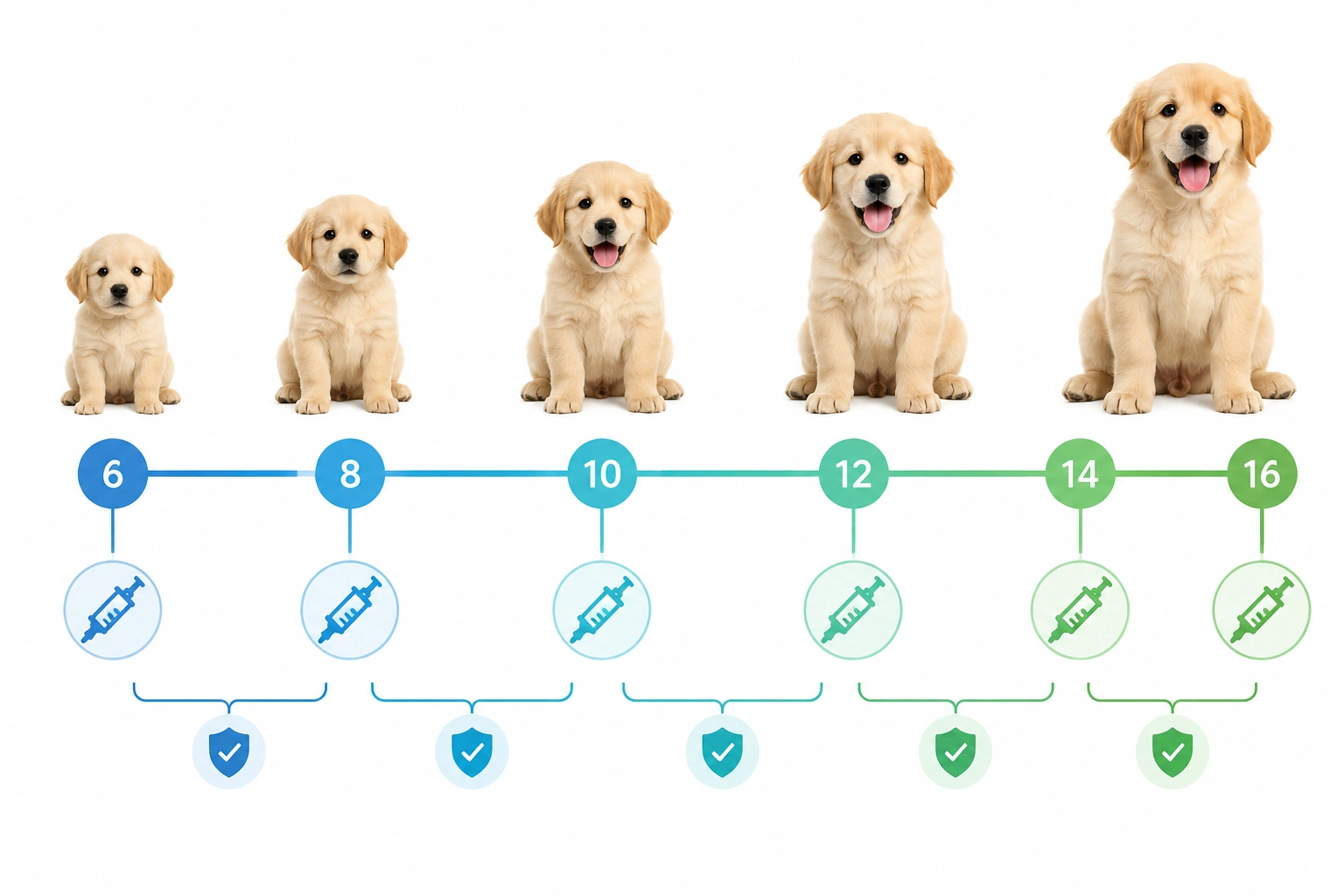
A common schedule looks like this:
- 6–8 weeks: first core puppy vaccines begin
- 10–12 weeks: next booster in the core series
- 14–16 weeks: final puppy booster in the core series
- After the puppy series: your vet schedules the next booster timing based on the vaccine used and local protocol
Optional add-ons are often discussed during the same window, but they depend on risk:
– Bordetella: often considered for puppies that will board, attend daycare, or join group classes
– Leptospirosis: often considered when exposure to wildlife, standing water, or rural areas is likely
– Lyme: often considered in tick-prone regions
The exact schedule can vary by veterinarian, product, and local risk, so the age ranges above are a common guide rather than a one-size-fits-all rule.
A simple decision rule:
– If your puppy is under 16 weeks, assume the vaccine series is still in progress.
– If your puppy missed a dose, don’t restart on your own — ask your vet how to catch up.
Adult Dogs: Booster Timing and When Protection Lapses
Adult dogs still need boosters. Protection is not permanent, and the timing depends on the vaccine and the dog’s history.
If your dog’s records are complete, your vet may use a schedule with boosters spaced farther apart for some core vaccines. If the history is unknown — common in rescues, rehomed dogs, or dogs that missed care — your veterinarian may recommend restarting or repeating parts of the series.
That’s not overkill. It’s risk management.
Here’s the practical version:
- Known, up-to-date adult dog: follow the booster schedule your vet recommends
- Overdue dog: expect a catch-up plan
- Unknown history dog: your vet may treat the dog as incompletely vaccinated until proven otherwise
This matters most for boarding, daycare, grooming, and travel. Facilities often care about documentation as much as medical status. A dog may be “probably covered” but still be turned away without paperwork.
Risk-Based Vaccines: Which Ones Depend on Lifestyle and Location
This is where many owners get confused. A vaccine can be useful without being universal.
The best way to decide is to match your dog’s real exposure pattern to the disease risk in your area.
Leptospirosis
Leptospirosis is a bacterial disease dogs can pick up from contaminated water, soil, or wildlife exposure. The AAHA says the leptospirosis vaccine warrants strong consideration, which is a clue that this is not a fringe add-on. For many dogs, especially those around standing water, rural areas, rodents, or wildlife, it’s worth serious discussion.
How to decide: if your dog hikes near creeks, drinks from puddles, swims in natural water, lives near wildlife, or spends time on farms or in wooded areas, leptospirosis moves up the list.
Bordetella
Bordetella is commonly associated with kennel cough. It is not a core vaccine, but it often becomes relevant for dogs that go to daycare, boarding, group classes, or busy dog parks. The ASPCA notes that Bordetella is a non-core vaccine given depending on exposure risk.
How to decide: if your dog is regularly around unfamiliar dogs, this is one of the first non-core vaccines to ask about.
Lyme disease
Lyme vaccine decisions are usually geography-driven. If you live or travel in a tick-heavy region, and your dog spends time in brush, woods, or tall grass, it becomes more relevant. If your dog rarely encounters ticks, it may not be worth adding.
How to decide: think about tick exposure, not just whether Lyme exists in your state. A dog that spends time in dense vegetation or on rural trails has a different risk profile than a mostly indoor dog.
Canine influenza and other region-specific options
Some dogs may need additional vaccines based on local outbreaks, shelter exposure, or travel plans. This is where your veterinarian’s local knowledge matters. A dog in one county may need a very different plan from a dog in another.
Local disease prevalence and regional recommendations can change what “essential” means in practice, so a good vaccine plan should always be grounded in where your dog actually lives and travels.
Border Collie Owners: What Matters and What Usually Doesn’t
Border Collies are not a special vaccine breed. There is no separate “Border Collie shot list.”
What does matter is how Border Collies are commonly lived with:
- high activity
- hiking and running
- outdoor training
- farm or rural exposure
- water contact
- strong curiosity around wildlife and livestock areas
That lifestyle can increase the value of non-core vaccines like leptospirosis or Lyme, especially if your dog spends time in tick country or around contaminated water.
What usually does not matter is the breed label itself. A Border Collie in a suburban apartment and a Border Collie working on acreage may have very different risk profiles, even though they are the same breed.
If your dog is mostly indoors but still social, the core vaccines remain the priority. If your dog is outdoors a lot, the extras become more worth discussing.
What’s Required by Law, Boarding, Daycare, Groomers, or Travel
Medical necessity and facility rules are not the same thing.
A vaccine may be:
– medically core
– legally required
– required by a boarding facility
– recommended but not required
– not needed for your dog’s lifestyle
Rabies is the clearest example of a legal requirement in many places. Boarding or daycare often require proof of rabies, DHPP, and sometimes Bordetella, even if Bordetella is not a core vaccine. Some groomers also ask for proof of rabies and may request DHPP or Bordetella depending on their policy. Travel rules can vary by destination, but rabies documentation is commonly part of the process.
That means you can’t plan only around what seems medically ideal. You also need to plan around the places your dog actually goes.
One practical tip: keep a digital copy of your dog’s vaccine records. If you board, travel, or use daycare even occasionally, that saves time and prevents last-minute problems.
How to Build the Right Plan With Your Veterinarian
Bring your vet a simple checklist, not a vague request for “whatever is standard.”
Tell them:
- your dog’s age
- whether your dog is a puppy or adult
- whether vaccine history is known or unknown
- where your dog lives
- where your dog goes
- whether your dog boards, attends daycare, or joins group classes
- whether your dog hikes, swims, or goes into rural or tick-prone areas
- whether your dog has had any prior vaccine reactions
That gives your vet the information needed to separate core protection from risk-based add-ons.
If your dog has a history of health issues or previous vaccine reactions, don’t guess. Ask for a tailored plan. The goal is not the most shots possible. The goal is the right protection at the right time.
Common Mistakes Dog Owners Make When Choosing Vaccines
A few errors come up again and again:
1. Thinking one puppy shot is enough
It isn’t. Puppies need a series because early immunity is incomplete.
2. Confusing “optional” with “unnecessary”
Bordetella, leptospirosis, and Lyme may be optional on paper, but they can be very sensible for the right dog.
3. Skipping boosters because the dog seems healthy
Health is not the same as immunity. Adult dogs still need booster planning.
4. Ignoring local risk
A dog in a tick-heavy region does not have the same vaccine needs as a dog in a low-exposure urban apartment.
5. Mixing up legal rules and medical rules
A vaccine can be legally required, facility-required, or medically recommended. Those are related, but not identical.
For a broader look at how Border Collie care decisions often hinge on lifestyle rather than breed alone, you may also find our guide to kibble vs fresh food for Border Collies useful when you’re building a complete care plan around your dog’s routine.
When to See a Veterinarian or Certified Trainer
See a veterinarian promptly if:
- your puppy has missed part of the vaccine series
- your adult dog’s vaccine history is unknown
- your dog is due for boarding, daycare, or travel paperwork
- you live in a region with high tick, wildlife, or standing-water exposure
- your dog has had a prior vaccine reaction
- your dog has an ongoing medical condition that may affect vaccine timing
A certified trainer won’t choose vaccines for you, but a good trainer can help reduce exposure risk by managing the situations where your dog is most likely to encounter disease — for example, crowded dog spaces, poor leash control near unknown dogs, or high-risk outdoor environments.
Bottom Line: Which Dog Vaccines Are Absolutely Necessary?
If you want the shortest honest answer, here it is:
The core vaccines — rabies, distemper, parvovirus, and adenovirus — are the ones most dogs should have.
After that, leptospirosis, Bordetella, Lyme, and similar vaccines are situation-dependent and should be chosen based on your dog’s lifestyle, location, and exposure risk.
For most Border Collie owners, the decision is not about breed. It’s about core protection first, then smart add-ons where the risk is real. If you’re unsure, start with your dog’s age, your local disease risk, and whether your daily routine includes boarding, daycare, travel, tick exposure, wildlife, or water contact — then build the plan with your veterinarian.
FAQ
Are any dog vaccines commonly required by boarding or daycare?
Yes. Many boarding and daycare facilities commonly ask for proof of rabies and DHPP, and some also require Bordetella. Policies vary, so it’s smart to check before you book.
Do groomers require vaccines?
Some do. Groomers often ask for proof of rabies, and some may also request DHPP or Bordetella depending on their house rules.
Do Border Collies need different vaccines than other dogs?
Not because of the breed alone. Border Collies often have active, outdoor lifestyles, so their exposure risk may be higher, but the core vaccine list is the same.
When do puppies usually get their vaccines?
A common puppy series starts around 6–8 weeks, continues with boosters every 3–4 weeks, and is often completed around 16 weeks. Your vet may adjust the timing based on the product and your puppy’s risk.
How do I know if my dog needs non-core vaccines?
Look at your dog’s location, travel, boarding/daycare use, tick exposure, wildlife exposure, and water exposure. Those factors often point to vaccines like Bordetella, leptospirosis, or Lyme.