
Why Your Dog Keeps Biting His Tail: Causes, Checks, and What to Do Next

If your dog keeps biting his tail, treat it as a clue, not a quirk. Sometimes the reason is simple, like fleas or irritated skin. Sometimes it is pain, and sometimes it is a repetitive habit that started with a physical problem and then stuck around.
The practical challenge is that tail biting looks similar from the outside even when the cause is very different. A dog with an itchy tail, a painful tail, an anal gland issue, or an anxious habit can all look like they are “just chewing.” That is why the first job is to sort the behavior into one of three buckets: itch, pain, or stress-driven repetition.
For Border Collie owners, that distinction matters even more. High-drive dogs can turn small discomforts into big routines, and they can also develop repetitive behaviors when under-stimulated. But do not assume this is “just a Border Collie thing.” Medical causes should be checked first.
Normal tail attention vs. a problem
A dog may briefly lick, sniff, or groom the tail and then move on. That is not the same as repeated biting, chasing, or chewing at one spot.
The pattern that raises concern is focused, repeated attention to the tail, especially if your dog:
- keeps returning to the same area
- bites hard enough to leave redness or broken skin
- reacts when the tail is touched
- does it more than once a day
- seems unable to settle afterward
A useful rule: brief, casual attention is usually a grooming behavior; repetitive, intense, or damaging attention is a problem until proven otherwise.
Tail biting vs. tail chasing or spinning
Tail biting is usually directed at a specific area of the tail, tail base, or hind end. The dog is often trying to chew, scratch, or relieve discomfort.
Tail chasing or spinning is different. In that behavior, the dog turns in circles or snaps at the moving tail itself, often in a more ritual-like or play-like pattern. Some dogs do both, but they are not the same problem.
A quick way to tell them apart:
- Tail biting: focused chewing or licking at one spot, often with skin irritation or pain
- Tail chasing/spinning: circling, grabbing at the tail in motion, or repetitive turning that looks more compulsive or playful
That distinction matters because tail chasing may point more toward a compulsive or frustration-based pattern, while tail biting more often starts with itch, pain, or anal-area discomfort.
Medical causes to rule out first
Most owners want to know whether tail biting is “behavioral” or “medical.” In practice, the safest assumption is that a physical trigger could be involved until a vet rules it out.
Fleas, mites, and other parasites
Parasites are a common place to look because they can make the tail base and hind end intensely itchy. Flea allergy can be especially frustrating because even a small number of fleas can trigger a big reaction in sensitive dogs. Some dogs also react to mites or other biting insects.
Check the coat around the tail base and lower back for:
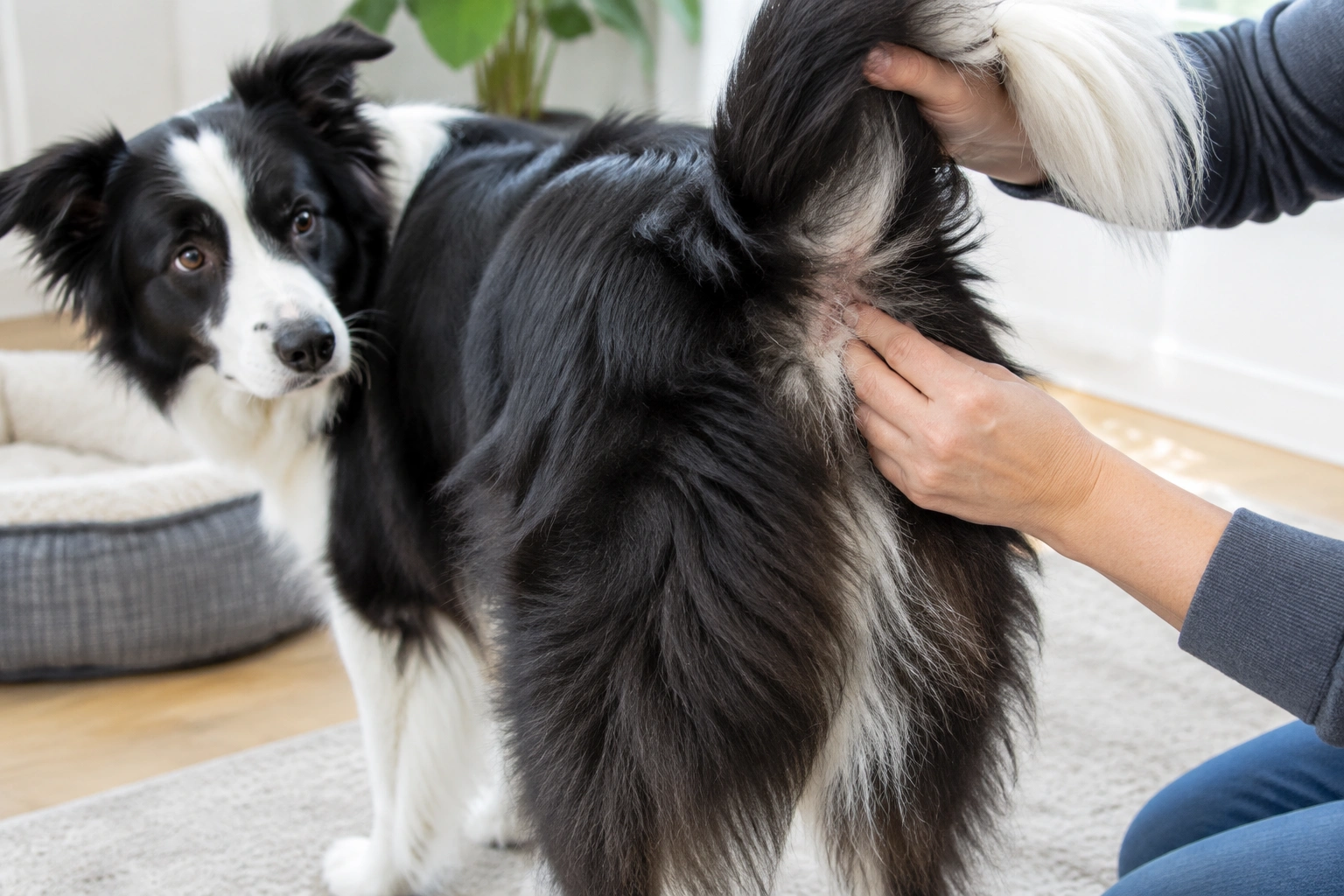
- flea dirt, which looks like black pepper
- live fleas moving through the coat
- scabby skin from scratching or biting
- irritation that seems worse after outdoor time
If you find evidence of parasites, that is not a “wait and see” situation. The dog needs proper parasite control, and the household may need treatment too.
Allergies and skin irritation
Dogs can bite at their tails because the skin is itchy, inflamed, or irritated. That irritation may come from environmental allergies, contact irritation, or sensitivity to grooming products. Some dogs react to shampoos or other topical products, which can leave the skin inflamed and itchy.
Look for:
- redness
- dry or flaky skin
- hair loss
- repeated licking after bathing or grooming
- irritation that comes and goes with seasons or specific exposures
If the tail biting seems to flare after baths, lawn time, or a change in products, that pattern is worth telling your vet.
Hot spots, wounds, and skin infections
A dog that keeps chewing one area can create a hot spot fast. Once the skin is wet, raw, or broken, the cycle often escalates: itch or pain leads to biting, biting damages the skin, damaged skin becomes more inflamed, and the dog bites more.
Clues include:
- a wet or moist patch
- a strong odor
- oozing, crusting, or discharge
- obvious tenderness
- the dog guarding the area
Hot spots and infections are not problems to “watch for a few days” if the skin is already broken. Self-trauma can worsen quickly.
Pain or injury
Pain can make a dog chew at the tail even when the skin itself is not the original problem. A dog may bite at a painful area to try to relieve discomfort. That can happen after an injury, a strain, or trauma to the tail.
A pain pattern often looks different from an itch pattern. The dog may:
- suddenly snap at the tail
- yelp when touched
- guard the tail or rump
- be reluctant to sit, jump, or wag normally
- seem generally irritated or withdrawn
Pain should be taken seriously even if the skin looks normal.
Anal gland problems
Sometimes what looks like tail biting is really a dog reacting to discomfort near the rear end. Anal gland issues can cause irritation, pressure, or pain that makes a dog focus on the tail base or hind end.
Watch for:
- scooting
- licking under the tail
- a foul smell near the rear
- discomfort when sitting
- repeated attention to the base of the tail
If your dog is biting the tail and also scooting or smelling unusually strong, the hind end needs to be checked by a veterinarian.
For a broader look at related body-language and posture clues, you may also find this guide useful: why dogs sleep with their butt toward you.
Behavioral causes: anxiety, boredom, frustration, and compulsive habits
Not every dog biting its tail has a skin problem. Stress, anxiety, boredom, and frustration can all lead to repetitive behaviors, including tail chewing. In some dogs, the behavior starts as a response to discomfort and then becomes a habit that continues even after the original trigger improves.
When stress or anxiety is more likely
Behavioral tail biting often shows up in predictable situations:
- when the dog is left alone
- during changes in routine
- after a noisy or stressful event
- when the dog is under-exercised or under-stimulated
- when attention is hard to get and the dog has learned the behavior gets a reaction
The dog may seem restless, unable to settle, or hyper-alert. The tail biting may stop when the dog is engaged and return when nothing is happening.
How compulsive patterns develop
Compulsive behavior is not the same as a simple bad habit. A dog may begin biting the tail because of itch or pain, then the behavior becomes self-reinforcing. Even after the skin heals, the dog may still return to the motion because it has become a default response.
That is why some cases need both medical workup and behavior intervention. If you only treat the skin and ignore the pattern, the behavior can keep resurfacing.
Border Collie context: why high-drive dogs can be more vulnerable
Border Collies are not the only dogs that tail bite, but their drive and intensity can make the problem more likely to persist once it starts.
A Border Collie that is under-challenged may not simply “get bored.” More often, you will see restlessness, scanning, pacing, fixation, or a repetitive behavior that becomes a self-soothing outlet. Tail biting can fit that pattern, especially if the dog is otherwise physically healthy.
That does not mean the dog needs endless exercise. It means the dog needs the right mix of physical work, mental engagement, and recovery. A tired Border Collie that still has no good outlet for the brain may still develop repetitive behaviors.
A practical example: a Border Collie that bites his tail after being crated for long stretches may need more than a longer walk. He may need structured decompression, problem-solving work, and a better daily rhythm so arousal does not keep building all day.
How to inspect the tail, skin, and hind end safely at home
A careful home check can help you decide how urgent this is, but the goal is to observe, not to dig around or irritate the area.
What to look for
Check the tail base, underside of the tail, skin around the rump, and the area just under the tail.
Look for:
- redness
- swelling
- hair loss
- scabs
- broken skin
- wetness or discharge
- foul odor
- flea dirt or live fleas
- sensitivity when touched
How to do it without making things worse
Keep the session short. Use good light. Part the hair gently with your fingers rather than scratching at the skin. If your dog flinches, growls, or tries to turn and bite, stop.
A calm dog can be examined while standing or lying on a non-slip surface. If your dog is already irritated, do not keep poking the same spot. You are trying to gather enough information to decide the next step, not to prove the dog will tolerate handling.
A simple step-by-step home check
- Start at the tail base. Part the fur with your fingers and look for redness, bumps, crusts, or hair loss.
- Check along the tail. Run your eyes over the top, sides, and underside for broken skin, swelling, or scabs.
- Lift the tail and inspect under it. Look closely at the skin around the anus and the area just beneath the tail for redness, discharge, or swelling.
- Notice any odor. A foul smell can point to infection, anal gland trouble, or irritated skin.
- Check for pain. Watch whether your dog flinches, tenses, sits oddly, scoots, or tries to turn and bite when you touch the area.
- Look for fleas or flea dirt. Use a flea comb if you have one, especially around the tail base and lower back.
- Note when the behavior happens. Write down whether it is tied to bathing, grooming, being alone, exercise, or outdoor time.
One simple decision rule
If the skin looks normal, the dog is not painful, and the behavior happens mainly during stress or inactivity, behavioral causes move higher on the list.
If you see redness, swelling, odor, discharge, or pain, medical causes move to the top.
Itching, pain, or anxiety: how to tell the difference
This comparison can help you narrow the likely cause:
| Clue | More suggestive of itch | More suggestive of pain | More suggestive of anxiety or habit |
|---|---|---|---|
| Skin changes | Redness, flakes, flea dirt, scabs | May look normal or mildly irritated | Often normal unless self-trauma has started |
| Dog’s reaction to touch | Scratching or biting the area repeatedly | Flinching, yelping, guarding | May ignore touch unless interrupted |
| Timing | After outdoor exposure, bathing, or parasite exposure | After injury, jumping, rough play, or sudden onset | When alone, bored, stressed, or under-stimulated |
| Behavior pattern | Focused on one itchy area | Sudden, sharp attention to a painful spot | Repetitive, ritual-like, or hard to interrupt |
| Other signs | Scratching, licking, rubbing | Limping, stiffness, reluctance to sit | Pacing, restlessness, fixation, difficulty settling |
This is not a diagnosis tool, but it helps you describe the problem clearly to your vet.
Red flags that mean the dog needs a vet promptly
Use this simple urgency guide:
Emergency or same-day vet visit
Go the same day if you see:
- bleeding
- swelling
- discharge
- foul odor
- broken skin
- sudden pain or yelping
- guarding the tail or hind end
- rapid worsening over hours or a day
- repeated biting that is clearly causing injury
Prompt vet visit
Book a prompt appointment, ideally within a day or two, if:
- the behavior is persistent but the skin is still intact
- the dog keeps returning to the same spot
- there is mild redness, licking, or irritation
- the dog seems uncomfortable but not severely painful
- the problem is new and happening more than once
Monitor briefly at home
You can watch for a short period if:
- the behavior is brief and rare
- the skin looks normal
- the dog is not painful
- there is no odor, swelling, or discharge
- the dog otherwise seems comfortable
If the pattern continues, moves from occasional to repeated, or starts causing skin damage, stop monitoring and call the vet.
If the dog is making the area worse, the problem is no longer just the original trigger. The self-trauma becomes part of the emergency.
What you can do right now to prevent self-trauma
The immediate goal is to stop the dog from damaging the area while you arrange the next step.
An Elizabethan collar can be useful when the dog will not leave the tail alone. It is not a treatment for the cause, but it can prevent the dog from turning a small irritation into a bigger wound.
Other short-term steps:
- keep the dog from rough play until the tail is assessed
- separate the dog from known triggers if you can, such as stressful visitors, intense play, or a noisy environment
- supervise closely if the dog is targeting one spot
- prevent licking or chewing with direct supervision and a cone if needed
- avoid bathing or grooming the area until the cause is known, unless your vet tells you otherwise
- keep the area clean and dry if the skin is already irritated
There is a trade-off here: a cone is inconvenient, but a small wound can become a much larger infection if the dog keeps chewing it. If the skin is already broken, protecting it is usually the better short-term choice.
What not to do
A few common mistakes make this worse:
- Do not apply human creams or ointments unless your veterinarian says they are safe.
- Do not use human pain relievers.
- Do not flood the area with essential oils or strong topical products.
- Do not assume the behavior will fade on its own if it has already become repetitive.
- Do not focus only on the tail if the real issue may be the skin, hind end, or pain elsewhere.
The risk with home treatment is not just ineffectiveness. Some products can irritate the skin further or mask a problem that needs diagnosis.
Treatment paths based on the cause
The right treatment depends on what is driving the behavior.
If parasites are involved
Your vet may recommend a parasite-control plan and check whether the skin has secondary irritation or infection. If fleas are the trigger, the tail biting may not stop until the parasite problem is fully addressed. Depending on the case, that may mean prescription flea prevention and treatment for any skin damage that has already developed.
If allergies or skin irritation are involved
Treatment may focus on reducing inflammation, identifying triggers, and managing flare-ups. That can include prescription therapy, bathing guidance, or changes in grooming products if those are part of the problem. Your vet may also suggest medicated shampoos or other skin-directed care if the skin is inflamed.
If infection or hot spots are present
The skin may need cleaning, medication, and a barrier to prevent further chewing. The key issue is not just calming the skin; it is stopping the cycle that keeps reopening it. In some cases, the vet may prescribe antibiotics, anti-itch medication, or both, depending on what the skin looks like.
If pain is involved
The vet needs to find the source of the pain rather than simply treating the tail. Tail injuries, hind-end discomfort, and anal gland issues all call for different approaches. Treatment may include pain relief, examination of the tail and rear end, and care for the specific injury or underlying condition.
If anal gland issues are involved
The vet may express the glands if appropriate, check for infection or impaction, and treat any inflammation or abscess. If the dog keeps scooting or biting under the tail, the glands and surrounding tissue need a proper exam rather than guesswork.
If the cause is behavioral
Behavioral treatment usually means more than “give the dog a toy.” It often includes better daily structure, more appropriate enrichment, and a plan to reduce the situations that trigger the behavior. If the pattern is strong or long-standing, a certified trainer or behavior professional can help build that plan.
For general breed guidance on working dogs and training-minded management, the American Kennel Club has useful background on canine behavior and care, and the ASPCA is a solid reference for common dog health and welfare concerns.
How to prevent tail biting from becoming a habit
Prevention is mostly about reducing the trigger and catching the behavior early.
That means:
- keeping up with parasite control
- watching for skin irritation after baths, hikes, or product changes
- treating itching or pain early instead of waiting
- building a daily routine that includes both physical exercise and mental work
- noticing when the dog starts repeating the behavior in low-stimulation settings
For Border Collies, enrichment can help reduce the chance that a dog falls into repetitive self-directed behavior. But enrichment is not a cure-all. If there is itching, pain, or infection, no amount of puzzle toys will fix the root problem.
When to see a veterinarian or certified trainer
See a veterinarian promptly if the tail biting is new, repetitive, worsening, or paired with any skin change, odor, pain, or discharge. Book the visit sooner rather than later if the dog keeps returning to the same spot, even when the skin looks only mildly irritated.
Bring in a certified trainer or behavior professional when:
- the vet has ruled out or treated the medical cause, but the behavior continues
- the tail biting happens in specific stress situations
- the dog seems restless, anxious, or unable to settle
- the behavior looks ritualized or compulsive
That combination matters. Medical care and behavior work are not competing explanations; often they are part of the same solution.
FAQs
Is tail biting ever normal in dogs?
Brief grooming or a quick check of the tail can be normal. Repeated biting, chewing, or chasing is not something to ignore.
Can fleas really cause tail biting?
Yes. Fleas and other parasites can make the tail base and hind end very itchy, and some dogs react strongly even when you do not see many fleas.
What if my dog only bites his tail when bored?
Boredom can contribute, especially in high-drive dogs. But first make sure there is not an itch, injury, or pain problem underneath it.
Should I wait a few days before calling the vet?
Only if the skin looks normal, the dog is not painful, and the behavior is brief and rare. If there is bleeding, odor, swelling, or repeated chewing, do not wait.
Can an Elizabethan collar help?
Yes, if the dog is causing self-trauma. It does not fix the cause, but it can protect the skin while you sort out what is driving the behavior.
Why does my Border Collie keep biting his tail?
In Border Collies, the answer is often one of three things: a medical trigger, under-stimulation, or a repetitive habit that has become self-reinforcing. The useful next step is to check the skin carefully and involve a vet if the behavior is more than occasional.
Final thought
Tail biting is one of those problems that looks small until it is not. If you catch it early, you have a much better chance of solving the real cause before the dog turns a minor irritation into a bigger skin or behavior issue.