
When Is It Too Late to Spay a Dog? A Practical Guide for Older Dogs and Border Collies

Quick Answer: Is It Ever Too Late to Spay a Dog?
In most cases, there is no universal age cutoff where a dog is automatically “too old” to spay. What matters most is overall health, anesthesia risk, and reproductive history, not the calendar alone.
A healthy adult or senior dog may still be a good candidate for spay surgery. A dog with serious heart, kidney, liver, respiratory, or endocrine disease may need more testing first, or may not be a safe surgical candidate at all. That is the real decision point.
For Border Collie owners, this matters because these dogs are active, lean, and often expected to stay physically sharp for years. That can make people hesitant to spay later in life, but age by itself is not the full story.
What Vets Mean by a “Late Spay”
A “late spay” usually means spaying a dog after the usual puppy window, often in adulthood or later. It does not mean the surgery is automatically unsafe.
Veterinarians tend to think in terms of surgical candidacy rather than age alone. In plain language, they ask:
- Is the dog healthy enough for anesthesia?
- Is there any reason to think surgery is higher risk today?
- Does the dog still have meaningful health benefits to gain from spaying?
That is why two dogs of the same age can get different recommendations. A fit 4-year-old may be an easier surgery than a frail 2-year-old with an undiagnosed heart problem.
What to do when your dog has a seizure is a good example of the same principle: the emergency or treatment plan depends on the dog in front of you, not just a label.
How Spay Timing Changes the Risk-Benefit Balance
Timing changes what you gain from spaying and what you give up by waiting.
| Timing | Main benefits | Main trade-offs | Typical vet considerations |
|---|---|---|---|
| Before first heat | Strongest protection against pyometra and the earliest reduction in mammary tumor risk; avoids heat cycles | May be less desirable for some dogs if you are waiting for maturity | Commonly discussed for puppies and young dogs |
| After multiple heat cycles | Still prevents pyometra and stops future heat cycles; still removes the reproductive organs | Some reproductive-cancer protection may be reduced compared with earlier spay | Often chosen when owners want more maturity before surgery |
| In adult or senior dogs | Can still prevent pyometra and may still reduce future reproductive disease risk | Higher anesthesia and recovery concerns if the dog has age-related disease | Usually paired with more pre-op screening |
The biggest practical takeaway is this: the later you wait, the more you need to weigh remaining preventive benefit against surgical risk.
Benefits That Can Still Matter in an Older Dog
The most important benefit that remains at almost any age is pyometra prevention. Pyometra is a serious uterine infection that can become life-threatening quickly. If a female dog still has a uterus, spaying removes that risk.
Late spaying may also still reduce the chance of some reproductive cancers and other uterine or ovarian problems. The benefit is not identical to spaying very young, but it is still real.
A peer-reviewed review in PubMed notes that some life-threatening diseases, including mammary neoplasia and pyometra, can be avoided by gonadectomy, and that the timing question in dogs is less clearly defined than many owners expect. You can read that review here: Current perspectives on the optimal age to spay/castrate dogs and cats.
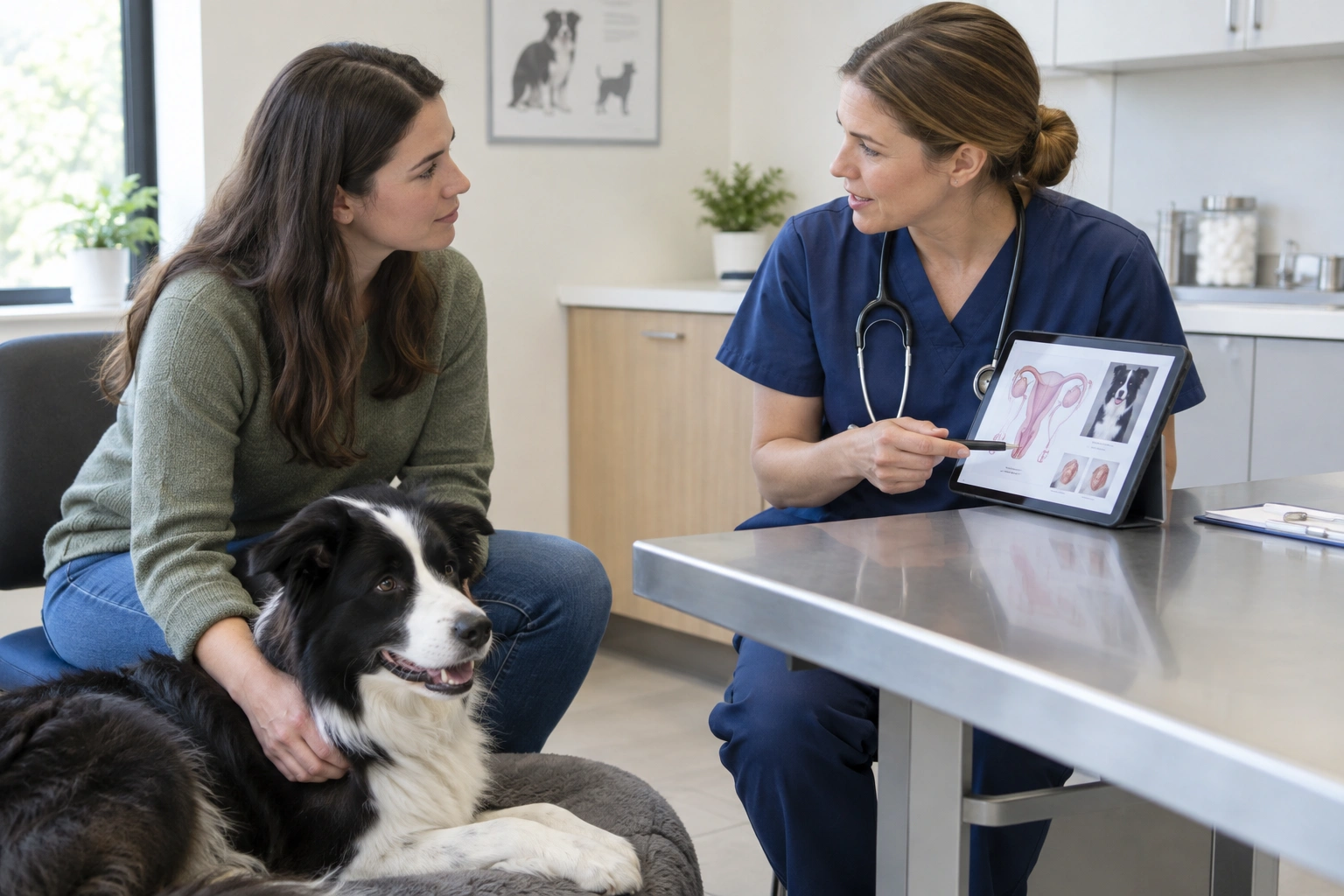
One important nuance: the earlier a dog is spayed, the more protection there may be against some mammary tumor risk. Once a dog has had multiple heat cycles, that protective window is not the same as it was at 6 months. Still, “less benefit than earlier” is not the same as “no benefit.”
Risks That Increase With Age or Chronic Disease
The main reason vets become more cautious with age is not the spay procedure itself. It is anesthesia and recovery.
Older dogs are more likely to have:
– heart disease
– kidney disease
– liver disease
– respiratory disease
– endocrine disease like Cushing’s or diabetes
– reduced muscle mass or poor body condition
– obesity
Each of those can change how safely a dog can be anesthetized and how smoothly she recovers afterward. The ASPCA notes that dogs can be spayed as adults, but that older dogs, overweight dogs, and dogs with health problems may have a slightly higher risk of post-operative complications. Their guidance is here: ASPCA spay/neuter guidance.
That does not mean older dogs should never be spayed. It means the vet may want to:
– run more pre-op testing
– adjust anesthesia protocols
– use tighter monitoring
– plan a slower recovery
Which Dogs Need Extra Caution Before a Late Spay?
Some dogs should be evaluated more carefully before surgery, even if they look “fine” at home.
Red flags that deserve a closer look
- a heart murmur
- unexplained coughing or tiring easily
- vomiting, diarrhea, fever, or lethargy
- abdominal pain or a swollen belly
- vaginal discharge
- recent heat cycle
- obesity or severe underweight condition
- known kidney, liver, or endocrine disease
- a history of fainting, collapse, or exercise intolerance
If a dog has vaginal discharge, fever, weakness, increased thirst, or loss of appetite, do not assume it is just a normal cycle issue. Those signs can fit uterine disease, and a spay may become a treatment decision rather than a routine elective surgery.
A useful rule: if the dog is not medically stable today, do not treat spay as a scheduling problem. Treat it as a veterinary assessment problem.
Breed, Size, and Activity-Level Considerations: Where Border Collies Fit In
Border Collies sit in an interesting middle ground. They are not giant breeds, but they are also not toy breeds. They are active, athletic, and often asked to do a lot physically and mentally.
That matters because many owners worry that spaying too early could affect growth, joint health, or body condition. There is some evidence that breed, sex, and age at neutering can influence health risks in dogs, and the AKC Canine Health Foundation notes that these risks vary by breed and that delaying neutering can reduce health risks for many breeds. Their overview is here: AKC Canine Health Foundation on spay/neuter timing.
For Border Collies, the practical question is usually not whether the dog is a Border Collie. It is whether the dog is physically mature, medically low-risk, and likely to benefit from surgery now rather than later.
A veterinarian may weigh:
– whether the dog has finished most of her growth
– whether she is underweight, lean, or in ideal body condition
– how demanding her sport, work, or exercise routine is
– whether delaying surgery is meant to support maturity or just avoid making a decision
– whether any current health issue changes the anesthesia plan
Border Collies are generally not a breed where you would postpone spay solely because they are Border Collies. But if the dog is still growing, very lean, or involved in demanding sport work, your vet may discuss timing more carefully.
A realistic Border Collie example
A healthy 2-year-old Border Collie that has had one or two heat cycles may still be a very reasonable late-spay candidate if the owner wants to prevent pyometra and avoid future heat management.
A 9-year-old Border Collie with a new heart murmur and weight loss needs a very different conversation first.
What Pre-Surgical Testing Is Appropriate for an Older Dog
For a younger healthy dog, a routine physical exam may be enough for a straightforward spay. For an older dog, vets often want more information before anesthesia.
Common pre-op steps include:
– full physical exam
– bloodwork to check red and white blood cells, kidney values, liver values, and protein levels
– sometimes a urinalysis
– sometimes chest imaging or an ECG if heart or lung disease is suspected
– additional testing based on the dog’s history
These tests help identify problems that may not be obvious during a normal exam, such as anemia, dehydration, kidney disease, liver dysfunction, infection, or hidden cardiac concerns. If a dog has a murmur, coughing, fainting, exercise intolerance, or known organ disease, additional testing is more likely to be warranted before elective surgery.
The point of testing is simple: don’t discover a problem after the dog is already under anesthesia.
How Veterinarians Decide Whether to Spay Now, Delay, or Avoid Surgery
A good vet is usually balancing four questions:
- How old is the dog, and what life stage is she in?
- How healthy is she right now?
- What is her reproductive history?
- What is the anesthesia risk compared with the benefit of surgery?
A practical decision framework
- Proceed now if the dog is healthy, the exam and bloodwork are reassuring, and the benefits clearly outweigh the risks.
- Delay briefly if the vet wants more testing, wants to stabilize another condition first, or needs to time surgery away from a recent heat cycle.
- Avoid or reconsider surgery if the dog has uncontrolled disease, high anesthesia risk, or signs that surgery would be more dangerous than helpful.
That framework is better than asking, “How old is too old?” because it leads to a real decision instead of a vague cutoff.
What Recovery Usually Looks Like After a Late Spay
Recovery after a late spay is usually similar to recovery after any spay, but older dogs may need a little more patience.
Expect:
– rest and restricted activity
– incision monitoring
– pain medication as prescribed
– an e-collar or recovery suit if needed
– follow-up if the incision looks red, swollen, or painful
You should also expect that an older dog may be a bit slower to get comfortable again. That does not automatically mean something is wrong. It may simply mean she has less reserve than a younger dog.
For active dogs like Border Collies, the hardest part is often not the incision itself. It is keeping them calm enough to heal. A dog that feels “fine” on day 2 may still need strict leash walks and no jumping for the full recovery period your vet gives you.
When Spaying May No Longer Be the Best Option
There are situations where the risks may outweigh the benefits.
That can happen when a dog:
– is a poor anesthesia candidate
– has serious uncontrolled heart, kidney, liver, or respiratory disease
– is very weak or underweight
– has an active illness that should be addressed first
– may need emergency treatment rather than elective surgery
In those cases, the conversation changes from “Should we spay?” to “What is the safest plan for this dog right now?”
Sometimes the answer is to stabilize the dog first and revisit surgery later. Sometimes the answer is to avoid elective surgery altogether. A good veterinarian will explain why.
Questions to Ask Your Veterinarian Before Scheduling
Bring these questions to the appointment:
- Is my dog a good anesthesia candidate right now?
- What pre-op tests do you recommend for her age and health?
- Does her breed, size, or activity level change your timing recommendation?
- Does she still get meaningful health benefit from spaying at this age?
- Are there signs that make you worry about uterine disease or another reproductive problem?
- How long should recovery take for a dog like mine?
- What complications are you most concerned about in her case?
- If you were making this decision for your own dog, what would you do and why?
Those questions help you move from general internet advice to a real medical plan.
Bottom Line
It is not usually too late to spay a dog just because she is older. The better question is whether she is healthy enough for anesthesia, whether she still has meaningful benefit from surgery, and whether any medical issues need attention first.
For Border Collies and other active dogs, the best decision is rarely based on age alone. It is based on the dog’s body, her reproductive history, and the vet’s assessment of surgical risk versus long-term benefit.
If you are unsure, get the exam and bloodwork first. That is often the fastest way to turn uncertainty into a clear plan.
Frequently Asked Questions
What is the oldest age a dog can be spayed safely?
There is no single oldest age that applies to every dog. Many adult and senior dogs can still be spayed safely if they are otherwise healthy enough for anesthesia.
Does spaying an older dog still help prevent pyometra?
Yes. If the uterus is removed, pyometra is prevented. That benefit remains meaningful even in older dogs.
Is it riskier to spay a senior dog?
Often, yes. Older dogs are more likely to have health conditions that increase anesthesia and recovery risk, so vets usually recommend more screening.
Should I wait longer to spay a Border Collie?
Not automatically. Border Collies are active dogs, but breed alone is not a reason to delay indefinitely. Health, growth, and your vet’s advice matter more.
What tests should my older dog have before spay surgery?
Usually a physical exam and bloodwork at minimum. Some dogs also need urinalysis, chest imaging, or heart testing depending on their history.
How long is recovery after a late spay?
The basic healing timeline is often similar to a routine spay, but older dogs may feel less energetic and need closer monitoring during recovery.
When should I avoid scheduling a spay?
If your dog has active illness, unexplained weakness, a heart murmur, or other uncontrolled medical problems, the vet should evaluate her before you book surgery.
Can a dog be spayed while in heat?
Sometimes, but it may carry more bleeding risk and is not always the preferred timing. Your veterinarian should advise based on the individual case.
What if I missed the usual spay window?
That is common. Missed timing does not automatically remove the option. It just means the vet may look more closely at health status before recommending surgery.
Should I get a second opinion?
If the recommendation is unclear, yes. A second veterinary opinion can be useful, especially for an older dog or one with medical complications.