
What Are the Lumps on My Dog? A Practical Guide to Dog Bumps, Risks, and Next Steps

Finding a lump on your dog can make your stomach drop. The hard part is that a lump can be something simple, something irritating, or something serious, and those can look surprisingly similar at first glance.
The goal here is not to guess from the sofa. It is to help you decide what the lump most likely is, what features matter most, and whether you should monitor it briefly or book a vet visit now.
What a Lump on Your Dog Could Be
A lump is just an abnormal swelling or mass, and that broad category covers a lot of ground. Some are benign, some are inflammatory or infectious, and some are cancerous. That is why appearance alone is not enough to rule anything in or out.
A soft, movable bump under the skin often points toward a fatty mass such as a lipoma, especially in middle-aged or older dogs. A red, raised, button-like lump in a young dog can sometimes fit a histiocytoma, but that is only one possibility. A rough, cauliflower-like bump may be a wart, while a smooth, flesh-colored bump can be a skin tag. A skin tag is usually a small, benign flap of skin that hangs off the surface, while a wart tends to have a more irregular, bumpy texture. A tumor is a broader term for an abnormal growth and can be benign or malignant, which is why “looks like a bump” does not tell you enough on its own. A painful, warm swelling with discharge leans more toward infection or an abscess. But none of those descriptions is a diagnosis.
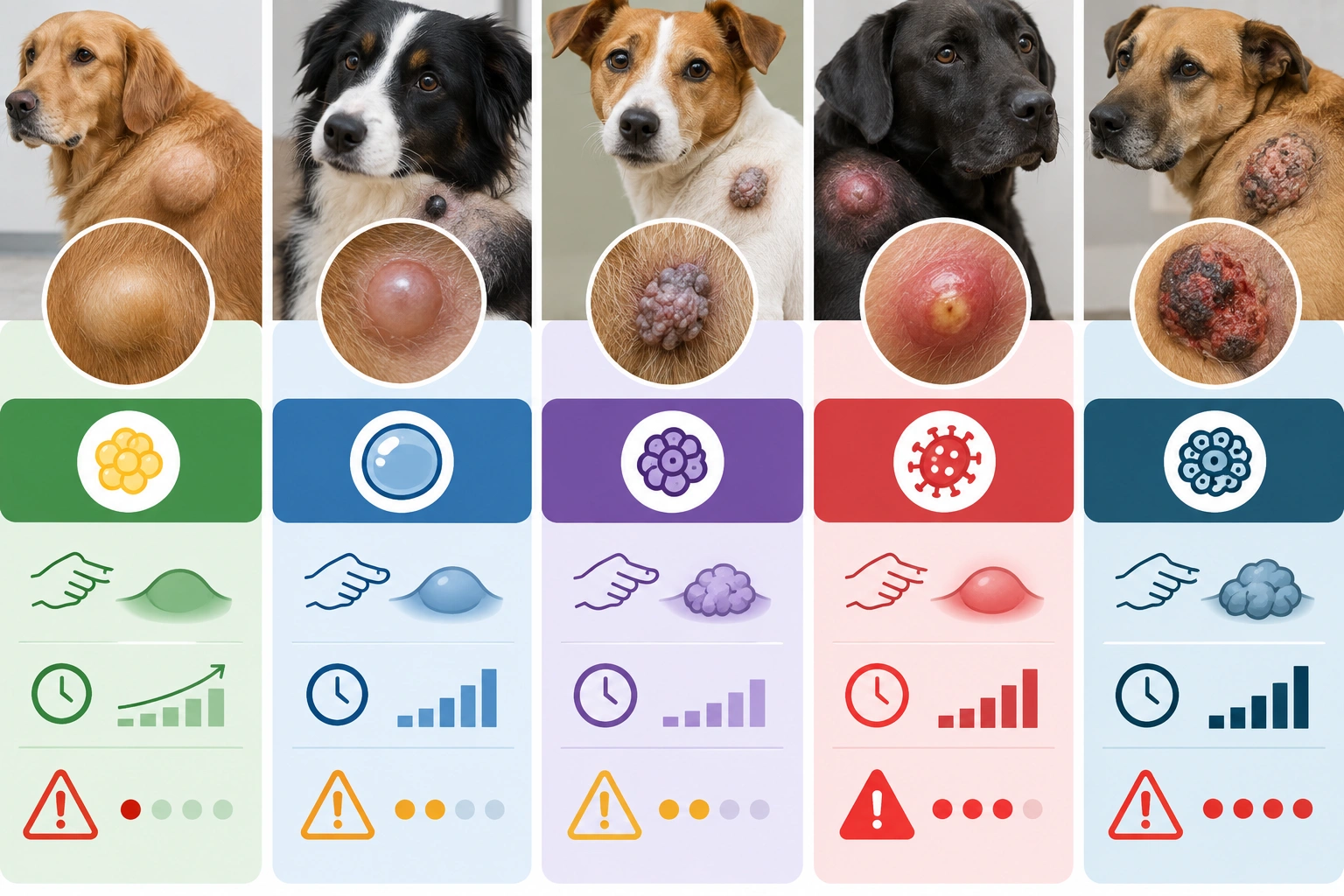
A quick plain-language comparison can help with common lookalikes:
- Cyst vs abscess: A cyst is usually a closed pocket under the skin that may stay quiet, rupture, or get inflamed. An abscess is an infected pocket of pus that is often painful, warm, and more likely to appear suddenly.
- Wart vs skin tag vs tumor: A wart is often rough or cauliflower-like. A skin tag is usually a small, soft, dangling piece of skin. A tumor is an abnormal growth that may look like either of those or something completely different, so it cannot be ruled out by appearance alone.
Lumps can also be hidden in places owners do not check often. They may sit inside the leg, under the collar line, in the armpit, along the belly, or near the mouth, so a dog can carry a new mass for a while before anyone notices it. That is one reason routine hands-on checks matter.
For a broader overview of common lump types, this guide from PDSA on skin lumps and tumours in dogs is a solid starting point.
When a Lump Needs a Vet Visit Now
Some lumps are worth watching for a short period. Others should be checked promptly. The difference is usually not the size alone; it is the behavior of the lump and how your dog feels.
Book a vet visit now if the lump is:
- growing quickly
- painful or tender
- firm and fixed in place
- bleeding or ulcerated
- hot, red, or draining
- causing limping, chewing, rubbing, or trouble moving
- paired with your dog seeming unwell, tired, feverish, or off food
Those signs raise concern because they suggest inflammation, infection, tissue invasion, or a mass that is affecting surrounding structures. A lump that appears suddenly and starts draining pus, for example, needs a different response than a soft fatty lump that has been unchanged for months.
If your dog is uncomfortable, the mass is changing fast, or there is discharge, do not wait to “see if it settles.” That kind of waiting can make diagnosis harder and can let an infection worsen.
Common Benign Lumps and Bumps
Some of the most common lower-risk lumps still deserve a vet’s eyes, but they are often not emergencies.
Lipomas
Lipomas are fatty lumps under the skin. They are usually soft, movable, and not painful. They are more common in middle-aged to older dogs. In extremely rare cases, a lipoma can become a malignant growth called a liposarcoma, so “fatty-feeling” does not automatically equal harmless.
A practical clue: if the lump slides under your fingers like a small pouch of dough and your dog ignores it, a lipoma is one possibility. But a vet still needs to confirm that the mass is truly a lipoma and not something else sitting deeper.
Sebaceous cysts
Sebaceous cysts are commonly seen in dogs and are linked to blocked oil glands. They may sit quietly for a while, rupture, or become infected. A cyst can feel like a round lump under the skin, sometimes with a central pore or a firmer surface.
The trade-off with cysts is that they can look simple until they break open or inflame. If one suddenly becomes red, sore, or starts leaking, it stops being a “watch and wait” lump.
Warts and papillomas
Warts are small bumps that can have a cauliflower-like texture. They may be related to viral infection, vaccination sites, or aging. Some remain minor nuisances, but anything that changes, bleeds, or grows deserves a vet check.
Histiocytomas
Histiocytomas are benign skin growths that usually occur in dogs younger than 2 years old. They are often found on the front half of the body, especially the head or legs. They can look pink and fleshy and may get bigger or look more irritated before improving.
That “looks worse before it gets better” pattern is exactly why owners can get alarmed. In a young dog, a button-like red lump may turn out to be benign, but it still needs monitoring and sometimes sampling because other masses can mimic it.
Lumps That Are More Concerning
Some masses deserve a lower threshold for testing because they can be malignant or locally aggressive.
Mast cell tumors are a classic example. They can vary a lot in appearance, which is why you cannot safely judge them by looks alone. A lump that seems small, smooth, or “just a skin bump” can still be important.
Other malignant tumors may feel firm, fixed, oddly shaped, or deeply attached to tissue below the skin. A mass that seems anchored in place rather than sliding freely is more concerning than a soft mobile one. Rapid growth, ulceration, and recurrent irritation are also warning signs.
A useful rule: if you find yourself saying, “It doesn’t look that bad, but it’s changing,” that change matters more than the appearance.
Quick Comparison: What the Lump Might Feel Like
| Lump type | Common feel or look | Typical pattern | Often seen where | How urgent it feels |
|---|---|---|---|---|
| Lipoma | Soft, movable, under the skin | Slow-growing, often stable | Body wall, chest, belly | Usually non-urgent, but should be checked |
| Sebaceous cyst | Round, firm to soft, sometimes with a pore | Can stay quiet, rupture, or infect | Anywhere on skin | Prompt if red, sore, or draining |
| Wart / papilloma | Rough, cauliflower-like bump | May remain small or change slowly | Skin, mouth area, face | Non-urgent unless changing or irritated |
| Histiocytoma | Pink, fleshy, button-like | May enlarge before improving | Head, legs, front half of body | Vet check recommended, especially in young dogs |
| Abscess | Swollen, warm, painful | Can appear quickly | Bite sites, skin injuries | Prompt, often urgent if painful or draining |
| Suspicious tumor | Firm, fixed, irregular, changing | May grow or ulcerate | Anywhere | Vet visit now |
This table is a guide, not a diagnosis. The same lump can break several of these rules.
How Location, Age, and Breed Change the Odds
Age changes the odds. Young dogs are more likely to develop certain benign growths such as histiocytomas. Middle-aged and older dogs are more likely to develop lipomas. Older dogs also deserve more caution overall, because a new lump should not be assumed harmless just because it appeared late in life.
Location matters too. Lumps on the head, legs, belly, armpits, or around the mouth may fit different patterns, but location alone does not identify the cause. A lump near a joint may interfere with movement even if it is benign. A lump in a high-friction area may keep getting irritated and inflamed.
Breed can be part of the context, but it should not be treated like a shortcut. Border Collies are not known for one single “signature lump” that lets you skip the vet exam. In practical terms, breed is a clue at most, not a diagnosis. Your dog’s age, the lump’s behavior, and what it feels like matter more than the breed label.
What Vets Do to Diagnose a Lump
Most vets begin with a hands-on exam. They will feel the lump, note whether it is attached to deeper tissue, check the skin over it, and ask how long it has been there and whether it has changed.
A common next step is a fine-needle aspiration. That means the vet uses a small needle to collect cells from the mass for testing. It is usually quick and often gives helpful information without surgery. Some dogs tolerate it very well, while others may need light restraint or, occasionally, sedation if the lump is in a sensitive spot or the dog is very anxious.
If the sample is unclear, or if the lump has suspicious features, the vet may recommend a biopsy. A biopsy looks at a larger piece of tissue and is more definitive than guessing from the outside. Depending on the location and the dog’s comfort level, sedation or anesthesia may be needed.
In some cases, surgical removal is recommended because the mass is bothersome, keeps getting irritated, or cannot be confidently identified as benign. When a lump is removed, the tissue is usually sent for lab analysis so the vet can confirm what it was.
PDSA explains that a vet may examine the lump and recommend taking a sample for testing, which is exactly the kind of practical next step most owners should expect. You can read more on how vets approach skin lumps in dogs.
How to Monitor a Lump at Home Without Missing Red Flags
If your vet has said the lump can be watched for now, monitor it in a way that gives you useful information.
Record these details:
- size
- shape
- color
- texture
- whether it moves under the skin
- whether it is painful
- whether the skin over it is red, crusted, or open
- whether your dog licks, scratches, or avoids touch there
Take a clear photo beside a coin or ruler so you have a scale reference. Keep the angle and lighting similar each time. That makes change easier to spot.
The key question is not “Does it still exist?” but “Is it behaving the same?” A lump that stays the same size, stays soft, and does not bother the dog is a different situation from one that becomes firmer, redder, or more sensitive.
Some benign growths can be monitored over time with measurements tracked at each visit. That approach is reasonable when the mass is stable and not causing trouble. If it starts changing, the decision should be revisited.
What Not to Do Before the Appointment
Do not squeeze, pop, cut, lance, or poke the lump. That can worsen inflammation, spread infection, or make the tissue harder to interpret.
Do not apply human creams, wart removers, antibiotic ointments, or home remedies unless your vet specifically told you to. A product that seems harmless can irritate the skin or mask the lump’s true appearance.
Do not wait for the lump to “come to a head” if it is painful, swollen, or draining. That is a common way for owners to lose time on an infection or an aggressive mass.
Decision Guide: Monitor Briefly, Book Soon, or Go Now
Use this simple triage approach.
Monitor briefly
This is reasonable when the lump is small, soft, movable, not painful, and unchanged, and your dog seems completely normal. Even then, plan a non-urgent vet exam if it persists. New lumps should not be watched indefinitely at home, even if they seem harmless at first.
Book soon
Make a regular vet appointment if the lump is new, you are unsure what it is, or it is slowly changing. This is the safest choice for most new masses, especially in older dogs.
Go now
Seek prompt veterinary attention if the lump is rapidly growing, firm, fixed, painful, bleeding, ulcerated, hot, draining, or making your dog act unwell. Those are the features that move the problem out of the “watch it” category.
A practical example: a soft belly lump that has been the same size for months is often lower concern than a firm leg mass that doubled in size over a short period. The first may be a lipoma; the second needs prompt testing.
When Removal Makes Sense Even If the Lump Seems Benign
Not every lump needs immediate surgery. But removal can still make sense when a mass is repeatedly irritated, interferes with movement, sits in a place that gets rubbed, or cannot be confidently identified without excision.
That is the trade-off: monitoring avoids unnecessary procedures, but removal can solve a recurring problem and give a definitive diagnosis. If a lump keeps getting traumatized by a collar, harness, or grooming, the “benign” label may not be the whole story because the location keeps turning it into a nuisance.
Removal is also more likely to be recommended when the mass is malignant or suspicious, or when testing does not give a clear answer.
The Bottom Line
If you find a lump on your dog, do not try to solve it by appearance alone. Soft and movable often points one way, firm and fixed points another, but there is enough overlap that a vet exam is still the right move for any new or changing mass.
For Border Collie owners, the most useful habit is simple: check your dog regularly, note changes early, and act quickly when a lump becomes painful, fast-growing, or irritated. That approach catches the worrying ones sooner and prevents minor lumps from becoming bigger problems.
FAQ
Can I tell if a dog lump is cancerous by touch?
Not reliably. Some benign lumps feel firm, and some cancerous lumps can feel deceptively ordinary. Touch helps you describe the lump, but it does not confirm the diagnosis.
Are soft lumps on dogs always lipomas?
No. Lipomas are common, but cysts, abscesses, and some tumors can also feel soft at first.
Should I wait a week to see if the lump changes?
Only if it is small, soft, not painful, and your dog seems normal. If it is growing, sore, or draining, book the vet now.
Will my vet need a biopsy right away?
Not always. Many lumps are first checked with a fine-needle aspiration. A biopsy is more likely if the result is unclear or the lump looks suspicious.
Can a lump go away on its own?
Some can, including certain histiocytomas and some cysts, but that is not something to assume without an exam.
For more context on common fatty lumps, Blue Cross explains lipomas in dogs. If you want a broader roundup of common bump types, see our related guide on what the bumps on my dog might be.