

Quick Answer
Yes, you can sometimes bathe a Border Collie with hot spots, but the bath must not leave the irritated skin or dense undercoat damp. If the hot spot is raw, rapidly spreading, painful, oozing, or infected-looking, contact your veterinarian before giving a full bath and review the AKC guidance on canine hot spots.
Safe Bathing Basics
- Check the lesion: Avoid routine bathing if the area is very painful, wet, swollen, or quickly getting larger.
- Use lukewarm water: Hot water can make already irritated skin more uncomfortable.
- Choose dog shampoo: Use a gentle dog-specific product or the medicated shampoo recommended by your veterinarian.
- Never scrub: Wash around an affected area gently instead of rubbing the sore skin.
- Rinse completely: Shampoo left beneath a Border Collie’s coat can irritate the skin.
- Dry thoroughly: Pay special attention to the dense undercoat and the fur surrounding the hot spot.
When to Get Help
- Call your vet if the lesion is spreading, smells bad, produces pus, causes significant pain, or keeps returning.
If you’re wondering whether to bathe a Border Collie with hot spots, the biggest issue isn’t simply getting the dog wet. The real concern is what happens to irritated skin when moisture remains trapped beneath a Border Collie’s thick coat.
I’ve found it helpful to think of drying as part of the bath itself. If I can’t dry the coat completely and comfortably, I don’t consider the bathing job finished.
In This Guide
- What Are Hot Spots on a Border Collie?
- Can You Bathe a Border Collie With Hot Spots?
- When Should You Skip the Bath and Call the Vet?
- How Do You Bathe a Border Collie With Hot Spots Safely?
- Which Shampoo Is Best for Hot Spots?
- How Do You Dry a Border Collie With Hot Spots?
- Why Do Border Collies Get Hot Spots After Baths?
- How Can You Prevent Hot Spots From Coming Back?
- Frequently Asked Questions
What Are Hot Spots on a Border Collie?
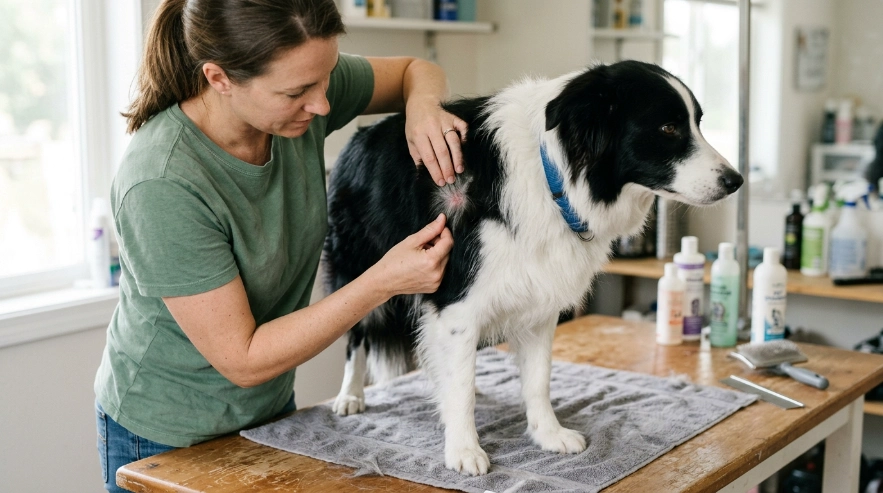
A hot spot is a localized area of inflamed, irritated skin that often becomes moist, red, painful, and intensely itchy. Veterinarians may call this condition acute moist dermatitis or pyotraumatic dermatitis.
Definition: A Border Collie’s hot spot is an area of damaged skin that can develop after persistent licking, chewing, or scratching breaks the skin and creates a warm, moist environment.
Hot spots can appear surprisingly fast. A small irritated patch may become a much larger sore when the dog continues licking or scratching it.
Why a Border Collie’s coat matters
Border Collies have rough or smooth coat varieties, but both have double coats. The undercoat can hold moisture close to the skin even when the outer hairs feel fairly dry.
- Rough-coated Border Collies: Longer feathering can conceal irritated skin and hold dampness around the lesion.
- Smooth-coated Border Collies: The coat is shorter, but the breed still has an insulating undercoat.
- Matted coats: Mats reduce airflow and can keep wet fur pressed against irritated skin.
- Frequent swimmers: Repeated moisture may create favorable conditions for skin trouble when the coat doesn’t dry completely.
According to AKC information about Border Collies, both coat varieties have dense, weather-resistant double coats. That coat structure is one reason I pay close attention to what’s happening underneath the visible hair.
Vet note: A red or wet patch isn’t automatically a hot spot. Ask your veterinarian for an examination if you’re unsure what type of skin lesion you’re seeing.
Section Takeaway: Hot spots involve more than dirty fur. The combination of itching, self-trauma, moisture, and an underlying trigger is what owners need to address.
Can You Bathe a Border Collie With Hot Spots?
Yes, some Border Collies with hot spots can be bathed safely. However, whether a full bath makes sense depends on the condition of the lesion and your veterinarian’s treatment plan.
Bathing isn’t automatically a treatment for every hot spot. In some cases, your vet may recommend a medicated shampoo, while another dog may need the area clipped, cleaned, dried, and protected instead.
| Situation | Full Bath? | Better Approach |
|---|---|---|
| Minor itching with no open lesion | Often reasonable | Gentle dog shampoo, thorough rinse, complete drying |
| Small diagnosed hot spot | Depends on treatment plan | Follow your vet’s cleaning or medicated-bathing instructions |
| Raw, wet, painful lesion | Usually postpone routine bath | Veterinary assessment and targeted treatment |
| Multiple or rapidly spreading lesions | Vet first | Determine the cause and appropriate treatment |
| Vet-prescribed medicated shampoo | Yes, as directed | Follow contact-time, rinsing, and frequency instructions exactly |
The key distinction is between controlled therapeutic bathing and simply washing a sore dog because the coat looks dirty. Those aren’t the same thing.
Vet note: If your Border Collie already has a diagnosed hot spot, follow the bathing instructions given by the veterinarian treating that lesion.
Section Takeaway: You don’t need to avoid water forever, but an active hot spot changes how and when you should bathe your Border Collie.
When Should You Skip the Bath and Call the Vet?
Skip a routine bath and contact your veterinarian when the skin looks significantly damaged or your Border Collie is clearly uncomfortable. Hot spots may worsen rapidly because scratching and licking continually injure the area.
The VCA overview of hot spots in dogs explains that these lesions can be painful, itchy, moist, and sometimes hidden beneath matted hair.
Warning signs that deserve veterinary attention
- Rapid enlargement: The irritated area becomes noticeably bigger over a short period.
- Persistent moisture: The lesion stays wet or produces discharge.
- Pus or strong odor: These signs can accompany infection.
- Significant pain: Your dog flinches, cries, snaps, or won’t allow the area to be touched.
- Heavy licking: Your Border Collie can’t leave the skin alone.
- Multiple lesions: More irritated areas appear elsewhere on the body.
- Repeated hot spots: The same problem keeps returning despite grooming changes.
- General illness: Your dog seems unusually tired, stops eating, or otherwise appears unwell.
Recurring hot spots are especially important to investigate. Allergies, fleas, ear disease, other skin infections, anal gland problems, and repeated moisture can all contribute to the itch-scratch cycle.
Vet note: Veterinary care becomes more important when the lesion is extensive, infected-looking, extremely painful, or repeatedly returning.
Section Takeaway: A bath should never delay veterinary treatment for a painful, spreading, or infected-looking skin lesion.
How Do You Bathe a Border Collie With Hot Spots Safely?
If your veterinarian says bathing is appropriate, keep the process gentle and controlled. Your goal is to clean without increasing skin trauma or leaving moisture trapped in the coat.
1. Brush only the unaffected coat
Gently remove loose fur and easy tangles before getting your Border Collie wet. Don’t pull a brush through a painful hot spot or a mat stuck to irritated skin.
2. Use lukewarm water
Wet the coat with comfortably lukewarm water. Avoid strong spray pressure directly against the sore area.
3. Use the recommended shampoo
If your veterinarian prescribed or recommended a medicated shampoo, follow those directions. Otherwise, choose a mild dog-specific shampoo rather than a strongly fragranced human product.
4. Don’t scrub the hot spot
Massage healthy areas gently with your fingertips. Rubbing a raw lesion can increase pain and further damage the skin.
5. Rinse longer than you think you need to
A Border Collie’s undercoat can trap shampoo. Separate sections of fur with your fingers and keep rinsing until you no longer feel slippery product in the coat.
6. Start drying immediately
Press clean absorbent towels into the coat instead of rubbing aggressively. Replace wet towels rather than continuing with a saturated one.
7. Stop licking after the bath
A freshly cleaned lesion can still itch. Use the recovery collar or other protective method recommended by your veterinarian if your dog keeps reaching the affected area.
Vet note: Don’t cut hair away from a painful lesion with household scissors. Your veterinarian or experienced professional can manage difficult clipping more safely.
Section Takeaway: Gentle washing matters, but complete rinsing and drying are just as important for a Border Collie’s dense coat.
Which Shampoo Is Best for a Border Collie With Hot Spots?
There isn’t one shampoo that’s right for every Border Collie with a hot spot. The best choice depends on whether you’re dealing with simple irritation, bacterial overgrowth, allergies, or another underlying skin condition.
For an active diagnosed hot spot
Your veterinarian may recommend a medicated cleanser or shampoo containing ingredients used for microbial skin problems. Follow the prescribed product’s frequency and contact time rather than improvising your own schedule.
The Merck Veterinary Manual’s information on canine pyoderma notes that acute moist dermatitis falls within surface pyoderma and that moisture and underlying skin problems can contribute to bacterial overgrowth.
For mild itchy skin without an open hot spot
A gentle dog shampoo may be suitable when the skin isn’t broken. Colloidal oatmeal products are also commonly used to soothe uncomplicated itchy skin.
PetMD’s veterinary guide to oatmeal baths distinguishes minor itching from persistent itching or hot spots that need veterinary expertise.
Products I’d avoid experimenting with
- Strongly fragranced human shampoo
- Harsh household soaps
- Undiluted essential oils
- Random human medicated creams
- Home antiseptics not approved by your veterinarian
- Any product that makes your dog lick the lesion more
A product being labeled “natural” doesn’t automatically make it appropriate for raw canine skin. When the skin barrier is already damaged, I prefer the simplest vet-approved approach possible.
Vet note: Ask your veterinarian before using medicated, antiseptic, antifungal, or antibacterial products on an open or painful hot spot.
Section Takeaway: Shampoo should match the skin problem. An active hot spot isn’t the best time to experiment with new home remedies.
How Do You Dry a Border Collie With Hot Spots?
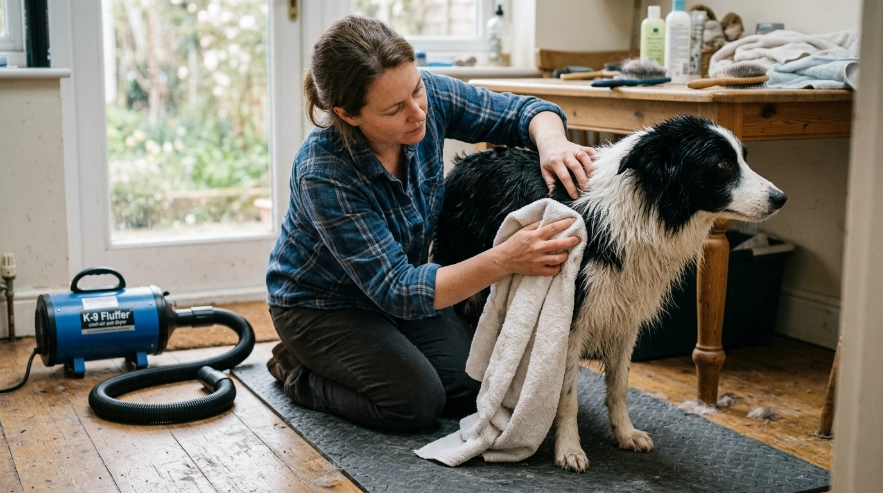
Drying may be the most important part of bathing a hot-spot-prone Border Collie. The surface coat can feel dry while moisture remains much closer to the skin.
I treat the undercoat as a separate drying job. I’ll part the hair with my fingers around the neck, hips, legs, belly, and behind the ears instead of judging dryness by the tips of the fur.
Use this drying sequence
- Let excess water drain: Give your dog a moment to shake naturally if it’s safe to do so.
- Press with towels: Blot and squeeze sections of coat gently instead of rubbing back and forth.
- Change towels: A soaked towel can’t pull much more moisture from the undercoat.
- Separate dense fur: Use your fingers to expose damp sections closer to the skin.
- Use cool or low airflow: If your dog tolerates a dryer, keep it moving and avoid concentrating heat on one area.
- Check the skin: Before finishing, feel beneath the outer coat for remaining dampness.
The AKC guide to drying dogs completely emphasizes thorough drying after bathing, swimming, or wet-weather activity to reduce matting and moisture-related skin problems.
Don’t blast a raw lesion with hot air. If drying the affected area causes obvious pain, stop and ask your veterinarian how they want the site managed.
Vet note: A painful lesion may require professional clipping and cleaning before the surrounding coat can be dried effectively.
Section Takeaway: For a Border Collie, “towel-dried” and “skin-dry” can be two different things. Check beneath the outer coat before declaring bath time finished.
Why Do Border Collies Get Hot Spots After Baths?
A bath doesn’t necessarily cause a hot spot by itself. Problems can develop when moisture, itching, skin irritation, matting, or another trigger starts the lick-and-scratch cycle.
Common post-bath triggers
- Damp undercoat: Moisture remains near the skin for hours after the surface looks dry.
- Incomplete rinsing: Shampoo residue may irritate sensitive skin.
- Pre-existing allergies: The dog was already itchy before the bath.
- Matted hair: Wet mats hold moisture and reduce airflow.
- Ear irritation: Water around the ears may contribute to scratching in dogs already prone to ear trouble.
- Excessive licking: Persistent licking turns mild irritation into damaged skin.
The same thing can happen after swimming or prolonged rain exposure. A wet Border Collie who runs around happily afterward can still have damp fur at skin level.
Don’t assume every post-bath rash is a hot spot
Contact irritation, allergies, parasites, bacterial infections, yeast problems, and other skin disorders can look similar at home. That’s one reason recurring “hot spots” deserve a proper diagnosis.
Timing provides a clue, not a diagnosis. A rash that appears after every bath may point toward a product, drying problem, or an underlying skin condition that bathing exposes.
Vet note: If skin problems consistently develop after bathing, show your veterinarian the shampoo and grooming products you use.
Section Takeaway: Post-bath hot spots often involve trapped moisture or an existing itch trigger. Improving the drying routine helps, but recurring lesions need a deeper look.
How Can You Prevent Hot Spots From Coming Back?
Prevention starts with figuring out why your Border Collie became itchy in the first place. Drying the coat better can help, but it won’t solve fleas, allergies, ear disease, or another ongoing trigger.
Build a simple skin and coat routine
- Brush regularly: Remove loose undercoat and prevent mats from trapping dampness.
- Check the skin: Look beneath dense fur when your dog suddenly scratches one location.
- Dry after swimming: Don’t reserve thorough drying only for shampoo baths.
- Rinse completely: Work through the coat until grooming product is gone.
- Manage parasites: Follow your veterinarian’s flea and parasite prevention advice.
- Watch the ears: Head and neck scratching may start with an uncomfortable ear.
- Interrupt obsessive licking: Address persistent licking before the skin becomes raw.
- Investigate recurrence: Repeated hot spots may signal an underlying medical problem.
Catch the early signs
When I check a Border Collie’s coat, I’m not only looking for obvious wounds. I pay attention to a small damp clump of fur, unusual licking, tenderness, redness, or an area where the dog suddenly dislikes being brushed.
Early action is easier than dealing with a large, painful lesion. That matters even more during humid weather or after frequent swimming.
As of 2026, veterinary guidance continues to emphasize managing the underlying itch and keeping hot-spot-prone coats properly groomed and dry. Prevention works best when coat care and medical care support each other.
Vet note: Ask your veterinarian about recurring hot spots rather than treating each new lesion as an isolated grooming problem.
Section Takeaway: The best prevention plan combines a dry, unmatted coat with control of the underlying reason your Border Collie is scratching or licking.
Frequently Asked Questions
Can water make a Border Collie’s hot spot worse?
Water itself isn’t always the problem, because medicated bathing may sometimes be part of veterinary treatment. However, leaving the lesion or surrounding double coat damp can create conditions that make skin problems harder to manage.
Should I wash a hot spot every day?
Don’t create your own daily washing schedule for an active lesion. Cleaning frequency depends on the severity, location, underlying cause, and products your veterinarian wants you to use.
Can I use oatmeal shampoo on a Border Collie with hot spots?
Oatmeal products may soothe mild, intact itchy skin, but a raw or infected-looking hot spot needs a different approach. Ask your veterinarian before applying oatmeal or another shampoo directly to an open lesion.
Can I use human shampoo on my Border Collie?
It’s better to use shampoo formulated for dogs. When your Border Collie already has irritated skin, introducing a strongly fragranced or unsuitable human product can complicate an already sensitive situation.
Can I let my Border Collie air-dry after a bath?
I wouldn’t rely on air-drying when a Border Collie is prone to hot spots. The dense undercoat can stay damp longer than it appears, so towel drying and a safe cool or low-airflow drying method are usually more controlled.
How do I know whether a hot spot is infected?
Increasing redness, swelling, pain, discharge, pus, bad odor, or rapid spreading are reasons to contact your veterinarian. You can’t reliably determine the depth or cause of a skin infection from appearance alone.
Should I shave my Border Collie’s hot spot?
Removing hair around a lesion may be part of veterinary treatment because it improves access and airflow. Don’t use scissors close to painful or moving skin; have your veterinarian handle difficult clipping when needed.
Vet note: These answers provide general care guidance and don’t replace an examination of your individual Border Collie.
Final Takeaway: You can sometimes bathe a Border Collie with hot spots, but don’t treat an active skin lesion like an ordinary grooming day. Check the severity first, follow veterinary instructions when the skin is raw or infected-looking, use gentle products, rinse completely, and make thorough undercoat drying a non-negotiable part of every bath.
If your Border Collie’s hot spots keep returning, focus on finding the trigger rather than simply washing the sore each time. A veterinarian can help determine whether parasites, allergies, infection, ear trouble, or another source of itching is driving the cycle.