

Quick Answer
The best grooming scissors for a Border Collie are sharp, comfortable pet-grooming shears that let you tidy feathering without removing too much of the double coat. For most owners, I recommend rounded-tip straight scissors plus thinning shears; the AKC Border Collie breed guide confirms that both rough and smooth Border Collies have double coats that need regular grooming.
What I Look For
- Rounded safety tips: A smart choice around paws, legs, ears, and other areas where a dog may suddenly move.
- 6–7 inch blades: This range gives most home groomers good control without making every trim painfully slow.
- Sharp stainless steel: Clean-cutting blades are less likely to fold, tug, or chew through soft feathering.
- Thinning shears: These blend long rough-coat feathering more naturally than repeatedly making hard straight cuts.
- Comfortable handles: Finger inserts, a finger rest, and adjustable tension make controlled trimming easier.
My Simple Recommendation
- If you want only one pair, start with 6-inch rounded-tip straight grooming scissors and use them for light tidying rather than major coat removal.
A Border Collie rarely needs the kind of full-body haircut you might give a continuously growing coat. What most BC owners need is a safe way to neaten paws, hocks, feathering, and occasional stray hairs.
I prefer to think of scissors as finishing tools, not coat-removal tools. That approach keeps a rough-coated or smooth-coated Border Collie looking natural while reducing the chance of a home-grooming mistake.
In This Guide
- What Are the Best Grooming Scissors for a Border Collie?
- Which Type of Grooming Scissors Does a Border Collie Need?
- What Size Grooming Scissors Are Best for a Border Collie?
- Do Rough and Smooth Border Collies Need Different Scissors?
- How Do You Choose Good Border Collie Grooming Shears?
- How Do You Trim a Border Collie Safely With Scissors?
- What Border Collie Scissoring Mistakes Should You Avoid?
- Frequently Asked Questions
- Final Takeaway
What Are the Best Grooming Scissors for a Border Collie?
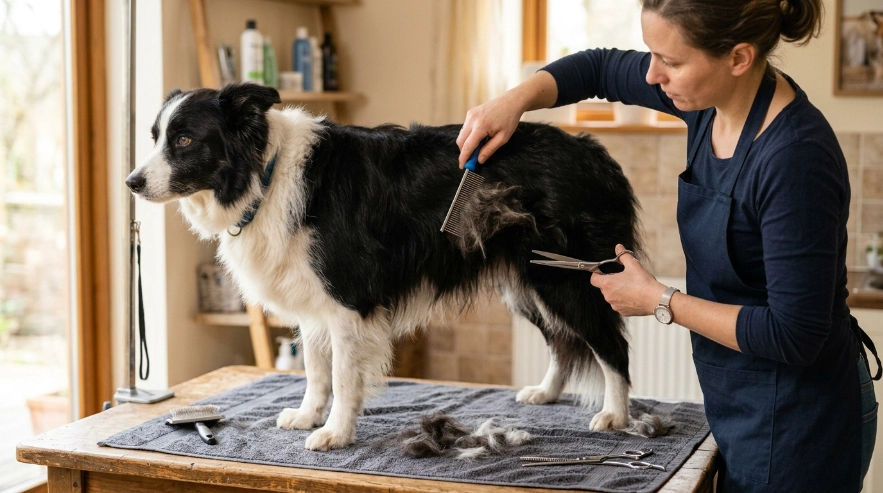
For most Border Collies, the best home-grooming setup contains two tools: rounded-tip straight scissors and thinning or blending shears. Adding curved scissors makes paw and outline work easier, but they’re optional for beginners.
Border Collie grooming scissors are pet-specific shears used to neaten selected coat areas without giving the dog a full haircut. They should cut cleanly while giving you enough control to work around a moving dog.
Best overall: 6–7 inch rounded-tip straight scissors
This is the pair I’d buy first. The blade is long enough for leg feathering yet short enough to control around paws and the rear outline.
- Best for: General tidying, paws, hocks, stray hairs, and feathering.
- Ideal user: Beginner or occasional home groomer.
- Look for: Rounded tips, removable finger inserts, and adjustable tension.
Best for a natural finish: thinning shears
Thinning shears have a toothed blade that removes only part of the hair with each closure. They soften an edge instead of leaving the obvious line produced by repeated straight cuts.
- Best for: Rough-coat feathering and blending transitions.
- Useful range: Around 30–46 teeth for light home finishing.
- Watch for: Cheap blades that fold or pull fine hair rather than cutting it.
Best for shaped areas: curved scissors
Curved grooming scissors follow rounded contours more naturally. I find them especially handy when neatening feet or following the outline of the hindquarters.
You don’t need to create a sculpted outline. Border Collies look best when the coat still looks functional and natural.
Section Takeaway: For the average owner, a rounded-tip straight shear plus a good blender covers almost every sensible Border Collie home-trimming job.
Which Type of Grooming Scissors Does a Border Collie Need?
Different scissors solve different problems. Buying one giant professional shear set isn’t necessary if you understand what each blade does.
| Scissor Type | Useful Size | Best Border Collie Use | Skill Level |
|---|---|---|---|
| Rounded-tip straight | 5.5–7 in. | Paws, legs, hocks, general tidying | Beginner |
| Curved | 6–7.5 in. | Rounded feet and body contours | Beginner–intermediate |
| Thinning/blender | 6–7 in. | Softening feathering and scissor lines | Beginner–intermediate |
| Chunker | 7–7.5 in. | Faster bulk reduction in heavy furnishings | Experienced |
| Short bull-nose | 4.5–6 in. | Small, sensitive trimming areas | Beginner |
Straight scissors vs thinning shears
Straight scissors remove every hair caught between the blades. That makes them precise, but a poorly placed cut can create an obvious notch.
Thinning shears remove fewer hairs per pass. They are often more forgiving when you’re blending the longer coat on a rough Border Collie.
What about chunkers?
Chunkers have wider-spaced teeth and remove more hair than fine thinning shears. Professional groomers often use them when they want speed plus a softer finish.
I wouldn’t make them a beginner’s first purchase. It’s easy to remove more feathering than intended before you learn how the coat falls.
What Size Grooming Scissors Are Best for a Border Collie?
A 6–7 inch grooming shear is the practical sweet spot for most adult Border Collies. It gives you useful blade length without sacrificing too much control.
When shorter scissors make sense
Choose 4.5–6 inch rounded-tip shears when you’re working in small areas. They’re easier to position when trimming stray paw hairs or carefully neatening a small section.
- Puppies: Short blades give you more control around a youngster who hasn’t learned to stand still.
- Paw work: A compact shear is easier to maneuver around toes.
- Nervous dogs: Smaller movements can feel less intimidating.
When longer scissors help
Seven-inch or 7.5-inch shears cover more coat with each cut. They can save time on long leg furnishings and the outer outline of a large rough-coated adult.
Longer isn’t automatically better. An 8-inch professional shear can feel awkward if you’ve never learned proper scissor control.
Do Rough and Smooth Border Collies Need Different Scissors?
Yes, although the basic tools stay similar. Rough-coated Border Collies usually give you more feathering to tidy, while smooth-coated dogs often need little scissor work.
Rough-coated Border Collies
The rough variety carries longer hair and noticeable feathering around areas such as the chest, legs, belly, and tail. A blender becomes especially useful because it preserves a soft transition.
- Use straight scissors for obvious stray ends.
- Use curved scissors when following rounded foot contours.
- Use thinning shears to soften heavy-looking edges.
- Brush and comb the coat before deciding what needs cutting.
Smooth-coated Border Collies
Smooth Borders have shorter coat over most of the body, although some feathering can remain. In many cases, your scissors may spend most grooming sessions in their case.
Don’t trim simply because you own scissors. Regular brushing normally matters more than cosmetic cutting.
Whether you have a rough or smooth BC, the breed carries a functional double coat. The goal isn’t to make a Border Collie resemble a Poodle, Australian Shepherd show trim, or heavily shaped companion breed.
Section Takeaway: Match the amount of scissoring to the individual coat, not to a generic haircut diagram.
How Do You Choose Good Border Collie Grooming Shears?
The best Border Collie grooming shears should feel predictable in your hand. Blade quality matters, but balance, safety tips, and correct handle fit matter just as much for a home groomer.
1. Choose pet-grooming scissors
Don’t substitute kitchen, craft, or household scissors. Pet-grooming shears are designed around the cutting and handling demands of animal coats.
The AKC’s home grooming guidance also recommends small blunt-edge scissors or appropriate clippers when dealing with excess hair around paw pads.
2. Check blade sharpness
A sharp shear should close smoothly through clean, dry hair. Dull blades may push the coat away, fold hair between the blades, or encourage you to squeeze harder.
That extra effort reduces control. Have quality shears professionally sharpened when performance declines.
3. Look for adjustable tension
A tension screw controls how firmly the blades meet. Too loose can make hair fold, while excessive tension makes the scissors tiring to operate.
Don’t constantly adjust the screw during grooming. Find a smooth setting and leave it there unless performance changes.
4. Pick a comfortable handle
- Finger inserts: Help oversized finger rings fit smaller hands.
- Finger rest: Adds stability during longer cuts.
- Offset handle: Can reduce awkward wrist positioning.
- Left-handed option: A true left-handed shear is better than forcing the wrong blade orientation.
5. Favor safety over impressive specifications
Expensive steel doesn’t compensate for poor handling. A moderate-priced rounded-tip shear you can control is a better home tool than an ultra-sharp pointed professional shear that makes you nervous.
How Do You Trim a Border Collie Safely With Scissors?
Start with a clean, dry, fully brushed coat and a calm dog. Never begin scissoring while you’re still discovering tangles with the blade.
The ASPCA’s dog grooming guidance emphasizes regular brushing and coat-specific grooming. That preparation is especially helpful for a Border Collie’s dense double coat.
A simple home trimming routine
- Exercise first: Let your Border Collie burn off some energy before asking for quiet grooming.
- Brush completely: Remove loose coat and work through ordinary tangles before picking up scissors.
- Comb the target area: Lift and separate the hair so you can see what you’re cutting.
- Position the dog securely: Use a non-slip surface and good lighting.
- Make small cuts: Remove less hair than you think you need.
- Comb again: Let the coat settle before deciding whether another cut is necessary.
- Blend the edge: Use thinning shears sparingly if a hard line remains.
- Stop when the dog moves: Reset instead of chasing the coat with open scissors.
Where can you safely tidy?
Common home-maintenance areas include long paw-edge hairs, light hock feathering, muddy skirt hairs, and a few uneven ends. Some experienced owners also maintain light sanitary-area feathering.
Keep the blade where you can see both hair and skin. If skin disappears into a fold or dense coat, change your position instead of cutting blindly.
What if you find a mat?
Don’t slide scissors underneath a tight mat. Skin can be pulled up into the mat, making it difficult to judge where the hair ends and skin begins.
PetMD’s guidance on pet matting warns against using scissors on close mats because of the risk of cutting skin. Ask a professional groomer or veterinarian for help with tight, painful, or skin-level matting.
Vet note: Stop grooming and contact your veterinarian if you discover bleeding, open sores, painful swelling, significant skin irritation, or unexplained hair loss.
Section Takeaway: The safest cut is a small, visible cut on a calm dog; tight mats and hidden skin aren’t appropriate scissor jobs.
What Border Collie Scissoring Mistakes Should You Avoid?
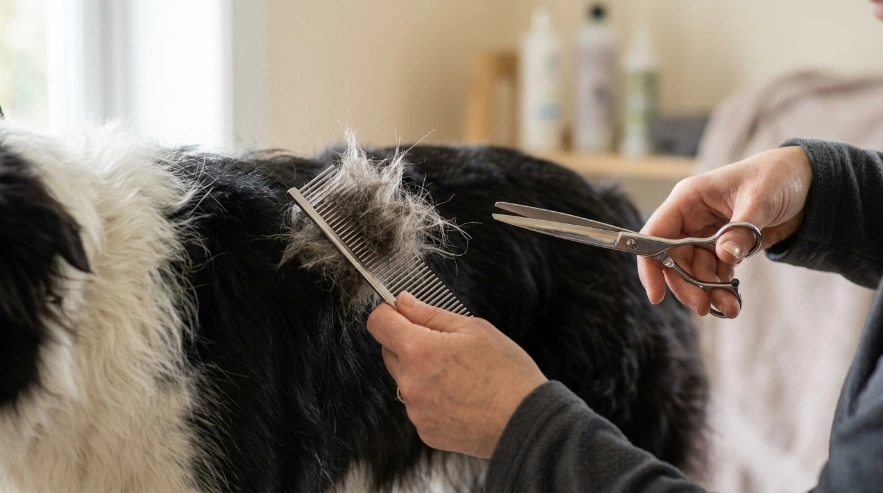
The most common mistakes come from trying to change too much at once. Border Collie coat care is usually maintenance, not a dramatic haircut.
Cutting the double coat too short
Don’t use scissors to drastically shorten the body coat. Removing excessive length can change the natural appearance without solving shedding or undercoat buildup.
Brushing and appropriate undercoat tools do those jobs better. Scissors are for targeted finishing.
Using scissors to remove tight mats
This is one of the risks I take most seriously. A mat can pull thin folds of skin into an area that appears to contain only hair.
Let a groomer handle close matting with appropriate equipment. Don’t try to rescue a mat by cutting blindly underneath it.
Trimming while the dog is restless
Border Collies are quick. A dog can turn its head, lift a foot, or spin toward a sound before you finish closing the blades.
End the session if your dog can’t settle. Five safe minutes are better than forcing a 30-minute grooming session.
Making repeated cuts without combing
Hair changes position after each cut. Comb the area down again so you can see the true outline.
This simple habit prevents the familiar home-grooming cycle of shortening one side, matching the other, then shortening the first side again.
Overusing thinning shears
Blenders look forgiving, but they still remove hair. Too many passes through the same spot can create a thin patch hidden beneath the outer coat.
- Make one or two light passes.
- Comb the area completely.
- Let the coat fall naturally.
- Only then decide whether more blending is needed.
Frequently Asked Questions
Can I use human hair scissors on my Border Collie?
Pet-grooming scissors are the better choice. They come in useful shapes, lengths, and safety-tip designs for working around a dog, while household or human scissors may give you less control for paws and moving body areas.
Should I use straight or curved scissors on a Border Collie?
Start with straight rounded-tip scissors for general home tidying. Curved scissors are helpful for following rounded areas such as feet and the rear outline, but they’re a useful second tool rather than an absolute requirement.
Are thinning shears good for Border Collies?
Yes, especially on a rough-coated Border Collie. Thinning shears can soften obvious cut lines and blend longer feathering, but make only a few passes before combing and checking the result.
Can I cut the hair between my Border Collie’s paw pads?
Excess paw-pad hair may need careful maintenance, but use a suitable small grooming tool and keep the dog still. If you’re unsure how close to work around the pads, ask a groomer or veterinary professional to demonstrate first.
Should I trim my Border Collie’s tail?
Usually, only minor tidying is needed. If long tail feathering becomes dirty or uneven, you can neaten obvious ends while preserving the natural shape rather than shortening the whole tail.
Can I cut mats out of a Border Collie’s coat with scissors?
Don’t use scissors underneath tight or skin-level mats. Matting can pull skin upward where you cannot see it, creating a serious cut risk; difficult mats are safer in the hands of a professional groomer or veterinarian.
How often should I use grooming scissors on a Border Collie?
There’s no fixed scissoring schedule. Inspect the coat during routine brushing and trim only when specific feathering becomes untidy, dirty, or impractical; many smooth-coated Border Collies need almost no routine scissoring.
Final Takeaway
The best grooming scissors for a Border Collie aren’t necessarily the longest or most expensive. For most owners, a controllable 6-inch to 7-inch rounded-tip straight shear and a good pair of thinning shears form a sensible home kit.
Add curved scissors if you regularly shape paws or long feathering. Keep every cut conservative and preserve the natural character of your Border Collie’s double coat.
Most importantly, know where scissors don’t belong. Tight mats, irritated skin, hidden folds, and a dog who won’t stay still are good reasons to stop and call a professional.
With the right tools and a light hand, you can keep your Border Collie neat between professional grooming visits without turning routine coat care into a full haircut.
