

Quick Answer
To mentally tire a Border Collie, combine short training sessions, scent games, food puzzles, problem-solving tasks, and calm sniffing activities. Don’t rely only on running or fetch; the Border Collie’s need for mental stimulation is tied closely to its intelligent herding background.
A simple mental workout
- Start with sniffing: Give your dog 10–20 minutes to explore scents on a relaxed walk.
- Train briefly: Practice a new trick or skill for 5–10 focused minutes.
- Add a search: Hide kibble, treats, or a favorite toy around one room.
- Use the meal: Serve food through a puzzle, snuffle mat, or simple search game.
- Finish calmly: Follow the activity with chewing, settling, or quiet rest.
If your Border Collie, or BC, can run for an hour and still bring you a ball, you’re seeing the difference between physical fatigue and mental satisfaction. These herding dogs were developed to watch, judge movement, respond to cues, and solve problems while working.
I’ve found that the calmest routine usually isn’t the one with the most exercise. It’s the one that gives a busy Border Collie brain several different jobs, followed by permission to switch off.
In This Guide
- What Does It Mean to Mentally Tire a Border Collie?
- What Are the Best Mental Games for a Border Collie?
- How Can Training Mentally Tire a Border Collie?
- Does Sniffing Tire a Border Collie Mentally?
- How Can I Turn Meals Into Mental Exercise?
- How Much Mental Stimulation Does a Border Collie Need?
- Why Won’t My Border Collie Settle After Exercise?
- Frequently Asked Questions
- The Best Way to Tire a Border Collie’s Brain
What Does It Mean to Mentally Tire a Border Collie?
Mentally tiring a Border Collie means giving the dog cognitive work that requires concentration, decision-making, memory, scent use, or impulse control. The goal is satisfaction and healthy fatigue, not frustration or exhaustion.
Definition: A Border Collie’s mental workout is any safe activity that makes the dog process information, solve a problem, make a choice, or control an impulse to earn a useful outcome.
A brisk walk exercises muscles and the cardiovascular system. A scent search or new training task asks your dog to think.
Why physical exercise alone can fail
Border Collies come from a working heritage where stamina was paired with concentration. They weren’t bred to mindlessly run until they became tired.
A working dog had to watch livestock, respond to a handler, predict movement, and change direction. That combination explains why many pet Border Collies still want a job after physical exercise.
- Running: Uses stamina and movement.
- Fetch: Uses movement with some attention and impulse control.
- Scent work: Requires searching, discrimination, and concentration.
- Trick training: Requires communication, memory, and problem-solving.
- Food puzzles: Encourage persistence and independent thinking.
There’s another problem with endlessly increasing exercise. A young, healthy Border Collie can become fitter rather than easier to settle.
If you keep adding harder runs whenever your dog seems energetic, you may build an impressive athlete who still hasn’t learned how to relax indoors.
Mental fatigue should look calm
A good session usually ends with softer body language. Your dog may drink, stretch, chew quietly, or lie down.
Frantic barking, spinning, relentless toy-dropping, or an inability to disengage can mean the activity created more arousal than satisfaction.
Section Takeaway: Mental work should leave your Border Collie satisfied and able to settle. More physical intensity isn’t always the answer.
What Are the Best Mental Games for a Border Collie?
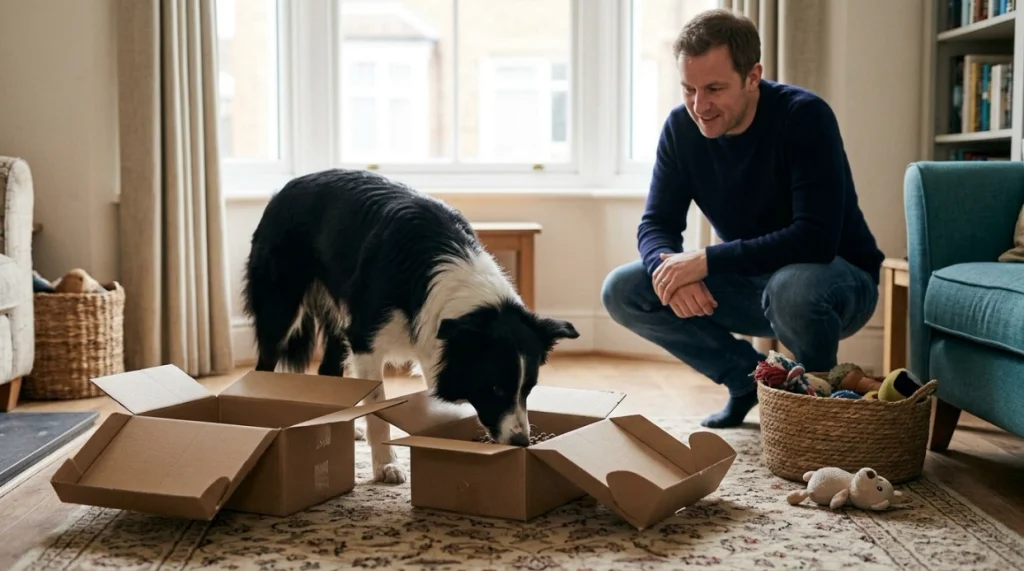
The best mental games make a Border Collie use natural skills such as searching, watching, remembering, choosing, and working with a person. Rotate several games so your dog can’t solve every activity on autopilot.
I prefer simple games before expensive equipment. A handful of kibble, three cardboard boxes, and five minutes can create a useful brain workout.
1. Play “find it”
Ask your dog to wait outside a room. Hide several treats at easy nose height, then release your dog with a consistent cue such as “find it.”
Once your Border Collie understands the game, hide food behind chair legs, beside boxes, or under safe objects. Let the nose solve the problem without pointing to every answer.
2. Teach toy names
Start with one familiar toy. Say its name before presenting or playing with it, then reward your dog for selecting it.
Add a second object only after the first name is reliable. Eventually, you can place several objects together and ask for one by name.
3. Use hide-and-seek
Ask someone to hold your dog while you hide in another room. Call once, then let your Border Collie search.
This combines listening, scenting, memory, and social interaction. It’s especially useful on rainy days.
4. Build a cardboard search box
Place several open cardboard boxes on the floor. Put kibble in one or two boxes and let your dog investigate.
Change box positions between rounds. The ASPCA’s canine enrichment guidance also encourages safe opportunities for dogs to play, smell, chew, forage, and scavenge.
5. Create simple household jobs
- Carry a toy to a basket.
- Find a named family member.
- Touch a target with the nose.
- Put toys away one at a time.
- Bring a lightweight object on cue.
- Find a hidden glove or cloth.
The task doesn’t have to resemble sheep herding. What matters is that the dog understands there’s a goal and must think to reach it.
Section Takeaway: Variety beats duration. Several short thinking games usually provide better enrichment than repeating one exciting activity for an hour.
How Can Training Mentally Tire a Border Collie?
Training is one of the easiest ways to mentally exercise a Border Collie because it combines problem-solving with communication. Five focused minutes can be more useful than drilling known commands for half an hour.
Keep sessions short enough that your dog still wants another repetition. I usually prefer stopping after a good response instead of waiting until concentration disappears.
Train new skills, not only old commands
Repeating “sit” twenty times isn’t much of a puzzle for a trained adult. Ask your dog to learn a new concept or apply a familiar behavior differently.
- Object targeting: Touch a hand, mat, cone, or object.
- Positions: Move from front to heel, middle, or behind.
- Directional cues: Learn left, right, forward, or back.
- Object discrimination: Choose one named toy from several.
- Cooperative care: Offer a paw or rest the chin calmly for handling.
- Tricks: Spin, bow, weave, retrieve, or close a door.
Add impulse control
Border Collies often find movement rewarding, so learning when not to move can be mentally demanding. Useful exercises include waiting at doors, pausing before retrieving a toy, and holding a mat position.
Use rewards rather than turning these exercises into battles. You want thoughtful self-control, not a dog worried about making mistakes.
Try shaping
Shaping means rewarding small steps toward a final behavior rather than physically placing your dog into position. It lets the dog experiment and discover which choices earn reinforcement.
For example, place a box on the floor. Reward looking at it, approaching it, touching it, and eventually putting a paw inside.
That kind of problem-solving can be demanding for an eager Border Collie. Keep the challenge achievable so thinking doesn’t become frustration.
Does Sniffing Tire a Border Collie Mentally?
Yes. Sniffing is a practical form of mental enrichment because your dog must collect and interpret scent information instead of simply moving through the environment.
A sniff walk is different from a fitness walk. You deliberately slow down and give the dog reasonable freedom to investigate safe smells.
Try a 15-minute sniff walk
Choose a safe route and loosen your normal walking pace. Let your Border Collie stop at grass, trees, posts, and other interesting scent points.
You don’t need to cover much distance. The purpose is exploration rather than mileage.
Make scent searches progressively harder
- Scatter several pieces of kibble on short grass.
- Hide treats around one familiar room.
- Place food inside one of several open boxes.
- Hide a favorite toy instead of food.
- Move the search into a new safe environment.
Change only one difficulty at a time. A dog that succeeds stays interested and learns to search carefully.
PetMD’s veterinarian-reviewed guidance also recommends activities such as scent walks, hide-and-seek, and “find it” games as inexpensive ways to provide mental stimulation for dogs.
How Can I Turn Meals Into Mental Exercise?
Meals are one of the easiest enrichment opportunities because you already provide them every day. Instead of always serving food in a bowl, let your Border Collie work safely for part of the meal.
Use your dog’s normal food allowance where practical. That helps prevent enrichment from quietly adding excessive calories.
Easy feeding challenges
- Scatter feeding: Spread kibble across a safe patch of grass.
- Snuffle mat: Hide dry food among fabric strips.
- Puzzle feeder: Let your dog manipulate compartments for food.
- Rolled towel: Fold kibble loosely inside a towel for supervised searching.
- Muffin tin: Put kibble in several cups and cover some with safe toys.
- Training meal: Use part of dinner as rewards for learning new skills.
Supervise homemade puzzles. Remove cardboard, cloth, plastic, or other materials if your dog begins shredding and swallowing them.
Don’t make every puzzle difficult
An enrichment activity should create productive effort. It shouldn’t make the dog increasingly frantic because the food is impossible to reach.
If your Border Collie paws violently, barks at the puzzle, or gives up, simplify it. Success is part of the enrichment.
How Much Mental Stimulation Does a Border Collie Need?
There isn’t one exact number that suits every Border Collie. Age, temperament, health, previous training, physical exercise, and daily routine all change what an individual dog needs.
As of 2026, I’d focus more on several purposeful sessions across the day than chasing a fixed number of “mental exercise minutes.”
| Activity | Starter Session | Mental Demand | Physical Demand | Best Use |
|---|---|---|---|---|
| New trick training | 5–10 minutes | High | Low–moderate | Learning and focus |
| Find-it game | 5–15 minutes | High | Low | Indoor enrichment |
| Sniff walk | 15–30 minutes | Moderate–high | Low–moderate | Calm exploration |
| Puzzle meal | 10–20 minutes | Moderate | Low | Daily routine |
| Fetch | 10–20 minutes | Low–moderate | High | Physical outlet |
A practical daily pattern
You don’t need to entertain your Border Collie continuously. A balanced adult routine can mix movement, thinking, social time, and genuine downtime.
- Morning: Walk with several minutes of sniffing plus a short training session.
- Breakfast: Puzzle feeder, scatter feeding, or training rewards.
- Midday: Short search game or calm interaction when practical.
- Evening: Physical exercise followed by scent work or skill practice.
- Night: Calm chewing, mat settling, and undisturbed rest.
Puppies need age-appropriate activity and plenty of sleep. Senior dogs may enjoy scent searches and gentle training without demanding high-impact exercise.
Vet note: If your Border Collie has pain, mobility problems, a medical condition, or a sudden change in energy, ask your veterinarian to help you choose suitable activities.
Section Takeaway: Think in short blocks across the day. Mental work, physical exercise, and rest should support each other rather than compete.
Why Won’t My Border Collie Settle After Exercise?
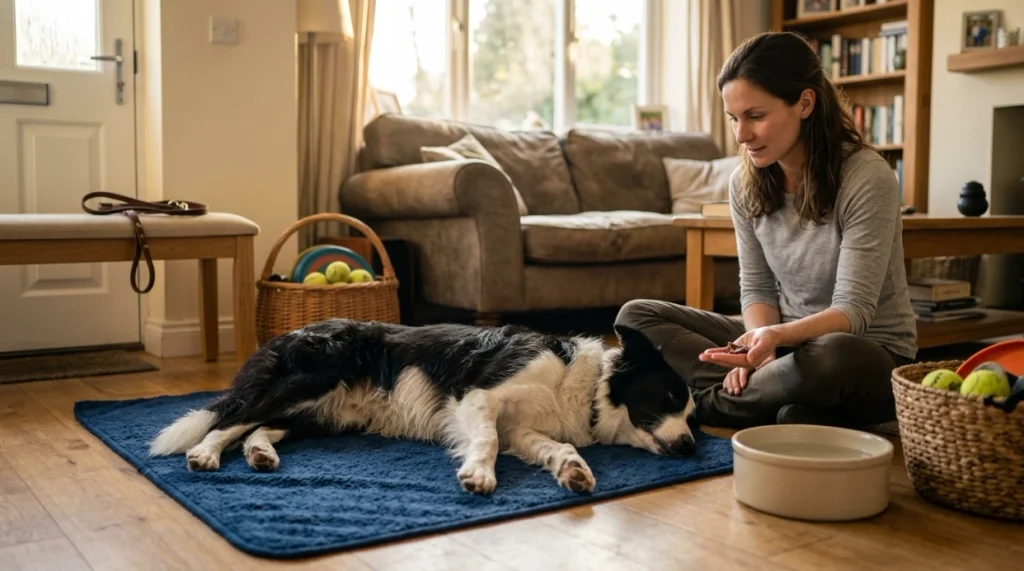
A Border Collie that remains frantic after plenty of exercise may need better mental enrichment, lower-arousal activities, more sleep, or specific settle training. More running isn’t automatically the cure.
Watch the pattern around the behavior. What happens before the pacing, barking, staring, toy-demanding, or shadow chasing begins?
Common mistakes that keep Border Collies switched on
- Endless ball throwing: Constant high-speed repetition can keep excitement elevated.
- No quiet routine: The dog never learns that parts of the day are boring and safe.
- Only easy training: Repeating mastered cues provides little cognitive challenge.
- Too much entertainment: The dog learns to expect human activity every waking minute.
- Too little sleep: An overtired dog may look restless instead of peacefully sleepy.
Teach an off-switch
Choose a mat or bed and reward calm behavior there. Start when your Border Collie is already reasonably relaxed, not during peak excitement.
Reward lying down, softer posture, and remaining on the mat. Gradually increase the time between rewards.
I like finishing brain games with the same simple routine: water, a calm activity, then quiet time. That predictable change of pace tells the dog the work period has ended.
Know when behavior needs more than enrichment
Persistent spinning, light or shadow chasing, self-injury, extreme anxiety, sudden behavior changes, or an inability to settle despite an appropriate routine deserve professional attention. Enrichment can help many dogs, but it isn’t a diagnosis or treatment for every behavior problem.
Vet note: Speak with your veterinarian if repetitive or anxious behavior is intense, worsening, sudden, or difficult to interrupt. A qualified veterinary behavior professional may also be appropriate.
Section Takeaway: A mentally fulfilled Border Collie also needs to learn how to do nothing. Calmness is a skill you can reinforce.
Frequently Asked Questions
How do I tire out a Border Collie indoors?
Use short trick-training sessions, hide-and-seek, treat searches, toy-name games, puzzle feeders, and supervised scent boxes. Rotate activities rather than extending one game until your dog becomes bored or overexcited.
Is mental stimulation better than physical exercise for Border Collies?
Neither replaces the other. Border Collies generally do best with a combination of physical movement, cognitive work, social interaction, training, and enough rest.
Can 10 minutes of training tire a Border Collie?
Ten focused minutes can create useful mental fatigue when your dog is learning something new or solving a problem. A familiar exercise repeated mechanically will usually be less demanding than a new task.
What can I give my Border Collie to do while I’m busy?
A suitable puzzle feeder, stuffed food toy, snuffle activity, safe chew, or supervised search game can help. Choose items that match your dog’s chewing style and remove anything they may destroy and swallow.
Why is my Border Collie still hyper after a long walk?
The walk may have exercised your dog’s body without providing enough problem-solving or sniffing. Excitement, insufficient rest, learned attention-seeking, or other behavior and health factors can also affect settling.
Do Border Collies need a job?
They don’t need sheep or a formal working role, but many thrive when they have purposeful tasks. Training, scent work, agility foundations, toy retrieval, tricks, and household games can all provide that sense of structured work.
Can too much mental stimulation be bad?
Yes. Constant difficult tasks can create frustration or keep an already excitable dog switched on. Mix challenging activities with easy wins, physical exercise, calm enrichment, and protected rest periods.
The Best Way to Tire a Border Collie’s Brain
The best way to mentally tire a Border Collie is to make the dog think, search, learn, choose, and then settle. You don’t need hours of complicated games or a house full of puzzle toys.
Start with one 5–10 minute training session, one sniff-heavy walk, and one simple food or scent search each day. Watch how your individual Border Collie responds, then adjust the challenge instead of simply adding more exercise.
A fulfilled Border Collie shouldn’t just be exhausted. The goal is a dog that has used its remarkable brain, enjoyed working with you, and can comfortably relax when the job is done.
