
Best Deshedding Tool for Border Collie: Complete 2026 Guide

Quick Answer
The best deshedding tool for a Border Collie is usually a gentle undercoat rake, especially during heavy seasonal shedding. A slicker brush works better for regular maintenance, while aggressive bladed tools should be used sparingly because a Border Collie’s double coat needs protection, not stripping. The AKC double-coat grooming guidance also emphasizes maintaining rather than shaving the protective coat.
Best tools by grooming need
- Best overall: A rounded-tooth undercoat rake lifts loose seasonal undercoat without needing excessive pressure.
- Routine brushing: A slicker brush catches loose hair and handles light tangles between heavier shedding periods.
- Rough coats: A pin brush plus metal comb works well around feathering, ears, legs, and the tail.
- Smooth coats: A slicker or grooming glove may handle much of the routine loose hair.
- Heavy coat blow: Use an undercoat rake in short sessions and stop once loose hair stops releasing easily.
- Bladed tools: Use light pressure and fewer passes to avoid repeatedly working healthy guard hairs.
My simple rule
- If I have to press hard or repeatedly scrape one area, I switch tools instead of fighting the coat.
Border Collies, often called Borders or working sheepdogs, can leave an impressive amount of hair around the house. Both rough and smooth Border Collies have double coats, so choosing the right deshedding tool matters more than buying the most aggressive one.
I prefer a small grooming kit instead of expecting one tool to solve every coat problem. In this guide, I’ll show you which tools work best, how I use them, and how to remove loose undercoat without overworking healthy hair.
In This Guide
- What Is the Best Deshedding Tool for a Border Collie?
- Why Does the Border Collie’s Double Coat Change Tool Choice?
- Undercoat Rake vs Slicker vs Deshedding Blade: Which Is Better?
- Does a Rough or Smooth Border Collie Need a Different Tool?
- How Do You Deshed a Border Collie Safely?
- How Often Should You Deshed a Border Collie?
- What Deshedding Mistakes Should You Avoid?
- Frequently Asked Questions
- Final Takeaway
What Is the Best Deshedding Tool for a Border Collie?
For most Border Collies, my first choice is a rounded-tooth undercoat rake during heavy shedding. It reaches beneath the outer coat and lifts loose undercoat with less temptation to scrape repeatedly over the same area.
A slicker brush is my everyday companion. It handles loose surface hair, small tangles, and routine coat maintenance better than a heavy-duty deshedding tool.
Why an undercoat rake wins during shedding season
The goal is to remove hair that is already loose. You don’t need to pull healthy coat out to make a Border Collie look tidy.
- Reaches the undercoat: Long enough teeth can work beneath the guard hairs when used correctly.
- Covers larger areas: It works efficiently across the shoulders, sides, chest, and rear.
- Easy to control: You can feel resistance and stop before tugging through knots.
- Useful seasonally: It becomes especially helpful when the undercoat releases heavily.
- Works on both coat types: Rough and smooth Borders can both carry dense seasonal undercoat.
Why I still keep a slicker brush nearby
A rake isn’t my first choice for every grooming session. When shedding is light, a slicker often removes enough loose hair without bringing out heavier equipment.
The American Kennel Club’s guide to choosing dog brushes also notes the value of selecting brushes according to coat type. That matters with a breed whose undercoat sits beneath protective outer hair.
Definition: A Border Collie deshedding tool is a grooming tool designed to reach and remove loose, dead hair from the coat before that hair falls naturally around your home. It should remove released coat without requiring force against healthy hair or skin.
Section Takeaway: For heavy shedding, start with a gentle undercoat rake. For normal weekly maintenance, a slicker brush is usually the more practical everyday tool.
Why Does the Border Collie’s Double Coat Change Tool Choice?
A Border Collie’s double coat contains a softer insulating undercoat beneath more protective outer hairs. Both rough-coated and smooth-coated Border Collies have this basic two-layer structure.
The AKC identifies Border Collies as medium double-coated dogs and recommends regular brushing to remove loose fur. PetMD also describes the breed as a regular shedder that benefits from routine brushing.
The outer coat and undercoat do different jobs
- Undercoat: Softer, denser hair provides insulation and is responsible for much seasonal shedding.
- Outer coat: Coarser guard hairs help protect the skin and repel dirt and moisture.
- Rough coat: Longer hair and feathering make hidden tangles easier to miss.
- Smooth coat: Shorter outer hair simplifies inspection, but the undercoat still sheds.
This is why I don’t choose a tool simply by asking which one removes the biggest pile of hair. A dramatic pile on the floor isn’t proof that the grooming session was better.
Seasonal shedding changes the job
Border Collies can shed throughout the year and lose more undercoat during seasonal changes. In those periods, daily light brushing may be more comfortable than one long weekly marathon.
As of 2026, mainstream coat-care guidance still favors regular brushing over shaving double-coated dogs. The coat should be maintained, not removed as a shortcut for shedding.
- Use a slicker or pin brush when shedding is light.
- Add an undercoat rake when loose undercoat builds up.
- Use a comb to check areas where longer hair hides knots.
- Reduce pressure whenever a tool catches or stops moving smoothly.
Undercoat Rake vs Slicker vs Deshedding Blade: Which Is Better?
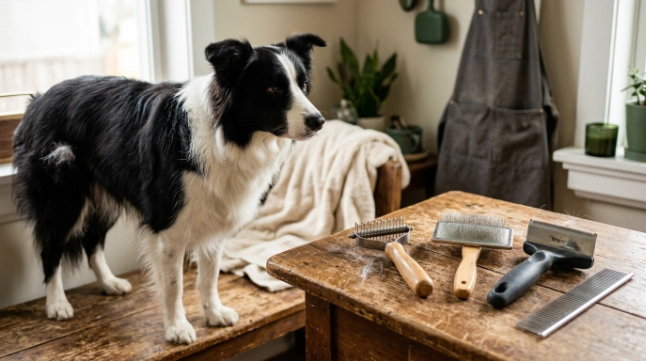
An undercoat rake is the strongest all-around choice for a Border Collie’s heavy seasonal shed, while a slicker is better for regular maintenance. A bladed deshedding tool can work quickly, but technique matters more because repeated aggressive passes can overwork the coat.
| Tool | Best Use | Typical Frequency | Main Advantage | Use With Care |
|---|---|---|---|---|
| Undercoat rake | Heavy loose undercoat | As needed during coat blow | Reaches dense undercoat | Don’t pull through knots |
| Slicker brush | Routine loose hair and light tangles | About 1–3 times weekly | Versatile everyday tool | Avoid scraping skin |
| Pin brush | Rough coat and feathering | Routine grooming | Gentle coat separation | May miss dense undercoat |
| Metal comb | Final tangle check | After brushing | Finds hidden knots | Never yank resistance |
| Deshedding edge | Loose undercoat during strong shedding | Short, occasional sessions | Removes hair quickly | Overuse and heavy pressure |
| Grooming glove | Surface hair and grooming training | Several times weekly if useful | Easy for sensitive dogs | Limited undercoat reach |
Do you need more than one brush?
Usually, yes. My basic Border Collie kit is an undercoat rake, slicker or pin brush, and stainless-steel comb.
That combination handles loose undercoat, surface brushing, and final checks without asking one aggressive tool to do everything.
Does a Rough or Smooth Border Collie Need a Different Tool?
The basic tools remain similar, but rough-coated Border Collies usually need more attention around long feathering. Smooth-coated Borders often need less detangling, though their undercoat can still shed heavily.
Best setup for a rough-coated Border Collie
- Pin or slicker brush: Work through the body and longer outer coat.
- Undercoat rake: Use when dead undercoat is releasing beneath the longer hair.
- Metal comb: Check behind the ears, chest, trousers, tail, and leg feathering.
- Detangling first: Deal with knots before using a shedding tool over them.
Long hair can make a Border appear fully brushed while loose coat remains underneath. I part the coat with my fingers and work through one small area at a time.
Best setup for a smooth-coated Border Collie
- Slicker brush: Useful for regular loose hair.
- Grooming glove: Convenient for surface hair and quick maintenance.
- Undercoat rake: Helpful when the seasonal undercoat becomes noticeably loose.
- Comb: Useful for checking dense areas even when tangles are uncommon.
Don’t mistake a shorter outer coat for a single coat. A smooth Border Collie still needs double-coat maintenance.
How Do You Deshed a Border Collie Safely?
Deshed a Border Collie by working on a dry, detangled coat with light pressure and short strokes in the direction of hair growth. Stop when the tool stops collecting loose hair easily instead of continuing until the coat looks thin.
My step-by-step deshedding routine
- Check the skin. Look for redness, sores, lumps, bald areas, ticks, or painful spots before brushing.
- Remove obvious tangles. Use your fingers, a suitable brush, or a comb before reaching for the undercoat tool.
- Start at the shoulders. Work toward the body, rear, and sides in manageable sections.
- Follow hair growth. Avoid repeatedly dragging a tool backward against the natural coat direction.
- Keep pressure light. The teeth should move through loose hair without scraping the skin.
- Clean the tool often. Removing collected hair lets you see whether the coat is still releasing.
- Check with a comb. Use the comb to find remaining tangles rather than repeatedly raking one spot.
- Finish gently. A pin or slicker brush can tidy the coat after the heavier undercoat work.
How long should a session take?
I prefer several short sessions to one exhausting session. Ten controlled minutes can accomplish more than thirty rushed minutes with an impatient dog.
On a heavy shedding day, I may work one side of the dog, take a break, then continue later. Border Collies learn routines quickly, and calm grooming is easier to repeat.
Watch your dog’s body language
- Repeatedly turning toward the brush
- Moving away from your hand
- Sudden stiffness
- Lip licking or yawning
- Trying to sit on the area you’re grooming
- Attempting to leave
Those signals tell me to inspect the coat and reduce pressure. Grooming should not become a contest of persistence.
Section Takeaway: Deshedding should feel like lifting loose coat, not scraping or pulling hair free. Light pressure, detangling first, and short sessions protect both the coat and your dog’s tolerance for grooming.
How Often Should You Deshed a Border Collie?
Most Border Collies benefit from regular brushing throughout the year and more frequent grooming when seasonal shedding increases. You don’t need to use an undercoat rake every time you pick up a brush.
PetMD recommends regular Border Collie brushing and notes that the breed sheds year-round. Its veterinarian-reviewed Border Collie care guide describes brushing two to three times weekly as a useful routine.
A practical schedule
- Normal weeks: Brush around two or three times, adjusting for your dog’s coat.
- Heavy shedding: Short daily sessions can prevent loose undercoat from accumulating.
- After muddy adventures: Let suitable dirt dry, remove debris, then brush carefully.
- Before bathing: Remove loose coat and manageable tangles before adding water.
- After drying: A light finishing brush can collect hair loosened during the bath.
The AKC’s current guidance on managing dog shedding likewise recommends increased grooming when double-coated dogs release more undercoat. Frequency should follow what the coat is doing rather than a rigid calendar.
Don’t chase a hair-free coat
A healthy Border Collie will continue to shed. Deshedding controls loose hair; it doesn’t switch off the normal hair-growth cycle.
If my rake stops filling quickly, I put it down. Continuing because I can still extract a few hairs risks turning useful grooming into over-grooming.
What Deshedding Mistakes Should You Avoid?
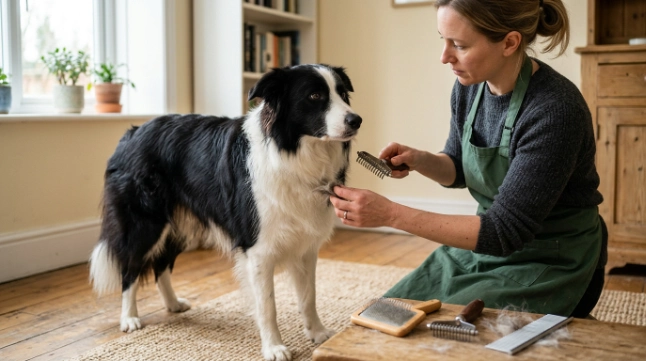
The most common mistake is assuming more removed hair always means better grooming. The goal is a comfortable, healthy double coat, not the largest pile of fur.
1. Pressing too hard
A shedding tool shouldn’t scrape the skin. If you need force to move it, check for a knot or switch tools.
2. Raking through mats
An undercoat rake is not a substitute for careful detangling. Pulling a mat with a rake can tug painfully on the skin.
3. Repeating stroke after stroke on one area
Constantly working the same patch can irritate skin and overwork the coat. Move through the dog methodically and stop once loose hair decreases.
4. Shaving to control shedding
Shaving a Border Collie’s double coat is not a routine shedding solution. The outer and inner coat layers have protective roles, and shaving does not stop the biological shedding cycle.
5. Assuming every hair problem is normal shedding
Normal shedding is different from bald spots, inflamed skin, sores, severe itching, or sudden patchy hair loss. Those changes need attention beyond a different brush.
Vet note: Contact your veterinarian if shedding is accompanied by bald patches, persistent itching, redness, sores, swelling, odor, pain, or an unexplained major change in the coat.
6. Ignoring grooming tolerance
I introduce tools gradually and reward calm behavior, especially with puppies. A Border Collie that trusts the grooming routine is far easier to maintain throughout life.
- Let the dog investigate the tool first.
- Start with a few gentle strokes.
- Reward calm standing or lying down.
- Keep early sessions short.
- Finish before frustration appears.
Section Takeaway: The safest deshedding routine removes what is already loose and stops there. Pain, skin irritation, or unusual hair loss is a reason to investigate, not brush harder.
Frequently Asked Questions
What brush removes the most Border Collie hair?
An undercoat rake or dedicated deshedding tool can remove large amounts of loose undercoat during seasonal shedding. However, removing the most hair should not be your only goal. A slicker brush is often better for routine maintenance because it gives you more control.
Is a FURminator-style deshedding tool safe for Border Collies?
A bladed deshedding edge can be used on some Border Collies when the product is suitable for the coat and pressure remains light. I prefer fewer controlled passes rather than repeatedly working one area, especially on a rough coat with longer guard hairs.
Is an undercoat rake better than a slicker brush?
Neither tool is better for every job. An undercoat rake is better for dense, loose seasonal undercoat, while a slicker brush is more useful for routine grooming, loose surface hair, and light tangles.
Should I deshed my Border Collie before or after a bath?
Brush thoroughly before bathing to remove loose hair, debris, and tangles. Once the coat is fully dry, a second light brushing can remove additional undercoat loosened during washing and drying.
Can I use a deshedding tool every day?
Daily light brushing can help during a heavy coat blow, but an aggressive undercoat or bladed tool does not need daily use for every dog. Switch to a gentler brush when there is little loose undercoat left to remove.
Do smooth Border Collies need deshedding?
Yes. Smooth Border Collies have shorter outer coats, but they still have double coats and can release significant undercoat. A slicker or grooming glove may handle routine shedding, with an undercoat rake reserved for heavier periods.
Why is my Border Collie suddenly shedding so much?
Seasonal coat changes can cause a noticeable increase in loose undercoat, especially around major weather changes. If shedding becomes patchy or comes with itching, redness, sores, odor, pain, or other symptoms, contact your veterinarian rather than assuming it is normal.
Final Takeaway
The best deshedding tool for a Border Collie is usually a gentle undercoat rake for heavy shedding, backed up by a slicker or pin brush for routine coat care. A metal comb completes the kit by finding hidden tangles before they become painful problems.
I don’t judge a grooming tool by how dramatic the pile of hair looks afterward. I judge it by whether loose coat comes away easily while the skin and protective outer coat remain comfortable and intact.
- Choose an undercoat rake for seasonal loose coat.
- Use a slicker or pin brush for regular maintenance.
- Add a metal comb for checking hidden tangles.
- Match the routine to rough or smooth coat density.
- Work with light pressure in the direction of hair growth.
- Use shorter, more frequent sessions during heavy shedding.
- Never shave a healthy double coat simply to reduce shedding.
- Stop and investigate if grooming becomes painful or the skin looks abnormal.
As of 2026, the simplest approach is still the one I trust most: remove loose undercoat regularly, protect healthy coat, and make grooming comfortable enough that your Border Collie is willing to do it again next time.
