

Quick Answer
A good routine for a Border Collie balances physical exercise, mental work, short training sessions, meals, social time, and genuine rest. Healthy adult Borders usually do best when activity is spread across the day instead of packed into one exhausting workout, which fits the Border Collie’s working-dog temperament.
A simple daily routine
- 1. Start moving: Give your dog a purposeful morning walk, sniffing time, or age-appropriate exercise.
- 2. Work the brain: Add five to ten minutes of obedience, tricks, scent work, or problem-solving.
- 3. Feed with purpose: Use some meals for training, food puzzles, or calm enrichment when suitable.
- 4. Schedule rest: Give your Border Collie quiet periods instead of providing entertainment all day.
- 5. Exercise again: Add an afternoon or evening walk, structured game, hike, or dog sport.
- 6. Finish calmly: End the day with sniffing, chewing, grooming, mat work, or relaxed family time.
Border Collies, often called Borders or BCs, usually thrive on structure because they were developed to think while working. A routine gives that busy brain predictable times to move, learn, engage, and switch off.
I prefer several useful activity blocks instead of trying to exhaust a Border Collie in one session. This 2026 guide shows how to build that balance without accidentally creating a dog that expects nonstop entertainment.
In This Guide
- What Should a Good Border Collie Routine Include?
- What Is a Good Daily Schedule for an Adult Border Collie?
- How Much Exercise Should Be in the Routine?
- How Much Mental Stimulation Does a Border Collie Need?
- Where Do Meals, Rest, and Alone Time Fit?
- How Should the Routine Change With Age?
- What Should Be in a Weekly Border Collie Routine?
- How Do You Know the Routine Is Not Working?
- Frequently Asked Questions
What Should a Good Border Collie Routine Include?
A good Border Collie routine should meet several needs rather than focusing only on exercise. Movement matters, but these dogs were also bred to watch, decide, respond, and cooperate.
A Border Collie’s daily routine is a repeatable pattern of physical activity, mental work, training, basic care, social connection, and rest. It should create a dog that can enjoy activity and settle afterward.
Build the day around six needs
- Physical exercise: Walking, hiking, running when appropriate, active play, swimming, or dog sports.
- Mental enrichment: Scent games, food puzzles, searching, problem-solving, and exploring new environments.
- Training: Short sessions involving recall, loose-leash walking, stays, tricks, handling, or useful household skills.
- Natural behavior: Sniffing, chewing safe items, exploring, carrying toys, and using the nose.
- Social contact: Calm interaction with family and appropriate exposure to people, animals, and environments.
- Rest: Uninterrupted periods when your dog is not expected to perform, chase, train, or play.
The breed’s famous herding instinct is an inherited tendency to notice and control movement. It can appear as staring, stalking, circling, chasing, or trying to influence other animals and people.
Structure gives those instincts better outlets. It also prevents the entire day from becoming one long request for a ball throw.
What Is a Good Daily Schedule for an Adult Border Collie?
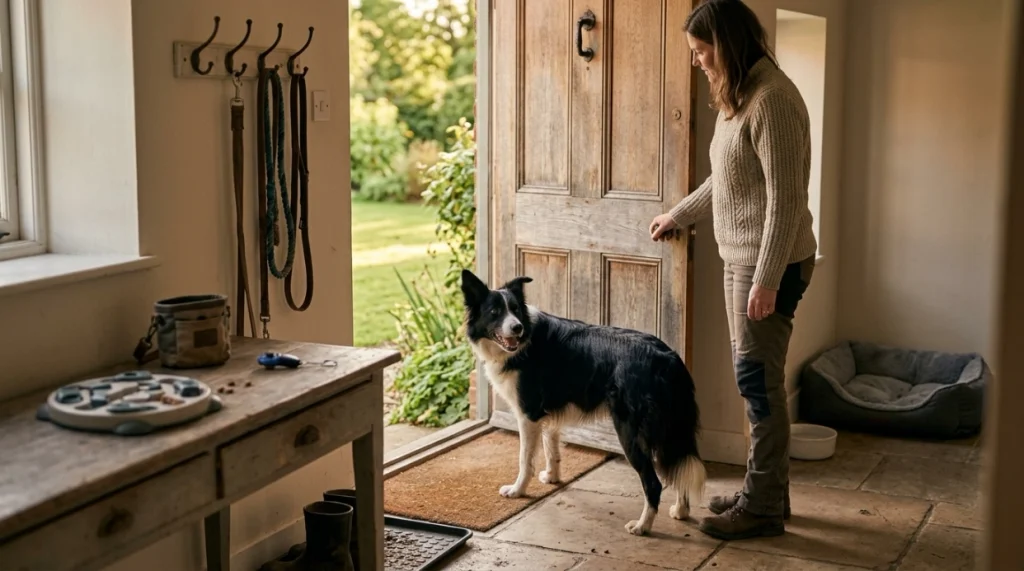
A healthy adult Border Collie often does well with three main engagement periods separated by quiet time. Exact timing matters less than consistency and balance.
Morning: movement plus focus
- Potty break after waking.
- 30–45 minute brisk walk, sniff walk, or suitable exercise.
- 5–10 minutes of recall, heelwork, positions, or trick training.
- Breakfast after activity.
- Quiet rest while the household starts its day.
I like morning walks that include both purposeful movement and permission to sniff. Marching quickly for the entire walk can miss one of the easiest forms of mental enrichment.
Midday: short mental work
- Potty break or short walk.
- 5–15 minutes of scent work, a puzzle, or training.
- A safe chew or calm enrichment activity.
- Another rest period afterward.
Midday does not need to become a second marathon. A small thinking task can break up the day without keeping your dog permanently aroused.
Late afternoon or evening: main activity
- 30–60 minutes of walking, hiking, structured fetch, swimming, or another suitable activity.
- A few minutes of obedience or impulse-control work.
- Dinner and water.
- Calm family time afterward.
Before bed: lower the intensity
Use the final part of the evening for a short toilet walk, gentle sniffing, grooming, or settling on a mat. Avoid turning bedtime into the day’s most exciting play session.
One useful test is simple: your dog should expect activity at predictable times, but also know that nothing interesting happens during rest periods.
Section Takeaway: A good adult schedule alternates activity and recovery. Several balanced sessions usually work better than one exhausting workout followed by hours of boredom.
How Much Exercise Should Be in the Routine?
Many healthy adult Border Collies need roughly 90 minutes to two hours of purposeful physical activity across the day. Some individuals need more or less depending on fitness, temperament, weather, health, and activity type.
Exercise quality matters too. The American Kennel Club notes that this high-energy herding breed needs substantial activity and meaningful work, not only a quick walk around the block.
Mix different forms of movement
- Brisk walking: Builds everyday fitness while giving you training opportunities.
- Sniff walks: Slow the pace and let your dog investigate the environment.
- Free movement: Safe off-leash exploration can allow more natural movement where legal and appropriate.
- Structured games: Tug, retrieving, and controlled toy play can combine movement with rules.
- Dog sports: Agility, herding, obedience, rally, and similar activities can challenge body and mind together.
Don’t assume more intensity always creates a calmer dog. Endless high-speed fetch can improve stamina while making some dogs increasingly obsessed with the game.
One pattern I watch for is a dog that finishes exercise more frantic than before it started. That dog may need less repetitive adrenaline-heavy play and more sniffing, training, and recovery.
Heat, humidity, hard surfaces, and your dog’s conditioning also matter. Reduce intensity when conditions make strenuous exercise unsafe.
Vet note: Ask your veterinarian for individual exercise guidance if your Border Collie has pain, mobility problems, breathing concerns, a medical condition, or a sudden change in stamina.
How Much Mental Stimulation Does a Border Collie Need?
Border Collies need daily opportunities to think, but mental work does not have to last for hours. Several focused sessions of five to fifteen minutes can be surprisingly effective.
The ASPCA’s canine enrichment guidance also emphasizes activities that let dogs sniff, search, chew, play, and solve simple problems.
Use mental activities that have a purpose
- Hide food around one room and ask your dog to find it.
- Teach names for two or three toys.
- Practice settling on a mat while you move around.
- Work on recall around gradually harder distractions.
- Scatter part of a meal safely in grass for searching.
- Teach simple tricks such as spin, touch, middle, or toy retrieval.
- Use food puzzles appropriate for your dog’s chewing style.
Training is part of enrichment
Training gives a Border Collie something the breed tends to value: clear information and a problem to solve. Keep sessions short enough that the dog still wants another repetition.
Positive reinforcement works especially well for teaching everyday skills. Reward the behavior you want with food, toys, access to an activity, or another reward your dog values.
Teach an off-switch too
One overlooked Border Collie skill is doing nothing. A dog should learn that lying quietly while you work, cook, watch television, or talk with visitors is normal.
You can reinforce calm choices without constantly giving commands. Quietly reward relaxed behavior, then let the dog return to resting.
Section Takeaway: Mental stimulation should make your Border Collie thoughtful, not permanently busy. Train the brain, then deliberately practice calmness.
Where Do Meals, Rest, and Alone Time Fit?
Exercise and training are only part of a sustainable routine. Eating, sleeping, independence, and quiet family time deserve scheduled space too.
Keep meals predictable
Many adult dogs eat once or twice daily, while puppies usually need more frequent meals. Follow your veterinarian’s feeding guidance and the needs of your individual dog.
You can reserve a portion of the daily food allowance for training or enrichment. Count it as part of the day’s food rather than automatically adding extra calories.
Protect genuine rest periods
Driven dogs don’t always make sensible decisions about stopping. Some Border Collies will keep chasing a ball long after thoughtful activity would have been better.
Create a quiet sleeping area and let rest remain boring. Don’t wake a sleeping dog simply because you have free time for another game.
Practice reasonable independence
A Border Collie that receives attention every waking minute may struggle when nobody is available. Build calm independent time gradually, especially with puppies and newly adopted dogs.
Start with manageable periods where the dog can rest safely without constant interaction. Increase difficulty based on behavior rather than forcing long absences immediately.
The goal is not emotional distance. You’re teaching that together-time and separate-time are both normal parts of life.
How Should the Routine Change With Age?
A puppy, athletic adult, and senior Border Collie should not follow the same exercise plan. Age changes stamina, recovery, training priorities, and physical risk.
| Life Stage | Main Routine Priority | Good Activities | Watch For |
|---|---|---|---|
| Puppy | Learning, socialization, sleep | Short walks, play, handling, brief training, exploration | Overtired behavior and excessive repetitive impact |
| Adolescent | Impulse control and consistency | Recall, sniffing, varied walks, structured games | Chasing, over-arousal, selective listening |
| Healthy Adult | Balanced physical and mental work | Hiking, training, sports, scent work, active play | Too little recovery or obsessive exercise |
| Senior | Mobility, comfort, mental engagement | Shorter walks, sniffing, gentle training, food searches | Stiffness, pain, slower recovery, sudden decline |
Puppies need learning more than endurance
Don’t try to create a tired puppy through long forced exercise. Use short sessions of exploration, socialization, play, training, toilet breaks, meals, and plenty of sleep.
Adolescents need boundaries
Adolescent Borders can have adult-sized energy before they have adult self-control. This is the stage where recall, settling, lead manners, and disengaging from movement become valuable.
Seniors still need a job
Older Border Collies may slow physically without losing their interest in thinking. Short scent searches, easy tricks, and slower exploratory walks can maintain engagement without demanding high impact.
Vet note: A senior dog that suddenly becomes reluctant to exercise, stiff, weak, confused, or unusually tired should be assessed by a veterinarian rather than simply given less activity.
What Should Be in a Weekly Border Collie Routine?
Daily exercise gets the attention, but routine care keeps the whole dog comfortable. Both rough-coated and smooth-coated Border Collies have double coats and benefit from regular grooming.
Add these jobs across the week
- Brush the coat: Check the undercoat, behind the ears, feathering, tail, and other tangle-prone areas.
- Check paws: Look for cuts, worn pads, burrs, cracks, or damaged nails after active outings.
- Check ears: Notice unusual odor, discharge, redness, or persistent scratching.
- Inspect teeth: Maintain an appropriate dental-care routine recommended by your veterinarian.
- Review body condition: Watch for gradual weight gain or loss instead of relying only on the scale.
- Change activities: Rotate walking routes and training tasks so the routine stays interesting.
The ASPCA dog-care resources provide broader guidance covering grooming, nutrition, health, and behavior. Regular veterinary care should remain part of your dog’s long-term routine as well.
You don’t need to create a complicated weekly calendar. Attach small care jobs to habits you already have, such as brushing after an evening walk.
How Do You Know the Routine Is Not Working?
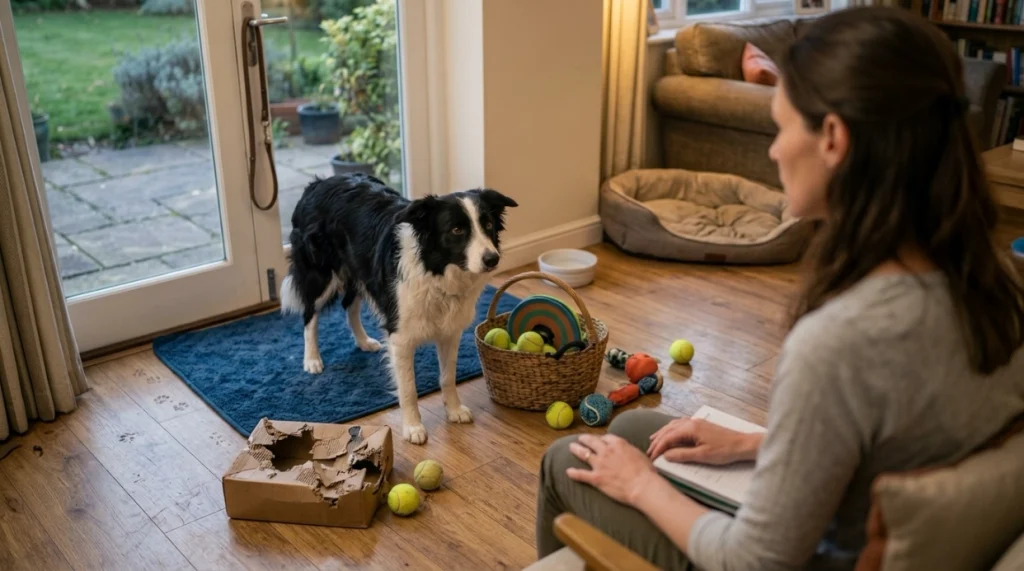
A good routine should leave your Border Collie engaged during activities and increasingly capable of relaxing between them. Constant chaos is not proof that the dog simply needs more exercise.
Possible signs of too little appropriate stimulation
- Persistent attention-seeking.
- Destructive chewing or digging.
- Excessive barking.
- Pacing or difficulty settling.
- Inventing repetitive chase games.
- Constantly bringing toys and demanding activity.
- Herding family members or other pets more intensely.
Possible signs you are doing too much
- Stiffness or limping.
- Sore or damaged paw pads.
- Slower recovery after exercise.
- Increasing obsession with balls or moving objects.
- Difficulty settling after exciting games.
- Irritability or unusual fatigue.
- Reluctance to begin normal activities.
Don’t automatically answer restlessness with another run. AKC training guidance on high-energy dogs and settling supports combining appropriate exercise with practical training and meaningful work.
Instead, look at the full day. Your dog may need more sniffing, clearer training, fewer frantic games, better sleep, or a more predictable schedule.
Change one variable at a time
If the routine feels wrong, adjust one part for several days and watch the result. Changing exercise, food puzzles, training, walks, and bedtime simultaneously makes it difficult to learn what helped.
Sudden changes are different. New lethargy, pain, appetite loss, unusual panting, weakness, or major behavior changes justify veterinary attention.
Vet note: Persistent behavioral or physical changes can have medical causes, so speak with your veterinarian when something feels significantly different from your dog’s normal pattern.
Section Takeaway: The best routine does not create the most exhausted Border Collie. It creates a dog that can exercise, think, cooperate, recover, and settle comfortably.
Frequently Asked Questions
Should a Border Collie have the same routine every day?
The basic rhythm can stay consistent, but individual activities should vary. Keep predictable times for exercise, meals, training, and rest while rotating routes, games, scents, skills, and environments to prevent boredom.
Is two walks a day enough for a Border Collie?
Two walks may form the foundation of a routine, but many healthy adults also need mental enrichment, training, and purposeful activity. A slow sniff walk plus an active outing can be more useful than two identical pavement walks.
How many hours should I play with my Border Collie?
You usually don’t need hours of continuous interactive play. Split attention into manageable sessions and combine play with walks, training, enrichment, social contact, and independent rest.
How long should Border Collie training sessions be?
Five to fifteen focused minutes is enough for many everyday sessions. Several short practices often maintain enthusiasm and precision better than one long session where the dog becomes tired or frustrated.
Should I tire my Border Collie out before leaving home?
Some appropriate activity before alone time can help, but avoid creating a pattern where departure always follows intense excitement. A walk, sniffing, brief training, food enrichment, and a calm transition often make more sense.
Do Border Collies need a job every day?
They benefit from purposeful activity, but a “job” does not have to mean sheep herding. Training, scent searches, carrying out household tricks, dog sports, puzzle feeding, or structured games can all provide useful mental work.
What is the best evening routine for a Border Collie?
Choose lower-arousal activities as bedtime approaches. A relaxed walk, sniffing, gentle grooming, a safe chew, or mat settling can help signal that the active part of the day has ended.
Build a Routine Your Border Collie Can Live With
A good Border Collie routine is not a contest to see how many miles you can cover. The goal is balance between movement, thinking, training, companionship, everyday care, and quiet recovery.
Start with a schedule you can maintain every day. Then adjust the intensity and activities around your individual dog’s age, health, temperament, and response.
When the balance is right, you’ll usually notice something more valuable than simple tiredness. Your Border Collie learns when it’s time to work, when it’s time to engage with you, and when it’s perfectly fine to relax.
