
Can Border Collies Eat Peanut Butter Safely? What Owners Should Know

Yes — Border Collies can eat peanut butter if it is xylitol-free and given in small amounts. That’s the short answer, and it’s the one that matters most. Peanut butter is not automatically dangerous for dogs, but it becomes risky when the label includes xylitol or when the portion is large enough to add too many calories, upset the stomach, or create a choking hazard.
For Border Collie owners, the practical takeaway is simple: peanut butter can be a useful treat, but it should stay in the “occasional tool” category, not become a daily habit. That matters because Border Collies are active, food-motivated dogs that can easily earn a lot of extras during training, enrichment, and medication time.
Why Peanut Butter Can Be Safe for Dogs — and When It Isn’t
Peanut butter itself is not the problem. The issue is what’s added to it and how much the dog gets. A plain, dog-safe peanut butter made from simple ingredients is generally fine as a treat. A peanut butter product with a sweetener or other risky additive is not.
That trade-off is what owners need to think through. Peanut butter is convenient, highly palatable, and easy to use in a Kong or to hide a pill. But it is also calorie-dense, sticky, and often sold in versions that contain ingredients dogs should not eat. So the question is less “Is peanut butter good for Border Collies?” and more “Is this specific jar safe, and is this portion reasonable?”
A useful rule: if the product would need a long ingredient explanation to feel safe, skip it.
The Main Danger: Xylitol and Other Harmful Ingredients
The biggest emergency risk is xylitol. This sugar substitute is extremely toxic for dogs, and it can appear in some peanut butters and peanut butter-style products. If a label contains xylitol, do not feed it. If your dog already ate it, treat that as urgent.
Other ingredients worth avoiding:
– artificial sweeteners
– added sugar in large amounts
– excess salt
– chocolate or cocoa flavoring
– flavor mixes not meant for dogs
– “diet” peanut butter products with unknown sweeteners
The label does not need to be fancy. In fact, simpler is better. A short ingredient list is easier to judge and usually safer to use.
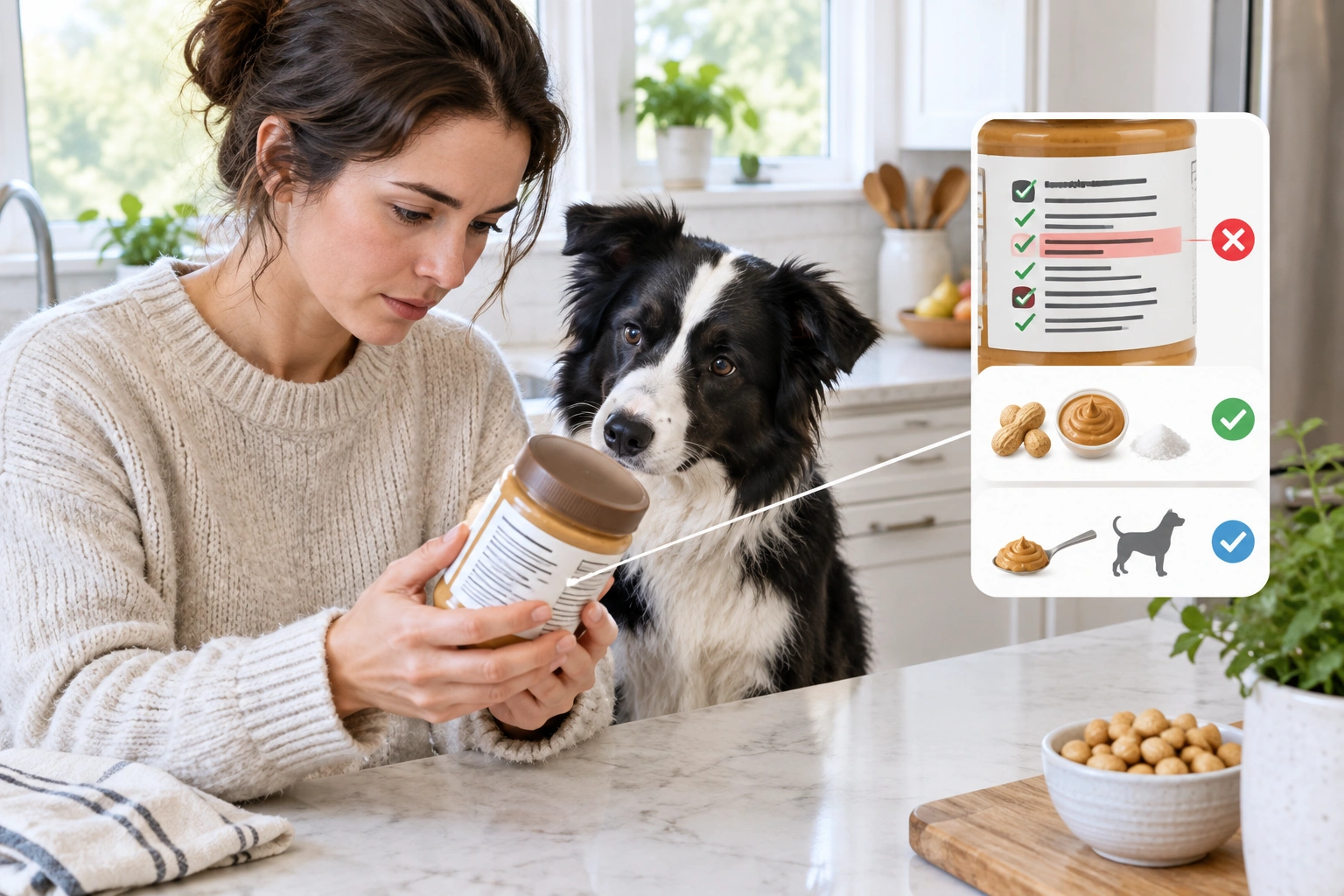
How to Read a Peanut Butter Label Before You Feed It
Before you offer peanut butter to your Border Collie, scan the ingredient list, not just the front of the jar. The front label can say “natural,” “healthy,” or “protein-packed” and still hide a problem ingredient.
Use this quick checklist:
What you want to see
- peanuts
- maybe a little salt
- possibly oil, depending on the product
What should make you put the jar back
- xylitol
- any sugar substitute
- chocolate or cocoa
- artificial sweeteners
- long additive lists you do not recognize
If the label is unclear, assume it is not the right choice.
Natural vs regular peanut butter
Natural peanut butter is often easier to evaluate because the ingredient list is usually shorter. That does not automatically make it “better,” but it often makes it easier to confirm that the product is dog-safe.
Regular peanut butter is not automatically bad, either. The issue is not the word “regular.” The issue is whether the product contains xylitol or other ingredients that do not belong in a dog treat.
How Much Peanut Butter Can a Border Collie Have?
Border Collies are active dogs, but that does not mean they can have unlimited peanut butter. Peanut butter is calorie-dense, so a small amount goes a long way.
For an average adult Border Collie, a practical serving is usually:
– about 1 teaspoon as a small treat or pill-hiding amount
– up to 1 to 2 teaspoons total in a day for many dogs, depending on size, activity level, and what else they are eating
– a thin smear on a lick mat or toy for enrichment
For training, keep it even smaller:
– use a pea-sized dab or very thin smear for a high-value reward
– avoid repeated spoonfuls during a session
For a Kong or similar toy:
– use a thin layer, not a thick fill
– the goal is enrichment, not a full snack
A simple benchmark: if you would call it more than a small smear or a teaspoonful, it is probably too much for routine use.
Count it as part of the day’s treats
Peanut butter should be counted as part of your Border Collie’s total treats for the day. If you use peanut butter, reduce other treats so the overall calorie load stays reasonable.
A simple decision rule
Use less peanut butter when:
– your dog is overweight or gains weight easily
– your dog already gets plenty of training treats
– your dog has a sensitive stomach
– your dog has a history of pancreatitis
– your dog is getting peanut butter more than once in a day
Use extra caution with puppies and seniors. Age alone does not make peanut butter unsafe if it is xylitol-free, but the portion should stay small. Puppies may be more likely to gulp sticky food, and older dogs may have more digestive or weight-management needs.
How Often Can You Give Peanut Butter?
Peanut butter can be given in tiny amounts daily if it fits your dog’s calorie needs and stays within a very small portion, but it should not become a routine daily snack in larger amounts.
That means:
– daily micro-portions are okay for some dogs when used for enrichment, pill hiding, or a small training reward
– regular daily feeding is not the goal and usually adds unnecessary calories
If you use peanut butter often for training or enrichment, keep the portions tiny and count it as part of your dog’s total treat intake. That is the cleanest way to avoid overfeeding. Many owners do not realize how quickly a “little lick here and there” becomes a meaningful calorie load over a week.
A good practical pattern:
– use it for specific jobs, like a Kong, a lick mat, or pill hiding
– do not offer it casually every day just because your dog likes it
– reduce other treats on days when peanut butter is used
If your Border Collie is on a weight-loss plan or has a very small daily treat allowance, peanut butter may be more of a “special use” item than a regular reward.
Best Ways to Use Peanut Butter for Training, Kongs, and Pill Hiding
Peanut butter can be genuinely useful when it has a job.
For Kongs and enrichment toys
A thin smear inside a Kong can keep a Border Collie occupied without needing a large amount of food. The goal is not to pack the toy full. The goal is to make the dog work a little for a small reward.
For pill hiding
Use the smallest amount that still does the job. A thick blob is unnecessary and adds calories fast. A thin coating around the pill is usually enough.
For training
Peanut butter is usually too rich to use as a routine training reward in large amounts, but a tiny dab can be a strong reinforcement for a difficult task. That works best when it is reserved for special moments, not every repetition.
Choking and texture caution
Sticky foods can be a swallowing issue if given in a large lump. Crunchy peanut butter is not automatically unsafe, but texture matters less than portion size and ingredient safety. If your dog tends to gulp treats, keep the serving very small and spread it thin.
When Peanut Butter May Not Be a Good Choice
Some Border Collies should get peanut butter only with extra caution, or not at all.
Be more careful if your dog:
– has a history of pancreatitis
– struggles with weight gain
– has a sensitive stomach
– tends to gobble food without chewing
– is already getting a lot of treats that day
High-fat foods can be a concern for dogs with certain digestive histories, and peanut butter is not a “free” treat just because it is popular. If your dog has reacted badly to rich foods before, choose a lower-fat option instead of testing peanut butter casually.
Peanut Butter vs Other Treat Options
Here are a few lower-calorie options that are often easier to use for training or enrichment:
- small training treats designed for frequent rewards
- plain cucumber slices cut into tiny pieces
- plain green beans as a low-calorie reward
- small pieces of cooked chicken breast when you need a higher-value but still simple reward
If you need a frequent training reward, a lower-calorie treat is often the better daily choice. Save peanut butter for higher-value moments or enrichment use.
What to Do If Your Border Collie Ate Peanut Butter With Xylitol
If your dog ate peanut butter and the label includes xylitol, call your veterinarian or a pet poison hotline immediately. Do not wait for symptoms to appear. Waiting to “see what happens” is unsafe because signs may not show up right away.
Here is the action plan:
1. Save the container so you can read the ingredient list.
2. Check for xylitol right away.
3. Call your veterinarian immediately or an emergency poison hotline.
4. Do not induce vomiting unless a veterinarian tells you to.
If the product contains an unknown sweetener and you cannot confirm the ingredients quickly, treat it as a possible emergency until a professional says otherwise. Time matters with xylitol exposure.
When to Ask Your Veterinarian
Ask your veterinarian if:
– your Border Collie has pancreatitis history
– your dog has repeated vomiting or diarrhea after peanut butter
– your dog is overweight and you want to use peanut butter for training
– you are unsure whether a specific product is safe
– your dog ate a peanut butter product with an unfamiliar sweetener
If your dog seems normal after a tiny amount of xylitol-free peanut butter, that is reassuring, but the product label still matters. If the product was questionable, the ingredient list matters more than the amount.
Quick Takeaway for Border Collie Owners
Border Collies can eat peanut butter only if it is xylitol-free and given in small amounts. Choose a product with a short ingredient list, keep servings modest, and use it as an occasional treat rather than a daily habit. For an average adult Border Collie, a teaspoon or two per day is a practical upper range for many dogs, and even that should count toward the day’s total treats. If your dog ate a peanut butter product with xylitol or an unknown sweetener, call your veterinarian right away.
FAQ
Can Border Collies have peanut butter every day?
Yes, but only in very small amounts and only if it fits your dog’s calorie needs. For many Border Collies, peanut butter is better kept as an occasional treat or enrichment food rather than a daily snack.
Is peanut butter safe for Border Collie puppies?
It can be, as long as it is xylitol-free and given in a tiny amount. Puppies are more likely to gulp sticky food, so keep the portion very small and avoid large spoonfuls.
Can senior Border Collies eat peanut butter?
Yes, if the product is xylitol-free and the portion is small. Senior dogs may need extra caution with calories, digestion, and swallowing, so a thin smear is usually better than a thick serving.
What is the safest peanut butter serving size for a Border Collie?
A small smear or about 1 teaspoon is a practical benchmark for many adult Border Collies. For repeated use, keep the total amount small and count it as part of the day’s treats.
For more breed-specific feeding basics, you may also find our guides on scrambled eggs for Border Collies and whether Border Collies can stay outside during the day helpful when you’re building a practical care routine.