
What Are the Common Behavioral Issues of Border Collies?

Quick Answer
The most common Border Collie behavioral issues are excessive chasing, herding and nipping, barking, destructive chewing, over-arousal, separation distress, reactivity, and obsessive fixations. Many start when a highly driven herding dog lacks the right mix of movement, problem-solving, rest, and clear training; the AKC’s Border Collie guidance also stresses the breed’s need for activity and mental stimulation.
Common signs owners notice
- Herding people: Stalking, circling, chasing, or nipping at moving children and adults.
- Motion chasing: Fixating on bikes, runners, cars, cats, or anything that moves fast.
- Demand behavior: Barking, pawing, staring, or repeatedly dropping a toy to start activity.
- Destructive outlets: Chewing, digging, pacing, or getting into household items when bored or frustrated.
- Anxiety or reactivity: Difficulty settling, distress when alone, or intense responses to dogs, strangers, sounds, or movement.
- Obsessive fixation: Repeatedly chasing shadows, lights, reflections, water, or balls and struggling to disengage.
How to judge severity
- Look at frequency, intensity, safety risk, and whether your dog can stop and settle when asked.
Border Collies can be brilliant house dogs, but they rarely thrive on autopilot. A Border Collie, often called a BC or Border, notices movement, patterns, sounds, and tiny changes in routine faster than many owners expect.
That sharp brain is a gift when you give it direction. In this 2026 guide, I’ll show you which behaviors are normal breed traits, which ones deserve attention, and what to do first.
In This Guide
- Why Do Border Collies Develop Behavior Problems?
- What Behavioral Issues Are Most Common in Border Collies?
- Why Do Border Collies Chase, Stalk, and Nip?
- Why Do Border Collies Bark, Chew, and Get Destructive?
- Are Border Collies Prone to Anxiety and Reactivity?
- Can Border Collies Develop Obsessive Behaviors?
- How Do You Prevent or Fix Border Collie Behavior Problems?
- When Should You Get Professional Help?
- Frequently Asked Questions
Why Do Border Collies Develop Behavior Problems?
Most Border Collie problems are not signs of a “bad” dog. They are often normal working traits showing up in the wrong setting, at the wrong intensity, or without a better outlet.
A Border Collie’s herding instinct is the built-in drive to watch, stalk, control, and move livestock. The breed’s famous “eye” is that intense stare used to influence movement.
Simple definition: A Border Collie behavioral issue is a repeated behavior that creates stress, safety risk, damage, or daily conflict for the dog or household. A strong breed trait becomes a problem when the dog cannot disengage or use it safely.
Working heritage matters
Border Collies were developed to work livestock with stamina, focus, and close handler awareness. That history explains why movement can switch them on so quickly.
A child running across the yard may look like play to you. To a motion-sensitive Border Collie, it can trigger an instant stalk-and-chase response.
Too little work is not the only problem
Owners often hear, “Just exercise the dog more.” That can backfire if every day becomes an endless cycle of fetch, sprinting, and adrenaline.
- Too little activity can create boredom and frustration.
- Too much high-speed activity can build a dog who expects constant excitement.
- Too little sleep can make impulse control worse.
- Too little mental work can leave a smart dog inventing its own jobs.
- Unclear rules can accidentally reward barking, jumping, staring, or toy demands.
My rule of thumb is simple: don’t try to empty the energy tank. Teach the dog how to work, pause, and settle.
What Behavioral Issues Are Most Common in Border Collies?
The most common issues cluster around motion control, arousal, boredom, anxiety, and fixation. The table below helps separate a manageable breed tendency from a behavior that needs a plan.
| Behavior | Common trigger | Problem threshold | First response |
|---|---|---|---|
| Chasing or herding | Kids, bikes, runners, cars | Dog cannot disengage or creates danger | Use distance, leash control, and alternate cues |
| Barking | Motion, sounds, frustration, attention | Long bouts or repeated demand barking | Find the trigger before training quiet |
| Destructive chewing | Boredom, stress, isolation | Furniture damage or swallowing objects | Manage access and add safe enrichment |
| Reactivity | Dogs, strangers, vehicles, noises | Lunging, snapping, panic, no recovery | Increase distance and stop forced exposure |
| Fixation | Balls, lights, shadows, reflections | Repetitive, hard to interrupt, affects rest | Remove triggers and seek help if persistent |
One behavior can also feed another. A dog frustrated by a window may stare, bark, pace, then redirect into chewing or nipping.
Why Do Border Collies Chase, Stalk, and Nip?
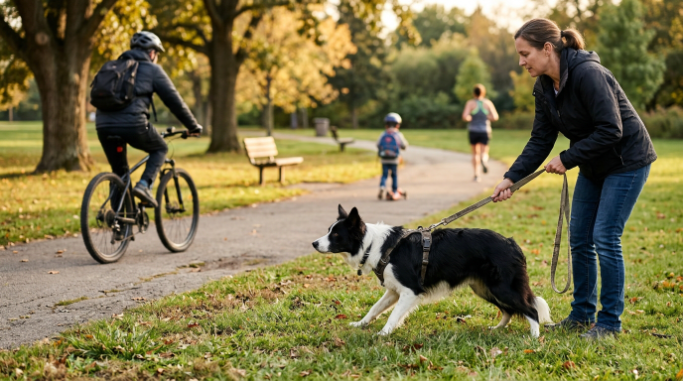
Chasing is one of the most predictable Border Collie behavior concerns because movement itself can be rewarding. The dog may crouch, stare, circle, rush forward, or cut across a moving person’s path.
The AKC’s explanation of herding behavior notes that herding breeds strongly express search, stalk, and chase parts of the predatory sequence. That helps explain why the behavior can appear even without sheep nearby.
Children can trigger the same pattern
- Running can trigger pursuit.
- Squealing can raise arousal.
- Sudden direction changes can keep the dog engaged.
- Heel nipping may appear when the dog tries to control movement.
Don’t let children become the training setup. Use gates, leashes, distance, and adult supervision while you build better responses.
Car and bicycle chasing is more serious
A dog that lunges toward traffic needs management first, training second. Prevent rehearsal with a secure leash, safe walking routes, and enough distance to keep the dog responsive.
At a workable distance, reward your Border Collie for seeing movement and returning attention to you. Start far enough away that food and familiar cues still matter.
Section Takeaway: Herding behavior is normal for the breed, but unsafe chasing needs immediate management. Build disengagement before you test self-control near fast movement.
Why Do Border Collies Bark, Chew, and Get Destructive?
Barking and destruction often tell you that the dog’s day is out of balance. The cause may be boredom, frustration, alerting, attention-seeking, isolation, or simple lack of appropriate outlets.
Demand barking can become a learned habit
If barking makes a ball appear, a door open, or a person start talking, barking worked. Smart dogs remember what works.
- Wait for a brief quiet moment before starting play.
- Ask for an easy behavior such as sit, touch, or mat.
- Reward calm requests more often than noisy ones.
- Keep training sessions short enough to prevent frustration.
Destructive chewing needs two fixes
First, stop access to tempting items with gates, closed doors, or a safe rest area. Second, provide legal chewing and foraging choices before the dog goes looking for its own project.
I prefer a predictable rotation over a mountain of toys. A stuffed food toy, a safe chew, a sniffing game, and a five-minute training session often do more than leaving 20 toys on the floor.
Rest is part of behavior training
Some Border Collies look energetic when they are overtired. They pace, grab toys, bark at tiny sounds, and struggle to switch off.
Build quiet periods into the day. A calm dog should learn that nothing happening is also a normal activity.
Are Border Collies Prone to Anxiety and Reactivity?
Some Border Collies are sensitive to separation, unfamiliar dogs, strangers, noises, or environmental change. Sensitivity is not the same as aggression, and the trigger matters.
The ASPCA’s guide to separation anxiety describes distress that appears around departures or when a dog is left alone. Signs can include persistent barking, destruction near exits, pacing, or house soiling.
Watch recovery, not just reaction
A single bark at a strange sound tells me less than what happens next. A dog that checks in and settles is coping better than one that stays tense for 20 minutes.
- Dog reactivity: Barking, lunging, freezing, or staring at other dogs.
- Stranger sensitivity: Avoidance, stiff watching, alarm barking, or retreating.
- Noise sensitivity: Hiding, pacing, trembling, or refusing food around certain sounds.
- Separation distress: Panic-like behavior tied to being left alone.
Don’t force a frightened dog closer to a trigger to “get used to it.” Use enough distance to keep the dog able to think, eat, and respond.
Vet note: Sudden anxiety, aggression, house soiling, or a major behavior change can have a medical component. Ask your veterinarian to rule out pain or illness.
Can Border Collies Develop Obsessive Behaviors?
Yes, some Border Collies can become intensely fixated on balls, shadows, reflections, water, spinning objects, or repetitive movement. The warning sign is not enthusiasm alone; it is difficulty stopping.
PetMD’s veterinarian-reviewed overview of canine compulsive disorder describes repetitive behaviors that become hard to interrupt and can interfere with normal life. Medical causes should be ruled out before assuming the problem is purely behavioral.
Ball obsession can look deceptively productive
A dog that fetches for an hour may look well exercised. Yet some dogs finish more wired than when they started.
- Put fetch on a clear start and stop cue.
- Mix high-speed play with sniffing and calm training.
- Store the ball when the session ends.
- Reward disengagement from the toy.
- Avoid laser pointers and deliberate light chasing.
If your Border Collie stares at walls, hunts reflections, or repeatedly checks places where a light once appeared, take it seriously. Reduce the trigger rather than turning it into a game.
Vet note: Repetitive behavior can overlap with pain, neurologic disease, skin problems, anxiety, or compulsive disorders. A veterinarian or veterinary behaviorist should assess persistent cases.
How Do You Prevent or Fix Border Collie Behavior Problems?
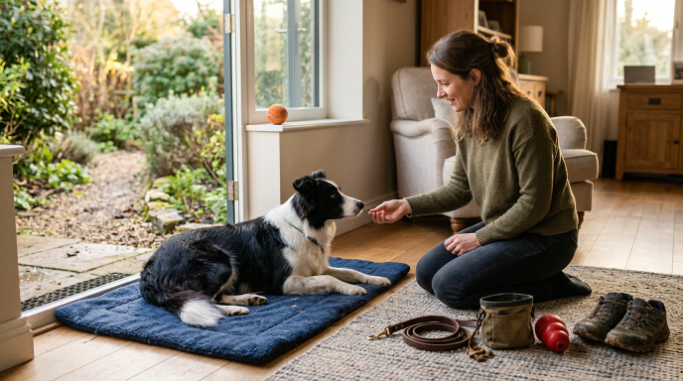
Start by changing the environment so the dog cannot keep practicing the unwanted behavior. Then teach a replacement behavior that serves a similar need more safely.
Use a balanced daily routine
There is no single exercise number that fits every Border Collie. Age, health, working lines, fitness, weather, and individual temperament all matter.
For a healthy adult, I like to divide the day into several purposeful blocks instead of one giant workout. A sample structure might look like this:
- 20-30 minutes: Brisk walk, hiking, controlled running, or active play.
- 5-10 minutes: Training focused on recall, place, leave-it, or handling.
- 10-20 minutes: Sniffing, food search, puzzle feeding, or scent work.
- 20-30 minutes: A second physical activity later in the day.
- Several quiet periods: Planned rest with no demand for entertainment.
That is an example, not a prescription. Puppies, seniors, injured dogs, and working dogs need different plans.
Train an off-switch on purpose
“Settle” is not laziness. It is a skill that helps a high-drive dog recover after excitement.
- Choose a mat or quiet resting spot.
- Reward the dog for stepping onto it.
- Reward sitting or lying down.
- Space treats farther apart as the dog relaxes.
- Practice after mild activity before trying it after intense play.
Reward what you want to see again
Border Collies learn patterns fast, including accidental ones. If staring makes you throw the ball, staring has been reinforced.
- Reward check-ins during walks.
- Reward calm behavior around moving people.
- Reward voluntary disengagement from toys.
- Reward quiet before opening doors.
- Reward relaxed choices around manageable triggers.
The AVMA’s responsible pet ownership guidance includes appropriate exercise, mental stimulation, socialization, training, and veterinary care. That combination fits Border Collies especially well.
Section Takeaway: Prevention works best when you manage triggers, meet breed needs, and teach calm behavior at the same time. More exercise alone is not a complete behavior plan.
When Should You Get Professional Help?
Get help early when behavior creates a safety risk, causes obvious distress, or keeps getting worse despite consistent management. Early support usually gives you more options.
- A bite, attempted bite, or repeated snapping
- Lunging toward traffic, children, or other animals
- Severe panic when left alone
- Self-injury during escape attempts or repetitive behavior
- Sudden aggression or a major personality change
- Compulsive behavior that interrupts eating, sleeping, or normal interaction
- Reactivity so intense that normal walks are unsafe
The Merck Veterinary Manual notes that behavior problems can involve fear, anxiety, conflict, learning, genetics, or medical factors. A veterinarian can help rule out physical causes and guide referral when needed.
For serious cases, ask about a qualified reward-based trainer, certified behavior consultant, or board-certified veterinary behaviorist. Avoid anyone who promises a guaranteed quick fix for fear or aggression.
Vet note: Pain and illness can change behavior. A veterinary exam is especially important when the problem appears suddenly or escalates quickly.
Frequently Asked Questions
Do Border Collies have more behavior problems than other dogs?
Not necessarily. Their intelligence, motion sensitivity, and working drive can make problems more visible when their needs and home routine do not match, but well-managed Border Collies can be calm, responsive companions.
Why does my Border Collie stare at me all the time?
Border Collies were bred to monitor movement and work closely with handlers, so staring can be normal attention. It becomes a concern when the dog cannot disengage, relax, sleep, or focus on anything else.
Why does my Border Collie nip ankles?
Ankle nipping often appears when movement triggers herding behavior or high arousal. Stop access to the moving target, lower excitement, and teach an alternate response such as recall, place, or following you calmly.
Can a Border Collie be happy without a farm?
Yes. A farm is not required, but the dog still needs purposeful physical activity, training, problem-solving, sniffing, social time, and rest. Dog sports, scent games, hiking, obedience, and structured play can provide useful outlets.
Does getting a second dog fix Border Collie boredom?
Usually not by itself. Another dog may add companionship and play, but it can also add competition, chasing, or shared bad habits. Meet the first dog’s exercise, training, rest, and enrichment needs before expecting a second dog to solve behavior problems.
At what age do Border Collies calm down?
Many dogs gain better impulse control as they mature, but there is no magic birthday when a Border Collie becomes easy. Training, routine, sleep, health, and the ability to settle matter more than age alone.
Should I punish my Border Collie for chasing or barking?
Punishment can suppress a behavior without fixing its cause, especially when fear or frustration is involved. Management, distance, clear replacement behaviors, and reward-based training give the dog a safer pattern to follow.
The takeaway: Most Border Collie behavior issues make more sense once you ask what the dog is trying to control, chase, avoid, or obtain. Meet the need safely, prevent rehearsal, and teach a calmer alternative.
If a behavior is intense, sudden, or unsafe, involve your veterinarian or a qualified behavior professional instead of trying to out-stubborn a highly driven dog.
