
What Is a Good Routine for a Border Collie?

Quick Answer
A good Border Collie routine balances physical exercise, short training sessions, mental enrichment, meals, social time, and predictable rest. Healthy adults commonly need substantial daily activity, but the goal is not to exhaust them nonstop; the AKC’s Border Collie guidance also emphasizes regular activity, training, and mental stimulation.
A simple daily routine
- Start calmly: Begin with a toilet break, sniffing, and 20–30 minutes of suitable morning movement.
- Train briefly: Add 5–10 minutes of obedience, recall, tricks, or impulse-control work.
- Provide downtime: Let your dog sleep or settle instead of filling every hour with entertainment.
- Exercise again: Use walking, hiking, fetch, controlled running, herding, or another suitable activity later in the day.
- Work the brain: Add scent games, food puzzles, problem-solving, or another short training session.
- Finish quietly: Use a relaxed evening walk, grooming, chewing, or settle practice before bed.
Border Collies, sometimes called Borders or BCs, usually do best when they know what happens next. Their herding heritage gives them energy, focus, sensitivity, and a strong desire to stay involved.
The best routine isn’t about keeping your dog busy every minute. It’s about creating a healthy rhythm between movement, thinking, connection, and genuine rest.
In This Guide
- What should a Border Collie’s daily routine include?
- What is a good morning routine for a Border Collie?
- How much exercise and mental stimulation does a Border Collie need?
- What should an afternoon and evening routine look like?
- Why does a Border Collie need scheduled rest?
- What does a balanced Border Collie schedule look like?
- How do you know if your Border Collie’s routine is working?
- Frequently asked questions
- Build a routine your Border Collie can predict
What Should a Border Collie’s Daily Routine Include?
A balanced Border Collie routine should include exercise, mental work, training, meals, toilet breaks, interaction, and uninterrupted rest. Leaving out either stimulation or recovery can create problems.
A Border Collie’s routine is a predictable daily rhythm that gives this working breed appropriate outlets for movement, thinking, natural behavior, social interaction, and recovery.
I prefer to think in terms of daily categories rather than one giant exercise target. That makes the routine easier to adjust when weather, work, age, or health changes.
- Physical movement: Walking, running, hiking, swimming, fetch, herding, or structured dog sports.
- Mental enrichment: Scent games, puzzle feeding, searching, problem-solving, and learning new skills.
- Training: Short sessions for recall, leash manners, impulse control, tricks, or sport foundations.
- Natural behavior: Sniffing, chewing, exploring, carrying toys, and appropriate chasing or gathering games.
- Social connection: Calm time with family, play, grooming, and suitable social experiences.
- Rest: Predictable periods when nothing exciting is expected from the dog.
That last item matters more than many owners realize. A Border Collie who expects entertainment every waking minute can struggle to switch off.
Routine is different from constant activity
Trying to physically exhaust a Border Collie can backfire. Regular high-intensity exercise may simply build a fitter dog who expects even more stimulation tomorrow.
My rule is simple: exercise the body, challenge the brain, then teach the dog to settle. All three belong in the same routine.
The ASPCA’s guidance on canine enrichment also highlights opportunities for dogs to sniff, play, chew, search, and use other natural behaviors.
What Is a Good Morning Routine for a Border Collie?
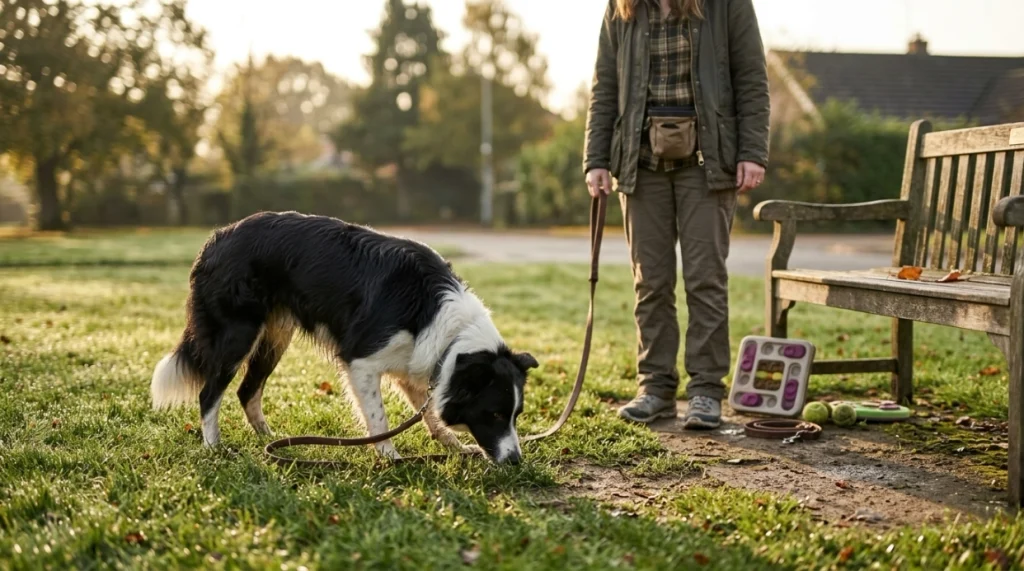
A good morning routine starts with a toilet break and purposeful activity before the household becomes busy. For many adult BCs, this is one of the day’s most useful exercise windows.
1. Start with a calm toilet and sniff break
Don’t make the first trip outside an instant sprint. Give your dog several minutes to toilet, sniff, and gather information from the environment.
Sniffing adds mental value without raising excitement as sharply as repetitive ball chasing. It can also make an ordinary walk more satisfying.
2. Add 20–30 minutes of suitable movement
A healthy adult might take a brisk walk, explore a trail, play structured fetch, or combine walking with short training games. The intensity should suit the individual dog.
Instead of marching the same route daily, change direction occasionally. Let your Border Collie investigate safe new smells and surfaces.
3. Use breakfast as enrichment
- Scatter some kibble safely in grass.
- Use a food puzzle or snuffle mat.
- Practice several known cues before feeding.
- Hide small portions for a supervised search game.
Food doesn’t have to arrive in a bowl every morning. Part of the meal can become an easy mental workout.
4. Finish with five minutes of training
Keep morning training short enough that your dog still wants more. Recall, place, down, heel position, targeting, and tricks are useful choices.
Then stop. A predictable end to activity helps the dog understand that exciting work is followed by quiet time.
How Much Exercise and Mental Stimulation Does a Border Collie Need?
A healthy young adult Border Collie often needs roughly one to two hours of total physical activity each day, usually divided into separate sessions. Mental work should be added in short blocks rather than replacing all physical movement.
PetMD’s Border Collie care overview likewise describes young Border Collies as needing about one to two hours of daily exercise, while older dogs may need less.
Don’t measure exercise by minutes alone
Thirty minutes of slow sniffing, recall practice, and exploration can challenge a dog differently from thirty minutes of repetitive fetch. Both duration and activity type matter.
I like to rotate activities rather than repeat the hardest option every day. Variety uses more of the Border Collie’s brain and reduces repetitive physical strain.
How much mental work is useful?
For many adult dogs, two or three focused sessions of about 5–10 minutes are more productive than one long training marathon. Stop while concentration remains good.
- Scent work: Hide food or toys and ask your dog to search.
- Obedience: Practice recall, stays, positions, and leash skills.
- Tricks: Teach targeting, spins, toy names, or object retrieval.
- Problem-solving: Use safe puzzle feeders and interactive toys.
- Dog sports: Consider agility foundations, herding, rally, flyball, or disc skills.
The AKC also recommends purposeful activities and dog sports for herding breeds as outlets for physical energy and working instincts.
Exercise needs change with life stage
| Life stage | Physical activity framework | Mental work | Main priority |
|---|---|---|---|
| Puppy | Several short, low-impact play and exploration periods | 3–5 minute training games | Socialization, confidence, sleep, basic skills |
| Healthy adult | About 60–120 minutes total, split across the day | Several 5–10 minute sessions | Balanced physical and mental work |
| Senior | Shorter, gentler sessions based on mobility and health | Scenting and low-impact problem-solving | Mobility, comfort, confidence, enrichment |
Vet note: Exercise needs vary with age, joint health, body condition, weather, and medical history. Ask your veterinarian before starting strenuous running, jumping, or sport conditioning, especially with puppies or senior dogs.
What Should an Afternoon and Evening Routine Look Like?
The middle of the day should not become a second nonstop workout. Most Border Collies benefit from a cycle of brief activity followed by meaningful downtime.
Use midday for a reset
If someone is home, offer a toilet break and 10–20 minutes of light activity. A sniff walk, search game, or short training session often works better than another intense chase session.
If your dog stays home while you work, build independence gradually. Safe enrichment can make quiet periods easier without teaching your Collie to demand constant attention.
- Food puzzle using part of the normal meal.
- Safe chew appropriate for your individual dog.
- Scatter feeding or a supervised snuffle activity.
- Short scent search before you leave.
- Comfortable sleeping area away from constant household traffic.
Make late afternoon the main activity block
Many households have more time after work. This is a good opportunity for a 30–45 minute walk, hike, training outing, structured game, or sport session.
Change the activity across the week. For example, one day might emphasize hiking while another uses obedience, scent work, or controlled fetch.
Lower the intensity before bedtime
A Border Collie doesn’t need to finish every evening panting. High-speed play immediately before bedtime can leave some dogs more aroused instead of calmer.
Try an easy 10–20 minute sniff walk, gentle grooming, a chew, or quiet settle practice. Keep the final toilet trip boring and predictable.
Why Does a Border Collie Need Scheduled Rest?
Border Collies need rest because physical fitness and emotional self-control aren’t the same thing. A dog can be physically tired yet remain mentally unable to switch off.
This is one of the biggest routine mistakes I would avoid in 2026. Owners sometimes keep adding exercise whenever their Collie appears restless.
Teach an off-switch instead of waiting for one
An off-switch simply means the dog can relax when no task is available. You can build this skill through routine and reinforcement.
- Choose a comfortable bed or mat.
- Reward calm lying down.
- Keep early sessions short and easy.
- Gradually extend quiet time while you remain nearby.
- Practice after moderate activity, not only when the dog is exhausted.
A crate can help some crate-trained dogs rest, but it should never substitute for adequate exercise or interaction. Use confinement according to your dog’s comfort and training history.
Watch for over-arousal
More exercise isn’t always the answer when a Border Collie is frantic. Repeated pacing, inability to settle, frantic toy obsession, constant demand barking, and escalating reactivity can signal that the routine needs closer examination.
Rest also protects the quality of tomorrow’s training. A rested dog usually learns better than one living in a constant cycle of stimulation.
What Does a Balanced Border Collie Schedule Look Like?
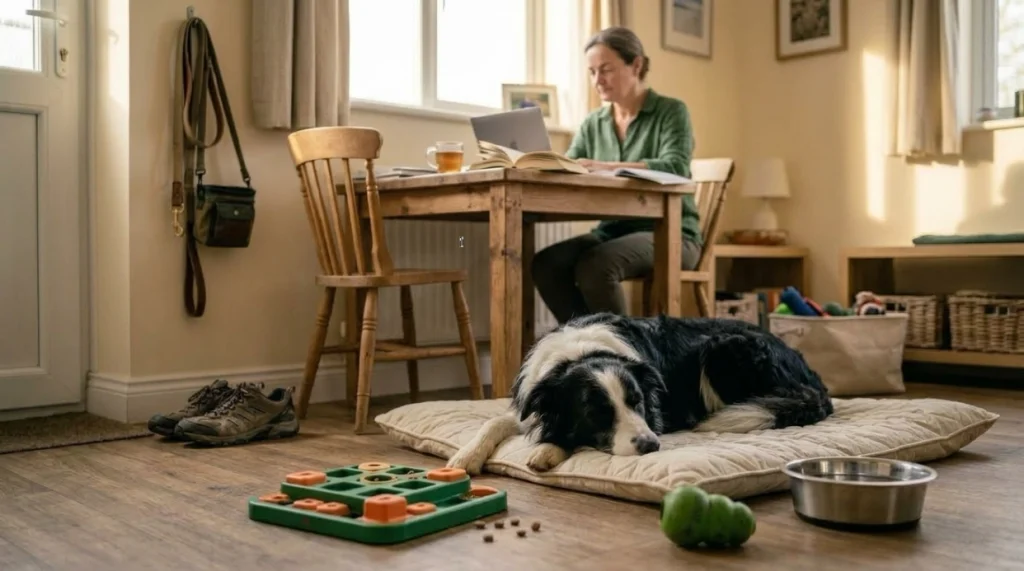
There is no single perfect timetable, but a predictable framework makes daily life easier. Here’s a practical starting routine for a healthy adult companion Border Collie.
| Time | Activity | Purpose |
|---|---|---|
| 6:30 a.m. | Toilet and 5–10 minutes of sniffing | Calm start |
| 7:00 a.m. | 20–30 minute walk, movement, or structured play | Morning exercise |
| 7:30 a.m. | Breakfast plus 5 minutes of training | Nutrition and mental work |
| 8:00 a.m.–12:00 p.m. | Quiet rest | Recovery and independence |
| 12:00 p.m. | 10–20 minute toilet, sniffing, or enrichment break | Midday reset |
| 1:00–4:30 p.m. | Rest and quiet enrichment | Downtime |
| 5:00 p.m. | 30–45 minute main activity | Physical and mental outlet |
| 6:00 p.m. | Dinner | Meal and decompression |
| 8:00 p.m. | 10 minutes of tricks, scent work, grooming, or calm play | Connection without over-arousal |
| 9:30–10:00 p.m. | Short toilet and sniff walk | Settle for bedtime |
Use the schedule as a framework rather than a stopwatch. A farm Border Collie, agility dog, puppy, senior, or dog recovering from injury will require a different workload.
Don’t make every day identical
Predictable timing is useful, but activities can change. Your dog can learn that late afternoon means “we do something together” without demanding the same game every day.
- Monday: Long sniff walk plus obedience.
- Tuesday: Fetch and scent searches.
- Wednesday: Easier recovery walk and tricks.
- Thursday: Hiking or structured running.
- Friday: Training class or sport skills.
- Weekend: Longer outdoor adventure balanced with recovery.
How Do You Know If Your Border Collie’s Routine Is Working?
A good routine produces more than a tired dog. You should see a Border Collie who can engage enthusiastically and also relax when the activity ends.
Signs the balance is probably good
- Your dog settles for meaningful periods during the day.
- Training focus remains enthusiastic instead of frantic.
- Destructive boredom behaviors are uncommon.
- Your dog maintains a healthy appetite and normal sleep pattern.
- Exercise produces satisfaction without constant exhaustion.
- Your Collie can cope when one day’s schedule changes slightly.
Signs the routine may need adjustment
- Constant pacing or inability to rest.
- Repeated destructive chewing or digging.
- Increasing demand barking or attention-seeking.
- Obsessive chasing of toys, shadows, lights, cars, or movement.
- Sudden reluctance to exercise or stiffness afterward.
- Major changes in appetite, sleep, mood, or normal behavior.
Boredom can create unwanted behavior, but anxiety, pain, and other health problems can look similar. Don’t automatically assume every restless Border Collie simply needs another run.
If troublesome behavior persists, the ASPCA provides guidance on finding qualified behavioral help.
Vet note: Sudden changes in activity, coordination, appetite, behavior, or willingness to exercise deserve veterinary attention. Don’t try to solve a possible medical problem by adding more exercise.
Frequently Asked Questions
How many times a day should I walk my Border Collie?
Many adult Border Collies do well with two or three outdoor activity periods rather than one long walk. Mix purposeful walking with sniffing, training, free movement where safe, and other forms of exercise suited to your dog.
Is one hour of exercise enough for a Border Collie?
One hour may suit some adults on lighter days, but many healthy young Border Collies benefit from closer to one or two hours of total daily activity. Quality matters too, so include mental work and don’t rely only on repetitive walking.
How much training should I do each day?
Several short sessions usually work better than one long session. Two or three periods of about 5–10 minutes can provide useful mental work while keeping your Border Collie interested.
Should I play fetch with my Border Collie every day?
Fetch can be excellent exercise, but I wouldn’t make endless ball chasing the center of every day. Rotate fetch with sniffing, walking, training, searching, hiking, and calmer activities so your dog’s routine stays balanced.
What routine is best for a Border Collie puppy?
A puppy routine should emphasize frequent toilet trips, short training games, gentle play, socialization, meals, and plenty of sleep. Avoid treating a growing puppy like an adult endurance athlete, and ask your veterinarian about appropriate exercise.
Can a Border Collie live happily without sheep to herd?
Yes. A companion Border Collie can thrive without livestock when you provide suitable outlets such as training, scent work, hiking, obedience, agility foundations, disc games, or other structured tasks that engage the dog’s body and brain.
How do I calm a Border Collie at night?
Reduce high-intensity activity before bedtime and create a predictable evening sequence. A gentle sniff walk, toilet break, quiet chew, grooming, and settle practice can help signal that the working part of the day has ended.
Build a Routine Your Border Collie Can Predict
A good Border Collie routine doesn’t require entertaining your dog from sunrise to bedtime. It requires a thoughtful balance of exercise, training, mental stimulation, natural behavior, companionship, and rest.
Start with a predictable morning, provide meaningful downtime, schedule another purposeful activity later, and lower the excitement before bedtime. Adjust the workload to your dog’s age, health, personality, and response.
Most importantly, don’t judge success by how exhausted your Border Collie looks. A better goal is a dog who works eagerly when it’s time to work and rests comfortably when the day becomes quiet.
