
Homemade Shampoo for Border Collie: Safe DIY Bath Guide

Quick Answer
A homemade shampoo for a Border Collie is safest when kept simple and used as an occasional gentle wash rather than a permanent replacement for dog shampoo. A plain oatmeal-and-water rinse can help remove light dirt without adding fragrances or harsh household cleaners, but dogs with itching, sores, allergies, or infections need an appropriate canine product or veterinary advice. PetMD also recommends avoiding routine human shampoo on dogs.
A simple DIY bath option
- Use plain oats: Finely grind unflavored oatmeal with no sugar, flavorings, or additives.
- Add warm water: Mix about 1 cup of finely ground oats into 4 cups of lukewarm water.
- Wet thoroughly: Work water through the Border Collie’s double coat before applying the mixture.
- Massage gently: Spread the oatmeal wash through the coat without aggressive scrubbing.
- Rinse completely: Remove every visible and slippery residue from the undercoat.
- Dry the undercoat: Don’t stop when only the outer hairs feel dry.
One important limitation
- An oatmeal rinse is useful for light cleaning, but a properly formulated dog shampoo remains the better choice for routine cleansing.
I’ve washed enough muddy Border Collies to understand why homemade shampoo sounds appealing. You want something simple, inexpensive, and gentle enough for that thick coat.
The challenge is that “natural” doesn’t automatically mean skin-safe. In this 2026 guide, I’ll show you which DIY approach I consider reasonable, which ingredients I skip, and how to rinse and dry a Border Collie correctly.
In This Guide
- Is Homemade Shampoo Safe for a Border Collie?
- What Is the Safest Homemade Shampoo Recipe?
- Which Homemade Shampoo Ingredients Should You Avoid?
- How Do You Use Homemade Shampoo on a Border Collie?
- Does Rough or Smooth Coat Type Change the Routine?
- When Should You Skip Homemade Shampoo?
- Homemade vs Commercial Dog Shampoo
- Frequently Asked Questions
- Final Takeaway
Is Homemade Shampoo Safe for a Border Collie?
A simple homemade wash can be reasonable for an otherwise healthy Border Collie when you need light cleaning. I don’t consider most kitchen-made recipes an equal substitute for a properly formulated canine shampoo.
A homemade Border Collie shampoo is a cleansing mixture prepared from household ingredients instead of a manufactured dog-grooming formula. The important difference is that homemade recipes usually haven’t been tested for canine skin compatibility, stability, or preservation.
Why Border Collie skin and coat matter
Both rough and smooth Border Collies have a double coat. The outer hairs help protect the dog, while the softer undercoat provides insulation.
The American Kennel Club Border Collie profile describes the breed’s coat as dense and weather-resistant. That density is why rinsing matters so much.
- Dense undercoat: Shampoo residue can hide beneath apparently clean outer hair.
- Feathering: Rough-coated dogs can tangle around the chest, legs, ears, tail, and rear.
- Active lifestyle: Working and sporting Border Collies may collect mud, dust, pollen, and plant debris.
- Frequent shedding: Loose undercoat can make wetting and rinsing more difficult.
My rule is simple. If the coat needs serious cleaning, I reach for a mild dog shampoo rather than trying to make a stronger kitchen recipe.
Why I don’t chase a homemade “perfect pH”
You’ll find DIY recipes claiming an exact pH is ideal for every dog. I don’t recommend trying to formulate veterinary skin care with kitchen measurements.
Human shampoos are designed around human skin rather than canine skin. PetMD notes that routine human shampoo can disrupt a dog’s skin environment and contribute to dryness or irritation.
Vet note: If your Border Collie develops persistent redness, itching, scaling, hair loss, odor, sores, or recurring skin trouble, ask your veterinarian before experimenting with home remedies.
Section Takeaway: Simple homemade rinses can handle light dirt, but they aren’t precision-formulated canine skin products. For routine bathing, a mild dog-specific shampoo remains the more predictable choice.
What Is the Safest Homemade Shampoo Recipe?
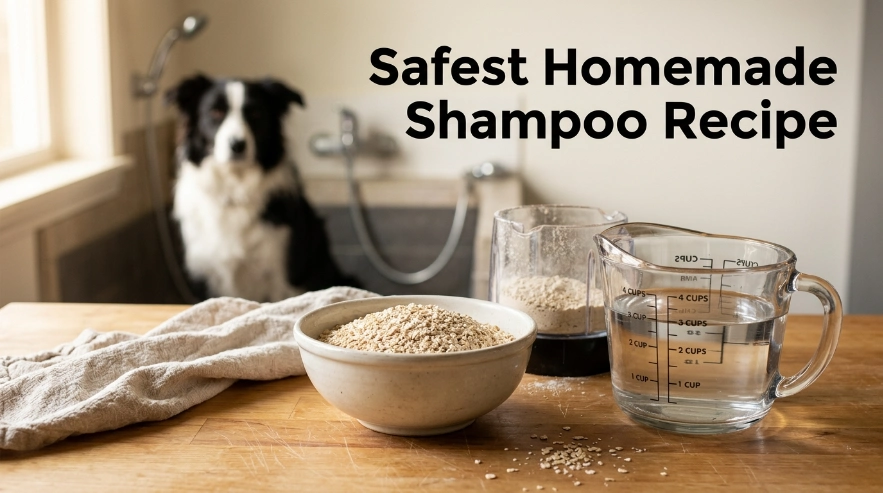
For a healthy dog needing light cleaning, my preferred DIY option is a plain oatmeal wash made only from finely ground oats and lukewarm water. I call it a wash or rinse because it won’t clean heavy grease like a true surfactant-based shampoo.
Simple oatmeal Border Collie wash
- 1 cup: Plain, unflavored rolled or quick oats
- 4 cups: Lukewarm water
- Optional equipment: Blender, large bowl, measuring cup, and squeeze bottle
Don’t use flavored instant oatmeal. It can contain sugar, sweeteners, spices, or other ingredients your dog doesn’t need on the skin.
How to prepare it
- Blend the dry oats until they become a very fine powder.
- Put the powder into a clean bowl.
- Add about 4 cups of lukewarm water.
- Stir until the mixture becomes cloudy and evenly suspended.
- Prepare only what you expect to use during that bath.
- Discard leftovers rather than storing the wet mixture.
I prefer a thin mixture because it moves through a Border Collie’s coat more easily. A thick paste tends to lodge in dense undercoat and takes longer to rinse.
What can this recipe realistically do?
This oatmeal wash can loosen light surface dirt and make rinsing easier. It may also feel soothing on normal skin without adding perfume.
It won’t reliably remove oily contamination, stubborn odor, flea treatments, paint, chemicals, or medically significant skin problems. Those situations need the right product for the job.
One muddy afternoon taught me this distinction well. My rough-coated Collie came home with dry trail dust everywhere, and an oatmeal rinse handled it nicely.
A week later, greasy grime along the belly was a different problem. A regular dog shampoo cleaned it faster and rinsed far more predictably.
Section Takeaway: The safest DIY recipe is intentionally boring. Plain finely ground oatmeal and lukewarm water reduce unnecessary ingredients, but this mixture should be viewed as a light cleansing rinse rather than full-strength shampoo.
Which Homemade Shampoo Ingredients Should You Avoid?
I avoid ingredients that make a homemade recipe unnecessarily harsh, complicated, strongly scented, or difficult to rinse. More ingredients don’t make a better Border Collie shampoo.
Ingredients I leave out
- Human shampoo: It’s formulated for people rather than routine canine bathing.
- Hand soap: It isn’t designed as a regular dog coat cleanser.
- Strong dish detergent: Degreasing power isn’t something I want for routine coat maintenance.
- Essential oils: Concentration, individual sensitivity, and ingestion through licking create unnecessary variables.
- Heavy fragrance: A clean dog doesn’t need to smell like perfume.
- Lemon juice: Acidic DIY additions offer no advantage for ordinary dirt removal.
- Baking soda scrubs: Powdery residue can be difficult to remove from a dense double coat.
- Hydrogen peroxide mixtures: I don’t use bleaching-style household recipes for normal grooming.
What about apple cider vinegar?
Diluted vinegar appears in many homemade dog-shampoo recipes. I don’t treat it as a required shampoo ingredient.
Acidic liquid can sting broken, inflamed, or freshly scratched skin. It also shouldn’t enter the eyes, ears, nose, mouth, or genital area.
If your goal is simply removing mud, oatmeal and water create fewer variables. If your goal is treating itching or odor, the underlying cause matters more than adding vinegar.
What about Dawn or baby shampoo?
PetMD notes that certain temporary substitutes may be used in a pinch, but it still recommends dog-specific shampoo for routine care. That’s the distinction I follow.
An emergency substitute shouldn’t quietly become your Border Collie’s regular grooming product. Buy a gentle canine shampoo before the next bath instead.
Vet note: Never improvise a shampoo treatment for suspected infection, parasites, severe dandruff, open wounds, or allergic dermatitis. Your veterinarian may need a medicated product with specific directions.
Section Takeaway: Skip the chemistry experiment. Avoid strong detergents, fragrances, essential oils, acidic additives, and medicated household products when a simple rinse or dog shampoo will do the job more safely.
How Do You Use Homemade Shampoo on a Border Collie?
Brush first, wet the coat completely, apply the mixture through the hair, rinse deeply, and dry the undercoat. The technique matters as much as the recipe.
1. Brush before getting the coat wet
I run my hands through the coat before picking up a brush. Fingers quickly reveal hidden tangles behind the ears and under longer feathering.
- Check behind both ears.
- Brush under the collar area.
- Inspect armpits and chest feathering.
- Check the back of the legs.
- Comb the tail and rear feathering.
- Remove loose undercoat without pulling healthy hair.
Mats become harder to manage once soaked. The ASPCA dog-care resources also include grooming guidance for routine canine care.
2. Wet the double coat completely
Use lukewarm water rather than hot water. Start around the shoulders and work toward the body.
Separate dense hair with your fingers. A Border Collie can look soaking wet while the undercoat near the skin remains surprisingly dry.
3. Apply the oatmeal mixture
Pour or squeeze small amounts onto the body. Massage in the direction of hair growth rather than twisting long sections in circles.
- Start at the neck and shoulders.
- Move across the back and sides.
- Work gently through the chest and belly.
- Clean the legs and feet.
- Finish the hindquarters and tail.
I use a damp cloth around the face instead of pouring homemade mixtures near the eyes and ears. Control matters there.
4. Rinse until nothing remains
This is the step I refuse to rush. Oat particles and other residue can hide beneath a thick coat.
Separate the hair while rinsing and feel near the skin. Keep going until the water is clear and the coat no longer feels coated.
5. Dry the coat thoroughly
Let your dog shake first. Then press absorbent towels into the coat rather than rubbing aggressively.
- Blot the back and sides.
- Gently squeeze long chest and leg hair.
- Replace saturated towels.
- Use comfortable airflow if your dog accepts a pet dryer.
- Keep heated airflow away from the skin.
- Comb-check dense areas once dry.
The outer coat can feel dry before the undercoat does. Check the neck, chest, rump, armpits, and base of the tail with your fingers.
Section Takeaway: Good bath technique protects the coat better than complicated recipes. Detangle before washing, rinse all the way to the skin, and don’t finish until the dense undercoat is properly dry.
Does Rough or Smooth Coat Type Change the Routine?
The cleaning principles stay the same for rough and smooth Border Collies, but rough coats usually demand more detangling and drying attention. Smooth-coated dogs still have undercoat, so they shouldn’t be treated like single-coated breeds.
| Bath Factor | Rough Border Collie | Smooth Border Collie |
|---|---|---|
| Outer coat | Longer hair with visible feathering | Shorter, closer outer hair |
| Undercoat | Dense and easy to overlook beneath long hair | Dense despite the shorter appearance |
| Tangle risk | Higher around ears, chest, legs, tail, and rear | Lower overall, but loose undercoat still collects |
| DIY rinse challenge | Oat residue may hide in long feathering | Easier to see residue, but still rinse to skin |
| Drying | Usually requires more section-by-section checking | Often quicker, but undercoat must still dry |
Rough-coated Border Collies
I keep the homemade mixture thin on rough coats. Thick oatmeal paste is more likely to cling around feathering.
I also spend extra time combing behind the ears and around the hindquarters after drying. Those areas can hide small tangles easily.
Smooth-coated Border Collies
The shorter coat makes rinsing easier to observe. Still, don’t assume water has reached the skin simply because the surface looks wet.
During seasonal shedding, loose undercoat can become packed regardless of coat length. Brush first and let the bath release hair that’s already ready to shed.
When Should You Skip Homemade Shampoo?
Skip homemade shampoo when you’re dealing with a medical skin problem, chemical contamination, parasites, or significant irritation. Those situations require diagnosis or a product designed for the specific problem.
Signs that change the plan
- Persistent itching: Especially when your dog scratches enough to damage skin.
- Strong or unusual odor: Odor can accompany skin or ear problems.
- Redness: Widespread inflammation isn’t something I treat with kitchen ingredients.
- Sores or scabs: Open or damaged skin deserves closer evaluation.
- Hair loss: Patchy thinning has many possible causes.
- Greasy scaling: This may require a specific therapeutic shampoo.
- Parasites: Fleas, mites, and ticks need appropriate control rather than improvised cleansing.
- Chemical exposure: Contact a veterinarian or poison-control resource for substance-specific advice.
If the skin looks abnormal, I stop asking, “What can I wash this with?” The better question becomes, “Why is my dog uncomfortable?”
Veterinary dermatology uses shampoos as treatment tools for some skin diseases. That doesn’t mean a generic homemade mixture can perform the same job.
The AVMA pet-care resources are a useful general starting point, but your own veterinarian can assess your dog’s specific skin.
Vet note: Seek veterinary guidance for persistent itching, infection-like odor, pus, painful skin, widespread redness, open wounds, sudden hair loss, or a reaction that worsens after bathing.
Homemade vs Commercial Dog Shampoo: Which Is Better?
A simple homemade oatmeal wash wins for minimal ingredients and occasional light rinsing. A quality dog shampoo wins for dependable routine cleaning, formulation consistency, and convenience.
| Factor | Homemade Oatmeal Wash | Dog-Specific Shampoo |
|---|---|---|
| Light dust and dirt | Good for mild cleanup | Good |
| Heavy grime | Limited cleansing | Usually better |
| Ingredient consistency | Depends on preparation | Manufactured to a consistent formula |
| Storage | Best made fresh and discarded | Designed for shelf storage |
| Medical skin condition | Not appropriate treatment | Veterinary or medicated formula may be appropriate |
| Routine use | Occasional option | My preferred choice |
When I choose homemade
I choose the oatmeal wash when the dog is healthy and only lightly dusty. It’s also useful when I want a plain water-based rinse with no fragrance.
When I choose commercial dog shampoo
I use dog shampoo for normal full baths, heavy dirt, oily coat, or noticeable doggy odor. It’s simply better at doing the job shampoo is meant to do.
If a veterinarian prescribes a medicated shampoo, I follow that product’s directions exactly. Contact time and frequency can be part of the treatment.
Section Takeaway: Homemade and commercial products don’t need to compete. Use a simple oatmeal rinse for occasional light cleanup and a well-chosen canine shampoo when your Border Collie needs proper cleansing.
Frequently Asked Questions
Can I make homemade shampoo for my Border Collie?
Yes, but I keep it simple. A fresh mixture of finely ground plain oatmeal and lukewarm water can work as a gentle light-cleaning rinse. It isn’t a full replacement for properly formulated dog shampoo, especially when the coat is oily, heavily soiled, or affected by a skin condition.
Can I use human shampoo on a Border Collie?
I don’t recommend human shampoo for routine Border Collie bathing. Human and canine skin differ, and veterinary guidance generally favors products made for dogs. If you have no dog shampoo available, a thorough lukewarm-water rinse may be enough until you can get the correct product.
Is oatmeal safe for a Border Collie’s coat?
Plain oatmeal is commonly used in canine grooming products and can be used as a simple rinse ingredient. Use unflavored oats, grind them finely, rinse the coat completely, and stop if your dog develops irritation. Don’t assume oatmeal will treat an underlying skin disease.
Can I put essential oils in homemade dog shampoo?
I leave essential oils out. Concentration varies, dogs may lick residue from their coats, and irritated skin doesn’t benefit from extra fragrance. A simple mixture creates fewer opportunities for reactions and makes it easier to identify the cause if irritation develops.
How often can I use homemade oatmeal shampoo?
There is no universal schedule because bathing needs depend on lifestyle, coat condition, and skin health. I use an oatmeal rinse only when light cleaning is needed rather than on a fixed weekly calendar. Frequent medicated bathing should follow veterinary instructions instead.
Why is my Border Collie still itchy after an oatmeal bath?
Oatmeal doesn’t solve every cause of itching. Fleas, environmental allergies, infections, parasites, contact irritation, and other skin problems can cause similar signs. Persistent or worsening itching deserves veterinary evaluation instead of repeated homemade baths.
Can I store leftover homemade Border Collie shampoo?
I don’t store a water-and-oatmeal mixture. Homemade wet preparations lack the preservation systems used in commercial grooming products. Make a small fresh batch for the bath, use what you need, and discard the remainder afterward.
Final Takeaway
The best homemade shampoo for a Border Collie is often the least complicated one. For light cleaning on healthy skin, finely ground plain oatmeal mixed with lukewarm water gives you a straightforward DIY rinse.
I wouldn’t turn that recipe into a chemistry project. Avoid piling in essential oils, detergents, fragrances, acids, or household medicated products.
- Brush the double coat before bathing.
- Use a thin, freshly prepared oatmeal mixture.
- Keep the product away from eyes and ears.
- Rinse all the way through the undercoat.
- Blot instead of aggressively rubbing.
- Dry dense areas completely.
- Use dog-specific shampoo when stronger cleansing is needed.
- See your veterinarian when the skin itself looks unhealthy.
With Border Collies, the recipe is only half the story. Careful brushing, deep rinsing, and complete drying are what turn a simple bath into good double-coat care.
