
How Long After Neutering Can a Dog Play Safely? A Practical Recovery Guide

The safest short answer is this: most dogs should not return to normal play until the veterinarian says the incision has healed well enough, which is often around 10–14 days after neutering. Until then, think in terms of controlled leash potty breaks, not fetch, wrestling, zoomies, or off-leash park time.
That distinction matters more than the calendar. A dog can look bright, hungry, and full of energy on day three and still be at real risk of reopening the incision with one jump off the couch or one hard sprint across the yard. For a Border Collie, that risk is especially easy to underestimate because the dog may seem “fine” long before the tissue is ready.
If you want the practical rule, use this: quiet leash walking may begin early if your vet allows it, but true play usually waits until the recheck or formal clearance. The discharge instructions from your veterinarian override any general timeline.
What “Play” Means During Recovery
Not all movement carries the same risk. Owners often say “play” when they mean several very different things, and recovery decisions change depending on which one you mean.
Low-risk movement: leash potty breaks and short walks
A short leash walk around the yard or down the block is mainly for bathroom needs and calm movement. It should stay slow, controlled, and boring. No pulling, no lunging, no sniff-then-sprint behavior.
Medium-risk movement: casual indoor wandering
Walking from room to room is usually less risky than active play, but it still should not turn into staircase marathons, furniture jumping, or excited greeting sessions.
High-risk movement: fetch, zoomies, wrestling, and off-leash running
These are the activities most likely to stress the incision. A dog can go from “standing still” to “full-speed launch” in a second, and that sudden force is the problem. Even if the outside skin looks neat, the deeper tissue may still be healing.
A useful mental model is this: if the activity would make the dog brace, twist, leap, or accelerate hard, it is probably too much too soon.
Typical Post-Neuter Recovery Timeline by Day and Week
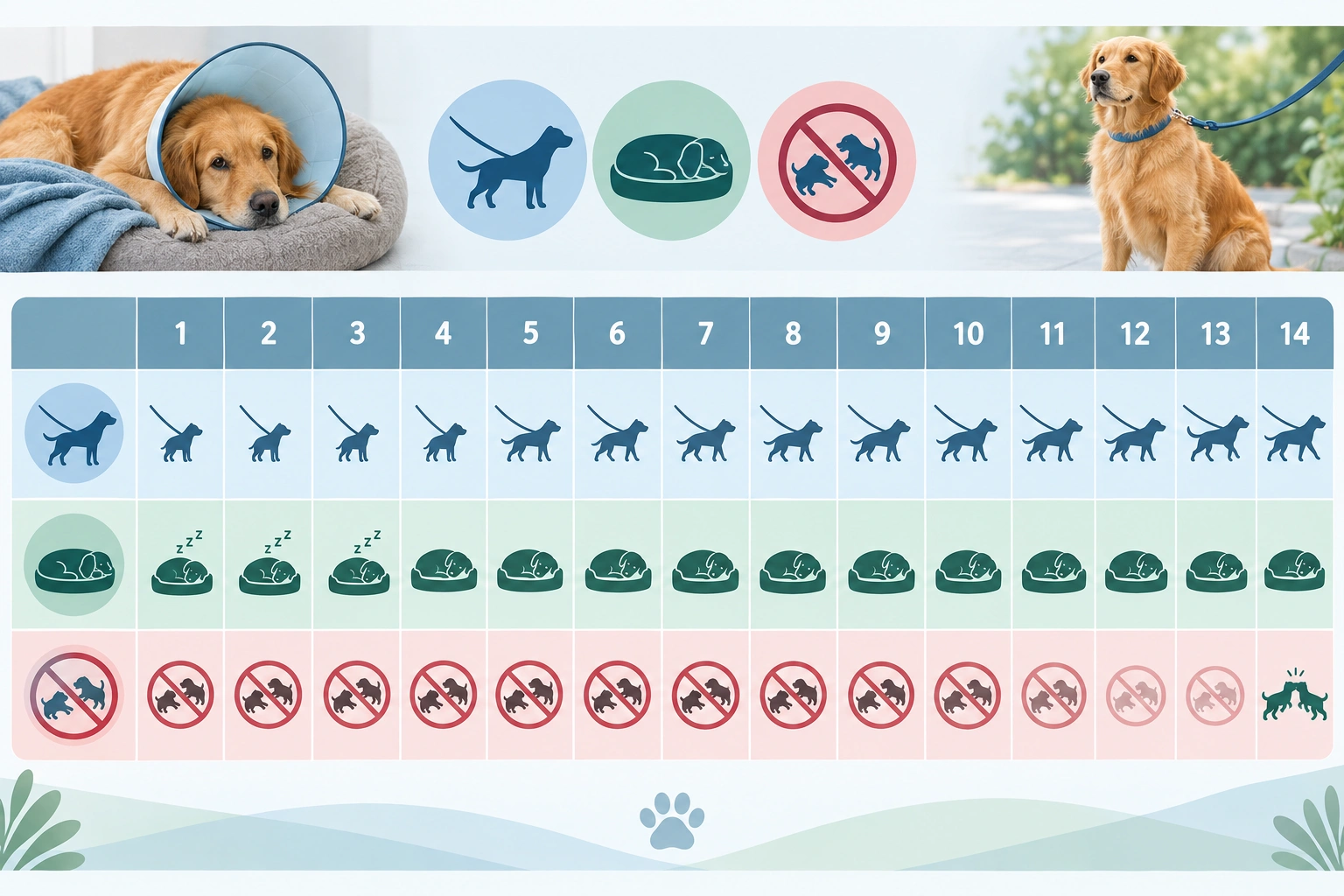
Recovery varies by dog and by the veterinarian’s instructions, but a staged timeline helps you make sane decisions. Many vets allow only very short leash potty breaks for the first 10–14 days, and some dogs need longer restriction depending on the incision, the closure method, and how they heal individually.
| Recovery stage | What is usually okay | What stays restricted | What to watch for |
|---|---|---|---|
| Days 1–3 | Calm indoor rest, very short leash potty breaks if allowed, brief supervised trips outside just long enough to eliminate | Running, jumping, stairs, rough play, long walks, car hops, furniture access if your dog tries to launch | Grogginess, mild discomfort, reluctance to move, licking at incision |
| Days 4–7 | Short supervised leash walks for bathroom needs; quiet indoor time; limited stair use only if unavoidable and controlled | Fetch, wrestling, off-leash play, jumping on furniture, zoomies, car jumps | Swelling, redness, heat, discharge, sudden pain, increased licking |
| Days 8–10 | Some dogs look more energetic, but activity should still stay controlled; brief leash walks can be extended only if your vet says the incision is calm | Normal play, dog park visits, hard running, stair races, jumping in and out of cars | Incision opening, new swelling, tenderness after activity |
| After clearance | Gradual return to normal exercise and play, starting with leash walks and then shorter controlled play sessions | Sudden “back to normal” bursts if the vet wants a slower ramp-up | Limping, soreness, incision irritation after activity |
The big trap is the middle of that timeline. Many dogs feel better before they are actually healed. That is when owners get tempted to “test” the dog with a longer walk or a quick game of fetch. That is usually the wrong move.
For a Border Collie, the better strategy is to treat the first two weeks as healing time, not exercise time. You are managing energy, not burning it off.
When Short Leash Walks Are Usually Safe
Short leash walks are different from exercise walks. They are for toileting, a little fresh air, and mental relief.
A leash walk is usually reasonable only if three things are true:
- Your veterinarian has allowed it
- The incision looks stable
- Your dog can stay calm on leash
If your dog is already bouncing, pulling, or trying to chase every sound and smell, the walk has stopped being controlled. At that point, it is no longer helping recovery.
Keep these leash walks short enough that the dog does not work up momentum. For many dogs, that means just long enough to eliminate and come back inside. If your dog starts to prance, lunge, or spin, shorten the outing rather than “letting him get it out of his system.”
That is the trade-off: a slightly under-stimulated dog for a few days is far safer than a dog that tears open a healing incision.
What Still Needs to Be Restricted
Some activities are risky even when the incision looks neat.
Running
Running creates repeated impact and twisting. It also encourages sudden stops and turns, which can strain the surgical site.
Jumping
Jumping onto the couch, into the car, or at a person can pull at the incision in a single explosive motion. This is one of the easiest ways to undo progress.
Stairs
A few careful stairs may be unavoidable in some homes, but repeated stair use should be limited if your vet asked for restricted activity. Dogs often take stairs faster than they should, especially when excited. If possible, block routine access to stairs, couches, beds, and car jumps until your vet says the incision is ready.
Fetch
Fetch is deceptively dangerous because it combines sprinting, braking, turning, and sometimes leaping. A dog that “just runs straight” still has to stop hard and pivot.
Rough play with other dogs
This is the kind of activity most owners misjudge. A friendly wrestle can turn into a sudden shoulder hit, body slam, or chase burst. One rough moment is enough to reopen a healing incision.
The practical rule is simple: if the dog cannot do it slowly, it probably does not belong in recovery.
For general recovery guidance, the AKC’s dog care resources and ASPCA health guidance are useful starting points, but your own vet’s discharge sheet should always win.
How to Reintroduce Activity Without Reopening the Incision
Once your vet says the incision is healing well, think in steps rather than switches. Do not go from “crate and leash-only” to “full park day” in one afternoon.
A safer ramp-up looks like this:
- Days 1–3: keep it to rest and bathroom trips
- Let your dog out only long enough to eliminate, then bring them back in.
- No stairs unless unavoidable, and no jumping on or off furniture.
- Days 4–7: add a few extra minutes of calm leash walking
- If your vet approves, you can add a slightly longer sniff walk, but keep it slow and boring.
- Delay fetch, rough play, and off-leash running.
- Days 8–10: increase leash time only if the incision stays quiet
- You may be able to add a second short walk or a little more distance.
- Still avoid sprinting, stair races, car jumps, and wrestling.
- After clearance: reintroduce normal activity in layers
- Start with longer leash walks.
- Then try controlled yard time.
- Save fetch, dog park play, and roughhousing for last, and only if your vet says the incision is ready.
A good checkpoint is not just “the incision is closed.” It is also: the dog is comfortable, not obsessively licking, not sore after movement, and able to settle after activity. If any of those pieces are missing, the dog is not ready.
How Age, Size, and Energy Level Change Recovery Management
The basic healing window is similar across many dogs, but management gets harder as the dog gets younger and more athletic.
Puppies
Puppies may heal quickly on the outside, but they are usually terrible at self-restraint. They bounce, twist, and forget themselves in seconds. That means a puppy can need stricter supervision than an older dog that is physically stronger but more settled, even if the puppy seems to feel fine.
High-energy breeds
A dog bred for work, speed, or constant motion may become frustrated fast. That frustration does not mean the dog is ready for exercise. It means the confinement plan needs better management.
Adult dogs
Adults often understand routine better, which helps. But a fit adult can still do damage if allowed to sprint too soon.
With a Border Collie, the challenge is often not weakness. It is self-control. The dog may look physically capable long before the tissue is ready. That is why recovery planning has to be stricter than the dog’s attitude suggests.
What Normal Healing Looks Like vs. Warning Signs
A healing incision should generally stay closed and gradually calm down. Mild swelling or tenderness early on can be normal, but the trend should improve, not worsen.
Commonly expected signs
- Mild grogginess at first
- Slight tenderness when moving
- A small amount of swelling near the incision early in recovery
- Reduced activity for a day or two
Warning signs that activity should stop
- Increasing redness
- New or worsening swelling
- Bleeding
- Discharge or a bad smell
- The incision opening or looking separated
- Persistent licking or chewing
- Limping, guarding, whining, or refusing to move normally
What to do next
- Monitor and keep activity restricted if you see mild redness or a small amount of swelling that is not getting worse and your dog otherwise seems comfortable.
- Call the vet today if redness or swelling is increasing, your dog is more painful after activity, or licking is becoming persistent.
- Seek same-day veterinary advice immediately if the incision opens, bleeds, has discharge or a bad smell, or looks separated.
If the incision looks worse after a walk, the walk was too much. If the dog is licking more after resting, that can also be a clue that the site is irritated.
The VCA Hospitals recovery guidance is a good general reference for post-op monitoring, but again, your veterinarian’s specific instructions come first.
How to Manage a High-Energy Dog During Restricted Activity
This is where many owners struggle, especially with herding breeds. The goal is not to exhaust the dog. The goal is to keep the dog calm enough that healing can happen.
Useful tools during recovery:
- Crate or pen time when the dog cannot be supervised
- Leash breaks only, rather than open-yard time
- Food puzzles or slow-feed meals if your vet says they are safe
- Quiet enrichment that does not involve lunging or jumping
- A cone or other vet-approved barrier if licking is an issue
What you are trying to avoid is the “one big blowout” effect. A dog that is bored for a few days is manageable. A dog that is allowed one wild chase and then develops swelling is not.
If your Border Collie is getting frustrated, shorten the challenge instead of increasing the physical outlet. Calmness is part of recovery, not a reward you give after exercise.
When to See a Veterinarian or Certified Trainer
See your veterinarian promptly if:
- the incision opens or bleeds
- swelling increases instead of improving
- there is discharge, heat, or a bad odor
- your dog seems painful, very restless, or unusually quiet
- your dog keeps licking despite the cone
- your dog seems worse after a walk or play attempt
- you are unsure whether the incision is healed enough for more activity
You do not need to wait until the recheck if something looks wrong. A quick call can prevent a small problem from becoming a real setback.
If the issue is not medical but behavioral — for example, your dog cannot settle, panics in confinement, or becomes impossible to manage without risking the incision — a certified trainer can help you build a safer recovery routine. That is especially useful for energetic dogs that need structure but not exercise.
The Bottom Line
Most dogs should wait about 10–14 days before returning to normal play after neutering, and even then, the final call belongs to the veterinarian. Short leash potty breaks are usually the earliest acceptable movement, while running, jumping, fetch, wrestling, and off-leash play need to stay off the table until healing is clearly on track.
If you keep one rule in mind, make it this: treat the incision, not the dog’s mood, as the guide for activity. Energetic behavior does not equal healed tissue.
For more on related post-op concerns, you may also find our guide on whether a male dog can still mate after being neutered useful, especially if you are trying to understand what changes immediately after surgery.
FAQ
Can my dog go for a walk after neutering?
Usually yes, but only if your veterinarian allows it and the walk is very short and controlled. For many dogs, that means just long enough to toilet, not a real exercise walk.
When can my dog run after neutering?
Running usually waits until your vet gives clearance and the incision has healed well enough, which is often around 10–14 days but may be longer for some dogs. If your dog is still on restricted activity, running is too much.
Can my dog jump on the couch or into the car after neutering?
It is best to block jumping until your vet says the incision is ready. Jumping in and out of cars or onto furniture can strain the surgical site even if your dog seems energetic and fine.
Are puppies harder to manage after neutering?
Yes. Puppies may seem physically recovered quickly, but they are often harder to keep calm. That usually means stricter supervision, more confinement, and less freedom than an adult dog that can settle better.
What if the incision looks a little red or swollen?
Mild redness or a small amount of swelling can happen early on, but it should not be getting worse. Keep activity restricted and contact your vet the same day if the redness, swelling, pain, or licking increases.
What should make me call the vet right away?
Call the vet right away if the incision opens, bleeds, has discharge, smells bad, or looks separated. Also call if your dog seems painful, suddenly worse after activity, or cannot stop licking the area.
