
How Much Should a Border Collie Eat Each Day? A Practical Feeding Guide

If you want the short answer, most adult Border Collies do well somewhere around 60–75 calories per kilogram of body weight per day as a starting point, but that is only a starting point. A Border Collie’s real food needs shift with age, activity, neuter status, and body condition. A 30-pound dog that spends the day on the sofa will not eat the same amount as a 45-pound working dog that runs, trains, and herds.
For raw feeding, a common starting point for an adult dog is 2–3% of ideal body weight per day. Highly active dogs may need more, while dogs that need to lose weight may need closer to 2% and close monitoring. Adult Border Collies typically fall in the 13–24 kg range, so the same “Border Collie” label can still cover very different daily portions. Border Collie feeding guide and breed weight reference are useful reminders that one number never fits every dog.
What Determines How Much a Border Collie Should Eat?
The right portion is really the result of five things working together:
- Age: puppies, adults, and seniors have different calorie needs and meal patterns
- Body weight and ideal weight: feeding should be based on the dog’s lean, healthy size, not just the number on the scale
- Activity level: a calm pet dog burns less than a dog doing agility, farm work, or long daily runs
- Neuter status: spayed or neutered dogs often need fewer calories than intact dogs of the same size and activity
- Body condition: if the dog is gaining fat or getting too thin, the portion is wrong even if the label says it is “correct”
That last point matters most in real life. A feeding chart can get you in the right neighborhood, but body condition tells you whether you are actually feeding the right amount.
Border Collie Feeding Chart by Age and Activity Level
Use the table below as a starting framework, not a fixed rule. Calorie needs vary by food density, metabolism, and how much exercise the dog truly gets.
Adult Border Collie feeding chart by body weight and activity
| Adult body weight | Low activity | Moderate activity | High activity |
|---|---|---|---|
| 25 lb (11.3 kg) | about 680–850 kcal/day | about 850–1,020 kcal/day | about 1,020–1,190 kcal/day |
| 30 lb (13.6 kg) | about 820–1,020 kcal/day | about 1,020–1,225 kcal/day | about 1,225–1,430 kcal/day |
| 35 lb (15.9 kg) | about 960–1,190 kcal/day | about 1,190–1,430 kcal/day | about 1,430–1,670 kcal/day |
| 40 lb (18.1 kg) | about 1,090–1,360 kcal/day | about 1,360–1,630 kcal/day | about 1,630–1,900 kcal/day |
These are broad starting ranges, not exact targets. If your dog is already lean and highly active, the upper end may make sense. If your dog is spayed or neutered and mostly sedentary, the lower end is often a better place to start.
Life-stage summary at a glance
| Life stage / activity | Practical starting point | What that usually means in real life |
|---|---|---|
| Puppy, 8 weeks to 6 months | Feed more often, in smaller meals | Usually 3–4 meals a day; portions should support steady growth, not rapid weight gain |
| Puppy, 6 to 12 months | Still calorie-dense, but meals can gradually decrease | Often 3 meals a day, then shifting toward 2 meals as growth slows |
| Adult, low activity | Lower end of the calorie range | A dog that mostly walks, naps, and does short play sessions often needs less food than the average chart suggests |
| Adult, moderate activity | Middle of the range | A typical pet Border Collie with daily walks, play, and some training often lands here |
| Adult, high activity / working | Higher end of the range or above | Herding, agility, long hikes, and sustained running can push needs well above the average pet dog |
| Senior, less active | Usually reduced portions | Many seniors need fewer calories but still need enough protein and nutrient quality |
For an average adult Border Collie, the verified calorie guideline of 60–75 calories per kg of bodyweight per day is a sensible baseline. That means an 18 kg dog may need roughly 1,080–1,350 calories daily before you adjust for activity and body condition. That is a useful estimate because it translates weight into an actual feeding target, not just a vague “feed more” or “feed less.”
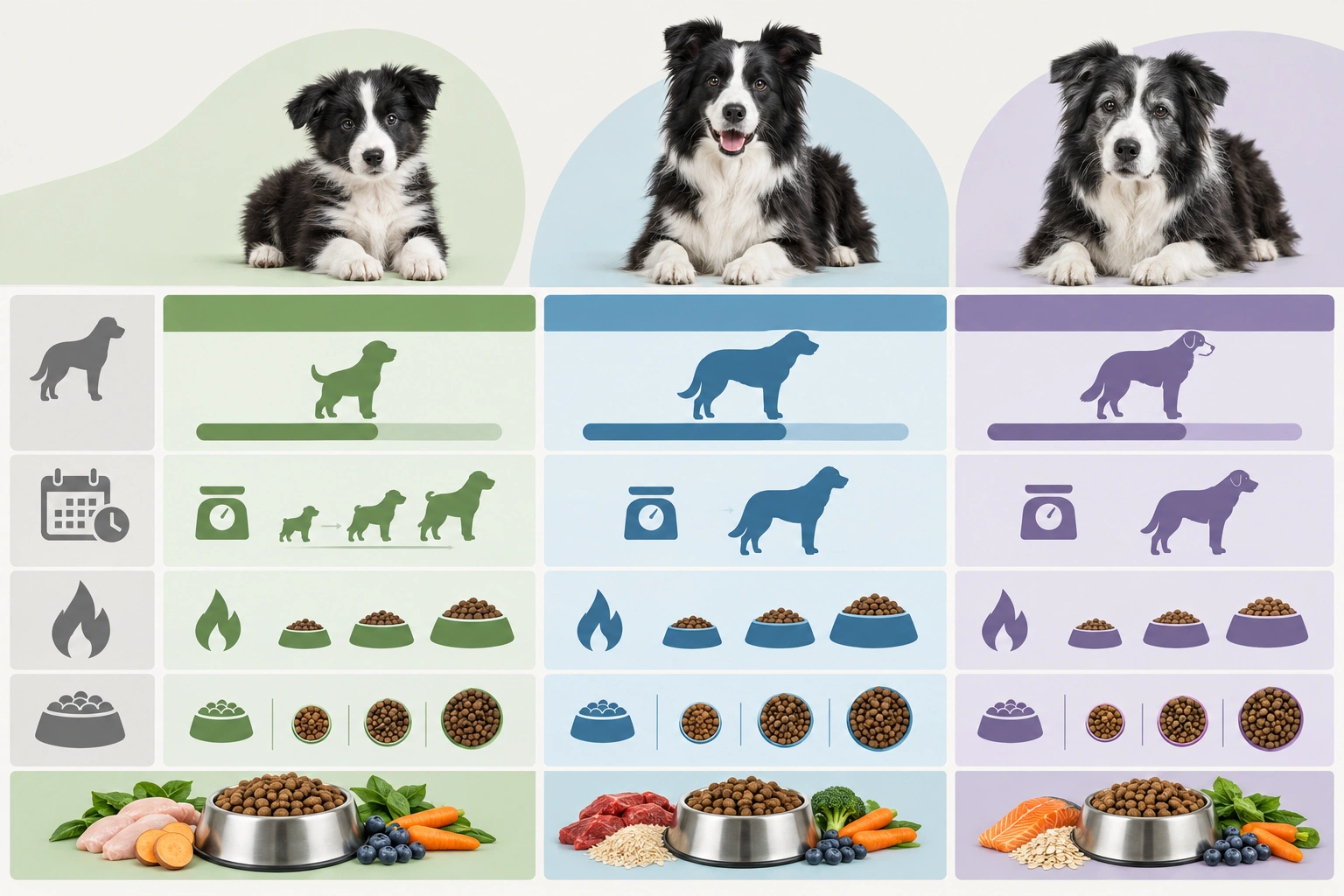
Turning Calories Into Cups, Ounces, or Raw Portions
This is where many owners get tripped up. A cup is not a calorie unit. A cup of one kibble can have far more calories than a cup of another, so two Border Collies eating “2 cups a day” may be eating very different amounts of energy.
Kibble
Kibble is the easiest to measure, but only if you use the calories per cup on the bag. If a food contains 400 kcal per cup and your Border Collie needs 1,200 kcal per day, that works out to about 3 cups daily. If the food is 500 kcal per cup, the same dog would need closer to 2.4 cups.
That is why cup counts from forums can be misleading. One Border Collie may hold weight on 1.5 cups of a calorie-dense food, while another needs 2.5 cups of a lighter formula. The cup number is the result of the food, not the breed.
Wet food
Wet food usually looks like a lot more volume because it contains more moisture and fewer calories per can or pouch. If you switch from kibble to wet food, expect the measured amount to increase even if the calorie total stays the same. Don’t judge by the size of the bowl.
Raw food
A common adult starting point is 2–3% of ideal body weight per day. For a 20 kg Border Collie, that would be roughly 400–600 g daily. Very active dogs may need more than 3%, while dogs needing to lose weight may do better closer to 2%, with progress monitored carefully.
Homemade food
Homemade diets are the hardest to portion correctly because the calories and nutrients depend entirely on the recipe. If the diet is not formulated by a veterinary nutrition professional, it is easy to accidentally underfeed energy or oversupply some nutrients while missing others. Homemade feeding can work, but it should be planned, not guessed.
Worked example: converting calories into real portions
Let’s say your Border Collie needs 1,200 kcal per day.
- Kibble: if the food provides 400 kcal per cup, the dog needs 3 cups per day
- Wet food: if one can contains 360 kcal and weighs 12 oz, the dog needs about 3.3 cans per day, or roughly 40 oz total
- Raw food: if you are feeding by a 2.5% starting point and your dog’s ideal weight is 40 lb, that is 1.0 lb of raw food per day, which equals about 16 oz or about 454 g daily
These examples are only math, not a final feeding prescription. The exact amount still depends on your dog’s body condition, activity, and whether the food is complete and balanced.
Mixed diets: calculate by calories, not by volume
If you feed more than one type of food, the portions must be based on total daily calories, not just bowls, cups, or cans. For example, kibble plus wet food, kibble plus raw, or homemade plus commercial food should all be added together as calories first, then divided into the right amounts of each food.
That means:
– 1 cup of kibble plus 1 can of wet food is not automatically a balanced meal
– A raw portion should not be guessed by eye if kibble is also being fed
– Homemade food should be counted by its calorie content, not by how full the bowl looks
How Often to Feed a Border Collie
Meal frequency is about digestion, appetite, and age—not just convenience.
- Puppies: usually 3–4 meals per day
- Adults: generally 2 meals per day
- Seniors: often 2 meals per day, though some do better with smaller, more frequent meals if appetite is inconsistent
The practical reason is simple: puppies have small stomachs and high energy needs, so spreading food across the day helps them get enough calories without one oversized meal. Adults usually do fine on two meals because it keeps hunger steadier and makes portion control easier.
For highly active dogs, two meals still works well, but some owners prefer splitting the daily total into smaller portions around exercise. The key is not the number of meals—it is the total daily intake.
How to Tell If You Are Feeding the Right Amount
Weight alone can fool you. A Border Collie can look “normal” on the scale and still be underfed or carrying too much fat. Use body condition instead.
A practical way to do this is with a 9-point body condition score (BCS) system, where 4–5/9 is usually the ideal range for most dogs. In a 5-point system, that roughly corresponds to 2.5/5. If your dog is outside that range, the feeding amount likely needs adjustment.
Signs the dog is probably getting the right amount
- You can feel the ribs with light pressure, but they are not sharply visible
- The waist is visible from above
- The abdomen tucks up from the side
- Energy level is steady, not frantic from hunger or sluggish from excess weight
Signs you may be feeding too much
- No visible waist
- Fat covering over the ribs and base of the tail
- Weight creeping up over several weeks
- Begging for food even after meals, especially if treats are also generous
Signs you may be feeding too little
- Ribs, spine, or hip bones are too easy to see
- The dog is losing weight without a planned reduction
- Coat condition worsens and muscle looks flat
- Persistent hunger plus low body reserves
How to Adjust Portions Safely
Make changes gradually. Border Collies often notice food changes quickly, and their stomachs can be sensitive to abrupt shifts.
A simple adjustment method:
- Weigh the dog or assess body condition
- Change the daily amount by about 5–10%
- Keep that amount steady for 1–2 weeks
- Recheck body shape, appetite, and energy
- Adjust again only if needed
If your Border Collie is gaining weight, reduce the daily intake a little rather than making a dramatic cut. If the dog is too thin or burning through calories during a hard training season, increase portions in measured steps.
For a working dog, the best feeding plan often changes with the season. A dog doing intense daily exercise in winter may need more than the same dog does during a quieter month. That is normal. Feed the workload, not the breed label.
Treats, Chews, and Extras Count Too
Treats are where many feeding plans quietly fall apart. A dog can eat the “right” meal portions and still gain weight because training treats, chews, and table scraps push the total calories too high.
A useful rule: keep treats and extras to a small part of the daily calorie budget and reduce meal portions if treats are frequent. If you use a lot of treats for training, pull some calories out of the main meals so the total daily intake stays balanced.
This matters especially for Border Collies because they are often trained frequently and rewarded often. That is useful for behavior, but it can also turn a good feeding plan into a slow weight-gain problem.
When a Border Collie Needs a Different Feeding Plan
Some Border Collies need more tailored feeding than a basic chart can provide.
Working or highly active dogs
These dogs often need the highest calorie intake relative to body weight. A dog that runs, herds, or trains hard may need more than the average pet Border Collie, and the food amount can rise quickly during heavy work periods.
Very sedentary dogs
A Border Collie that gets limited exercise usually needs fewer calories than many owners expect. The breed is energetic by nature, but individual lifestyle still drives the numbers.
Puppies
Puppies need more frequent meals and careful growth support. Overfeeding a puppy can create messy growth, while underfeeding can slow development. This is one place where precision matters more than guesswork.
Seniors
Older dogs may move less and need fewer calories, but they still need good nutrition. A senior Border Collie that is gaining weight on the same food amount it used as a younger adult likely needs a smaller portion.
Spayed or neutered dogs
Spayed or neutered Border Collies often need fewer calories than intact dogs of the same size and activity level. A practical approach is to start slightly lower than the standard adult estimate and monitor body condition closely, then adjust if the dog begins to lose or gain weight.
Underweight or overweight dogs
If a dog is already too thin or too heavy, the feeding plan should be based on the ideal body weight, not the current one. That distinction is important because feeding an overweight dog based on current weight can keep the problem going.
If you are using a raw diet, the same logic applies: the 2–3% guideline is based on ideal weight, not a body condition that is already off.
When to Ask Your Veterinarian
Ask your veterinarian if your Border Collie has any of these issues:
- sudden appetite loss
- unexplained weight loss or gain
- vomiting or diarrhea
- poor growth in a puppy
- a big change in energy or thirst
- persistent picky eating
- trouble maintaining weight despite what seems like enough food
That is especially important for puppies, seniors, and very active dogs. If the feeding problem is tied to illness, parasites, pain, or another medical issue, changing the portion size alone will not solve it.
The FDA’s pet food guidance is also worth reviewing if you are evaluating whether a food is appropriate for your dog’s life stage and feeding routine: FDA pet food and nutrition guidance.
A Practical Bottom Line for Border Collie Owners
If you want a simple decision rule, use this:
- Pick a calorie target first
- Convert it using your specific food’s label
- Split it into age-appropriate meals
- Check body condition after a couple of weeks
- Adjust in small steps
That approach is more reliable than chasing a single cup number. A Border Collie’s food needs are shaped by how the dog lives, not just by the breed name on the bag.
For more context on how feeding fits into the breed’s daily routine, you may also find these guides useful: how long should you walk a Border Collie and how much attention does a Border Collie need.
Frequently Asked Questions
How many cups should a Border Collie eat per day?
There is no single cup amount that fits every Border Collie because cup size depends on the food’s calorie density. Some adult dogs may do well on around 2 cups a day, while others need more or less. Check the calories per cup on your food bag and match that to your dog’s calorie target.
How much should a Border Collie puppy eat?
Puppies need more frequent meals and more calories per pound than adults. Most do better with 3–4 meals per day early on, then gradually moving toward 2 meals as they mature. Growth stage matters more than breed alone.
Do active Border Collies need more food?
Yes. A Border Collie that works, runs, or trains hard usually needs more calories than a low-activity pet of the same size. Some working dogs need substantially more than a standard pet feeding amount.
Should I feed by cups or calories?
Calories are more accurate. Cups are only useful after you know the food’s calorie density. Two foods can both say “1 cup” and still deliver very different energy levels.
How do I know if my Border Collie is overweight?
Look for a lack of waist, fat covering the ribs, and a tail base that feels padded. Body condition is a better guide than scale weight alone. On a 9-point BCS scale, many dogs should aim for about 4–5/9.
How often should I feed an adult Border Collie?
Most adults do well on two meals a day. Puppies usually need three or four meals, and some seniors may benefit from smaller meals depending on appetite and digestion.
Can I feed raw or homemade food instead of kibble?
Yes, but the portion size changes and the diet needs to be balanced carefully. Raw feeding is often estimated at 2–3% of ideal body weight per day for adults, while homemade diets should ideally be formulated with veterinary guidance.
Should treats be counted in daily food?
Absolutely. Treats can add up fast, especially in a trainable breed like the Border Collie. If treats are frequent, reduce meal portions so the total daily intake stays in range.
How do I know when to change the amount?
If your dog is gaining fat, losing weight, or changing activity level, the portion likely needs an adjustment. Make small changes and reassess after 1–2 weeks.
When should I call the vet?
Call if appetite changes suddenly, weight shifts quickly, or your Border Collie has vomiting, diarrhea, poor growth, or persistent trouble maintaining condition. That is not a problem to troubleshoot blindly.
