
How Long Should You Walk a Border Collie?

Quick Answer
A healthy adult Border Collie usually does well with about 60–90 minutes of purposeful walking each day, normally split between two outings. However, walking alone may not satisfy this energetic herding breed, so combine it with training, sniffing, play, or another mentally challenging activity, as reflected in AKC guidance on Border Collies.
A practical daily starting point
- Healthy adults: Aim for roughly 60–90 minutes of walking, usually divided into two sessions.
- Young puppies: Keep walks shorter and allow plenty of self-paced play and rest.
- High-drive adults: Add structured training, running, games, herding, or dog sports rather than endlessly extending walks.
- Senior dogs: Favor shorter, comfortable walks based on mobility and veterinary advice.
- Watch the dog: Adjust duration when you notice fatigue, stiffness, unusual panting, or reluctance to continue.
Most important rule
- Build a balanced routine instead of trying to exhaust your Border Collie with miles alone.
Border Collies, also called Borders or BCs, were developed to work, think, and move for long periods. That heritage is why a ten-minute stroll around the block rarely feels like a complete exercise plan.
As of 2026, I prefer to think about walking as one part of a Border Collie’s daily routine. The right amount depends on age, fitness, health, temperament, weather, and what else the dog does that day.
In This Guide
- How long should an adult Border Collie walk each day?
- How much walking does a Border Collie need by age?
- Is walking enough exercise for a Border Collie?
- Should you walk a Border Collie once or twice a day?
- How do you know if your Border Collie needs more or less exercise?
- When should you shorten a Border Collie’s walk?
- What does a balanced Border Collie exercise routine look like?
- Frequently Asked Questions
- Final Takeaway
How Long Should an Adult Border Collie Walk Each Day?
For a healthy adult Border Collie, I use 60–90 minutes of daily walking as a practical starting range. I prefer splitting that time rather than doing one huge outing.
This isn’t a strict veterinary rule. One Border Collie may settle beautifully after two 35-minute walks, while a working-line dog may finish the same routine ready for another job.
Definition: A Border Collie walking plan is an age-appropriate combination of leash walking, free movement, sniffing, training, and recovery that contributes to the dog’s total daily physical and mental activity.
The American Kennel Club describes the Border Collie as a high-energy herding breed that thrives when given work and regular mental stimulation. Their original job required stamina, concentration, quick decisions, and repeated bursts of movement.
That history matters. A slow pavement walk exercises the legs, but it may barely challenge the brain.
Does every adult need 90 minutes?
No. Start with the individual dog rather than chasing a number on a clock.
- Lower-drive adults: Two walks totaling around 60 minutes may work when combined with play and training.
- Typical active adults: Around 60–90 minutes of walking plus mental work is a useful starting routine.
- Working or sport dogs: Walking may become recovery exercise because training, herding, agility, or running supplies harder physical work.
- Dogs returning to exercise: Build duration gradually instead of immediately attempting long outings.
I also judge the quality of the walk. Thirty minutes of sniffing, training, changing direction, and exploring can be more satisfying than sixty minutes of marching the same route.
Section Takeaway: Most healthy adult Border Collies need more than a brief neighborhood walk. Start around 60–90 minutes of daily walking, then adjust according to the individual dog.
How Much Walking Does a Border Collie Need by Age?
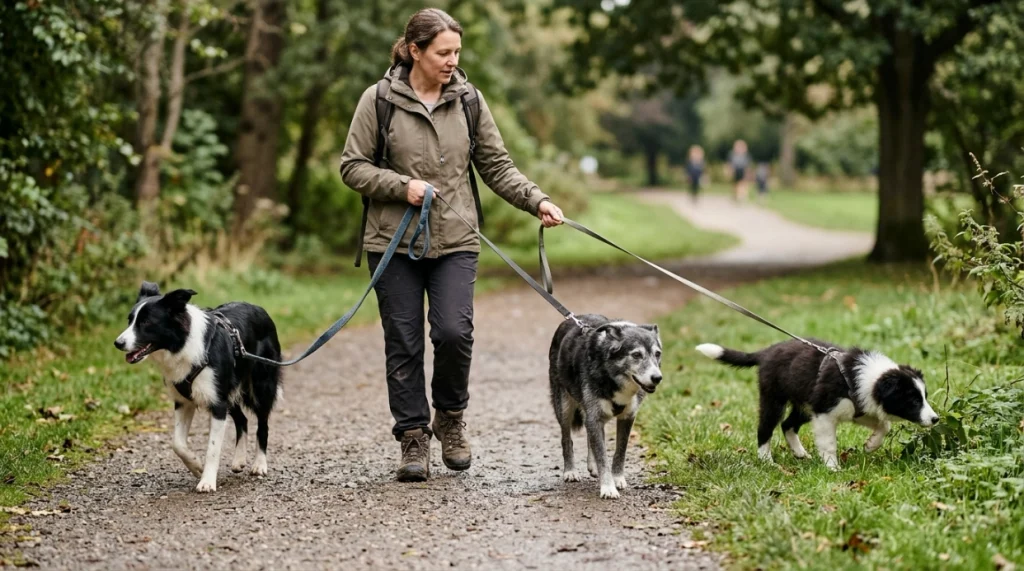
A Border Collie’s ideal walk changes significantly from puppyhood to old age. Growth, coordination, conditioning, joints, and recovery all affect what is sensible.
| Life Stage | Practical Walking Approach | Main Priority |
|---|---|---|
| Young puppy | Several short, easy outings rather than long forced walks | Exploration, socialization, rest |
| Older puppy / adolescent | Gradually longer walks with training and sniffing | Controlled development |
| Healthy adult | About 60–90 minutes daily as a starting range | Fitness plus mental enrichment |
| Highly active adult | Walking combined with harder structured activities | Purposeful work and recovery |
| Senior | Shorter, comfortable walks, often more frequently | Mobility and comfort |
Border Collie puppies
Puppies need activity, but more isn’t automatically better. Their growing bodies aren’t miniature versions of adult dogs.
VCA’s veterinary guidance on puppy exercise advises against pushing immature puppies through strenuous jogging, long hikes, repeated jumping, and similar high-impact exercise before maturity.
Short exploratory walks work well. Let the puppy sniff, practice leash skills, experience surfaces, and take breaks.
Adult Border Collies
Healthy adults can handle more sustained activity once they have been conditioned gradually. This is where the 60–90 minute daily walking range becomes most useful.
Don’t jump from twenty-minute walks to two-hour hikes in a weekend. Fitness develops through consistent work.
Senior Border Collies
Older Borders still benefit from movement, even when speed and endurance decline. Comfortable regular exercise can be more useful than occasional exhausting adventures.
PetMD’s senior dog exercise guidance also stresses tailoring activity to mobility and medical needs.
Vet note: Ask your veterinarian about appropriate exercise if your Border Collie is still growing, has been inactive, is overweight, has joint problems, or has another medical condition.
Is Walking Enough Exercise for a Border Collie?
Walking is important, but walking alone often isn’t enough for a healthy Border Collie. These dogs were selected for both physical endurance and concentrated problem-solving.
A Border Collie’s famous herding eye refers to the intense stare used to influence livestock movement. That working style illustrates how much mental engagement sits behind the breed’s physical activity.
Add work for the brain
You don’t need sheep to give a Border Collie meaningful work. You need activities that require attention and choices.
- Obedience practice: Add five to ten minutes of recalls, stays, heelwork, or position changes.
- Sniffing: Give part of the walk to free, safe scent exploration.
- Search games: Hide treats or toys and let your dog locate them.
- Tug or fetch: Use controlled sessions with clear starts, stops, and breaks.
- Dog sports: Agility, rally, herding, tracking, and similar sports can combine thinking with movement.
- Everyday jobs: Carrying out simple trained tasks gives many Borders useful structure.
I prefer variety over endlessly increasing mileage. Creating a canine athlete who can run for hours doesn’t automatically create a dog who knows how to relax at home.
Sniffing walks deserve special attention. VCA’s guidance on play and exercise notes that walks can provide both physical activity and mental enrichment when dogs get opportunities to explore and sniff.
A balanced Border Collie should learn two skills: how to work and how to switch off. Both matter.
Should You Walk a Border Collie Once or Twice a Day?
For most adult Border Collies, two meaningful walks are better than one enormous walk. Splitting activity provides stimulation at different parts of the day and avoids relying on a single exercise burst.
A simple schedule might look like this:
- Morning: 30–45 minutes of brisk walking, sniffing, and several short training exercises.
- Midday: A brief toilet break, puzzle, search game, or five-minute training session.
- Evening: 30–45 minutes of walking, controlled play, or another appropriate activity.
- Later: Quiet chewing, settling practice, and genuine rest.
Some families prefer a longer morning outing and shorter evening walk. Others reverse the pattern.
The schedule should fit your dog’s behavior and your household. Consistency matters more than making every day identical.
Can you do one long walk instead?
You can occasionally take a conditioned adult Border Collie on a longer hike or adventure. One long walk shouldn’t automatically replace all other interaction, though.
Consider the following day as well. A dog that completed a demanding hike may benefit from an easier recovery day rather than another endurance session.
Border Collies can appear willing to continue long after sensible owners should stop. Drive isn’t the same thing as unlimited physical capacity.
How Do You Know If Your Border Collie Needs More or Less Exercise?
Don’t judge exercise only by whether your dog looks tired immediately afterward. Look at behavior, recovery, movement, and ability to settle throughout the day.
Possible signs the routine needs more enrichment
- Constantly demanding games or attention
- Pacing and struggling to settle
- Repeated nuisance barking
- Digging or destructive chewing from boredom
- Inventing chasing games around moving people, bicycles, or pets
- Persistent attempts to initiate activity despite getting adequate rest
These behaviors don’t prove that exercise is the only problem. Anxiety, training history, environment, and medical issues can create similar behavior.
Signs you may be asking for too much
- Lagging behind on a familiar route
- Repeatedly sitting or lying down
- Unusual stiffness after exercise
- Limping or altered movement
- Extreme or prolonged panting
- Reluctance to exercise the following day
- Noticeably slower responses or unusual irritability after activity
Fatigue is a normal response to demanding activity, but excessive or persistent fatigue deserves attention. The Merck Veterinary Manual’s exercise guidance explains that conditioning should build gradually for dogs doing prolonged or high-intensity work.
Vet note: Stop strenuous exercise and contact your veterinarian if your Border Collie develops persistent limping, weakness, breathing difficulty, collapse, significant pain, or an unexplained change in exercise tolerance.
When Should You Shorten a Border Collie’s Walk?
Even an athletic Border Collie shouldn’t follow the same walking schedule every day. Weather, illness, age, surface conditions, and recent exercise should change your plan.
Hot or humid weather
Move exercise to cooler parts of the day and reduce intensity when necessary. Carry water on longer outings and watch your dog’s breathing and behavior.
A Border Collie’s double coat shouldn’t be treated as proof that the dog can exercise hard in any weather. Heat generated through physical activity still matters.
After a demanding activity
A quiet sniffing walk can make sense after a long hike, agility session, or intense training day. Recovery is part of fitness.
When your dog is sore or unwell
Don’t attempt to “walk off” unexplained limping or obvious pain. Reduce activity and get professional advice when symptoms persist or concern you.
For an overweight or unconditioned Border Collie
Begin with manageable outings and add time gradually. Sudden high mileage puts unnecessary stress on a body that hasn’t adapted to it.
Vet note: Dogs with arthritis, heart or respiratory disease, obesity, previous injuries, or other medical problems may need an individualized exercise plan from a veterinarian.
What Does a Balanced Border Collie Exercise Routine Look Like?
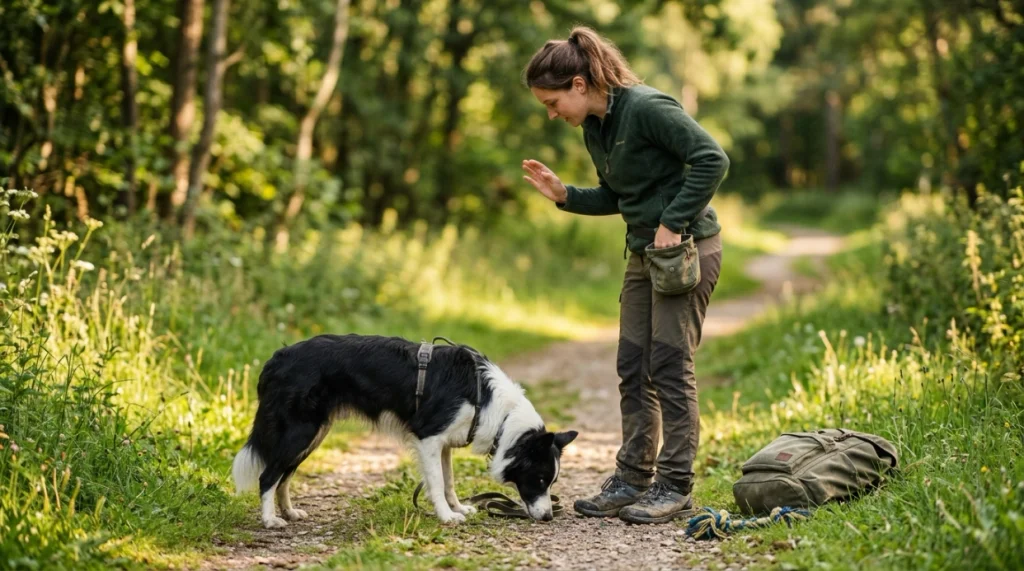
A strong routine isn’t designed to leave a Border Collie exhausted every night. It should create fitness, engagement, confidence, and an ability to rest.
For a healthy adult, I would start with a week that mixes several types of activity:
- Daily walking: Roughly 60–90 minutes across two outings for many healthy adults.
- Sniffing: Include relaxed exploration rather than demanding perfect heelwork for every minute.
- Training: Use several short five-to-ten-minute sessions instead of one exhausting lesson.
- Higher-energy play: Add controlled fetch, tug, running, or appropriate dog sports according to fitness.
- Problem-solving: Rotate scent games, food puzzles, searches, and learned tasks.
- Rest: Protect quiet periods rather than continuously stimulating the dog.
A sample day for a healthy adult
At 7 a.m., you might take a 40-minute walk with sniffing and five minutes of recall work. The dog then gets breakfast and settles while the household starts its day.
At midday, use a ten-minute scent game or short training session. This gives the brain something useful to do without another long workout.
In the evening, take a 35-minute walk and finish with controlled play. Later, encourage calm rest rather than repeatedly throwing a ball until the dog quits.
This totals around 75 minutes of walking while supplying several other forms of stimulation. For many pet Border Collies, that balance works better than simply adding another hour of pavement.
Australian Shepherds, Kelpies, and other active herding breeds share some similar needs. Individual Border Collies can still vary considerably in drive, fitness, and ability to settle.
Section Takeaway: Use walking as the foundation, not the entire exercise program. Physical work, mental challenges, training, sniffing, play, and rest should support each other.
Frequently Asked Questions
Is a 30-minute walk enough for a Border Collie?
One 30-minute walk is usually too little as the entire daily activity plan for a healthy adult Border Collie. It can still be a useful individual session when the dog gets another walk, training, play, sniffing, or an appropriate sport later.
Is two hours of walking too much for a Border Collie?
A conditioned, healthy adult may comfortably handle two hours on some days, especially at moderate intensity. That doesn’t mean every Border Collie requires two hours daily, and puppies, seniors, unfit dogs, or dogs with health problems may need much less.
Can Border Collies go on long hikes?
Healthy adult Border Collies can make capable hiking partners when properly conditioned. Build distance gradually, consider terrain and weather, carry water, allow breaks, and don’t assume enthusiasm means the dog cannot become tired or injured.
How far should a Border Collie walk each day?
Time and intensity are usually more useful than prescribing a fixed mileage because terrain, pace, age, and fitness change the workload. For many adult pet Border Collies, two purposeful walks totaling around 60–90 minutes are a sensible starting point.
How often should a Border Collie puppy be walked?
Give puppies several short, gentle opportunities to explore rather than forcing long-distance exercise. Their exact routine should reflect age, vaccination status, physical development, behavior, and your veterinarian’s advice.
Does playing fetch replace walking?
Fetch can provide vigorous physical activity, but it shouldn’t automatically replace walking. Walks offer sniffing, environmental exposure, leash skills, lower-intensity movement, and opportunities for calm exploration that repetitive ball chasing doesn’t provide.
Why is my Border Collie still energetic after a long walk?
The walk may have exercised the body without challenging the brain. Try adding scent work, short training sessions, problem-solving games, controlled play, and planned rest rather than automatically making every walk longer.
Final Takeaway
So, how long should you walk a Border Collie? For a healthy adult, about 60–90 minutes of walking per day, usually split between two outings, is a useful starting point rather than an absolute rule.
The bigger goal is balance. Give your Border Collie physical exercise, mental work, chances to sniff and explore, clear training, and enough downtime to recover.
Watch the dog in front of you. When you adjust the routine for age, health, fitness, weather, and temperament, you’re far more likely to end up with a fit Border Collie who can also relax when the day’s work is done.
