
How Often Do Dogs Urinate? A Practical Guide for Owners

If you want the short answer, most healthy adult dogs pee about three to five times a day. Puppies usually need to go much more often, and senior dogs often need extra breaks too. That said, “normal” depends on age, water intake, exercise, diet, and health.
For Border Collie owners, the key is not memorizing one perfect number. It’s learning your dog’s baseline and noticing change. A dog that suddenly pees far more often, starts straining, or begins having accidents after being reliable deserves attention. A dog that is simply asking to go out more after a long walk or a hot day may just be responding to normal hydration needs.
How Often Do Dogs Urinate? The Short Answer
A practical baseline looks like this:
- Puppies: often every 1 to 3 hours during the day, depending on age
- Adult dogs: usually around 3 to 5 times a day
- Senior dogs: often more often than adults, especially if bladder control is weaker
A healthy adult dog may often be able to hold urine for 6 to 8 hours, but that is best understood as a general estimate rather than a goal to aim for every day. Puppies and senior dogs usually need more frequent opportunities. For puppies, a common rule of thumb is about one hour of holding time per month of age, though that can vary by dog.
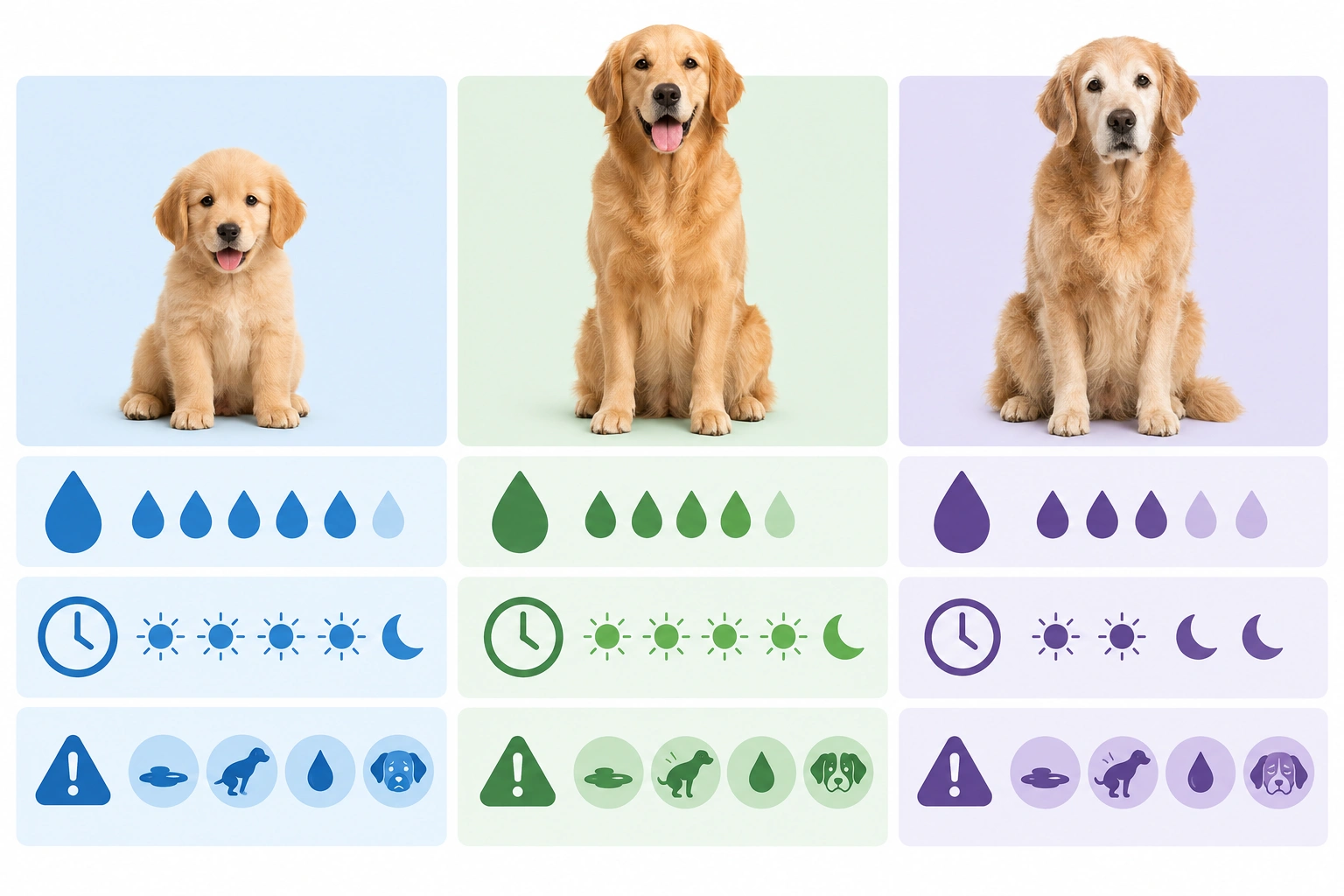
The most useful question is not “How many times is normal for all dogs?” It is “Is this normal for my dog, right now, in this routine?” A Border Collie who drinks more after a hard training session may need an extra potty break. A dog who suddenly starts peeing much more often without a clear reason may need a vet check.
What’s Normal by Age and Life Stage
Puppies
Puppies urinate more often because their bladders are small and their control is still developing. A young puppy may need to go out every 1 to 2 hours while awake, and many need bathroom breaks after waking, after eating, and after play.
A simple age-based guide helps:
- 8-week-old puppy: often every 1 to 2 hours
- 3-month-old puppy: often every 2 to 3 hours
- 4- to 5-month-old puppy: often every 3 to 4 hours
- 6 to 8 months: closer to adult timing for many dogs
That does not mean every puppy follows the same clock. A lively puppy, a puppy with easy access to water, or a puppy in a hot environment may need more frequent breaks. If you are house training, more trips outside are usually better than trying to stretch the gap and hoping for the best.
Adult dogs
Most healthy adult dogs fall into the 3 to 5 times per day range. Some will need more. Smaller dogs may need to go more often, and active dogs often need extra opportunities because exercise and water intake go together.
A Border Collie that spends the morning doing fetch, training, or hiking may need to urinate more often than a dog with a quieter routine. That does not automatically mean anything is wrong. It usually means the day included more movement and more drinking.
Senior dogs
Older dogs often need more bathroom breaks than they used to. Some of that is reduced bladder control. Some of it is age-related health change. If a senior dog starts having overnight accidents, asks to go out more often, or seems less able to “hold it” than before, that may be part of aging, but it should still be tracked.
The important detail is change. A senior dog that has always needed one extra break may be predictable. A senior dog that suddenly begins peeing frequently after years of stability is not something to ignore.
| Life stage | Typical pattern | What to watch |
|---|---|---|
| Puppy | Very frequent, often every 1–3 hours | Accidents are common if breaks are too far apart |
| Adult dog | Usually 3–5 times daily | Sudden increases, straining, or thirst |
| Senior dog | Often more frequent than adult | Overnight accidents, weaker control, medical changes |
How Long Can a Dog Hold Its Urine?
A healthy adult dog may often be able to hold urine for 6 to 8 hours, but that is a ceiling, not a target. Just because a dog can wait that long does not mean they should do it regularly.
Puppies need shorter intervals because they are still developing bladder control. Senior dogs may also need shorter intervals because their control is weaker. Breed, size, health, and routine matter too.
There is a practical trade-off here:
- More frequent breaks mean fewer accidents and less bladder stress
- Longer gaps may fit your schedule better, but they increase discomfort and can create house-training setbacks
For most owners, the safest approach is to build the schedule around the dog’s needs, then slowly stretch it only if the dog is consistently successful.
Factors That Change How Often a Dog Needs to Pee
Several normal factors can change urination frequency without indicating disease.
Water intake
More drinking usually means more peeing. That sounds obvious, but it matters because owners sometimes notice the urine frequency without noticing the water bowl. If your dog drank heavily after a long walk, a warm afternoon, or a salty treat, expect more bathroom trips.
Diet
Wet food adds moisture. Some treats and diets can also affect thirst. A change in food may change urination patterns slightly, especially during the transition period.
Exercise and weather
Dogs often drink more during hot weather or after exercise, which leads to more urination. That is especially relevant for active breeds like Border Collies. A dog that has been running, training, or hiking may need extra opportunities to relieve itself simply because it is hydrating more.
Size and bladder control
Smaller dogs often need to go more frequently than larger dogs. They have less bladder capacity, so the timing may be tighter. Breed can play a role too, but the bigger practical factors are size, age, and routine.
Medications
Some medications can increase thirst and urination. If your dog’s potty pattern changed after starting a new drug, that is worth discussing with your veterinarian rather than assuming it is just behavior.
Frequent Small Trips vs. Large-Volume Peeing
Not all frequent urination means the same thing.
Frequent small amounts
If a dog squats often but only passes a little urine each time, that pattern can point to irritation or a urinary issue. It may look like the dog “has to go” repeatedly but cannot empty normally.
This pattern is more concerning than a dog who urinates a normal amount several times a day. Frequent tiny pees, especially with straining or discomfort, deserve attention.
Large-volume peeing
If a dog is producing a lot of urine each time and also drinking more, that can suggest a different problem. Increased thirst plus large-volume urination is one of the combinations that should make you think about a medical cause rather than a simple house-training issue.
A helpful way to judge the pattern is to ask:
- Is my dog peeing often and only a little?
- Or is my dog peeing more than usual and in larger amounts?
- Is my dog also drinking more?
Those answers point in different directions.
When Frequent Urination May Signal a Health Problem
A sudden change in urination frequency matters more than a single odd day. If your dog is peeing much more often than usual, especially with other symptoms, a medical cause becomes more likely. Persistent increased thirst along with increased urination should be evaluated by a veterinarian.
Common concerns include:
- Urinary tract infection or bladder infection
- Bladder irritation
- Diabetes
- Kidney disease
Watch for these combinations:
- frequent urination plus increased thirst
- frequent urination plus blood in the urine
- frequent urination plus pain or restlessness
- frequent urination plus lethargy or vomiting
If your dog is otherwise acting normal and the change is mild and brief, you can monitor closely for a day or two. If the pattern persists, gets worse, or comes with other symptoms, call your veterinarian.
For a general reference on normal dog bathroom patterns, the American Kennel Club’s dog care guidance is a useful starting point, but your dog’s own baseline still matters most.
When Reduced Urination or Straining Is Urgent
A dog that cannot urinate, strains repeatedly, or only passes drops may need urgent veterinary care. That is not a “watch and wait” situation.
Get help quickly if you notice:
- repeated squatting or straining with little or no urine
- obvious pain while trying to pee
- a sudden sharp decrease in urination
- vomiting, lethargy, or a very unwell appearance along with urinary trouble
This is one of those cases where waiting for the next day can be the wrong move. If the bladder cannot empty normally, the problem can become serious fast.
For broader veterinary guidance on urinary concerns, VCA Hospitals has reliable owner-friendly information on common pet health issues.
Behavioral Accidents vs. Medical Causes
Not every accident is a medical problem. Sometimes the issue is simply a schedule that no longer fits the dog.
Behavioral or training-related accidents are more likely when:
- the dog pees in predictable places, like near the door or after being left too long
- the dog is otherwise acting normal
- the pattern improves when potty breaks become more frequent
- the dog is young and still learning
Medical causes are more likely when:
- the change is sudden
- the dog is drinking more
- the dog is straining, licking, or showing discomfort
- the dog was previously reliable and now has repeated accidents
A Border Collie with a sharp mind can still have accidents if the schedule is too ambitious. But if a well-trained dog suddenly starts peeing in the house, do not assume it is “just behavior” until health has been considered.
Potty Schedules for Puppies, Adults, Seniors, and Active Dogs
A useful schedule is one the dog can actually succeed on.
Puppies
Take puppies out:
- after waking
- after eating
- after play
- before bed
- every 1 to 3 hours while awake, depending on age
You are not trying to prove bladder strength. You are preventing mistakes and building a habit.
Adult dogs
Most adult dogs do well with:
- first thing in the morning
- midday or afternoon
- evening
- right before bed
That usually lands near the 3 to 5 times per day range.
Senior dogs
Older dogs often benefit from a more generous schedule, especially if they have overnight accidents or weaker bladder control. Adding one extra break before bed or during the evening can make a big difference.
Active dogs like Border Collies
Border Collies often have active days, and active days usually mean more drinking. If your dog gets a long walk, training session, fetch game, or hike, add a potty break afterward rather than assuming the normal schedule will still work.
A practical approach is this: if the dog drinks heavily or has had a high-output exercise session, give an extra bathroom opportunity within the next hour or two.
What to Do if Your Dog’s Peeing Pattern Changes
Use a simple decision framework.
Monitor at home if:
- the change is small
- your dog is otherwise bright and comfortable
- there is a clear reason, like hot weather or a long exercise session
- the pattern improves within a day
Track three things for 24 to 48 hours:
- How often the dog urinates
- How much comes out each time
- Whether thirst also increased
Increase potty breaks if:
- your dog is having accidents because the gap is too long
- your puppy is failing between scheduled outings
- your senior dog seems to need a shorter interval
Call the veterinarian if:
- urination frequency changes suddenly and stays changed
- your dog is drinking much more than usual
- there is blood, pain, or repeated straining
- your dog is peeing very small amounts over and over
- your house-trained dog starts having repeated accidents without an obvious schedule problem
Seek urgent care if:
- your dog cannot urinate
- your dog strains repeatedly and only drops come out
- your dog seems painful, weak, vomiting, or very unwell
If you want to compare this issue with other routine care questions, you may also find our guide on how often dogs should get their teeth cleaned helpful for building a sensible health schedule overall.
Frequently Asked Questions
How many times a day should a dog pee?
Most healthy adult dogs pee about 3 to 5 times a day. Puppies and seniors often need more frequent breaks.
How often should puppies urinate?
Many puppies need to go out every 1 to 3 hours during the day, depending on age. A rough rule of thumb is about one hour of holding time per month of age, though it varies by puppy.
Is it normal for a dog to pee more after exercise?
Yes. Dogs often drink more after exercise, and that usually means they need to urinate more often too.
How long can a dog hold its urine overnight?
A healthy adult dog may hold urine for 6 to 8 hours, but puppies and senior dogs often need shorter intervals.
Should I worry if my dog is peeing small amounts often?
Frequent small urinations can be more concerning than normal-sized pees. If it is paired with straining, discomfort, or repeated attempts, contact your veterinarian.
When is frequent urination an emergency?
If your dog cannot urinate, strains repeatedly, or only passes drops, seek urgent veterinary care.
Do Border Collies need more potty breaks?
Not because of the breed alone, but because many Border Collies are active. More exercise often means more drinking, which can mean more bathroom trips.
Final practical rule
If your dog is peeing more often than usual, ask three questions: Is my dog drinking more? Is the urine amount changing? Did the pattern change suddenly? Those answers usually tell you whether you are looking at a normal routine shift, a training issue, or a reason to call the vet.
