
How to Brush a Border Collie Correctly

Quick Answer
To brush a Border Collie correctly, inspect the coat, work through small sections with a suitable brush, gently loosen tangles, and finish with a comb to check for hidden knots. Pay particular attention behind the ears, under the legs, around the chest, and at the base of the tail. Use light pressure and avoid pulling, scraping the skin, or overworking the double coat.
Brushing a Border Collie is easier when you work methodically rather than repeatedly dragging a brush over the entire coat. Both smooth-coated and rough-coated Border Collies have a dense undercoat beneath a protective outer coat, but longer feathering can make tangles harder to spot.
The goal is to remove loose hair and debris, keep the coat free of knots, and leave your dog comfortable. You do not need to remove every loose hair in one session or brush until the coat looks unnaturally thin.
What should you prepare before brushing?
Gather a brush suited to your dog’s coat, a suitable comb, and a few small treats. For many rough-coated Border Collies, a soft or medium slicker brush or a pin brush works well. A metal comb with appropriately spaced teeth helps identify tangles that the brush may miss. For smooth-coated dogs, a soft bristle brush or grooming glove may be enough for routine maintenance.
- Brush: Choose one that removes loose hair without scratching the skin or catching repeatedly.
- Comb: Use it to check feathering and detect hidden knots.
- Detangling spray: If needed, use a dog-safe grooming product according to its label.
- Treats: Reward calm behavior, especially if your dog is new to grooming.
Inspect the coat before you start. Look for burrs, grass seeds, tight mats, sore patches, and areas that your dog resists having touched. Remove loose debris with your fingers when possible rather than pulling it through the coat with a brush.
If you want to understand how coat length affects tool selection, see our guide to the different Border Collie coat types.
How do you brush a Border Collie correctly?
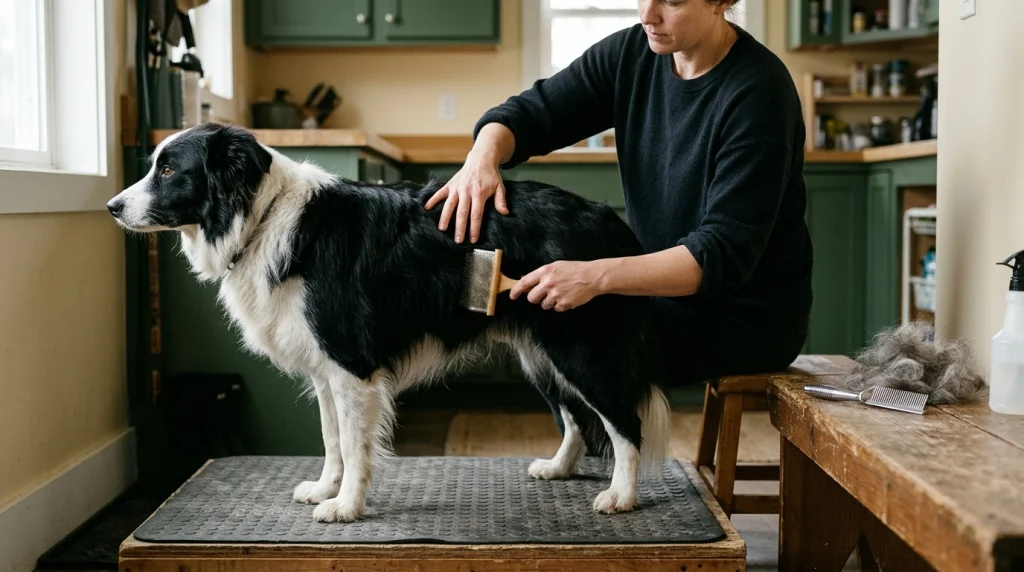
Use the following sequence for a routine grooming session. Adjust the time and pressure to your dog’s coat density, sensitivity, and tolerance for handling.
1. Let your dog settle into a comfortable position
Choose a quiet, well-lit place with a nonslip surface. Let your dog stand, sit, or lie down comfortably, provided you can reach the area without twisting or restraining them awkwardly.
Start with a few gentle strokes on an easy area, such as the shoulder. Reward your dog for remaining relaxed. If they are unfamiliar with grooming, keep the first sessions brief and gradually introduce more areas.
2. Brush in small sections
Divide a rough coat into manageable sections instead of brushing only the visible surface. Start near the shoulders or back, then work toward the sides, chest, legs, and tail.
Use short, controlled strokes that follow the direction of hair growth. Keep the brush at a shallow angle and apply enough pressure to separate the hair without scraping the skin. Lift and reposition the brush rather than dragging it forcefully through resistance.
On longer feathering, gently separate the hair with your fingers so you can see where the brush is working. This helps you avoid repeatedly brushing the same outer layer while leaving loose undercoat or small knots underneath.
3. Work through loose undercoat carefully
Border Collies shed, and loose undercoat can accumulate during heavier shedding periods. Use a suitable brush to remove hair gradually, checking the coat as you go. An undercoat rake may help when substantial loose undercoat is present, but it is not necessary for every session.
Make gentle passes and stop if the tool catches, the skin becomes red, or your dog shows discomfort. Avoid aggressively scraping, repeatedly combing one spot, or using a blade-based deshedding tool as though it were an ordinary brush.
4. Detangle knots before moving on
If you encounter a small, loose tangle, hold the hair near its base to reduce pulling on the skin. Gently separate the knot with your fingers, then work from the outer ends toward the base using short strokes.
Do not yank the brush through a knot. If it will not loosen easily, stop and reassess rather than increasing pressure. Tight or extensive mats may need a professional groomer, particularly when they sit close to the skin.
5. Check the coat with a comb
Once you have brushed a section, pass a comb through it gently. The teeth should move through the hair without repeatedly catching on hidden tangles. If the comb stops, investigate the specific spot instead of forcing it through.
Check both the outer hair and the deeper coat. A smooth-looking surface does not necessarily mean the hair underneath is free of knots.
6. Finish with a gentle surface brush
Finish by brushing the outer coat in the direction the hair grows. This removes remaining loose surface hair and helps the coat lie naturally.
Check your dog’s skin for redness, scratches, unusual lumps, or areas of hair loss. End the session with praise or a treat so grooming remains a positive experience.
Which areas need the most attention?
Some parts of a Border Collie’s coat are more likely to collect tangles, debris, or compacted loose hair. Give these areas an individual check rather than assuming a whole-body brushing has reached them.
- Behind the ears: Fine, longer hair can form small knots. Separate it gently and keep brush pressure low.
- Under the front legs: Friction and movement can encourage tangling in this area.
- Chest and neck ruff: Longer hair can trap dirt and loose undercoat.
- Rear feathering and trousers: Check for knots, dried mud, and plant material.
- Base of the tail: Dense hair can conceal tangles and loose undercoat.
- Legs and paws: Inspect for grass seeds, burrs, and debris between the toes. Be especially gentle where the coat is thin.
Move slowly around the face, ears, armpits, belly, and other sensitive areas. If your dog repeatedly turns toward the brush, stiffens, licks their lips, or tries to leave, pause and check whether a knot or uncomfortable technique is causing the reaction.
How often should you brush a Border Collie?
For most Border Collies, brushing once or twice a week is a reasonable starting point. Longer rough coats may need more frequent attention, while smooth coats often require less work to prevent tangles. During heavier shedding periods or after outdoor adventures, additional brushing may be useful.
There is no single schedule that suits every dog. Coat density, feathering, activity, climate, and the amount of loose hair all affect how often brushing is needed.
- Short, smooth coat: Start with a weekly session and adjust if loose hair builds up.
- Medium or rough coat: Check the coat several times a week, especially behind the ears and around feathering.
- Heavy shedding: Increase gentle brushing as needed rather than trying to remove all the undercoat at once.
- After walks: Inspect the coat for burrs, grass seeds, mud, and tangles.
For more detail on building a manageable routine, read how to brush a Border Collie before a bath. Pre-bath brushing is particularly useful because water can tighten existing tangles and make them harder to remove.
What brushing mistakes should you avoid?
- Brushing too hard: Repeated pressure can irritate the skin and make grooming unpleasant.
- Rushing through knots: Pulling can hurt your dog and make them fearful of future sessions.
- Ignoring the undercoat: Brushing only the visible surface can leave loose hair and tangles underneath.
- Overusing deshedding tools: Excessive scraping or cutting can damage healthy coat and irritate skin.
- Forcing a long session: A few comfortable sessions are preferable to one stressful session.
- Brushing over sore skin: Stop if you find a wound, inflamed patch, or painful area.
Routine brushing should maintain the coat, not strip it down. A Border Collie’s double coat helps protect the skin and provides insulation, so shaving the entire coat to reduce shedding is generally not advisable unless a veterinarian recommends it for a specific medical reason.
The American Kennel Club’s guide to double-coated dog grooming explains the protective role of the coat and why careful maintenance matters.
When should you stop brushing and get help?
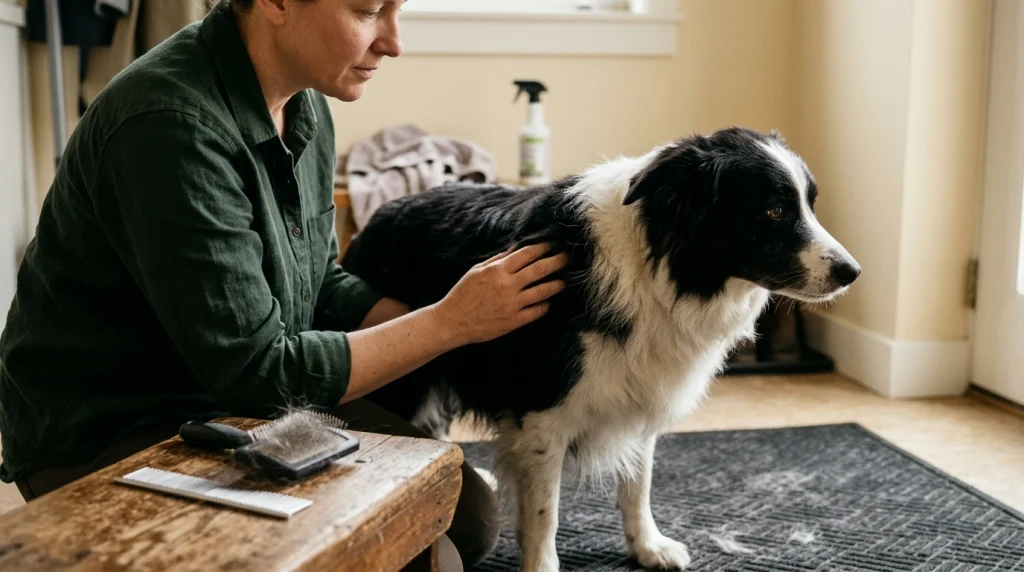
Stop brushing if your dog appears painful, the skin becomes irritated, or the brush repeatedly catches in a tight mat. Do not use scissors to cut mats out close to the skin; a dog’s skin can be pulled up into the tangled hair and accidentally cut.
Arrange professional grooming for extensive or skin-tight matting that cannot be loosened safely. Contact a veterinarian if you notice persistent itching, sores, bleeding, swelling, unusual hair loss, or painful skin. These problems may need more than a change of brush.
If your Border Collie suddenly becomes reluctant to be brushed, do not assume the dog is simply being difficult. Check for hidden tangles, tenderness, or a skin problem, and seek help when the cause is unclear.
Related Product
Dog Slicker Brush and Metal Grooming Comb
A gentle slicker brush and a suitable comb can help remove loose hair and check for hidden tangles, particularly in a rough-coated Border Collie.
As an Amazon Associate, we earn from qualifying purchases.
Frequently Asked Questions
Should you brush a Border Collie against the direction of hair growth?
Most routine brushing should follow the direction of hair growth. If you need to loosen undercoat, use a suitable tool and gentle, controlled movements rather than forcefully brushing backward against the coat.
Can you brush a Border Collie every day?
Yes, gentle daily brushing can be appropriate during heavy shedding or when a longer coat tangles easily. Daily brushing is not necessary for every dog, and repeated strokes over the same area can irritate the skin.
Should you brush a Border Collie when its coat is wet?
For routine maintenance, brushing a dry coat or using a suitable grooming spray is generally easier. Brush out tangles before bathing, and handle the coat gently while drying because wet hair can be more vulnerable to damage from pulling and friction.
How do you brush a Border Collie puppy?
Start with brief sessions using a soft, puppy-appropriate brush. Let the puppy investigate the tool, touch easy areas gently, and reward calm behavior before gradually introducing more of the body.
What should you do if your Border Collie hates being brushed?
Keep sessions short and rewarding, use less pressure, and begin with areas your dog tolerates comfortably. Check for painful knots or skin problems, and seek veterinary advice if the resistance is sudden or brushing appears painful.
Can brushing remove all Border Collie shedding?
No. Brushing removes loose hair, but it cannot stop normal shedding. Regular grooming helps manage loose fur and keep the coat in good condition without trying to remove healthy, attached hair.
Conclusion
Brushing a Border Collie correctly means working in small sections, using a suitable brush, removing loose undercoat gently, and checking your work with a comb. Give extra attention to the hair behind the ears, under the legs, around the chest, and near the tail, where tangles can hide.
Start with a manageable routine and adjust it to your dog’s coat length and shedding. Avoid forceful brushing, excessive deshedding, and attempts to cut out tight mats yourself. A calm, consistent approach helps maintain the coat while making grooming more comfortable for your Border Collie.