
How to Get a Dog to Stop Peeing in the Kennel: A Practical Fix-First Guide

If your dog keeps peeing in the kennel, treat it like a problem to diagnose, not a bad habit to punish. The fastest way forward is to sort the cause into one of five buckets: medical, crate setup, timing, anxiety, or incomplete house training.
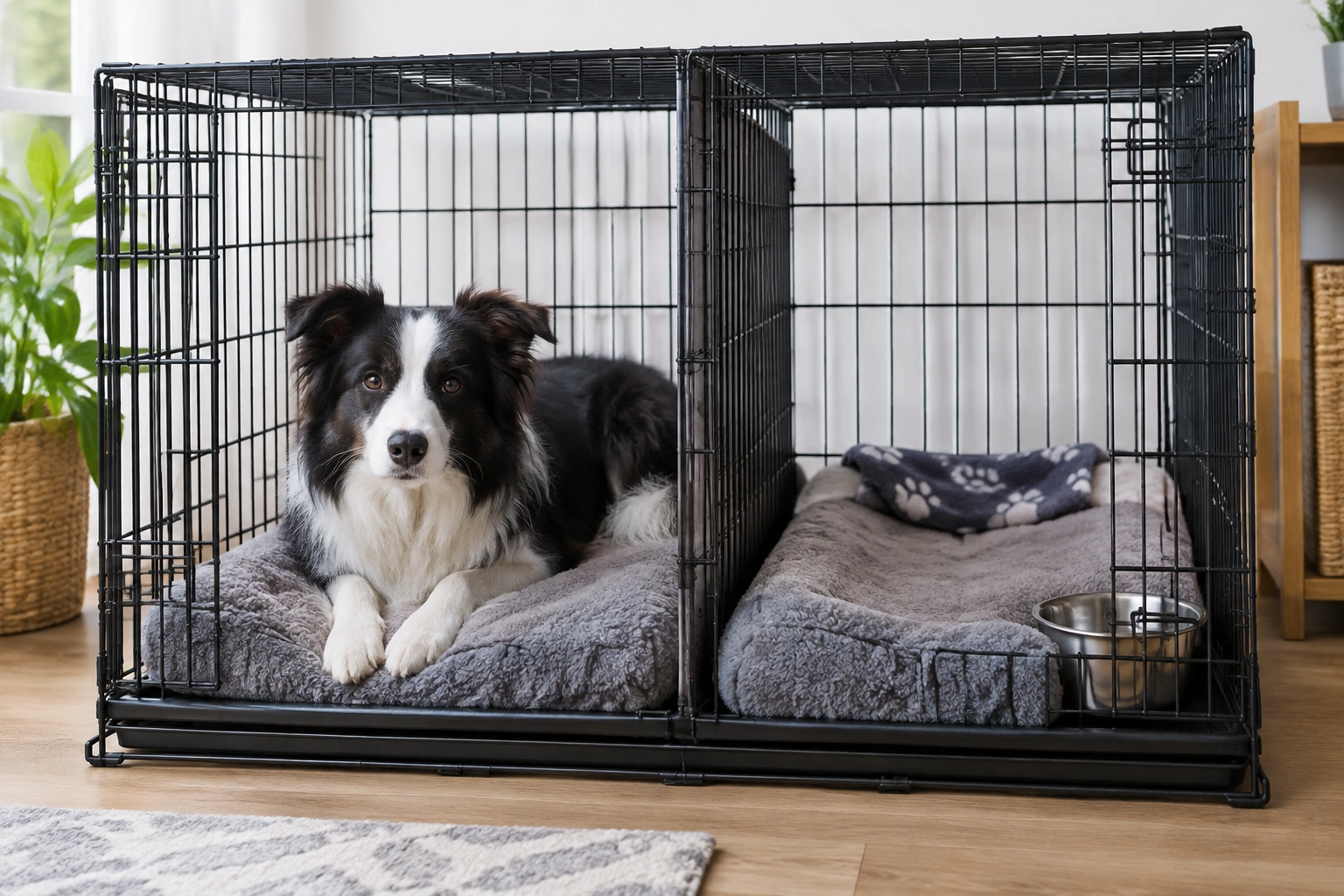
That matters because the fix is different for each one. A dog with a urinary tract issue needs a vet. A dog in a crate that is too large may need a divider. A Border Collie that only pees when left alone may need behavior help, not more discipline.
The good news: most kennel accidents become much easier to solve once you stop guessing and start changing one variable at a time.
Why Dogs Pee in Kennels: The Fastest Way to Narrow the Cause
Think of kennel peeing as a symptom, not a diagnosis.
A useful first question is: when does it happen?
- Right after being crated too long: likely a schedule or bladder-control issue
- Only when you leave: anxiety, stress, separation-related urination, or excitement-related urination may be involved
- In a crate with bedding, but not without it: the dog may be using soft material as a toilet spot
- Suddenly, after weeks of being dry: a medical issue becomes more likely
- Repeatedly, despite a solid routine: the setup, cleaning, or confinement plan may be undermining you
For puppies, the answer is often simple: they were crated longer than their bladder could handle. For adults, sudden changes deserve more caution. A dog that was fine yesterday and is soaking the crate today should not be assumed to be “being difficult.”
Border Collies can make this look more confusing because they are sensitive, highly aware dogs. If the crate routine is inconsistent, stressful, or too long, they may show it quickly.
Red Flags: When Kennel Peeing Is a Vet Problem, Not a Training Problem
A sudden change in urination is a reason to think medical first.
Call your veterinarian if you see any of these:
- sudden onset of kennel accidents
- frequent urination
- straining
- blood in the urine
- signs of pain
- a major behavior change
- accidents that continue even after you tighten the routine
- increased thirst
- accidents outside the crate
- a new medication started around the same time the problem began
That does not mean every accident is a medical emergency. It does mean you should not spend a week “training harder” if the dog may have a urinary tract infection, bladder irritation, incontinence, or another health issue.
Some general crate-soiling advice can also apply to senior dogs or dogs with medical incontinence, which is another reason not to assume the problem is purely behavioral. If you want a broader health check list for Border Collies, our guide on can a dog get a cold? is useful for spotting when symptoms need a vet visit.
Check the Crate Setup First: Size, Divider, Bedding, and Surface
A crate should be large enough for the dog to stand, turn, and lie down comfortably, but not so large that they can toilet in one corner and sleep in another. That balance is the whole point.
Crate too large vs. crate too small
A crate that is too large can encourage peeing because the dog has room to separate the toilet area from the rest of the space. Even if the dog can turn around comfortably, the crate may still be too big if it allows a toilet/sleep split.
A crate that is too small is a different problem. It may increase stress, reduce comfort, and make the dog restless. So the goal is not “small at all costs.” The goal is “just large enough.”
If your dog is still growing, a crate divider is often the best fix. It lets you keep the usable space appropriate without buying a new crate every few months.
Bedding vs. no bedding
Bedding is comforting for many dogs. But if a dog keeps peeing on it, bedding can become part of the problem. AKC-style crate guidance commonly emphasizes taking the puppy out before crating and confirming they have relieved themselves first, but the bigger point is simple: some dogs learn to soil the crate and cover the mess with bedding, and some prefer to pee on something soft.
That creates a practical trade-off:
- Keep bedding if it helps the dog settle and stay dry
- Remove bedding if the dog keeps soaking it or using it as a toilet surface
If your dog has a strong positive relationship with the crate but still has accidents, try a few days without bedding and see whether the pattern changes. That is a cleaner test than changing food, crate location, and schedule all at once.
Surface matters more than people realize
Some dogs are drawn to absorbent surfaces. If the crate floor is covered with soft material, the dog may treat it like a bathroom spot. A hard, easy-to-clean surface can reduce that temptation during retraining.
How Long a Dog Can Stay in a Crate Without Peeing
There is no single safe number for every dog. Age, size, hydration, exercise, and training stage all matter.
Use this as a practical rule:
- Young puppies: often need a potty break every 1 to 2 hours during the day, sometimes sooner after waking, eating, drinking, or play
- Older puppies: may stretch to roughly 2 to 3 hours, depending on the individual and the routine
- Adolescents: often do better than young puppies, but many still need breaks every 3 to 4 hours rather than long stretches
- Healthy adult dogs: may manage 4 to 6 hours in a crate during the day, but that is not a target for every dog
- Senior dogs or dogs with medical issues: may need more frequent breaks and should not be expected to “hold it” like a younger adult
At night, many healthy adult dogs can go longer than they can during the day, but puppies and seniors often cannot. If you are unsure, start shorter and build up only when the dog stays dry.
The key is to match the crating time to the dog’s current ability, not to your convenience.
If your dog pees after three hours but stays dry after 90 minutes, that is a clue that the crate interval is too long right now. Shorten the crate time and rebuild from there.
The First 24–72 Hours: A Simple Troubleshooting Sequence
If kennel peeing just started, use this order instead of changing everything at once:
-
Check for vet red flags first.
Look for increased thirst, straining, blood, pain, sudden accidents outside the crate, or a new medication. If any of those are present, call your vet. -
Check crate size and divider next.
Make sure the dog cannot use one end as a toilet and the other as a bed. If the crate is roomy enough to create that split, use a divider or a smaller crate. -
Test bedding.
Remove soft bedding for a few days if the dog is peeing on it or using it to hide accidents. If the dog stays dry without bedding, you have learned something useful. -
Tighten potty timing.
Potty before crating, after waking, after meals, after play, after drinking, and immediately after release. Shorten the crate duration if needed. -
Then consider anxiety or stress.
If the dog only pees when you leave, or shows panic signs in the crate, shift from “more crating” to behavior support.
That order helps you figure out whether the kennel itself is the problem, or whether the dog’s body or emotions are driving the accidents.
Build a Potty Schedule That Prevents Kennel Accidents
The best kennel fix is often timing, not correction.
A reliable schedule usually includes potty breaks:
- before crating
- after waking up
- after meals
- after play
- after drinking a lot
- before bed
- immediately after coming out of the crate
That sequence matters because dogs often need to go after they move, eat, drink, or transition from rest to activity.
A strict daily routine can help because the dog learns what happens next. Some training resources also suggest exercise, routine, and in some cases a pee pad or a veterinary visit as part of stopping crate peeing, but a pad should be treated as a management tool, not a universal fix.
Should you use absorbent pads inside the crate?
Usually, not if the goal is to stop kennel peeing. Pads can blur the line between sleeping space and toilet space, especially for puppies or dogs already inclined to use soft material. If you use a pad at all, it is usually better as a temporary management choice in a larger confinement area, not as a default inside a crate.
Should you limit water?
Be careful here. Do not cut water aggressively just to avoid crate accidents. That can create new problems. If you need to adjust evening water before bedtime, keep it conservative and discuss it with your vet if the dog has any health issues or is very young.
A useful real-world example
A Border Collie puppy may do fine crated for 90 minutes after a potty break, then pee at the three-hour mark. That does not mean the crate failed. It means the schedule did.
How to Clean a Kennel So the Smell Does Not Trigger Repeat Peeing
If the crate still smells like urine to the dog, you may be training into the same accident loop.

Use an enzymatic cleaner on all washable surfaces, bedding, and nearby flooring. Standard soap may make the area smell better to you without removing the odor cues that matter to the dog.
A practical cleaning process looks like this:
- Blot up all liquid first with paper towels or an absorbent cloth.
- Rinse or wipe away surface residue so the cleaner can reach the urine, not just the top layer.
- Saturate the soiled area with enzymatic cleaner according to the label.
- Let it dwell long enough to work. Many products need the area to stay wet for a period of time, so do not wipe it dry immediately.
- Air-dry completely. If the product label allows it, let it dry fully before reusing the crate.
- Wash bedding separately if it is salvageable, and repeat treatment if odor remains.
For washable bedding or crate covers, follow the product label and fabric care instructions. If the item can be machine-washed, use the warmest water the fabric allows and dry it fully before returning it to the crate.
Clean the crate thoroughly, including:
- tray or floor pan
- bars and corners
- bedding
- any floor area around the crate
- nearby fabric or rugs
What not to do:
- do not mix enzymatic cleaner with bleach, ammonia, vinegar, or other cleaners unless the label specifically says it is safe
- do not use strong deodorizing sprays to mask the smell
- do not steam-clean or heat-dry urine spots before the odor is removed, because heat can set the smell
- do not assume one quick wipe is enough for a repeat-soiled kennel
Humane World for Animals also recommends eliminating odors where a dog submissively urinates. That advice is useful here even if the peeing is not submissive, because odor cues can reinforce repeat accidents.
A simple rule: if the dog has peed there before, clean it as if odor could still be present. Enzymatic cleaners are preferred because they are designed to break down urine residue rather than just cover it up.
If It Happens Only When You Leave: Anxiety, Stress, and Submissive Urination
This is one of the biggest clues you can get.
If your dog is dry when you are home but pees when you leave, the issue may be less about bladder control and more about stress. That can include separation anxiety, general stress, submissive urination, or excitement-related urination, and they do not all look the same.
How to tell them apart
- Separation anxiety: usually happens when the dog is left alone or expects you to leave. You may also see panic behaviors such as vocalizing, pacing, scratching, drooling, or trying to escape.
- General stress or confinement stress: may show up in the crate even if you are nearby, especially if the dog cannot settle or seems tense before being confined.
- Submissive urination: often happens during greeting, handling, or direct interaction. The dog may crouch, roll over, avoid eye contact, or pee when approached.
- Excitement urination: usually happens during happy greetings or high-arousal moments, not from fear. The dog may be over-threshold, wiggly, and unable to fully control the response.
Look for patterns like:
- panting before you leave
- drooling
- scratching at the crate
- vocalizing
- pacing
- accidents that happen very quickly after confinement
- peeing only in the context of departure
If the dog is too scared to perform a behavior, do not force it. Humane World for Animals advises increasing distance from the thing or person causing fear rather than pushing the dog through it. That principle applies here too.
Anxiety-related peeing vs. incomplete house training
A dog that pees because it simply cannot hold it is usually having accidents based on time and timing.
A dog that pees because of anxiety often has a stronger emotional pattern:
– only when left alone
– only in specific contexts
– paired with panic behaviors
– sometimes even after being well house-trained elsewhere
If that sounds familiar, a trainer or behavior professional is usually a better next step than just “more crate time.”
Crate Training a High-Energy Dog Like a Border Collie Without Repeated Setbacks
Border Collies are smart, active, and often very quick to notice when a routine is off. They also tend to do better when the day has structure.
Before crating, give the dog a chance to:
- potty
- move
- settle
- have a short mental outlet
That does not mean exhausting the dog for an hour. It means taking the edge off so the crate is not the first place all that energy lands.
For many Border Collies, a short training session, a sniff walk, or a few minutes of focused work can help more than frantic play. The goal is not to wear the dog out. It is to make the crate feel like a reasonable next step, not a punishment.
Exercise before crating: useful, but not magic
Exercise can help reduce stress-related accidents, but it will not fix a crate that is too large, a schedule that is too long, or a dog with a medical problem. Use it as one part of the plan.
What Not to Do: Punishment, Overcrating, and Other Common Mistakes
Punishment after a kennel accident usually backfires. The dog may learn that the crate or your presence predicts stress, which can make the problem worse.
Avoid these mistakes:
- yelling after you find the mess
- rubbing the dog’s nose in urine
- leaving the dog crated longer just to “teach a lesson”
- using bedding that keeps getting soaked without testing a change
- ignoring sudden changes in urination
- changing five things at once and losing track of what helped
Also avoid assuming that a dog who soils the crate is being stubborn. In many cases, the dog is either under-supported, stressed, or dealing with a physical issue.
When to Change the Confinement Plan or Bring in a Trainer
If the dog cannot settle safely in the crate, the answer may be to change the setup rather than force more crate time.
Consider a different plan if:
- the dog panics in the crate
- the dog injures itself trying to get out
- the dog only pees when confined and alone
- the dog improves with a smaller space or x-pen setup
- the dog is still having accidents despite a clean crate, tighter schedule, and shorter confinement
- the dog is not ready to be crated at this stage without repeated accidents or panic
An x-pen can be preferable to a crate when the dog needs more room to move, a potty area plus a rest area is being managed temporarily, or the dog is not yet calm enough for full crate confinement. A crate is usually better for short, structured rest; an x-pen can be better for controlled freedom when crating is making the problem worse.
If you bring in a trainer, look for someone who can specifically address:
– crate comfort and duration
– separation-related behavior
– potty timing and house-training structure
– confinement alternatives such as x-pens or gated areas
– whether the dog is reacting to stress rather than lack of training
If you are also working through other behavior issues, such as stool eating, our guide on how to stop a dog from eating poop may help you build a cleaner management routine overall.
A Simple Decision Framework You Can Use Today
Use this quick filter:
-
Sudden change, pain, blood, straining, increased thirst, new medication, or frequent accidents?
Book a vet visit. -
Dog pees after being crated too long?
Shorten the interval and tighten the potty schedule. -
Dog can pee in one corner and sleep in another?
Add a divider or reduce crate space. -
Dog pees on bedding?
Remove bedding for a few days and retest. -
Dog only pees when alone or panicked?
Think anxiety and get behavior help. -
Dog is a high-energy Border Collie that never fully settles?
Rework exercise, routine, and confinement setup together.
That approach is usually faster than trying random fixes and hoping one sticks.
When to See a Veterinarian or Certified Trainer
See a veterinarian first if the behavior is sudden, painful, bloody, linked to increased thirst, or clearly out of character.
See a certified trainer or behavior professional if the dog seems anxious, panicked, or only pees in the kennel when left alone. If the dog is physically healthy but still cannot settle in the crate, you may need a behavior plan that goes beyond house training.
The cleanest progress usually comes from matching the cause to the fix. Once you do that, kennel peeing stops being a vague frustration and becomes a solvable problem.
FAQ
Why does my dog pee in the kennel but not in the house?
The crate may be too large, the dog may be crated too long, or the behavior may be tied to stress or separation rather than general house-training failure.
Should I remove bedding if my dog pees in the crate?
If bedding keeps getting soaked, yes, it is worth testing a few crate sessions without it.
How do I know if it is anxiety?
If the dog only pees when left alone and shows stress signs like panting, vocalizing, scratching, or pacing, anxiety becomes more likely.
Can a puppy be crated too long?
Yes. Puppies usually need much more frequent potty breaks than adult dogs, and the right interval depends on age and training stage.
Should I use pee pads inside the crate?
Usually no. Pads can encourage the dog to separate sleeping and toilet areas. They are better used only in specific management setups, if at all.
Do I need to clean the crate with special cleaner?
Yes, an enzymatic cleaner is the safest choice if you want to remove urine odor cues that can trigger repeat accidents.
