
How to Get Your Dogs to Get Along: A Practical Guide for Multi-Dog Homes

When dogs in the same home keep snapping, stiffening, guarding, or starting fights, the goal is not to force friendship. The goal is to build enough safety, predictability, and positive association that they can live together without constant tension.
That distinction matters. Some dogs become genuine companions. Others never do, and that’s okay. A calm, well-managed household is a real success.
For Border Collie owners, this topic often gets complicated faster than expected. Border Collies are quick, observant, and intense. That can be a strength in training, but in a multi-dog home it can also mean more staring, herding, blocking, pacing, and arousal around another dog’s movement. If one dog is already nervous or pushy, the combination can become a pattern rather than an isolated bad moment.
The good news: most conflict improves when you stop guessing and start managing the situation like a system. That means controlling introductions, reducing trigger points, reading body language earlier, and deciding honestly whether the dogs need coexistence or real separation for now.
When Dogs Don’t Get Along: What’s Normal, What’s Not, and When to Act Fast
Not every tense interaction means your dogs hate each other.
Normal play usually has give-and-take. The dogs take turns chasing, wrestling, or pausing. Their bodies stay loose enough that they can break away and re-engage. There may be noise, but the energy rises and falls.
Trouble looks different. Watch for these patterns:
- one dog repeatedly avoids the other
- stiff posture instead of loose movement
- freezing before a lunge or snap
- hard staring
- blocking doorways, bowls, people, or resting spots
- one-sided chasing with no pause
- one dog pinning the other without release
- growling that escalates when the other dog tries to leave
If a dog is showing fear, repeated freezing, or intent to bite, separate the dogs immediately. Don’t wait to see if it “works itself out.” Once arousal spikes, dogs may stop noticing normal social cues.
The safest rule is simple: if you are unsure whether the interaction is play or conflict, treat it like conflict until proven otherwise.
Why Dogs Fight: The Most Common Triggers Behind Conflict
Dogs usually do not fight “for no reason.” The reason is often just easy to miss.
Resource guarding
Food, bones, toys, beds, doors, laps, and even your attention can become high-value resources. A dog that guards may not be trying to be “dominant”; it may simply be trying to keep a valuable thing from disappearing.
That’s why feeding dogs separately is commonly recommended when there is tension. Feeding time can trigger conflict even in otherwise friendly dogs, and the Animal Foundation advises not feeding new dogs near each other.
Territorial behavior
Some dogs become more reactive in the home than outside it. They may be fine on a walk but tense at the front door, in the hallway, or near the couch. The home itself can become a trigger.
Poor introductions
If dogs were rushed together, allowed to crowd each other too soon, or forced into off-leash freedom before trust existed, the relationship may have started on the wrong foot. A bad first week can leave a lasting negative association for some dogs.
Arousal overload
High energy is not the same as good social skill. Two excited dogs can look playful right up until they tip from excitement into conflict. This is especially relevant for Border Collies, who can move from focused interest to over-arousal quickly.
Fear and social mismatch
Some dogs simply do not like the other dog’s style. A bold, bouncing dog may overwhelm a cautious one. A slower, older dog may resent a younger dog that keeps following, nudging, or herding.
Compatibility matters. Matching dogs by energy, temperament, and personality can improve the odds of peace, but it is not a guarantee.
Read the Room: Dog Body Language That Predicts Trouble Before a Fight Starts
The most useful skill in a multi-dog home is catching the early warning signs.
Look for:
- stiff legs
- closed mouth after previously relaxed panting
- weight shifted forward and still
- tail held high and rigid, or very low and tight
- whale eye, where the whites of the eyes show
- freezing during play
- one dog hovering over another
- repeated blocking or cutting off movement
- head turns away from the other dog paired with a tense body
- a sudden stop in movement before a snap
A lot of owners miss the freeze. They expect growling or barking to be the first warning, but the body often warns before the voice does.
If one dog’s posture changes and the other keeps pushing in, step in early. Early interruption is far easier than breaking up a full fight.
How to Introduce or Reintroduce Dogs Safely
The first meeting should be controlled, not casual.
A commonly recommended approach is to begin on neutral territory with plenty of space, such as a quiet street, open field, or park. The Animal Humane Society recommends neutral ground and starting on opposite sides while walking the same direction. That setup reduces the pressure of direct face-to-face contact.
Here is a practical sequence:
1. Start with distance
Let the dogs see each other without immediate contact. Keep both handlers calm and move in the same direction if possible. Parallel movement often feels less confrontational than a direct approach.
2. Use short, boring exposure
The goal is not excitement. The goal is neutrality. If both dogs can notice each other and then disengage, that is progress.
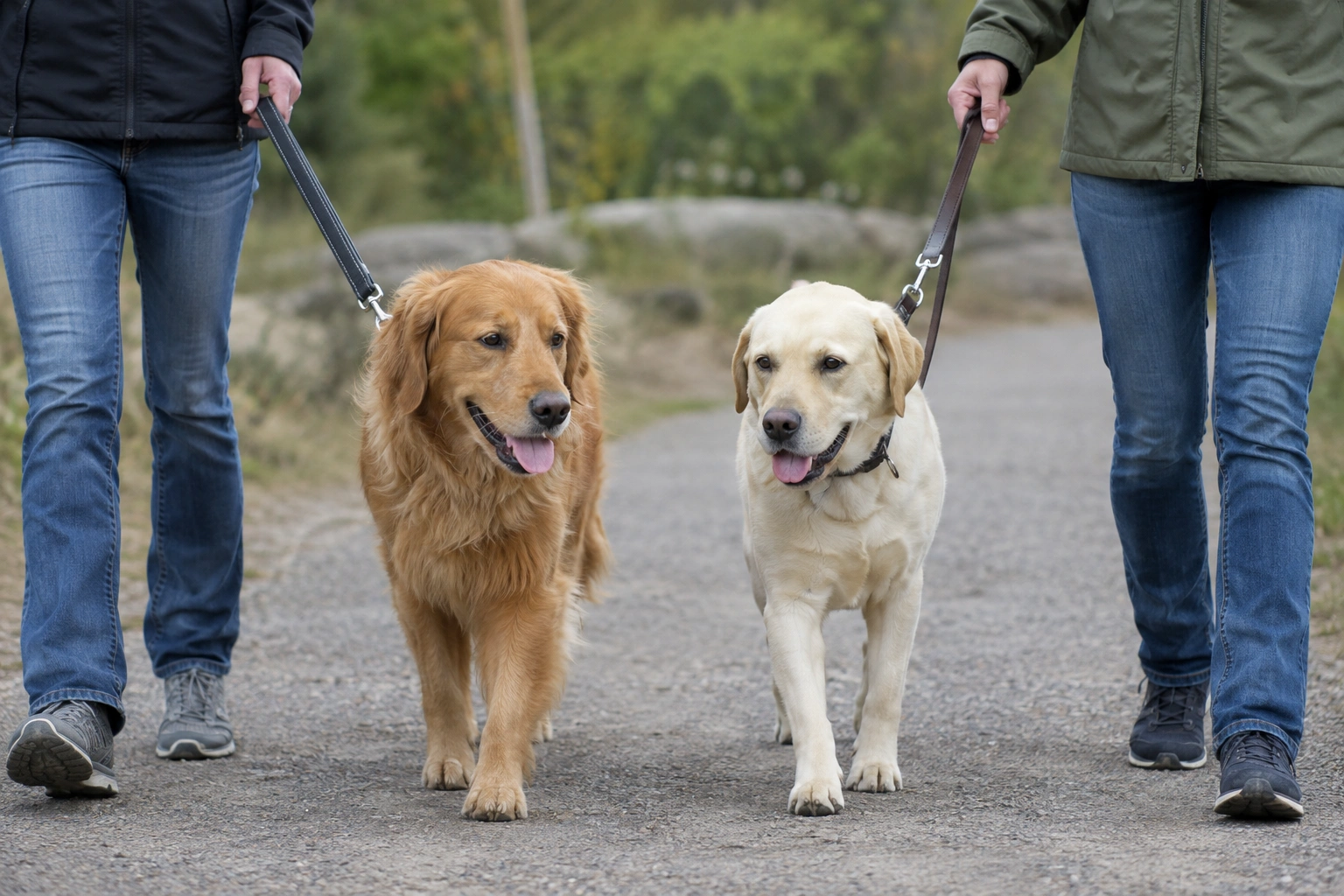
3. Watch for softening
Loose bodies, sniffing the ground, curved movement, and brief glances followed by turning away are better signs than intense staring or rushing.
4. End the walk early if arousal climbs
If either dog starts fixating, pulling hard toward the other dog, vocalizing, stiffening, refusing food, or repeatedly trying to close distance, stop the session before things escalate. Give them space, increase distance, or end the walk and try again later. If one dog is too aroused to notice cues, that is a sign the introduction is moving too fast.
5. Move indoors only if both dogs are still calm
Do not bring them inside just because the outdoor walk has lasted long enough. Bring them in only if both dogs can stay loose and recover quickly after looking at each other.
6. Keep the first indoor session very short and structured
For the first indoor meeting, aim for just a few minutes of calm, controlled access. Use leashes, baby gates, or barriers so you can separate them quickly. Keep the dogs on opposite sides of the room at first, then allow brief parallel movement or calm sniffing if both remain relaxed. End the session while things are still going well.
7. End immediately if you see warning signs
Stop the session at once if either dog:
– stiffens
– freezes
– stares hard
– blocks the other dog
– guards a doorway, toy, bed, or person
– starts chasing, crowding, or herding
– cannot disengage when called away
8. Separate and reset before trying again
If the first indoor meeting goes well, that does not mean the dogs are ready for free access. Repeat short, positive sessions and slowly increase time only if they keep showing calm behavior.
9. Delay off-leash freedom
Off-leash introductions can go well, but they remove your ability to interrupt quickly. On-leash or behind-barrier work is usually safer until you have a clear pattern of calm behavior.
That trade-off matters: off-leash can feel more “natural,” but it also gives the dogs more opportunity to rehearse bad choices.
The First 24–72 Hours After a Conflict: Resetting the Household Without Making Things Worse
After a fight, most owners make one of two mistakes: they either panic and overcorrect, or they act as if nothing happened.
Neither helps.
For the first day or two, your job is to lower pressure.
Separate the dogs
Use crates, gates, rooms, or leashes so the dogs cannot rehearse another conflict. This is not punishment. It is damage control.
Use a simple decision rule
If the fight involved biting, repeated chasing, sustained aggression, or you do not feel confident reading the dogs safely, keep them fully separated for now. If the conflict was brief, minor, and both dogs are already settling quickly at a distance, you may allow carefully supervised, very brief contact only if you can interrupt immediately and the dogs remain loose. When in doubt, choose full separation first.
Remove triggers
No shared bones, no tug games, no food bowls left down, and no unsupervised access to favorite resting spots.
Keep interactions brief and structured
If the dogs must pass each other, keep it short and calm. Do not force “make up” time.
Avoid emotional scenes
Do not lecture, scold, or create chaotic reunions. Dogs recover better from calm structure than from intense human energy.
Rebuild with distance first
A short walk in parallel, each dog handled separately, is often more useful than trying to put them together in the house immediately.
This is where parallel activities can help. Structured side-by-side work, with each dog having its own handler, is often one of the best ways to improve relationships between dogs because it lets them share space without direct social pressure.
Managing Food, Toys, Beds, Doorways, and Attention to Prevent Repeat Conflict
If the dogs keep fighting over the same categories, manage those categories separately.
Food
Feed in separate rooms or behind closed barriers. Pick up bowls after meals. Don’t leave food available for casual grazing if the dogs are tense.
Toys and chews
Toys can escalate play quickly, especially when one dog becomes possessive. Supervise toy time closely, and remove toys if the dogs start hovering, guarding, or stealing from each other.
Beds and resting spots
Each dog should have its own space. This is one of the simplest ways to reduce friction because many conflicts start when one dog feels crowded or displaced.
Doorways and hallways
Narrow spaces increase pressure. Use gates or leashes to prevent one dog from controlling access.
Your attention
Avoid playing favorites. If one dog always gets the couch, the greeting, or the first snack, the other dog may begin to compete more intensely. Give each dog one-on-one time so they do not feel they must fight for your attention.
Clear, consistent rules matter here. When the household is predictable, dogs have less reason to test boundaries.
For more on managing feeding routines safely, see this guide to whether dogs get sick of their food, which also covers changing routines without creating stress.
Training for Calm Coexistence: What to Reinforce and What to Stop Rewarding
Training should make the dogs easier to live with, not just more obedient in a vacuum.
Reward these behaviors:
- looking away from the other dog
- settling on a mat or bed
- walking past the other dog without escalating
- calmly responding to a cue
- disengaging from a trigger
- choosing space instead of crowding
What not to reward:
– frantic greeting
– repeated chasing
– rough play that ignores one dog’s attempts to leave
– hovering over bowls, toys, or people
– escalation after the first warning sign
Do not punish growling. Growling is a warning signal, and if you suppress the warning without changing the underlying problem, you may end up with a dog that bites more suddenly. The better move is to treat the growl as useful information and increase distance, structure, or separation.
A calm voice can help too. Dogs often respond to the emotional tone of the household. Loud corrections, shouting, and repeated “no” can raise the temperature instead of lowering it.
Supervision, Barriers, and Safety Tools: When to Use Leashes, Baby Gates, and Crates
Management tools are not a sign of failure. They are what make progress possible.
Leashes
Useful for controlled movement, short introductions, and preventing a sudden chase or lunge. They are especially helpful when you are still collecting information about the dogs’ triggers.
Baby gates
Good for visual access without direct contact. Gates let dogs learn to coexist near each other while still giving you a quick barrier if tension rises.
Crates
Helpful when a dog needs a safe, separate resting space. A crate should never be used to force a tense dog into proximity with another dog.
Separate rooms
Sometimes the simplest answer is the best one. If a dog cannot relax, separate spaces may be the kindest and safest setup.
The trade-off is freedom versus safety. More freedom is only useful if the dogs can handle it. Otherwise, barriers protect the relationship by preventing rehearsed conflict.
Managed Coexistence vs. True Friendship: What Success Actually Looks Like
Not every pair of dogs becomes cuddly.
Managed coexistence means:
– no fights
– no constant tension
– predictable routines
– safe shared spaces with supervision or barriers as needed
True friendship means:
– relaxed body language around each other
– spontaneous calm interaction
– play that stays balanced
– resting near each other by choice
Both outcomes can be good. If your dogs can peacefully share a home but do not seek each other out, that is still a win.
This is where owners often need to reset expectations. The goal is not to manufacture affection. The goal is to create a stable household.
When You Need a Professional: Signs Basic Training Is Not Enough
Seek help from a certified trainer or veterinary behaviorist if:
- there have been bites
- fights are repeated
- one dog is targeting the other
- the dogs cannot relax even at a distance
- fear is becoming worse over time
- management is not preventing incidents
- you feel unsafe separating them yourself
A good professional can help you decide whether the problem is mainly management, training, fear, or a more serious behavior issue. If the dogs are already biting or escalating quickly, don’t try to troubleshoot alone for weeks.
Border Collies and Other High-Drive Dogs: Special Considerations
Border Collies often need extra structure in multi-dog homes because their default style can be intense. Herding, stalking, circling, and fixed staring may be normal Border Collie tendencies, but those same behaviors can irritate another dog very quickly.
What helps most:
- more decompression time
- clearer rules around movement and access
- calm outlet activities that do not involve pestering the other dog
- separate attention and separate resting places
- early interruption of stalking or blocking
A Border Collie that keeps “managing” the other dog may be trying to control movement, not play. That distinction matters. What looks like interest can feel like pressure to the other dog.
How Long It Takes for Dogs to Get Along—and What Progress Should Look Like
There is no honest universal timeline.
Some dogs settle after a few calm, well-managed weeks. Others need months of careful structure. Some never become close, but they can still live peacefully.
Look for progress in small signs:
– fewer hard stares
– quicker recovery after excitement
– less guarding around routine items
– more ability to pass each other without tension
– relaxed body language in the same room
If things improve in one setting but not another, that still counts. Progress is often context-specific. A pair may do well on walks before they can handle shared indoor freedom.
The important question is not “Are they friends yet?” It is “Are they safer and calmer than they were before?”
A Simple Decision Framework You Can Use Today
If you are unsure what to do next, use this rule set:
- If the dogs are stiff, freezing, or guarding, separate them.
- If the dogs are calm at a distance, continue structured exposure.
- If food, toys, or resting spots trigger tension, manage those separately.
- If fights are repeated or escalating, bring in a professional.
- If the dogs can coexist peacefully but not cuddle, count that as real success.
That framework keeps the focus where it belongs: on safety, repetition, and realistic progress.
FAQ
Can two dogs that dislike each other ever learn to live together?
Yes, sometimes. Many dogs never become affectionate, but they can learn to coexist safely with structure, barriers, and consistent management.
Should dogs meet on neutral territory first?
That is commonly recommended and often helpful because it lowers territorial pressure. Neutral ground gives both dogs a cleaner first impression.
Is normal play supposed to look rough?
Sometimes, yes. But normal play has breaks, role changes, and loose bodies. If one dog freezes, stiffens, or tries to leave and the other keeps pushing, that is no longer healthy play.
Should I separate my dogs at home?
If there is guarding, repeated tension, or recent fighting, yes. Separation is often the safest short-term choice while you reset the household.
Do toys cause fights?
They can. Toys are a common trigger, especially if one dog guards them or if arousal gets too high during play.
When should I call a trainer or behaviorist?
If there have been bites, repeated fights, or you cannot keep the dogs safe with basic management, call a professional sooner rather than later.
Final Takeaway
Getting dogs to get along is usually less about forcing affection and more about removing pressure, building structure, and rewarding calm behavior. If you control the triggers, read body language early, and move at the dogs’ pace, you give the relationship a real chance to stabilize.
For some homes, that leads to a close bond. For others, it leads to peaceful coexistence. Either outcome can be a good one if the household is safe and predictable.
