
How to Obtain a Urine Sample from a Dog Without Stress or Guesswork

A urine sample sounds simple until you are standing outside with a leash in one hand and an empty container in the other, waiting for your dog to do something very private on cue. If your vet has asked for a sample, the goal is not perfection. The goal is a fresh, clean-enough sample that gives the clinic useful information without turning the experience into a struggle.
For Border Collies, that matters even more than it does for some other dogs. Many are quick, sensitive to handling, and easily distracted by movement, noise, or your own tension. The smoother your setup, the better your chances of getting a usable sample on the first attempt.
Why a Vet May Ask for a Dog Urine Sample
Your veterinarian may request urine for a few practical reasons: a urinalysis, a urine culture, or monitoring a urinary issue that is already known or suspected. The sample helps the clinic look for signs of infection, inflammation, crystals, blood, glucose, or other changes that need follow-up.
That is why sample quality matters. A dirty container, grass contamination, or a sample that sits too long can make results harder to trust. When the question is “what is happening in the bladder right now?”, freshness and cleanliness are part of the answer.
If you want a broader overview of the process, this guide on how to get a urine sample from a dog without stress or mess fits well alongside this one.
What You Need Before You Start
Keep the setup simple. You do not need a complicated kit, but you do need a plan.
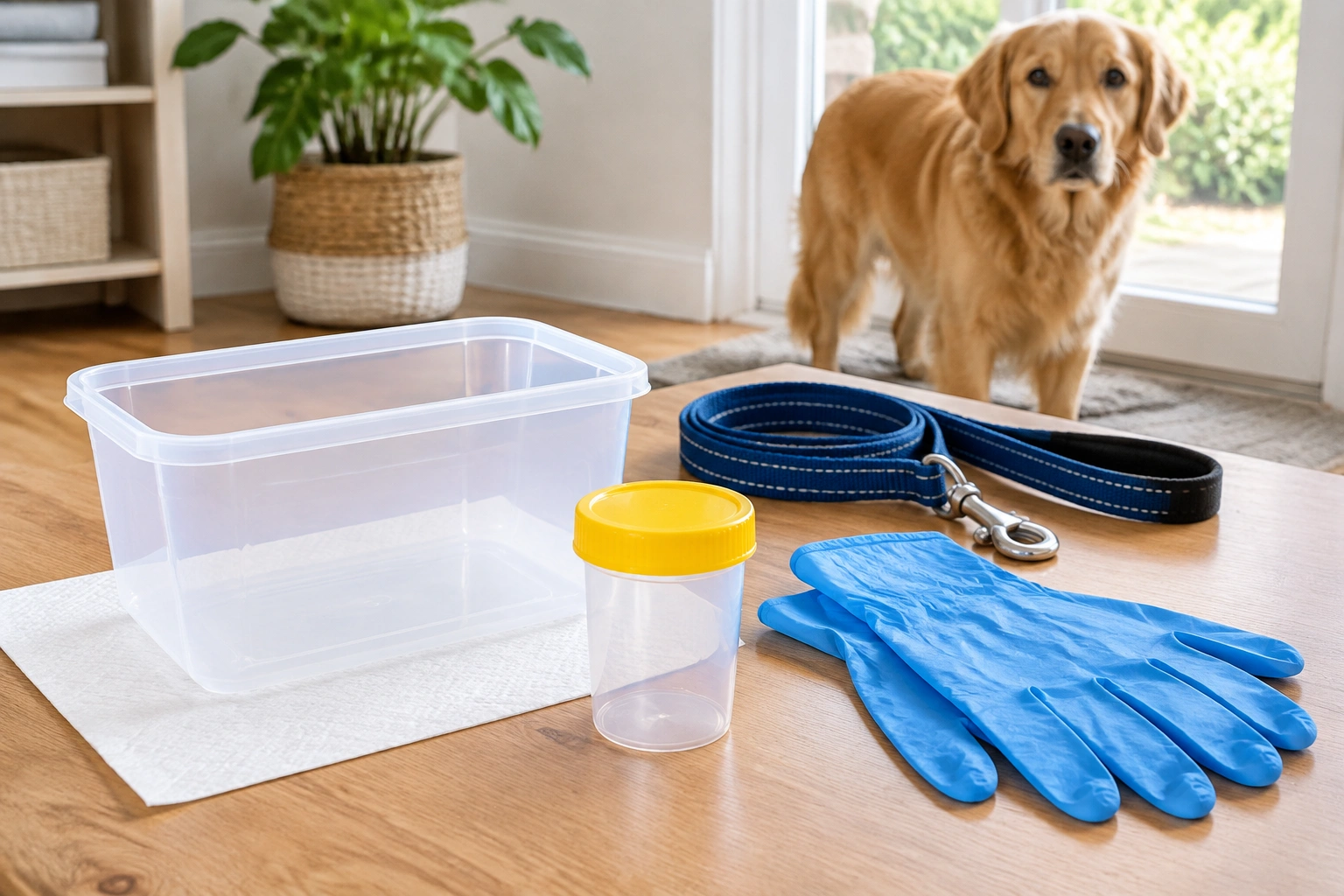
Use:
– a clean, empty container or a sterile sample pot
– a leash
– gloves if you want them
– a lid or cover for transport
– a way to label the sample
– a fridge space in case you cannot get to the clinic right away
A clean container matters because household residue can interfere with results. If your vet gave you a sterile pot, use that. If not, a clean, empty container is better than improvising with something dirty or scented.
One practical detail from veterinary guidance: label the sample with your name, your dog’s name, and the date and time it was collected. That small step saves confusion at the clinic.
Choose the Right Collection Method for Your Dog
The easiest method for most dogs is a free-catch, or clean-catch, sample. That simply means catching urine as your dog naturally urinates, rather than forcing a collection.
Here is the trade-off:
| Method | Best for | Pros | Cons |
|---|---|---|---|
| Clean-catch / free-catch | Most dogs that urinate normally | Least invasive, usually fastest, can be done at home | Higher contamination risk than vet-collected samples |
| Midstream catch | Dogs that urinate in a predictable stream | Cleaner than catching the first drops | Can be hard to time |
| Non-absorbent collection tray or foil pan | Dogs that squat quickly or are hard to reach | Helps catch urine without touching the dog | Still needs careful handling and transfer |
| Veterinary collection | Dogs that cannot be sampled at home or need a very clean sample | Cleanest option, useful for culture | More invasive and requires a clinic visit |
A midstream sample is usually preferred over catching the first drops. The reason is simple: the beginning and end of urination are more likely to pick up debris from the urethra or the ground. If you can only catch a small amount, though, that may still be useful.
For some dogs, especially reactive or overexcited ones, the best method is the one that keeps everyone calm enough for the dog to actually urinate.
How to Collect a Clean-Catch Urine Sample at Home
The basic rule is: wait for the dog to start, then move the container in quickly and calmly.
Here is the process:
- Take your dog outside on a leash, ideally where they usually toilet.
- Have the container ready before you go out.
- Wait until your dog begins to urinate.
- Slide the container under the stream without touching the dog.
- Catch a midstream portion if possible.
- Remove the container before the dog finishes.
- Transfer the urine into a sample pot with a lid if needed.
- Label it and refrigerate it if you cannot get to the vet right away.
The container should stay clear of fur, skin, dirt, grass, bedding, or litter. If it touches the dog or the ground, the sample is more likely to be contaminated.
A useful practical tip from veterinary guidance: keep the container low and steady rather than reaching in from above. Dogs often stop mid-pee if they feel something brush against them, and then you are left waiting for another opportunity.
How to Catch Urine from a Dog That Squats Quickly or Urinates While Walking
This is where most owners struggle. Some dogs squat for a second and finish. Others keep moving as they go. Border Collies can be especially brisk about it, which means timing matters more than technique.
For fast squatters, stand ready before you leave the house. Watch for the first sign of the squat, then move the container in from the side rather than straight over the top. A shallow container gives you a little more room for error.
For dogs that “walk and pee,” keep the leash long enough to let them move naturally, but close enough that you can step in beside them without rushing. If possible, position yourself slightly ahead and to the side before the dog starts, then angle the container under the stream as they pass. If direct catch fails, a clean non-absorbent surface such as a foil tray, pie tin, or similar flat container can sometimes help you collect a sample without having to crouch as low or reach as far.
For owners who cannot safely crouch, kneel, or reach low enough, a long-handled tray or a helper can make the process much easier. If you have mobility limitations, set up the collection spot in advance so you are not trying to bend, twist, or chase the dog at the same time.
For anxious or reactive dogs, the best strategy is often predictability. Use the same exit, the same route, and the same calm voice you always use. Dogs that are already tense are less likely to urinate if you hover over them or keep changing position.
If your dog absolutely will not cooperate, stop turning the outing into a battle. Repeated failed attempts can make the dog avoid urinating altogether, which creates a bigger problem than the sample itself.
Male vs Female Dogs: What Changes in Collection
The principles are the same for both sexes: catch a fresh sample, avoid contamination, and do not touch the dog with the container.
With male dogs, urine may be easier to catch if they lift a leg in a predictable spot. With female dogs, a shallow container placed quickly under the dog after she begins to squat is often the cleanest approach.
The main difference is not the biology so much as the posture. A shallow container helps either way, but it is especially useful when the dog squats low to the ground.
How Much Urine the Vet Usually Needs
As a practical target, 1–3 tablespoons, or about 15–45 ml, is typically enough for many tests. Smaller amounts can still be useful if that is all you can get.
That said, not every test needs the same volume. If your vet asked for a specific amount, follow that instruction first. If you are unsure, bring what you have rather than discarding a small sample. Clinics can sometimes work with less than owners expect.
Do not keep chasing a bigger sample if the dog is getting stressed. A smaller fresh sample is often more valuable than a larger one collected after ten frustrating attempts.
How Fresh the Sample Needs to Be
Fresh is better. In practice, that means collecting the sample as close as possible to the time you leave for the clinic.
If you can get the sample to the clinic within about 1–2 hours, that is ideal for many routine tests. If that is not possible, refrigerate it and follow your clinic’s exact timing instructions if they differ.
The reason is straightforward: urine changes over time. Sitting at room temperature makes the sample less reliable, especially if the clinic is looking for fine details. If your vet is doing a culture or another test that is sensitive to contamination, speed matters even more.
A morning sample can sometimes be easier to collect because the dog may have held urine longer overnight, but the main goal is still freshness and proper handling.
How to Store and Transport the Sample Safely
Once you have the sample, seal it well. A leak-proof lid matters more than people realize, because spills create both a mess and a contamination risk.
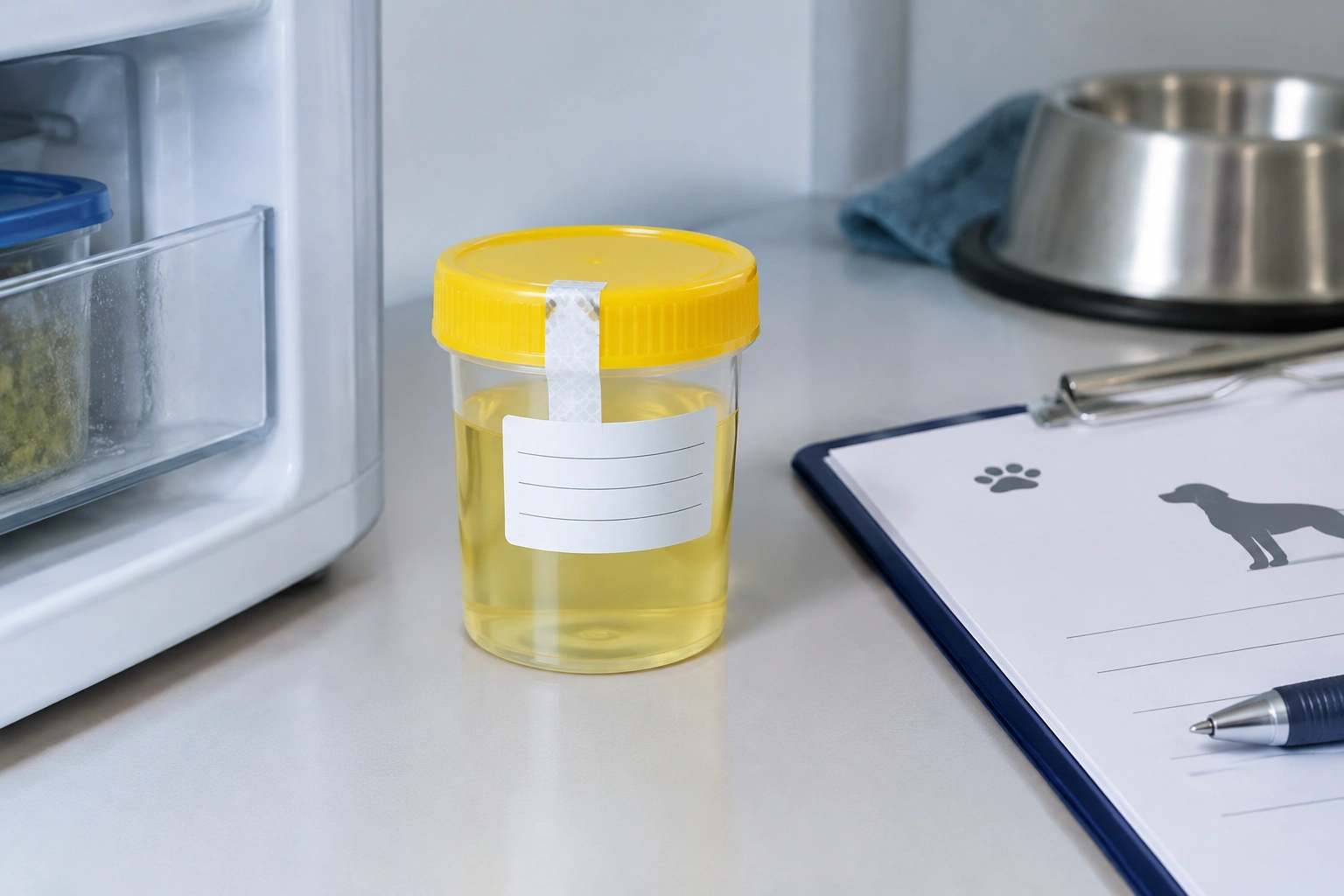
If the sample is going to the clinic later the same day, refrigerate it unless your vet told you otherwise. Keep it chilled until you leave, and bring it in cold rather than letting it warm back up to room temperature.
A good label includes:
– your name
– your dog’s name
– the date
– the time collected
That label helps the clinic judge freshness and decide how much trust to place in the result.
If you are carrying the sample in a car, keep it upright and out of direct sun. Do not leave it in a hot vehicle while you run errands. Heat and delay work against you.
For a broader clinic-facing perspective, AKC’s discussion of veterinary collection methods is useful because it explains when a vet may choose to collect urine directly instead.
What to Do if the Sample Is Contaminated or Too Small
If the sample has stool, dirt, grass, bedding, or litter in it, ask your vet whether it is still usable. Do not assume it is worthless, but do not assume it is fine either.
Here is a practical rule:
– If the contamination is minor and the vet only needs a basic urinalysis, the clinic may still be able to use it.
– If the vet needs a very clean sample, especially for a urine culture, contamination is more likely to make the sample unusable.
That difference matters. A mildly contaminated sample may still give useful information for urinalysis, but a urine culture is much more sensitive to outside bacteria and is more likely to need a cleaner sample.
If the sample is too small, bring it anyway. A small fresh sample may still help. If the clinic cannot use it, they can tell you whether to try again at home or come in for collection.
Do not keep making repeated attempts if your dog is becoming irritated, withholding urine, or acting uncomfortable. At that point, the problem is no longer the sample; it is the dog’s ability to urinate normally.
When Home Collection Is Not the Best Option
Sometimes the cleanest answer is to let the vet collect the sample.
That is often the better route when:
– the dog will not urinate at home
– a very clean sample is needed
– repeated home attempts have failed
– the dog is too reactive or uncomfortable to handle safely
Veterinarians may collect urine with a catheter or by cystocentesis, a method that takes urine directly from the bladder. That sounds more technical than home collection because it is. It is also often the right choice when the clinic needs a sample with minimal contamination.
Home collection is less invasive and usually easier for the owner. Vet collection is more controlled. The trade-off is stress versus precision.
When to See a Veterinarian or Certified Trainer
Stop trying at home and call your vet promptly if your dog:
– strains but cannot pass urine
– seems painful when urinating
– has visible blood in the urine
– is repeatedly trying to urinate with little or no output
– seems unwell, restless, or distressed
Those signs can point to a problem that needs medical attention, not just a better collection method.
If your dog is anxious, reactive, or hard to handle outdoors, a certified trainer can help with the handling piece later. For the sample itself, though, safety comes first. A calm dog and a safe owner matter more than getting the sample on the first try.
A Simple Decision Rule That Saves Time
Use this quick filter:
- Dog urinates normally and you can catch it cleanly: try home clean-catch.
- Dog urinates too quickly, too awkwardly, or too rarely: use a shallow tray or ask the vet about collection.
- Sample is contaminated but the dog is otherwise fine: ask the clinic whether to bring it in or retry.
- Dog is straining, painful, or not producing urine: stop and call the vet.
That approach keeps you from overcomplicating a task that should be practical, not perfect.
FAQ
Can I use a regular cup to collect dog urine?
Yes, if it is clean and empty, but a sterile sample pot is better. The cleaner the container, the lower the contamination risk.
Should I collect the first part or middle of the stream?
Midstream is preferred when possible because it is less likely to pick up contaminants from the start of urination.
Can I refrigerate the sample overnight?
If your vet says refrigeration is acceptable, yes. If you can get it to the clinic sooner, that is better.
What if my dog only urinates on walks?
Take the container with you and stay ready. A shallow container or tray is often easier than a deep cup for dogs that keep moving.
Is it okay if the sample is only a small amount?
Often yes. Smaller samples can still be useful, so bring what you have and let the clinic decide.
What if my dog refuses to pee while I’m trying to collect?
Do not force it. End the attempt, give the dog a break, and call the vet if repeated tries are not working.
Final Thought
The best urine sample is the one you can collect cleanly, quickly, and without turning your dog’s toilet break into a standoff. Keep the setup simple, catch the middle of the stream if you can, label it clearly, and get it to the clinic fast.
