
How to Potty Train a Rescue Dog Without Setbacks: A Practical Housebreaking Plan

Bringing home a rescue dog is exciting, but the first few days can also feel messy in every sense. If your new dog is having accidents, that does not automatically mean they are “stubborn” or “badly behaved.” More often, it means they are adjusting to a new environment, a new routine, and sometimes a history you do not fully know yet.
The good news: adult rescue dogs can absolutely learn reliable house training. The key is to make potty success easy to repeat and indoor accidents hard to practice. That means a tighter schedule, close supervision, a predictable potty spot, and calm cleanup when mistakes happen.

Why Rescue Dogs May Not Be Potty Trained Yet
A rescue dog may arrive with no real house-training history at all. Some dogs lived outdoors, some had inconsistent routines, and some learned to go inside because nobody gave them another option. Others were house-trained in one home, then lost the habit after a move, shelter stay, or major stress.
Stress matters more than many owners expect. A dog that is overwhelmed may not settle enough to toilet on cue, may hold it too long, or may have an accident the moment they finally relax indoors. That is why the first goal is not perfection. It is reducing confusion.
There is also a medical side to consider. Frequent urination, straining, blood in the urine, diarrhea, or sudden accidents after the dog seemed reliable can point to a health issue rather than a training gap. When in doubt, a veterinarian should be part of the plan.
A quick comparison: what the accidents may mean
| Pattern | More likely cause | What to do first |
|---|---|---|
| Accidents only in the first days after adoption | Stress, unfamiliar routine, unknown history | Tighten supervision and schedule |
| Accidents happen after naps, meals, or play | Training gap or missed potty break | Increase potty trips and reward timing |
| Sudden new accidents after being reliable | Medical issue or stress change | Call your veterinarian |
| Accidents plus frequent licking, straining, or diarrhea | Possible health problem | Vet visit soon |
| Accidents mainly when left alone | Separation stress, poor management, or both | Limit freedom and reassess alone-time setup |
If you want a broader step-by-step version of this process, the guide on how to potty train a rescue dog covers the same foundation in a shorter format.
Start With a Calm First-Week Plan
The first week after adoption is not the time to test freedom. Think of it as a reset period where your dog learns two things: where to potty and how your household runs.
A simple first-24-hours checklist can keep things from getting overwhelming:
- Take the dog straight to the potty area as soon as you arrive home.
- Keep the first indoor space small and easy to supervise.
- Offer water, then take another potty break after drinking, resting, or eating.
- Use a leash indoors if the dog wants to wander.
- Keep greetings quiet and the routine low-key.
- Reward any outdoor elimination right away.
- Clean up any accident calmly and reset the schedule.
- Plan another potty trip before bedtime and once during the night if needed.
Keep the first few days simple. Limit access to only the areas you can supervise. Use a leash indoors if needed so the dog cannot wander off and sneak an accident behind furniture. If your dog seems nervous, keep greetings quiet and avoid turning every outing into a social event. The potty trip should feel boring and clear.
A useful rule is this: if the dog has not just pottied, has not just been closely supervised, and has not just been crated or confined safely, assume they may need another trip outside. That mindset prevents most early mistakes.
If your dog is especially unsettled, you may also find it helpful to pair potty training with a calmer daily rhythm. Our article on how to train a dog to be calm can help reduce the overarousal that often leads to indoor accidents.
Set a Reliable Potty Schedule
The most reliable house-training plans are built around timing, not guesswork. AKC recommends taking a rescue dog out first thing in the morning, about every two hours, after every meal, and for a final trip at night before bed. If your workday is long, a mid-day break from a person or pet sitter can make a big difference. AKC housetraining guidance
That schedule is a starting point, not a law. Some dogs need more frequent trips at first, especially if they are young, anxious, or still learning the house rules. A practical training approach is to go out often enough that the dog keeps succeeding, then slowly stretch the time between breaks as they become reliable.
A practical way to decide how often to go out is to ask: “Has my dog had a chance to empty their bladder since the last sleep, meal, play session, or drink?” If the answer is yes, take them out again sooner rather than later.
Use these high-value potty moments
- Right after waking up
- After eating
- After drinking a lot
- After play or excitement
- After naps
- Before being left alone
- Before bedtime
If the dog does not go within a few minutes, bring them back in and confine them briefly, then try again after 10 to 15 minutes. That keeps the outing purposeful instead of turning the yard into a long, distracting hangout.
Choose One Potty Spot and Use It Consistently
Dogs learn faster when the environment stays predictable. Pick one outdoor potty area and keep using it. The ground surface can matter as a training preference, so try to choose the substrate you want them to use long term.
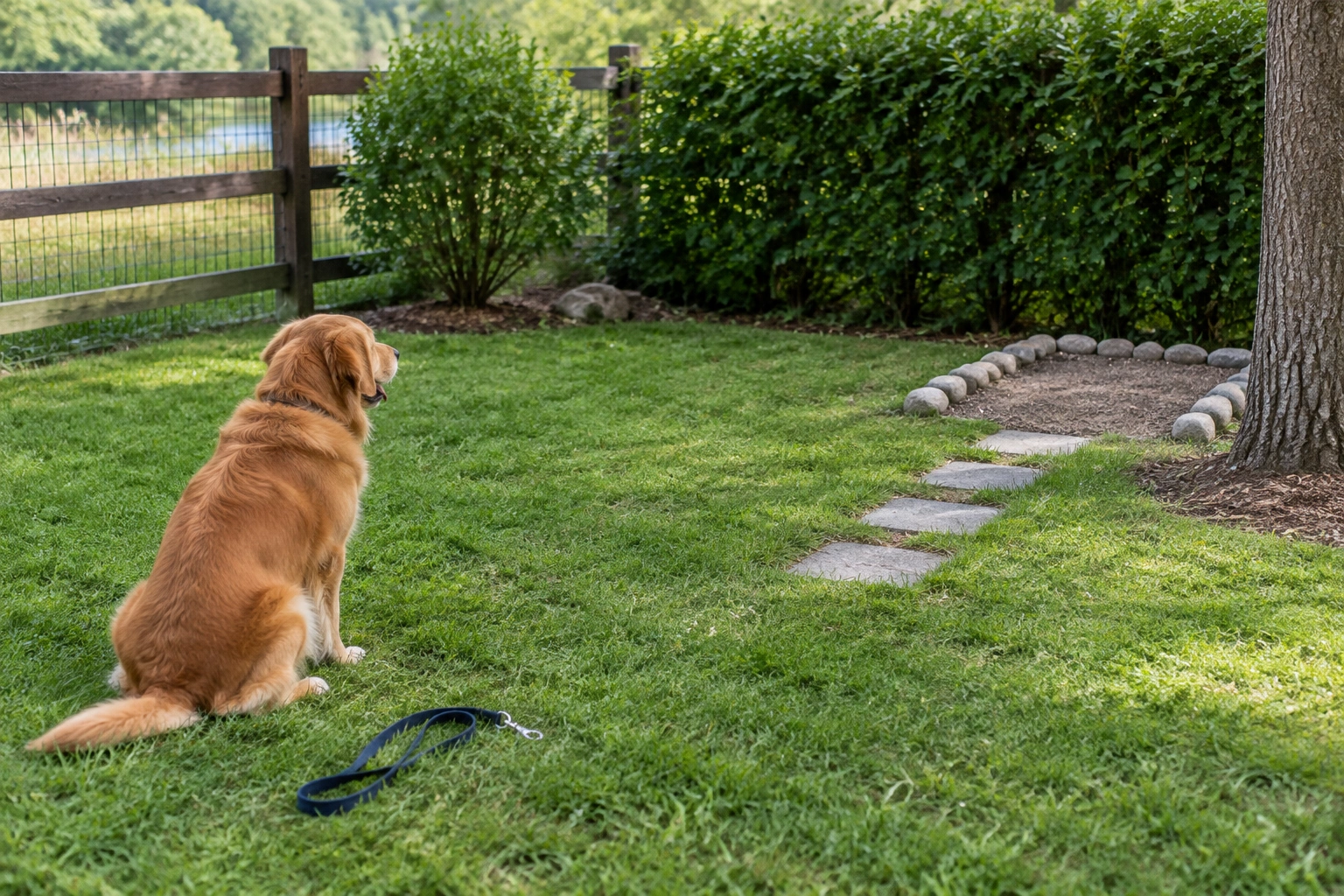
Some trainers also suggest “seasoning” the spot with the dog’s own urine or feces so it smells familiar. That is not magic, but it can help a dog with an unknown history recognize, “This is the place.”
The main trade-off here is convenience versus clarity. If you use several different spots, the dog may still learn eventually, but the message is weaker. One spot, used consistently, usually teaches faster.
A simple cue can help too. As the dog begins to eliminate, say the same phrase every time, such as “go potty.” Over time, that phrase can become a useful prompt because the dog hears it in the exact moment the behavior is happening.
What to Do If Your Rescue Dog Is Scared to Go Potty Outside
Some rescue dogs are not refusing to potty outside on purpose. They are worried. A noisy street, unfamiliar yard, people passing by, or too much open space can make a dog hold it in even when they need to go.
If your dog seems hesitant, make the potty trip easier:
– Choose a quiet, low-traffic potty area.
– Keep the dog on a leash so they feel more secure and you can guide them calmly.
– Stand still and wait quietly instead of asking for lots of interaction.
– Give them time; some dogs need a few minutes to relax before they will go.
– Reward any outdoor elimination immediately, even if it happens quickly or in an awkward spot.
The goal is to remove pressure. Try not to pace, coax constantly, or end the trip the second the dog seems distracted. Calm repetition often works better than encouragement that feels intense.
If the dog will only potty in one very specific spot at first, use that spot. You can generalize later once they are more confident.
Use Supervision and Confinement to Prevent Indoor Accidents
Prevention is the heart of house training. Every accident the dog rehearses indoors makes the habit a little easier to repeat next time. Your job is to make mistakes less available.
There are three practical management tools:
- Leash supervision: keep the dog attached to you when they are out of the crate or pen
- Baby gates or closed doors: block access to rooms where you cannot watch closely
- A small safe area: use a pen or limited room when you need a break from direct supervision
The trade-off is simple. More freedom is nicer for the dog in the moment, but less freedom usually means fewer accidents and faster learning. For a new rescue, that is often the better deal.
A useful rule: if you cannot confidently say where the dog is and what they are doing, they have too much freedom for now. Expand access only after you have several accident-free days under close supervision.
Should You Use a Crate for Potty Training?
A crate can be very helpful for house training, but only if it is used correctly. The goal is not to “trap” the dog. It is to create a space where they are less likely to wander off and eliminate unnoticed.
Crate training tends to work well when:
– the dog is comfortable in a crate
– you need a way to prevent unsupervised roaming
– the dog settles better in a smaller, calmer space
A pen or gated area may be a better fit when:
– the dog is not crate-trained yet
– the dog becomes anxious in a crate
– you need a little more room for water, bedding, or decompression
Free roaming is the least useful option early on, because it gives the dog too many chances to make mistakes. If you choose not to crate, you still need some other form of confinement or direct supervision.
One caution: the crate should never be used as a long-term holding pen that forces the dog to soil themselves. If your dog is having accidents in the crate, the setup is too big, the schedule is too loose, or the dog needs a vet check.
How to Reward Outdoor Potty Success
The reward has to arrive fast enough that the dog connects it to the act of pottying outside. Praise and a small treat right after the dog finishes are usually enough. If you wait until you are back inside, the timing is too muddy.
Keep the reward quiet and immediate. You do not need a big celebration. In fact, some dogs get distracted if the praise is too intense before they are done. A calm “yes” or “good potty,” followed by a treat, is often cleaner.
The important part is consistency. If the dog sometimes gets rewarded and sometimes does not, learning slows down. If every successful potty outside is followed by the same clear payoff, the dog has a much easier job understanding what earns the reward.
What to Do After Indoor Accidents
When an accident happens, skip the lecture. Punishment after the fact does not teach the dog where to go next time; it mostly teaches them that humans get unpredictable around urine or feces.
Instead:
1. Interrupt only if you catch the dog in the act, then calmly take them outside.
2. Clean the area thoroughly with an enzyme cleaner.
3. Reset the schedule so the next potty break comes sooner.
The enzyme cleaner matters because ordinary cleaners may remove the visible mess but leave odor behind. To a dog, that lingering scent can act like a signpost saying, “This is a bathroom.”
If the dog keeps returning to the same indoor spot, that space needs a management reset. Block access, clean again, and make sure the outdoor potty trips are frequent enough that the dog is not being asked to hold it too long.
How to Tell If Accidents Are Normal Adjustment or a Sign of Pain
Some accidents are part of normal adjustment. A new rescue dog may have a few mistakes while learning the routine, especially in the first days. Those accidents usually happen because the dog is confused, distracted, or still settling in.
Signs that point more toward normal adjustment include:
– accidents mostly in the first week or two
– no obvious discomfort while peeing or pooping
– the dog otherwise eats, drinks, and moves normally
– accidents improve when you tighten the schedule
Signs that make pain or illness more likely include:
– straining to pee or poop
– whining, pacing, or repeated attempts without much coming out
– blood in the urine or stool
– diarrhea
– sudden changes in how often the dog goes
– accidents paired with licking the genital area
– a dog who seems sore, restless, or withdrawn
If the pattern looks painful, treat it as a health issue first, not a training issue.
How Long Potty Training a Rescue Dog Usually Takes
There is no honest timeline that fits every rescue dog. Some settle into the routine quickly once the schedule is clear. Others need weeks of repetition, especially if they have never had reliable house training or if they are still decompressing from a big life change.
A more useful way to think about progress is in stages:
- First few days: the dog is learning the routine and may have setbacks
- First few weeks: accidents should become less frequent if management is tight
- Longer term: freedom can expand once the dog is consistently successful
Adult rescue dogs do not necessarily learn slower than puppies, but they may come with more confusion or more ingrained habits. That means the issue is not age so much as history. A dog with an unknown background often needs more structure at the start, not less.
How to Tell If Accidents Are Stress-Related or Medical
Stress-related accidents often show up during change: moving homes, meeting new people, being left alone, hearing unfamiliar noises, or adjusting to a new schedule. These dogs may otherwise seem healthy but still have trouble settling enough to potty on cue.
Stress clues can include:
– accidents during big household changes
– the dog seeming anxious, clingy, or easily startled
– accidents that improve when the routine gets calmer
– normal eating, drinking, and energy overall
Medical issues are more likely when you see:
– sudden changes in urination
– frequent tiny pees
– straining
– blood in the urine
– diarrhea
– accidents that appear out of nowhere after the dog had been doing well
A dog can also have both stress and a medical problem at the same time. That is why it is worth taking a cautious approach instead of assuming every accident is behavioral.
When to Call Your Veterinarian
Call your veterinarian if the accidents are sudden, frequent, paired with physical symptoms, or not improving despite a consistent routine. It is especially important to call if a dog that was previously reliable starts having repeated accidents, if you see signs of pain, or if the dog strains, cries, or produces only small amounts.
A trainer can also help if the issue looks more like fear, confusion, or poor management than a health problem. The best case is often a combination: the vet rules out illness, and a trainer helps you adjust the potty plan.
How to Increase Freedom in the Home Without Causing Setbacks
Freedom should be earned in small steps. A good rule is to expand access only after the dog has shown a reliable pattern under supervision, not just one good day.
Try this progression:
– first, one supervised room
– then, a second room with the dog still under watch
– then, short periods of limited freedom
– finally, broader access once accidents are no longer happening
If the dog has an accident after gaining more space, the freedom came too quickly. Go back one step for a while. That is not failure; it is useful information.
Common Mistakes to Avoid With a Rescue Dog
The biggest house-training mistakes are usually management mistakes, not “training failures.”
Avoid these:
– giving too much freedom too soon
– waiting too long between potty breaks
– using punishment after accidents
– changing the potty spot constantly
– forgetting to reward successful outdoor pottying
– assuming every accident is just “bad behavior”
– letting family members use different rules
Consistency wins here. A rescue dog does not need a perfect owner. They need a predictable one.
FAQ
How often should I take a rescue dog out to potty?
Start with a frequent schedule: first thing in the morning, after meals, after naps, after play, and before bed. Some dogs need even more frequent trips in the first few days.
How long does it take to potty train an adult rescue dog?
It varies. Some dogs improve within days once the routine is clear, while others need several weeks of close supervision and repetition, especially if their history is unknown.
What if my rescue dog is afraid to go outside?
Use a quiet potty area, keep the dog on a leash, wait calmly, and reward any outdoor elimination right away. If fear is severe or sudden, ask your veterinarian about possible medical or anxiety-related causes.
Should I punish my dog for indoor accidents?
No. Punishment usually does not help the dog understand where to go next time. Calm cleanup and better management work much better.
Final Thoughts
Potty training a rescue dog is less about forcing obedience and more about building a routine the dog can actually succeed with. If you keep the schedule tight, supervise closely, reward fast, and clean accidents thoroughly, most dogs make steady progress. The first few weeks may be imperfect, but that does not mean the process is failing. It usually means the dog is still learning where life is safe and predictable.
