
How to Potty Train a Rescue Dog: A Practical Housebreaking Plan for a Fresh Start

A rescue dog can be house-trained quickly, or it can need a full reset. The difference usually comes down to history you cannot see: shelter stress, inconsistent prior handling, fear, medical issues, or habits that were never taught properly in the first place.
The goal is not to “catch up” to a perfect timeline. The goal is to make every correct potty choice easy to repeat and every accident harder to rehearse. That means you manage the environment first, then build a routine, then reward the right location with precision.
If you want a calm, reliable result, think in this order:
- Rule out medical causes.
- Prevent accidents from happening.
- Create a predictable potty pattern.
- Reward outdoor elimination immediately.
- Only then widen freedom.
First, rule out medical causes and identify the kind of potty problem
Before you assume your rescue dog is “being stubborn,” check whether the problem is actually physical. A sudden change in bathroom habits, frequent urination, straining, blood, diarrhea, urgency, or accidents that seem painful all warrant a veterinary exam. If the dog was reasonably clean and then started having repeated accidents after adoption, a medical issue should stay on the table until a vet says otherwise.
It also helps to identify what you are seeing, because not every indoor pee is the same problem.
| Pattern | What it often looks like | What usually helps |
|---|---|---|
| True house-soiling | Dog empties bladder or bowels indoors, often because it never learned the rule or has too much freedom | Strict schedule, supervision, confinement, reward outside |
| Marking | Small amounts on vertical surfaces, often near doors, furniture, or new smells | Close management, cleanup, reduce access to trigger areas |
| Excitement urination | Dog pees when greeting, playing, or becoming overstimulated | Calm greetings, low-key handling, shorter interactions |
| Submissive urination | Urination during direct eye contact, looming, reaching, or correction | Gentle approach, no punishment, build confidence |
| Stress-related accidents | Dog eliminates after changes, fear, noise, separation, or confusion | Routine, predictability, low-stress management, behavior support |
This distinction matters because punishment rarely fixes any of them. It usually adds fear, and fear makes hiding easier. A dog that pees when startled or scolded does not need a harsher correction; it needs a safer plan.
For medical background, the ASPCA’s guidance on house-training is worth reviewing alongside your vet conversation.
Why rescue dogs often need a reset instead of a standard puppy timeline
A rescue dog may arrive with no routine at all. Some dogs have never had a clear potty system. Others were kept outdoors, were allowed to eliminate whenever they wanted, or learned to go in one place at one time and are now expected to generalize that habit to a new home.
Shelter stress can also scramble bathroom habits. A dog may hold urine longer in a kennel, then empty as soon as it feels safe. Another dog may seem “trained” in the shelter because the environment is structured, only to regress at home where everything smells different and the schedule changes.
That is why I prefer to treat adoption as a reset, not proof of reliability. If the dog has an unknown background, train from zero until the pattern is stable.
That mindset also helps with Border Collies specifically. Many are sensitive to routine changes and environmental pressure. A dog that looks “smart” can still be uncertain, distracted, or anxious enough to miss the bathroom cue you think is obvious. Calm repetition beats cleverness every time.
Set up the environment before you train
Housebreaking fails fastest when the dog gets too much freedom too soon. Every unsupervised accident teaches the same lesson: “This room is also a toilet.”
Your job is to prevent rehearsal.
Three tools help most:
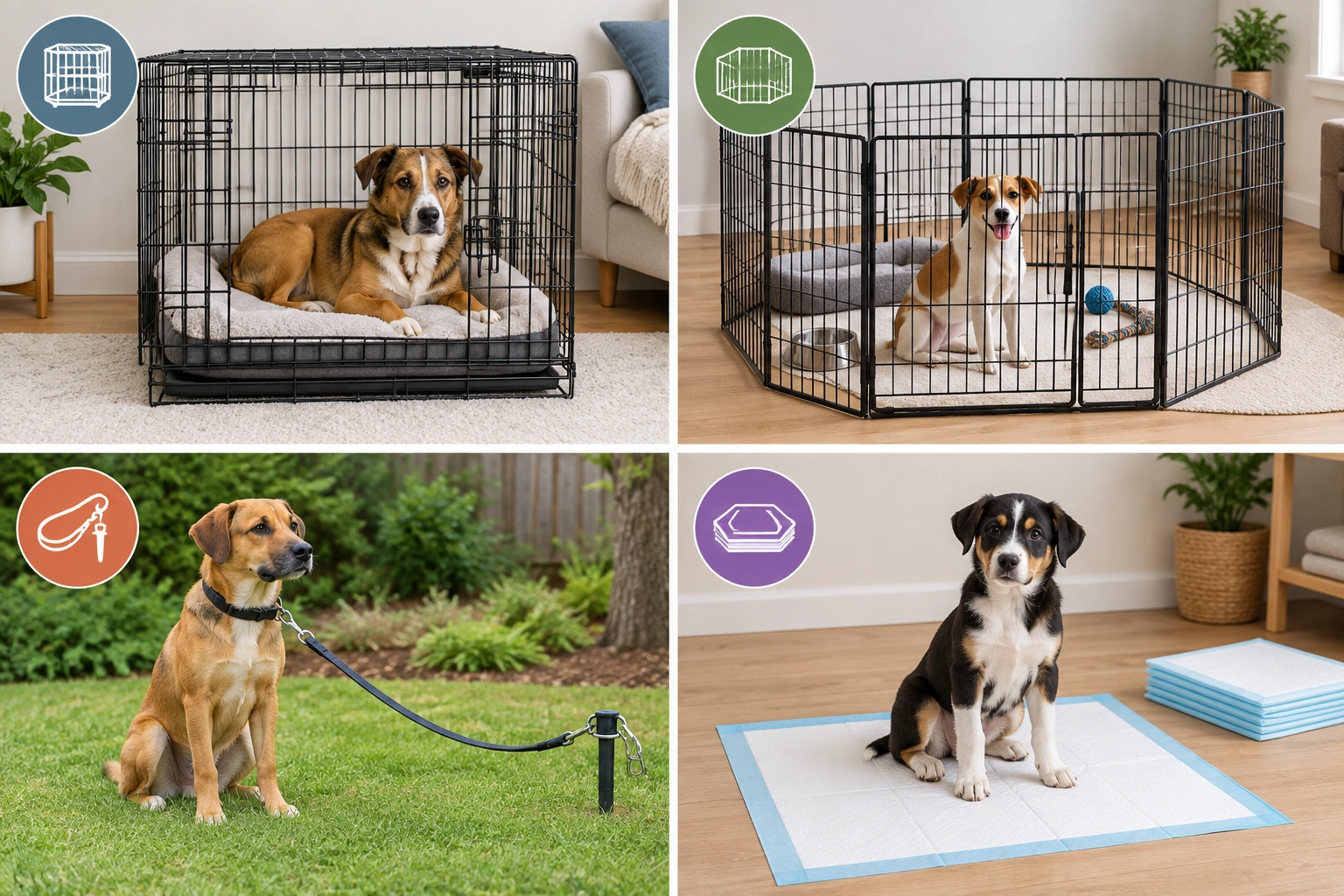
- Crate
- Exercise pen
- Tethering to you or a nearby anchor point
A crate is useful when the dog settles well in it and you can match it to a realistic potty schedule. It works because dogs usually avoid soiling their resting space when the schedule is tight enough. But a crate is not magic. If it is too large, used too long, or paired with long gaps between outings, accidents can still happen.
An exercise pen or small confined area is better when the dog is not ready for full crating or needs a little more room to decompress. It gives you control without asking the dog to stay silent and still for long stretches.
Tethering is the most practical option when the dog is awake and you are home. Clip the leash to your belt or keep the dog within arm’s reach. That lets you notice sniffing, circling, leaving the room, or suddenly getting restless—the early signs that a potty trip is due.
For a home or apartment, make the setup as concrete as possible:
– Close bedroom and office doors so the dog cannot wander.
– Use baby gates to block hallways or stair access.
– Keep the dog in a dog-proofed room with washable flooring if you cannot watch closely.
– Set up a small confined area with the crate, water, and a bed or mat if the dog relaxes there.
– In apartments, keep a leash by the door so you can move quickly without creating a big indoor chase.
If you want a broader calmness framework to support this stage, my guide on how to train a dog to be calm pairs well with housetraining because overstimulation often precedes accidents.
Crate, pen, tether, or pee pads: which setup fits best?
Here is the practical decision rule I use:
- Use a crate if the dog can relax in it and you can take it out often enough.
- Use a pen if the dog needs more space or crate time is causing stress.
- Use tethering when you are actively supervising and want to prevent wandering.
- Use pee pads only as a temporary bridge when outdoor access is limited, weather is extreme, or the dog is too fearful to go out yet.
Pee pads can solve an access problem, but they can also slow outdoor housebreaking if your real goal is outside-only elimination. Once a dog learns that soft indoor surfaces are acceptable, you may spend extra time undoing that habit later.
If you do use pads, treat them as a short-term management tool, not the final destination.
Outdoor-only training is usually best for long-term clarity. Indoor options make sense for apartment living, mobility limits, or a dog that is too frightened to step outside on day one. The trade-off is simple: indoor options reduce accidents now, but may lengthen the transition to outdoor pottying later.
Build a strict potty schedule based on the dog’s real pattern
A rescue dog usually needs more frequent trips than an already reliable adult. The exact interval depends on age, size, health, anxiety, and how recently the dog last relieved itself. In the first few days, I prefer to err on the side of too many trips rather than too few.
The most useful rule is this: take the dog out after the moments when elimination is most likely.
That means:
– first thing after waking
– after meals
– after naps
– after play
– after training sessions
– before bed
– anytime the dog starts sniffing, circling, or drifting away from you
Best Friends Animal Society recommends walking the dog on leash to the elimination spot after meals, after naps, and every couple of hours in between, and not turning those trips into playtime. That keeps the dog focused on the job.
A simple schedule for a new rescue dog might look like this:
- Wake up: outside immediately
- Breakfast: outside again soon after eating
- Mid-morning: another trip
- After play or training: outside
- Lunch or snack: outside after
- Afternoon: repeat before the dog gets restless
- Evening: after dinner, then again before bed
- Overnight: one or more breaks if the dog cannot reliably hold it yet
A realistic timeline helps here too. In the first week, progress may simply look like fewer surprises, faster trips to the potty spot, and one or two successful days without an accident when you stay on schedule. In the first month, many dogs begin to signal more clearly, hold it longer between breaks, and recover faster if you miss a cue. Longer-term regression can still happen after a move, a schedule change, visitors, or stress, so a dog that was clean for months may need a temporary return to tighter supervision if habits slip.
If the dog has been having accidents, shorten the interval rather than waiting for the “normal” schedule to work. Patricia McConnell has recommended going outside far more often than many owners expect at the start, though the exact frequency should be adjusted to the dog’s age, health, and current pattern. That is not forever. It is a reset phase.
Feeding at consistent times also helps. Avoid free-feeding during housebreaking, because it makes elimination less predictable. Consistent meals create more predictable potty windows.
Teach the dog exactly where and how to eliminate outdoors
Choose one outdoor potty area and keep using it. Dogs learn patterns through repetition, and a single consistent spot reduces confusion. Surface matters too. Grass, gravel, and dirt do not feel the same to every dog, so if your rescue dog refuses one surface, that may be part of the problem rather than “bad behavior.”
Take the dog there on leash. Keep the trip businesslike. No wandering, no long sniffing detours, no play until after the dog has gone. That keeps the bathroom cue clear.
A cue word such as “go potty” or “do your business” can help, but only if you use it when the dog is actually in position to eliminate. Say it calmly as the dog starts to settle, not while dragging the dog around the yard hoping for a miracle.
If the dog does not go, give it a short chance and then return inside under supervision. Don’t turn the outing into a reward party for nothing happening. The dog should learn that potty trips are short, focused, and predictable.
Reward timing: how to reinforce the right behavior
The reward needs to happen immediately after the dog finishes eliminating outside. That is the moment the dog can connect the behavior with the payoff.
What counts as a reward?
– a small treat
– cheerful praise
– a brief, happy “yes”
– then a return indoors or a short walk if the potty job is done
The important part is timing. If you wait until you are back inside, the dog may think the treat is for coming indoors, not for peeing or pooping outside.
I like to keep treats near the door so I can pay quickly. If you are fumbling in a pocket for 20 seconds, you are already late.
Also, don’t overdo the celebration. A fearful rescue dog may find a big emotional reaction confusing. Calm praise is usually enough.
How to handle accidents in the house without making them worse
If you catch the dog in the act, interrupt gently and get the dog outside right away. The goal is to stop the pattern, not to frighten the dog. Animal Humane Society recommends interrupting an accident rather than punishing it, and that approach is the one that tends to preserve trust.
If you find the accident after the fact, do not scold the dog. It will not understand the connection, and you may teach it to hide next time.
Clean the area thoroughly with an enzyme cleaner. Ordinary cleaners often leave scent behind, and scent is part of how dogs choose bathroom spots. If the odor remains, the dog may return to the same place.
PAWS notes that leaving the soiled paper towels or rags in the designated bathroom spot can help some dogs recognize where you want elimination to happen outdoors. That can be useful when you are trying to transfer the smell cue to the correct location.
One more rule: do not punish by rubbing the dog’s nose in it, shouting, or physically moving the dog back to the mess. Those tactics create fear, not learning.
Nighttime, early mornings, and being away from home
Nighttime training is mostly about management. If the dog cannot yet make it through the night reliably, schedule a late-night potty trip and an early-morning one before the dog has a chance to panic or fail.
Keep the night routine boring:
– leash on
– straight to the potty spot
– no play
– no long conversation
– back inside and settled again
That prevents the dog from learning that nighttime outings are social time.
For busy schedules, the safest option is to reduce freedom rather than stretch the time between breaks. A crate or pen is better than giving the dog access to the whole house and hoping for the best.
If you must be away for longer than the dog can handle, arrange help. A neighbor, sitter, or midday walker is often the difference between progress and repeated setbacks.
What to do if the dog is scared to go outside
Some rescue dogs freeze at the door, refuse the yard, or only eliminate when they are finally relaxed enough to stop scanning for danger. In those cases, forcing the issue usually backfires.
Use a quieter routine:
– leash on
– same exit route
– same potty spot
– minimal talking
– no crowding
– no pressure to “hurry up”
If the dog is afraid of the yard itself, you may need to build comfort in tiny steps. Stand near the door. Then open it. Then step outside for a second. Then return. The aim is to lower the emotional load attached to the potty trip.
If the dog refuses to potty because of bad weather, leash pressure, or apartment logistics, handle the access problem first. For rain, snow, or extreme cold, some dogs do better with a covered area, a short leash walk to a familiar spot, or a temporary indoor backup like a pad or turf patch while you keep the main potty routine consistent. In apartments, plan for quick elevator trips, use the same exit and same route, and keep the outing efficient so the dog does not get overwhelmed by hallway noise or long delays. If fear is the main barrier, this is not just a housetraining issue. It is a confidence issue too.
My article on whether it is too late to socialize your dog can help if your rescue dog’s reluctance seems tied to broader fear or shutdown.
How long potty training a rescue dog usually takes
There is no honest universal timeline. Some rescue dogs settle in within days once the routine becomes clear. Others need weeks of tight management. A dog with anxiety, medical issues, a chaotic background, or a history of being allowed to eliminate indoors may take longer.
What matters more than the calendar is the trend:
– fewer accidents
– longer stretches of success
– faster pottying outside
– less confusion about the routine
If the dog is still having frequent accidents after you have tightened the schedule, improved supervision, and ruled out medical issues, the problem is usually not “lack of intelligence.” It is either an unresolved habit, fear, or a management gap.
Troubleshooting setbacks and regression
Regression is common after adoption, after visitors, after a move, after schedule changes, or after stressful events. When it happens, do not start over emotionally. Just tighten the system.
Check these failure points first:
– too much freedom too soon
– not enough potty trips
– reward arriving too late
– missed medical issue
– inconsistent feeding times
– accidents not cleaned well enough
– fear of the outdoor area
– crate too large or too much crate time
If the dog was doing well and suddenly starts going backward, simplify for a few days. More supervision, more trips, fewer opportunities to make mistakes.
When to see a veterinarian or certified trainer
See a veterinarian if:
– accidents started suddenly
– urination seems painful or urgent
– there is blood, diarrhea, or straining
– the dog cannot seem to hold it at all
– the dog is eliminating in the crate despite close management
See a certified trainer or behavior professional if:
– fear is blocking outdoor pottying
– the dog seems panicked outside
– marking, anxiety, or submissive urination is the main issue
– you have followed a solid routine and still see little improvement
The sooner you get help, the faster you avoid rehearsing the wrong habit.
FAQs
How often should I take a rescue dog out at first?
Often enough that accidents become unlikely. In practice, that means after waking, after meals, after naps, after play, before bed, and more frequently during the reset phase if needed.
Should I use pee pads?
Only if you need a temporary bridge. They can help in apartments or when a dog is too fearful to go outside yet, but they may slow outdoor housebreaking if used long term.
What if my rescue dog only pees outside but won’t poop?
Keep the same routine and same potty spot. Some dogs need more privacy, more time, or less pressure. Don’t turn the yard into a performance test.
How do I know if it’s marking instead of house-soiling?
Marking is usually small amounts, often on vertical surfaces, and often near doors, furniture, or new smells. True house-soiling is usually a fuller elimination pattern.
Can I punish accidents if I catch them quickly?
No. Interrupt calmly, take the dog outside, and reward the right behavior. Punishment makes many rescue dogs more anxious and less honest about where they go.
How do I reset a dog that was “trained” before adoption but regressed?
Treat the dog like a new learner. Tighten supervision, shorten the schedule, use a consistent potty spot, reward immediately, and rule out medical causes if the regression is sudden.
A rescue dog does not need perfect conditions to learn. It needs a clear pattern, enough supervision to prevent mistakes, and enough calm repetition to make the right habit feel safe.
