
How to Stop a Dog from Resource Guarding: A Practical, Safe Training Guide

Resource guarding is one of those behavior problems that can look minor right up until it isn’t. A dog that stiffens over a bowl, freezes around a chew, or growls when someone nears the couch is not being “bad” in some moral sense. The dog is communicating that a valued resource feels at risk.
That matters because the wrong response can push the behavior in the wrong direction. If you punish the warning, force the item away, or keep testing the dog, you may get less growling and more biting. The goal is not to “win” the object. The goal is to make the dog feel safer around it and remove the situations that keep rehearsing the problem.
What Resource Guarding Is — and What It Is Not
Resource guarding is a dog’s attempt to protect something it values: food, treats, toys, chews, beds, a person, a doorway, or even a stolen sock. The behavior often comes from a feeling that the resource may be taken away. That’s why a dog can seem relaxed one second and then suddenly stiff, watchful, or defensive the next.
It is not the same thing as general aggression. A dog can be friendly in many contexts and still guard specific things. It is also not the same as “dominance,” despite how often that word gets used. In practice, the dog is usually worried about losing access, not trying to run the household.
There is also a difference between fear-based guarding, more possessive guarding, and broader aggression:
- Fear-based guarding usually shows up when the dog looks worried, tense, or ready to protect what it has because it expects loss or conflict.
- More possessive guarding tends to look like strong attachment to a resource with quicker blocking, hovering, or refusal to share.
- Broader aggression means the dog reacts aggressively in many situations, not just around a specific item or space.
These categories can overlap. A dog can guard and also be fearful, anxious, or in pain. Guarding does not rule those out. It can also appear alongside other behavior issues, so the context matters.
Here’s a useful comparison:
| Behavior | What it usually means | Risk level | Best response |
|---|---|---|---|
| Mild possessiveness | The dog values the item but is still flexible | Low to moderate | Manage the item and teach trade games |
| Resource guarding | The dog feels threatened about losing the resource | Moderate to high | Distance, management, counterconditioning |
| Broader aggression | The dog reacts aggressively in many contexts | Variable, often higher | Veterinary and professional behavior help |
If you want a broader guide to guarding between dogs, see our related article on how to stop resource guarding between dogs.
Why Dogs Guard Resources
The short version: guarding usually makes sense to the dog. If a dog has learned that people or other animals approach and then take things, guarding becomes a survival strategy.
Common causes include:
- Fear of loss: the dog expects the resource to disappear.
- Past experiences: a dog that has had food, toys, or bones taken may guard more intensely.
- Competition: multi-dog homes can raise the pressure around high-value items.
- Stress and arousal: a dog that is already on edge has less tolerance.
- Pain or illness: discomfort can make a dog less willing to be touched, moved, or interrupted.
A practical way to think about it: guarding is easier to prevent when the dog’s needs are being met consistently. That means enough food, water, rest space, and appropriate outlets for play. In a home with more than one pet, the same principle matters even more because competition raises the stakes.
The American Kennel Club notes that resource guarding in puppies can be accidentally shaped over time, which is why early warning signs matter. You can read more about that preventive angle on AKC’s puppy resource guarding guidance.
Early Warning Signs That a Dog Is About to Escalate
The safest point to intervene is before the dog is fully committed. Watch for these signs:
- body stiffening
- freezing over the item
- head dropping lower over the resource
- hard staring
- whale eye, where the whites of the eyes show
- hovering over the object
- blocking access with the body
- eating or chewing faster when approached
- growling
- snapping
A growl is not the problem to eliminate. It is a warning signal. If you punish the growl, you may remove the warning and keep the feeling underneath it. That is the opposite of what you want.
Use distance as your first tool. If the dog stiffens when you are six feet away, that is the line to respect. Do not keep walking in to “prove” that you can.
What to Do Immediately When Guarding Starts
When the dog freezes, stiffens, or growls, your job is to lower pressure fast and safely.
- Stop moving toward the dog.
- Do not reach for the item.
- Avoid leaning over the dog.
- Back away calmly and give space.
- Use a barrier if needed — a gate, a door, or a crate door only if the dog is already comfortable with it.
- Do not scold or grab.
If the dog is guarding food, leave the room. If the dog is guarding a chew, create distance and wait for the dog to disengage before you try any training. If the dog has something dangerous, your safest move is usually to prevent access next time rather than force a showdown now.
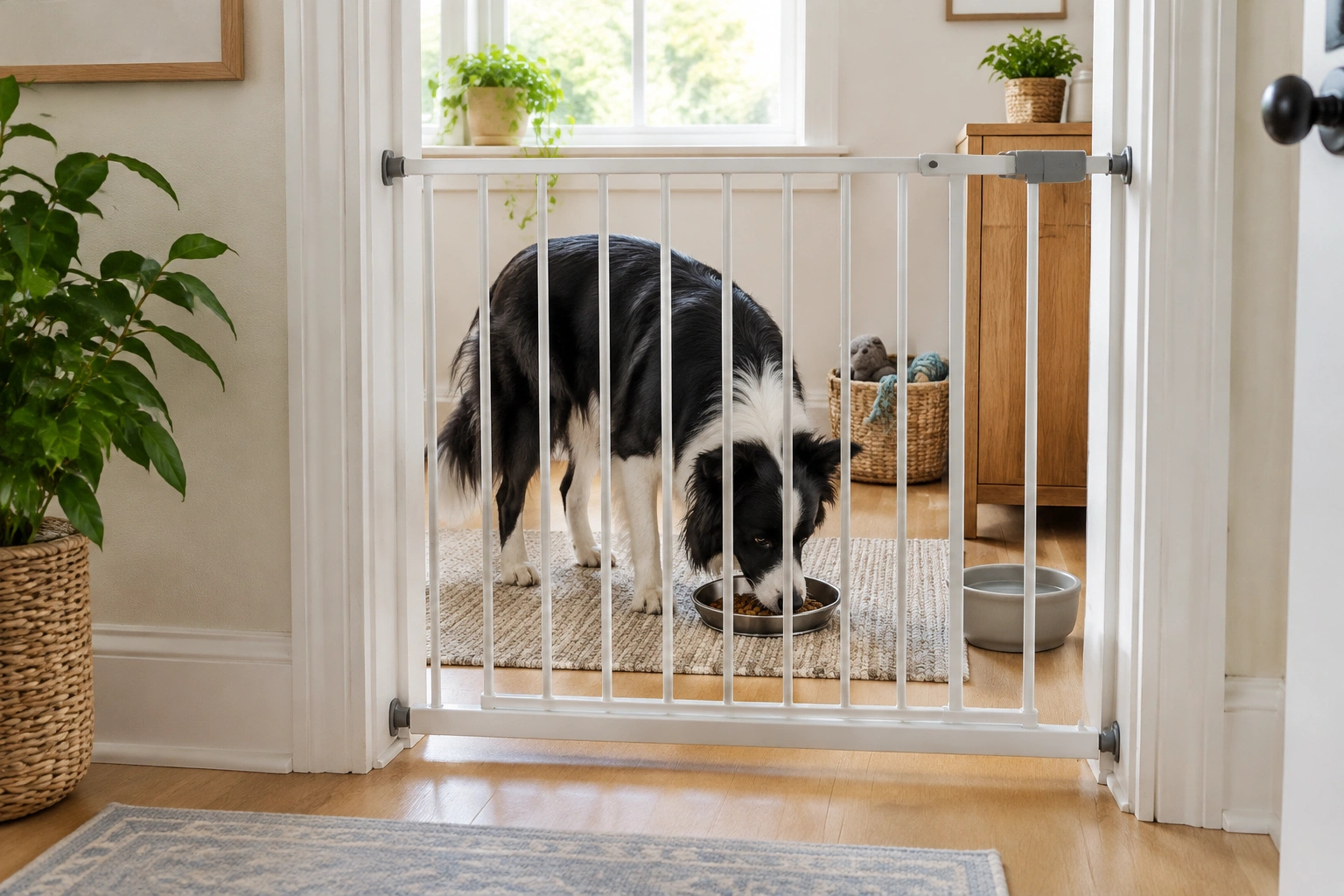
If your dog growls at the bowl: exact do/don’t steps
Do:
– Stop approaching immediately.
– Say nothing, or keep your voice neutral.
– Turn away and leave the area.
– Next time, feed behind a gate or in a separate room.
– Later, work at a distance where the dog stays loose, then toss a better treat and walk away.
Don’t:
– Reach into the bowl.
– Pick the bowl up to “show you can.”
– Push the dog away from the bowl.
– Punish the growl.
– Keep testing whether the dog will tolerate you closer.
If the dog is already tense over the bowl, the bowl should not be taken away as a punishment. Take away the opportunity to rehearse the problem instead: manage the setup, increase distance, and train from there.
This is also where household rules matter. Children should not be allowed to approach a dog that is eating, chewing, or resting with a valued item. That is a safety rule, not a training preference.
What Not to Do
Some common “fixes” make guarding worse:
- taking items by force
- pinning the dog
- reaching into the bowl
- cornering the dog on a couch or bed
- yelling at growling
- using dominance-based methods
- repeatedly testing the dog to see if it will “allow” you closer
Why these backfire: they teach the dog that human approach predicts loss, pressure, or conflict. That can make future guarding faster and more intense.
The same warning applies to “just show the dog who’s boss” advice. A dog that already feels threatened is not likely to become more relaxed because you confront it harder. The safer route is to reduce pressure and change the dog’s expectation.
How to Manage the Environment So the Dog Cannot Practice Guarding
Management is not a cure by itself, but it stops the dog from rehearsing the behavior while you work on training.
Make a simple list of the dog’s triggers:
- food bowl
- chews
- toys
- bones
- stolen items
- couch or bed
- doorway or hallway
- your lap or a specific person
Then change the setup around those triggers.
Useful management moves include:
- feeding in separate rooms
- using baby gates or closed doors during meals
- picking up high-value toys when not actively supervised
- removing chews when the dog is likely to guard them
- keeping children away from resting dogs
- avoiding crowded spaces during high-value activities
- giving each dog its own resting area in multi-dog homes
In day-to-day life, the biggest mistake is accidentally practicing conflict. For example, if the dog grabs a sock, do not chase, grab, or corner the dog. Instead, call the dog away if you can, then trade for something better. If the dog will not come, block access to the area, get the dog’s attention with a treat, and prevent the next theft by managing laundry, trash, and dropped food more carefully.
For dropped food, the safest routine is simple: stop other pets or children from rushing in, calmly create space, and pick it up only when the dog is away from it. Do not keep snatching things from the dog’s mouth or repeating take-and-return games that make the dog feel threatened.
In multi-dog households, the safest feeding setup is usually separation. That may mean different rooms, barriers, or crates if each dog is already comfortable and relaxed in them. The point is to prevent competition, not to create a stressful standoff.
For a deeper look at multi-dog management, our guide on how to stop resource guarding with other dogs covers feeding setup and household spacing in more detail.
Deciding Whether This Is Safe to Work on at Home
Some cases are appropriate for careful home work. Others are not.
Home training is more reasonable when:
- the dog has not bitten
- the guarding is limited to a few predictable items
- you can create distance and keep everyone safe
- the dog can still eat, rest, and relax normally
Get professional help sooner if:
- the dog has bitten or tried to bite
- snapping is repeated or escalating
- the guarding involves multiple items or multiple locations
- the dog cannot be safely approached at all
- children are in the home
- the behavior changed suddenly
A clearer bite-risk threshold: if the dog has already made contact with skin, if you have seen a lunge that came within inches of a bite, or if the dog is escalating faster than you can safely manage, stop home training and call a professional immediately. Do not keep experimenting at home in a way that could trigger another bite.
If the guarding started abruptly, worsened quickly, or seems linked to soreness, mobility trouble, or a new sensitivity, book a veterinary exam first. Pain can lower a dog’s tolerance and make an existing problem look more severe.
Step-by-Step Training: Desensitization and Counterconditioning
This is the core behavior-change process. The idea is to change how the dog feels about your approach.
1) Find the distance where the dog stays relaxed
That might be across the room. For one dog, it may be 10 feet. For another, 30 feet. The correct distance is the one where the dog can notice you without stiffening.
2) Pair your approach with something better
Approach just a little, then toss a high-value treat away from the guarded item. The dog learns that your presence makes good things happen.
3) Leave before the dog tenses
The dog should not be pushed to the point of growling. If body language tightens, you went too far too fast.
4) Repeat in tiny increments
Over time, you can reduce distance, but only when the dog stays loose and calm at the current level.
A brief worked example: if your dog guards a bowl from about 12 feet, start at 15 feet and toss a treat behind or beside the dog, then walk away immediately. Wait a second or two, return to the same spot, toss again, and leave. If the dog stays relaxed after several repetitions, you might move to 14 feet on a later session. If the dog stiffens, go back farther. The reward should arrive within a second or two of your approach so the dog can clearly connect your presence with something good.
This is counterconditioning in plain language: you are changing the emotional meaning of your approach from “danger” to “good news.” That is slower than punishment, but it is much safer and more likely to hold.
Trade-Ups and Exchange Games That Build Trust
A trade-up is different from forcing the dog to surrender something. The dog gives up one item because the new item is better.
A good exchange looks like this:
- show a treat the dog truly wants
- let the dog choose to release the item
- give the better reward immediately
- return the original item sometimes, if safe
That last part matters. If every exchange means permanent loss, the dog learns to guard harder next time. A fair trade builds trust.
This works best when the dog already has a history of positive exchanges. It does not work well if you use the same cue to snatch things away.
Teaching “Leave It,” “Drop It,” and “Give” as Prevention Skills
These cues are useful, but they are not a complete resource-guarding fix.
- Leave it helps prevent the dog from picking up something risky.
- Drop it helps when the dog already has an item.
- Give can be a softer, more structured release cue.
Use these skills for everyday prevention: socks, tissues, dropped food, and low-value objects. For a dog with guarding history, teach them away from the highest-value item first. Build success with easy objects before trying to use the cue on a bone or favorite chew.
A reliable recall can also help because you can call the dog away from something instead of walking straight in to take it. That reduces the pressure the dog feels.
How to Handle Food Bowl Guarding Safely
Food bowl guarding needs a simple, calm protocol.
- Feed in a separate room or behind a gate.
- Do not reach into the bowl while the dog is eating.
- Do not pet the dog over the bowl.
- If you want to work on bowl tolerance, begin at a distance where the dog stays loose.
- Walk by, toss a better treat, and leave.
If the dog growls when approached at the bowl, stop approaching and increase distance. Do not take the bowl away in the moment as a correction. Instead, remove the risk by feeding separately, then later work on desensitization and counterconditioning from a safe distance.
The goal is not to “test” whether the dog can tolerate your hand in the bowl. The goal is to make your presence around meals boring or pleasant.
If the dog is a multi-dog household feeder, separation is the safer choice. Co-feeding may look convenient, but for many homes it is not worth the risk.
How to Handle Toy, Bone, and Chew Guarding Safely
Chews and bones are often higher-value than toys because they last longer and feel more important to the dog. That makes them a common trigger.
A practical plan:
- remove high-value chews while you are training if the dog is too tense
- give chews only when the dog can be left alone
- avoid approaching from above
- use trade-ups rather than grabbing
- keep children away entirely
If the dog guards toys, structured games can help. Use short sessions, then end the game before the dog gets over-aroused. For some dogs, “single-sitting” chews are safer than long-lasting ones because they reduce the chance of a later confrontation.
How to Handle Bed, Couch, People, and Space Guarding
Space guarding is easy to miss because it can look like clinginess or stubbornness. The dog may block a doorway, stiffen on the couch, or protect access to a favorite person.
Set clear rules:
- furniture is invitation-only, not automatic access
- the dog is taught to move off on cue before conflict starts
- no one reaches over a resting dog
- children do not climb onto a dog’s space
- if the dog guards a person, manage access around that person until the behavior is stable
For couch guarding, the best immediate fix is often simple: remove access to the couch for a while. That is not “giving in.” It is preventing a predictable trigger while you retrain the pattern.
If the dog guards a person’s lap, ask the dog to get off before conflict starts and reward that choice. If the dog is already tense, do not try to lift or drag it away. Instead, stand up, create space, and use management so the dog does not rehearse guarding the lap again.
Multi-Dog Household Rules for High-Value Resources
In homes with more than one dog, resource guarding can become a household management issue fast.
Use these rules:
- feed dogs separately
- give chews separately
- hand out treats one dog at a time
- avoid piles of toys in shared spaces
- pick up leftovers after training sessions
- supervise closely around new beds, bones, or food puzzles
A new bed can become a flashpoint surprisingly quickly. If one dog claims it and another wants it, the easiest solution is often to control access rather than hope they “work it out.”
House Rules for Children Around Dogs That Guard
Children need very specific rules, not just a general warning to “be careful.”
Teach children to:
- never approach a dog that is eating, chewing, or carrying a toy
- never touch a dog on a bed, couch, or blanket without an adult’s okay
- never take food, bones, socks, or toys from a dog
- never hug, climb on, or crowd a resting dog
- never follow a dog into a crate, under a table, or into a corner
- always call an adult if the dog has something valuable
The simplest household rule is this: if the dog is eating, chewing, sleeping, or lying on its bed, children do not go near it. If a child wants to play, the adult should supervise and choose a low-risk game in open space.
For households with children, management is not optional. It is the safety plan.
Preventing Resource Guarding in Puppies
Prevention is easier than rehab. With puppies, the goal is to build a history of people approaching and good things happening.
Useful habits:
- hand-feed some meals
- trade low-value items for better treats
- touch the bowl briefly and add food, then walk away
- handle toys gently and return them
- teach “drop it” with easy objects
- avoid teasing, chasing, or grabbing
AKC warns that guarding can be accidentally shaped over time, which is why you should not ignore early growls or clingy behavior around possessions. The safest response is calm management plus positive associations, not confrontation.
When Guarding May Be Linked to Pain or Illness
If a dog suddenly starts guarding more, or guarding gets sharper without an obvious reason, think medical first.
Watch for:
- reluctance to jump or lie down
- stiffness
- sensitivity to touch
- changes in appetite
- slower movement
- irritability during handling
Pain can make a dog less tolerant of interruption. A veterinary check is the right next step if the change is new, sudden, or paired with other physical signs.
When to See a Veterinarian or Certified Trainer
Call for help if you see any of the following:
- a bite or near-bite
- repeated snapping
- guarding that spreads to more items
- guarding around children
- guarding that cannot be managed safely
- sudden behavior change that may signal pain or illness
A certified dog trainer with behavior experience is often enough when the guarding is limited, the dog is still safe to handle at a distance, and you mainly need a structured plan for management and training. A veterinary behaviorist is the better first call when the case is severe, bite-risk heavy, medically complicated, or not improving with basic management.
If you want a general resource on why dogs guard and why meeting their needs matters, this veterinary overview on resource guarding in dogs is a useful reference. For multi-dog safety and feeding separation, Humane World for Animals also gives practical prevention guidance.
Progress Markers, Setbacks, and Realistic Expectations
Progress usually looks quiet before it looks dramatic. You may notice:
- less stiffening
- slower recovery after being approached
- easier exchanges
- fewer warnings at the same distance
- more relaxed eating or chewing
Setbacks are normal if you move too fast, skip management, or let the dog rehearse the behavior again. When that happens, do not interpret it as failure. Back up to a safer distance, simplify the setup, and make the next rep easier.
The best sign that your plan is working is not that the dog “lets you win.” It is that the dog no longer feels the need to defend the resource in the first place.
