
How to Stop Resource Guarding Between Dogs: A Practical Guide for Safer Multi-Dog Homes

Resource guarding between dogs is one of those problems that looks small at first and then suddenly becomes a household safety issue. A dog stiffens over a chew, blocks a doorway, or snaps when the other dog comes near the couch. The pattern is the same: one dog believes a resource is at risk, and the other dog pays the price.
In a Border Collie home, this can escalate faster than people expect. Border Collies are often quick to notice movement and highly responsive to their environment. That does not mean they are doomed to guard. It does mean you need a cleaner setup, tighter management, and calmer training than you might use for a lower-arousal dog.
The good news is that many cases improve when you stop rehearsing the conflict and teach both dogs that good things happen around each other. The less good news is that “just let them work it out” is how many guarding cases turn into bites.
What Resource Guarding Between Dogs Actually Looks Like
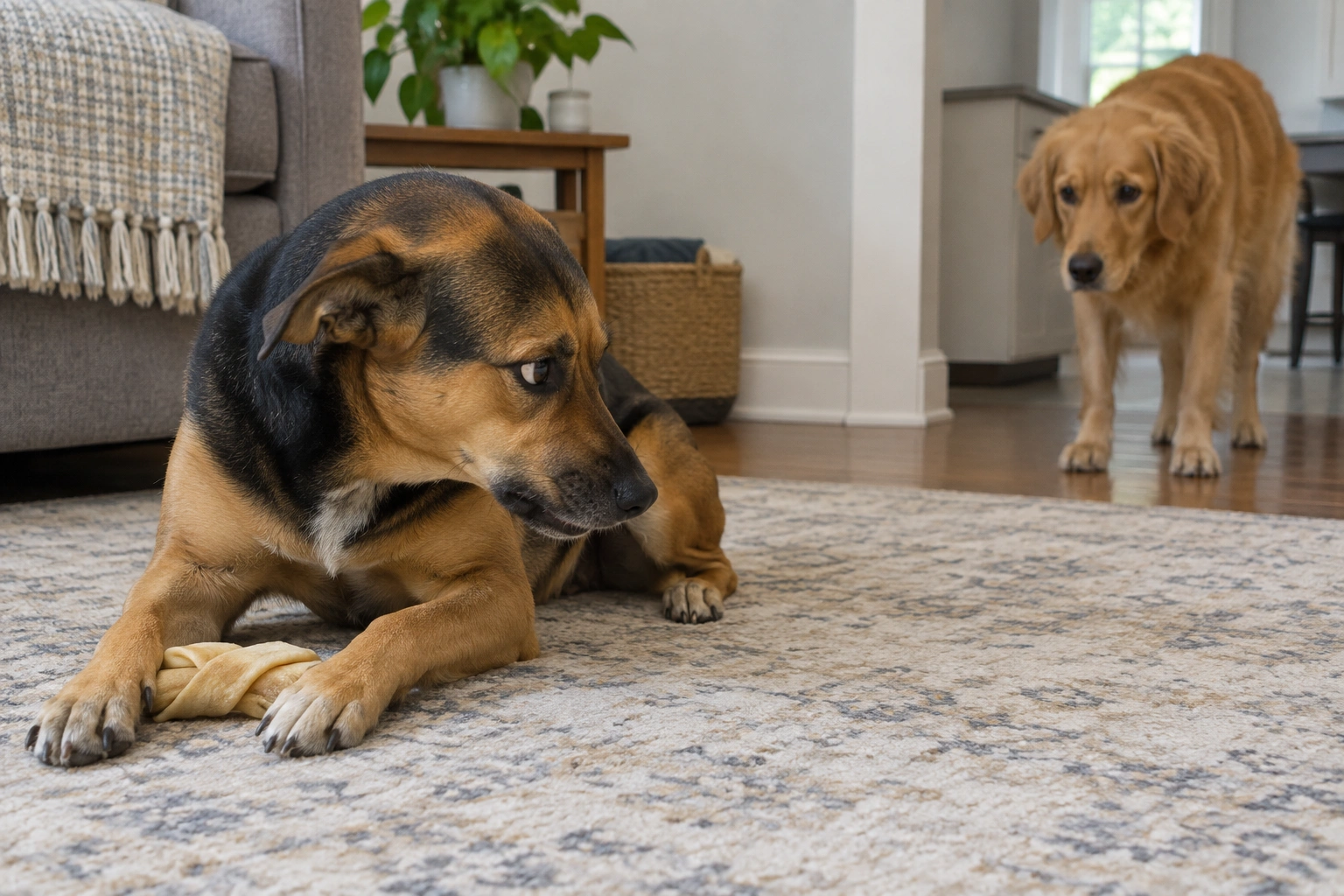
Resource guarding is not just “my dog doesn’t like sharing.” It is a defensive pattern that shows up when one dog tries to control access to something valuable: food, toys, chews, a bed, a couch, a doorway, a person, or even a favorite patch of floor.
Between dogs, the warning signs often come before any vocalization. Watch for:
- freezing over the resource
- hard staring
- hovering over the item
- a lowered head with a tense body
- lip lifting, whale eye, or a tight mouth
- standing over or blocking the other dog
- moving the item away from the other dog
- growling, snapping, or sudden lunging if the other dog comes closer
Some signs suggest mild guarding, while others mean the situation is moving toward a fight. Mild guarding may look like brief hovering, a quick body block, or a single low growl that stops when the other dog backs off. More dangerous signs include a stiff, still body; direct staring; repeated blocking; a lifted lip; a closed mouth with tension through the face and neck; or escalation from warning to snapping when the other dog does not retreat. If you see those stronger signs, intervene immediately rather than waiting to see what happens next.
Normal competition is usually looser and more social. Two dogs may both want the same toy or both drift toward the kitchen when food is prepared. Guarding is different because the dog is saying, with body language or teeth, “back off.”
A practical rule: if one dog has to protect an item from the other, treat it as a guarding problem, even if no bite has happened yet.
Why Dogs Guard Resources From Each Other
Guarding usually starts because the resource matters and the dog does not feel safe about losing it. That can happen for several reasons.
Some dogs are simply more motivated by food, toys, or resting spots. Some have learned that another dog has taken things before, so they stay on alert. Some are more reactive when the household is noisy, crowded, or unpredictable. And some are uncomfortable because of pain, stiffness, or another medical issue.
Trigger stacking matters too. A dog that is already tired, overexcited, or stressed may tolerate normal household traffic until one more dog approaches, then the whole thing tips over.
Humane World for Animals advises making sure dogs have enough toys, beds, treats, and food to go around, and that advice is especially relevant in multi-dog homes. One dog getting a new bed or chew can immediately change the value of that item to the other dog. You can read more about that approach in Humane World for Animals’ resource guarding guidance.
What to Do in the First 24 to 72 Hours
Your first job is not training. Your first job is preventing rehearsal.
Every time the dogs successfully guard, stare each other down, or get into a fight over a resource, the pattern gets easier to repeat. So for the next few days, put the household on a low-conflict setup.
Do this immediately:
- Feed the dogs separately, behind a barrier or in separate rooms.
- Remove chews, bones, and high-value toys when you cannot supervise closely.
- Stop free access to shared food areas.
- Keep the dogs apart during any activity that has caused tension before.
- Supervise closely around the couch, bed, doorway, or hallway if those are flashpoints.
- If you cannot watch them, separate them.
If a fight seems imminent or has just started, focus on safe separation, not punishment. Stay calm and move people out of the way first. Use a barrier if one is already nearby: close a door, drop a baby gate into place, or create distance with a chair, laundry basket, board, or other large object. If the dogs are already locked on, do not grab collars, do not reach between them, and do not put your hands near their mouths. If you can do so safely, interrupt with a loud noise from a distance or toss a blanket or cushion as a visual barrier, then separate each dog to a different space. Once they are apart, secure them before checking for injuries.
A baby gate, crate, closed door, or leash can be the difference between calm and conflict. In most homes, separation is safer than trying to “build tolerance” while both dogs still have access to the trigger.
That is the first big trade-off: short-term structure versus long-term freedom. If you keep giving the dogs access to the problem, you get more rehearsals. If you temporarily restrict access, you buy time to change the pattern.
How to Manage Meals, Chews, Toys, Beds, and People Safely
Different resources need different rules.
| Resource | Common risk | Best immediate management | When to reintroduce under training |
|---|---|---|---|
| Food bowls | Staring, hovering, rushing, snapping | Separate rooms or barriers for every meal | Only when both dogs can eat calmly at a safe distance |
| Chews and bones | High value, long duration, fast escalation | Give only when fully separated | After calm history is built with low-value items first |
| Toys | Possession, chasing, “mine” behavior | Remove shared toys if guarding starts | Use controlled trade games, one dog at a time |
| Beds and couches | Blocking, standing over, snapping at approach | Limit access to favorite resting spots | Reintroduce only if both dogs can disengage easily |
| People | One dog crowding the other away from you | Separate attention sessions, no competition for laps | Practice calm parallel settling at distance |
| Doorways and hallways | Blocking and pressure buildup | Use gates, tethers, or separate routes | Only after movement through space is relaxed |
Meals
For most multi-dog homes, co-feeding is a risk that is usually not worth taking if guarding is already present. Feed separately and leave each dog alone while eating. That is not “giving up.” It is preventing a predictable fight.
If one dog finishes early and starts wandering toward the other bowl, interrupt the opportunity by physically separating them until both are done.
Chews and bones
These are common flashpoints because they are high value and slow to finish. If your dogs have already shown guarding, do not hand out chews in the same space and hope for the best. Give chews only under supervision and only with enough distance that neither dog is concerned. If that setup is not possible, skip chews for now.
Toys
Toys can be tricky because they create motion, excitement, and pursuit. A Border Collie may lock on to a toy with intense focus, then guard it from the other dog without ever guarding food at all. If toys trigger tension, remove them from free access and use them only in one-dog training sessions.
Beds, couches, and resting spots
Resting places are often overlooked, but they matter. A dog that guards a couch or bed is not necessarily being “dominant.” It may simply feel safer in that spot and less willing to share.
If one dog snaps when the other approaches a favored bed, treat the bed as a guarded resource. Block access when needed. Do not force the dogs to “sort it out” on the furniture.
People and attention
Some dogs guard access to their person. One dog may wedge itself between you and the other dog, or block a sibling from climbing onto the couch beside you. If that happens, stop rewarding the competition. Give attention to one dog at a time, or call both dogs away and reward calm settling at a distance.
If you want more detail on guarding people specifically, see why dogs resource guard their owner.
Management vs. Behavior Modification
Management changes the environment so the dogs cannot keep practicing the problem. Behavior modification changes how the dogs feel about the trigger. You usually need both: management for immediate safety, and behavior modification for long-term improvement. If the dogs are already stiff, reactive, or escalating, management comes first and training should wait until you can work below threshold.
Training That Changes the Emotional Response
Management stops the fights. Training changes the feeling underneath them.
The safest behavior work for guarding usually includes desensitization, counterconditioning, and trade-and-return exercises. These methods are about changing the dog’s expectation from “the other dog means loss” to “the other dog predicts something good.”
Karen Pryor Clicker Training recommends bringing the second dog in far enough away that the first dog is not concerned, then rewarding both dogs for calm behavior. The key is distance. If you are too close, you are not training; you are provoking. Their guidance on this point is worth reading in their multiple-dog guarding article.
A simple trade-and-return pattern
Use a low-value item first.
- Let Dog A have the item.
- Approach calmly with something better or equally valuable.
- Cue a trade only if Dog A is relaxed enough to respond.
- Reward the release immediately.
- Give the original item back sometimes, so Dog A learns that giving it up does not always mean it disappears forever.
That last step matters. If every trade means the item vanishes, the dog may start guarding harder. If trade means “something good arrives, and I may even get it back,” the emotional pressure drops.
Building tolerance around another dog
With two dogs, the setup should be boring and easy. Keep the other dog far enough away that the guarding dog can stay loose and eat, chew, or rest without tension. Reward calm behavior. If the guarding dog stiffens, stares, stops eating, or starts hovering over the item, you are too close.
Work only at sub-threshold distance, where the dog can notice the other dog and still remain relaxed enough to take food, chew, or disengage. Progress only when the current distance stays relaxed across several sessions. If the dog is already reactive, stiff, or escalating, get professional help sooner rather than trying to push through it on your own. If the dog regresses, increase distance again. That is slower than people want, but it is safer and more reliable.
What Not to Do When Dogs Are Guarding
Some common “fixes” make the problem worse.
Do not:
- grab the item by force
- reach into the dog’s mouth or over the dog’s head
- yell or punish the growl
- force the dogs to share a bed, bowl, or chew
- drag one dog toward the other to “prove a point”
- keep testing the same trigger to see if the dog is “over it”
A growl is not bad behavior in the sense people often mean. It is a warning. If you punish the warning, you may get a quieter dog, not a safer one. The dog can learn that growling is pointless and move straight to snapping or biting.
Taking items away by force is especially risky because it confirms the dog’s fear that resources disappear when people or other dogs approach. A safer approach is to trade, manage, and prevent access.
How to Reduce Competition in a Multi-Dog Home
Long-term improvement usually comes from making the household feel less competitive.
That means predictable routines, enough resources, and fewer moments where the dogs have to negotiate for the same thing.
Useful changes include:
- feeding at consistent times and in separate spots
- providing separate resting areas
- rotating toys instead of leaving everything out
- giving each dog its own chew or bed if that is safe
- preventing one dog from stealing from another
- avoiding crowded, high-arousal group moments when possible
The goal is not to make every resource identical. It is to make each dog feel that it does not have to fight to keep access.
This is especially helpful in Border Collies, where arousal can climb quickly. A dog that is already keyed up by movement, noise, or anticipation may have less room to stay calm around a valued item. Predictability lowers that pressure.
A good practical test: if your dogs have fewer reasons to compete, do you see fewer guarding incidents? If yes, your management changes are working.
When Guarding May Be About Pain, Stress, or Anxiety
If guarding appears suddenly, gets worse fast, or shows up alongside other behavior changes, think beyond training.
Pain can make a dog more defensive around beds, couches, food bowls, or handling. Stiffness, limping, reluctance to jump, sensitivity to touch, or a sudden change in temperament are all reasons to schedule a veterinary exam before you push ahead with behavior work.
Stress and anxiety can also lower tolerance. A dog that is under-slept, overexcited, or generally overwhelmed may guard more intensely because it feels less able to cope.
This is where the question shifts from “How do I train this?” to “What is making my dog feel unsafe right now?”
When to See a Veterinarian or Certified Trainer
Some guarding problems are manageable at home. Others need professional help quickly.
You should get help promptly if:
- there has been a bite
- snapping or lunging is repeated
- the guarding is getting more intense
- multiple resources are involved
- the dogs cannot be safely separated in daily life
- the behavior started suddenly
- you suspect pain, illness, or stiffness
- a child or vulnerable person is in the home
A certified professional dog trainer with experience in resource guarding can help you set up safe training plans and manage distance, timing, and reinforcement. A veterinary behaviorist is the better choice when the behavior is severe, medically complicated, or tied to anxiety, pain, or broader behavior issues.
If you want a simple decision rule: if you can keep everyone safe with management and the guarding is mild and predictable, a trainer may be enough. If safety is shaky, the dogs are already escalating, or pain or anxiety may be involved, bring in veterinary support sooner.
Can Resource Guarding Between Dogs Be Fixed Completely?
Sometimes yes, sometimes not in the way people hope.
Many dogs improve dramatically when management is consistent and training is done carefully. They may stop guarding bowls, relax around toys, and live peacefully with fewer restrictions.
But some dogs remain sensitive around certain resources for life. In those cases, the goal is not perfection. The goal is low risk, low stress, and a household setup that prevents fights.
That is not a failure. It is realistic behavior management.
If you think in terms of “risk reduction” instead of “instant cure,” the plan becomes clearer. You remove the triggers that cause trouble, teach new emotional associations where possible, and keep the dogs out of situations they cannot yet handle. That is how you protect both dogs while building real change.
FAQs
Should I always separate dogs during meals?
If guarding is present or even suspected, yes, separate them. Separate rooms, baby gates, or crates are safer than hoping they will co-feed politely.
Can I let them keep toys if they seem fine most of the time?
Only if the toys do not create tension. If one dog stiffens, hovers, or guards, remove shared toys and reintroduce them only under controlled training.
Is it normal for one dog to guard the couch or bed?
It is common, but not something to ignore. Furniture can become a guarded resource just like food or bones.
Will more toys solve the problem?
More resources can help, but only if they are distributed in a way that reduces competition. Simply adding more items without changing access can still leave the conflict in place.
Can I train this myself?
Mild, predictable cases can often be improved at home with careful management and positive reinforcement. If there has been a bite, repeated escalation, sudden onset, or your dog is already stiff or reactive, get professional help.
What is the biggest mistake owners make?
Waiting for a fight to “prove” the problem is serious. By then, the dogs have already rehearsed the behavior and the risk is higher.
Does this mean my dogs can never be together?
Not necessarily. Many dogs can live together safely with the right structure. Some just need lifelong management around specific triggers.
If you want a calmer multi-dog home, the formula is simple even if the work is not: prevent access to the trigger, stop rehearsing the conflict, and teach the dogs that the presence of the other dog does not mean loss. That is how you turn a tense house into a manageable one.