
Why Does My Dog Resource Guard Me? A Practical Guide for Border Collie Owners

If your dog wedges between you and a guest, stares down another dog, or growls when someone comes close to you, the behavior can feel confusing and a little alarming. The first thing to know is this: a dog can resource guard a person. In other words, you may be the valuable thing your dog is trying to keep access to.
That does not automatically mean your dog is “dominant” or trying to run the house. More often, guarding comes from insecurity, fear, overattachment, frustration, or a history of learning that approaching people changes the social situation. In Border Collies and other sensitive herding breeds, the behavior can look especially intense because these dogs often notice movement quickly, attach closely to one person, and react fast when they feel uncertain.
The good news is that this behavior can often be managed and improved, but the outcome depends on the dog’s severity, bite history, and any underlying anxiety or pain. The key is to read it correctly, keep everyone safe, and change how your dog feels about people approaching you.
What It Means When Your Dog Guards You
Resource guarding is any behavior a dog uses to keep others away from something they value. That “something” is not limited to food bowls or toys. Dogs can guard sleeping spots, stolen items, chew bones, other pets, and yes, humans.
When the guarded “item” is you, the dog may act as if access to you is limited or precious. You might see this when a guest leans in to say hello, when another dog approaches on a walk, or when a child climbs onto the couch beside you. The dog’s goal is usually not to protect you in a noble sense. The more practical explanation is that the dog wants to control access to you because it feels safer, more rewarding, or less uncertain when others stay back.
That distinction matters because it changes the plan. If you assume the dog is simply “protective,” you may miss the guarding pattern and accidentally reinforce it in some situations, even if praise is not the main issue. If you recognize it as guarding, you can manage the trigger and retrain the emotional response.
For a broader look at how guarding shows up in dogs, the ASPCA’s explanation of guarding behavior is a useful reference point. Their description fits this situation too: guarding can range from mild warning signals to more serious aggression, and some dogs direct it only toward certain people.
Resource Guarding vs Protectiveness vs Separation Anxiety
These behaviors can overlap in appearance, but they are not the same. The fastest way to sort them out is to ask: What is the dog trying to control?
| Behavior | What it looks like | Likely driver | Best first response |
|---|---|---|---|
| Resource guarding | Dog blocks, stiffens, growls, or snaps when someone approaches you | Fear of losing access to a valued resource | Increase distance, prevent rehearsal, begin counterconditioning |
| Protectiveness / alerting | Dog notices a person and barks or stays watchful, but relaxes once the situation settles | Vigilance or uncertainty about strangers | Manage the environment, teach calm behavior, avoid reinforcing alarm |
| Separation anxiety | Dog panics when left alone, follows you constantly, may destroy exits or vocalize when separated | Distress at separation from the owner | Treat the separation issue directly; guarding may be secondary |
These categories often overlap. A dog can guard the owner and also show separation anxiety, fear-based reactivity, or general anxiety. In mixed cases, the guarded resource may still be the owner even if the dog is also distressed about being left alone or is generally uneasy around people and dogs.
A dog can show elements of more than one category. For example, a Border Collie may be both highly attached and prone to guarding the owner from visitors. Another dog may be anxious generally, and that anxiety spills into possessive behavior around one person.
A useful decision rule: if the dog escalates when someone comes near you, that points toward guarding. If the dog escalates when you leave, that points more toward separation anxiety. If the dog mainly watches, barks, or patrols but settles once the person is no longer a threat, the behavior may be more protective or vigilant than true guarding.
Why Dogs Guard Their Person
When a dog guards a person, the underlying emotion is usually some version of “I do not want to lose access to this thing that matters to me” or “I do not trust what happens when someone gets close.”
Common contributors include:
- Insecurity or fear. The dog may be unsure about strangers, guests, or other dogs and uses blocking as a distance-increasing strategy.
- Overattachment. Some dogs bond very tightly to one person and become possessive when others approach.
- Frustration. The dog wants interaction, control, or proximity and reacts when that access is interrupted.
- Learning history. If growling, moving in, or blocking has worked before, the behavior gets reinforced.
- Pain or discomfort. A dog that feels sore may become more defensive when touched, crowded, or physically handled.
A practical way to think about it: guarding is often the dog’s way of creating space or control, not of making a moral statement. That is why punishment usually makes the problem worse. If the dog learns that growling leads to scolding or restraint, it may skip the growl next time and go straight to a snap.
Why Border Collies and Other Herding Breeds May Be Prone to It
Border Collies are not doomed to guard their people, but the breed does have traits that can make the behavior more likely or more obvious.
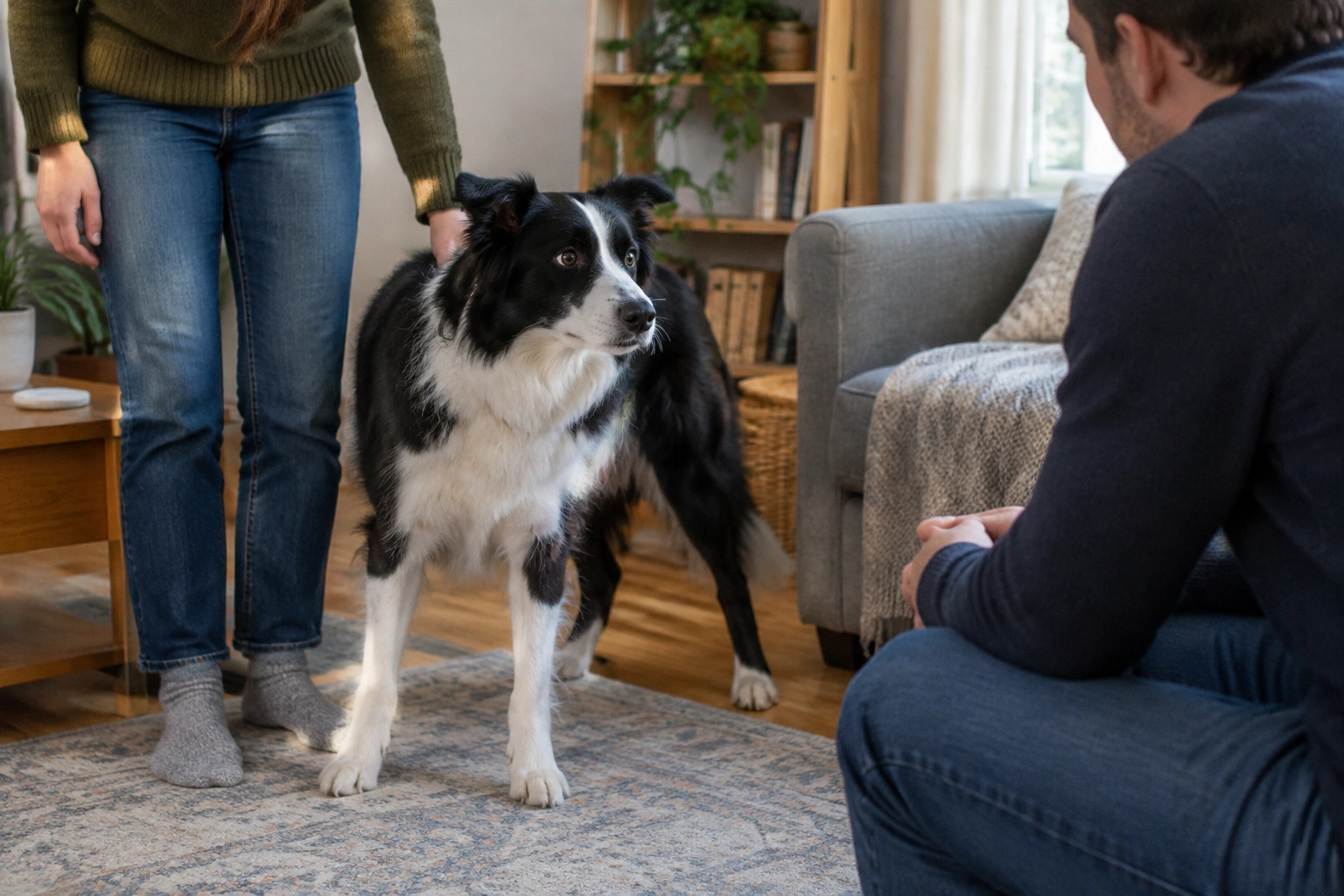
They are typically:
- highly observant,
- sensitive to movement and social tension,
- quick to form strong attachments,
- and often motivated by control of motion and space.
That combination can create a dog that notices every approach to you and reacts fast when it thinks the situation is changing. In a Border Collie, guarding can look like a subtle body check, a fast move to your side, or a sharp stare before the dog ever growls.
The important line to draw is this: breed tendencies may shape the style of the behavior, but they do not explain away the problem. An individual dog’s history, confidence level, pain status, and daily management matter just as much.
If you live with a Border Collie that is already highly aroused around visitors, don’t assume it will “grow out of it.” These dogs often get better when the environment is structured and the training is specific.
Common Triggers and Real-World Examples
Owner-directed guarding usually shows up in ordinary, repeatable moments. The pattern matters more than the exact trigger.
Guests approaching you
A visitor walks in, and your dog moves between you and the door. If the guest bends down or reaches toward you, the dog stiffens, barks, or growls.
Other dogs coming near you
On a walk, your dog is fine until another dog closes the distance. Then it starts leaning into your legs, barking, or blocking the path.
Children climbing onto you
Some dogs tolerate adults but guard their owner from children, especially if children are noisy, unpredictable, or physically impulsive.
Physical contact with you
A dog may react when someone hugs you, sits beside you on the couch, or puts a hand on your shoulder. The trigger is not always the person; sometimes it is the closeness, movement, or social pressure around you.
Petting, cuddling, or lap-sitting
Owner-directed guarding can also show up when your dog is already sharing physical contact with you. A dog that is curled against you on the couch, lying in your lap, or leaning into a cuddle may stiffen or growl if someone tries to join, move you, or interrupt the contact.
Specific household members
Some dogs guard one person from everyone. Others only guard against strangers, men, children, or a particular family member. That uneven pattern is common and does not rule out guarding.
One reason this matters: if your dog only reacts in certain contexts, you can build a plan around those situations instead of treating every interaction as a crisis.
Warning Signs the Behavior Is Escalating
Most guarding does not begin with a bite. It usually starts with smaller signals that owners miss or normalize.
Watch for:
- hard staring at the approaching person or dog
- body stiffening
- leaning or blocking in front of you
- slow, deliberate movement toward the trigger
- closed mouth after being relaxed
- raised hackles
- low growl or rumble
- quick snap, air snap, or lunge
A dog that is still taking food, responding to cues, or moving away may be more manageable than one that is locked in and unwilling to disengage. But do not wait for a bite before taking the behavior seriously. Guarding often gets worse through rehearsal.
If your dog is already growling, the growl is useful information. It means the dog is uncomfortable enough to warn. Punishing that warning can remove your early alert system.
What to Do in the Moment When Your Dog Starts Guarding You
Your job in the moment is not to “win” the interaction. It is to lower arousal and prevent the dog from practicing the guarding response again.
Do this instead:
- Increase distance immediately. Step away from the trigger, ask the guest to back up, or move behind a barrier.
- End the interaction if the dog is stiff, staring, or growling. Do not keep the greeting going in hopes that the dog will settle on its own.
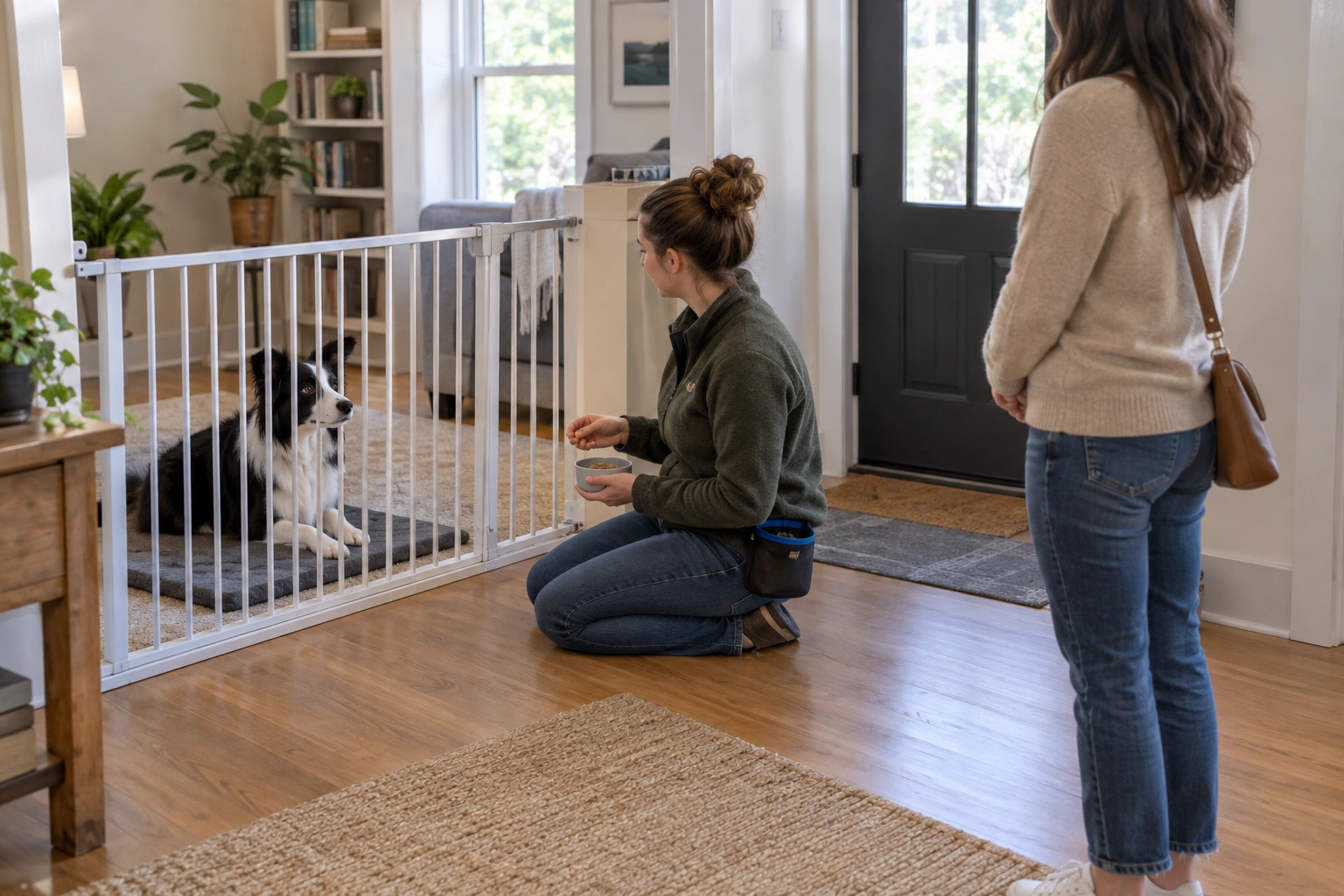
- Move the dog behind a gate, into another room, or onto a leash away from the trigger if needed. Use a barrier or separation to reset the situation before anyone gets closer.
- Keep people from reaching in. No petting, looming, or leaning over the dog.
- Redirect to a known behavior only if the dog can still think. A simple “place” or “let’s go” can help if the dog is not over threshold.
Do not scold, pin, alpha-roll, or force the dog to tolerate the person. That tends to increase fear and can make the next warning faster and sharper.
If children or unfamiliar dogs are present, separate them during initial management. These cases can escalate quickly, and it is much easier to prevent rehearsal than to repair it later.
If you need a practical comparison, think of it this way: management is about preventing a fire from spreading; training is about changing what causes the spark. You need both, but management comes first.
How to Manage the Environment to Prevent Rehearsal
Management is not avoidance forever. It is a temporary safety strategy that gives you room to retrain the behavior.
At home
- Use baby gates or closed doors during greetings.
- Put the dog on a mat or behind a barrier when guests arrive.
- Feed treats away from the front door so the dog does not practice guarding the entry point.
- Keep greetings short and structured.
- Ask guests to ignore the dog until it is calm.
In public
- Create more space on walks when another dog approaches.
- Cross the street before the dog starts to tense.
- Avoid crowded sidewalks if your dog is already sensitive.
- Keep children from rushing up to pet the dog when you are standing still.
The trade-off is simple: more distance usually means less drama, but if you only avoid triggers forever, the dog never learns that the trigger can be safe. That is why management should support training, not replace it.
How to Change the Emotional Response Safely
The core training goal is not “make the dog obey harder.” It is to change how the dog feels when someone approaches you.
The two main tools are desensitization and counterconditioning:
- Desensitization means exposing the dog to the trigger at a low enough level that it stays calm.
- Counterconditioning means pairing that trigger with something the dog likes so the emotional response changes over time.
For example, if your dog guards you from guests, the guest might start far enough away that the dog notices but does not stiffen. At that distance, the guest tosses high-value treats away from you. The dog learns that a person approaching at a safe distance predicts good things, not conflict.
A concrete setup might look like this: have a guest stand 20 to 30 feet away at first, then toss a treat on the floor away from you every time the dog looks at the guest and remains loose-bodied. If the dog stays relaxed for several short reps in a row, you can reduce the distance a little at the next session. If the dog stiffens, stops eating, or starts to stare hard, you went too fast and should increase distance again.
The setup has to stay below the dog’s threshold. If the dog is already barking or lunging, you are too close. Back up and make the exercise easier.
This kind of work is usually slow, but it is more reliable than trying to suppress the behavior. The dog must feel safer, not just quieter.
For a general veterinary perspective on guarding as a behavior issue, Veterinary Partner’s overview of resource guarding is a solid reference. It reinforces the idea that dogs guard what they perceive as valuable.
Teaching Alternative Behaviors That Compete With Guarding
Once the dog can stay calm at a workable distance, teach behaviors that give it something else to do.
Useful options include:
- Place: go to a mat or bed and stay there until released
- Settle: lie down and relax in a low-arousal state
- Recall: come when called away from the trigger
- Hand target: touch your hand and move with you
These behaviors help because they create a habit pattern that competes with blocking or hovering. But obedience alone is not enough if the dog still feels worried. A dog can sit beautifully while still being emotionally ready to explode. That is why the emotional work and the skill work must happen together.
A simple example: teach “place” when nobody is around first. Then practice with a calm family member entering the room at a distance. Reward the dog for staying on the mat. Only later do you add more realistic distractions.
When to Rule Out Pain, Illness, or Sudden Sensitivity
If the guarding behavior is new, suddenly worse, or linked to being touched, a veterinary check is smart before you assume it is purely behavioral.
Pain can make a dog less tolerant of being approached, crowded, or handled. A dog that used to be easygoing and is now snappy when someone leans over it may be telling you that something hurts.
Pay close attention if:
– the change happened quickly,
– the dog seems sore, stiff, or reluctant to move,
– the behavior appears around petting or lifting,
– or the dog is guarding more intensely than before.
A medical issue does not rule out training, but it can change the plan. If pain is part of the picture, behavior work will be harder until the discomfort is addressed.
When to See a Veterinarian or Certified Trainer
Get professional help sooner rather than later if any of these are true:
- your dog has snapped, bitten, or made contact with teeth
- the guarding is escalating quickly
- children are in the home
- you cannot reliably manage guests or other dogs
- the dog is guarding suddenly and you suspect pain or illness
- you feel unsure about setting up safe training sessions
A certified trainer with experience in guarding and aggression can help you build a step-by-step plan when the behavior is milder, manageable, and there is no bite history. For bite history, rapid escalation, or complex anxiety cases, a veterinary behaviorist is preferred because they can assess behavior alongside medical factors and, when appropriate, discuss broader treatment options.
A precautionary mindset is sensible here: if the behavior feels like a safety issue, treat it seriously and get help early rather than waiting for it to escalate.
What Progress Usually Looks Like
Improvement is often gradual and easy to miss if you only look for dramatic change. Early wins may look like:
- the dog notices a person and stays loose instead of stiffening
- the dog can take food while someone is nearby
- the dog chooses to move to a mat instead of wedging in
- the dog recovers faster after a trigger
That is progress. The aim is not perfect indifference. It is a dog that can stay calm, take direction, and no longer feels the need to control access to you.
FAQs
Is my dog being protective or resource guarding me?
If the dog is trying to keep others away from you, especially by blocking, stiffening, growling, or snapping, that leans toward resource guarding. If the dog is simply watchful and alert but settles once the situation passes, it may be more protective or vigilant.
Why does my dog guard me from other dogs but not people?
Dogs can be selective. Some guard from other dogs because those dogs feel more threatening, more exciting, or more likely to interrupt access to the owner.
Can training fix this behavior?
Training can help a lot, especially when combined with management. The biggest gains usually come from changing the dog’s emotional response, not just drilling obedience.
Should I punish the growl?
No. A growl is a warning sign. Punishing it can remove the warning without solving the problem.
Does this happen more in Border Collies?
Border Collies may be more likely to show intense, fast-reacting behavior because they are sensitive and highly observant, but any breed can guard a person.
For more on safe behavior handling and dog health topics that can affect training, you may also find our guides on how long dog dental cleaning takes and how long neutering a dog takes useful when planning veterinary care around behavior work.
