
How to Tell If a Border Collie Is Purebred?

Quick Answer
You cannot prove that a Border Collie is purebred just by looking at the dog. Appearance, coat, size, movement, and herding behavior can provide clues, but documented pedigree records offer much stronger evidence. Start by comparing your dog with the official Border Collie breed information, then check registration and ancestry records.
Best ways to check
- Check the pedigree: Trace the registered parents and several generations of ancestry.
- Review registration: Confirm that the papers match your dog’s identity and breeder information.
- Compare physical traits: Look at size, structure, coat, head shape, tail, and athletic build.
- Notice working traits: Herding eye, responsiveness, stamina, and intense focus are common breed characteristics.
- Consider DNA testing: Breed-ancestry tests can provide useful supporting evidence, but they do not replace a documented pedigree.
The key point
- A black-and-white coat, intense stare, or strong herding instinct does not automatically make a dog a purebred Border Collie.
I’ve seen plenty of dogs that looked unmistakably like Border Collies until I watched them move or learned their history. I’ve also seen purebred Borders that looked nothing like the classic black-and-white dog people expect.
That is why I use several clues together. In this guide, I’ll show you what matters, what doesn’t, and which evidence gives you the strongest answer in 2026.
In This Guide
- What does purebred Border Collie mean?
- Can you tell if a Border Collie is purebred by appearance?
- What does a purebred Border Collie look like?
- What do pedigree papers and registration prove?
- Can a DNA test prove a Border Collie is purebred?
- Does Border Collie behavior reveal breed purity?
- Border Collie vs Australian Shepherd
- What should you check before buying or adopting?
- Frequently asked questions
What Does Purebred Border Collie Mean?
A purebred Border Collie comes from Border Collie parents whose ancestry remains within the breed. The strongest practical evidence is a documented family line rather than a particular coat color or facial marking.
Definition: A purebred Border Collie is a dog with documented Border Collie ancestry through its parentage and pedigree. Breed appearance supports identification, but appearance alone cannot establish that ancestry.
This distinction matters because Border Collies have never been defined by one narrow appearance. Their history centers heavily on working ability, livestock sense, stamina, responsiveness, and trainability.
That working heritage produced considerable variation within the breed. Two genuine Border Collies can differ noticeably in color, coat length, ear carriage, bone, and overall appearance.
Purebred does not mean show quality
A purebred dog can have features that differ from the ideal show-ring picture. That doesn’t suddenly make the dog mixed breed.
Likewise, registration does not promise perfect health, temperament, or working ability. Those are separate issues that responsible owners and breeders should evaluate individually.
Can You Tell If a Border Collie Is Purebred by Appearance?
No. You can make an educated guess from appearance, but you cannot reliably prove ancestry by sight alone.
This is one of the biggest mistakes I see with Border Collies. People expect every purebred dog to have a white blaze, white chest, white feet, and a black saddle.
In reality, Border Collies occur in many colors and markings. The official standard also recognizes both rough and smooth coat types.
Why visual identification can fool you
- Border Collie mixes can look convincing. A first-generation cross may inherit many classic Border Collie features.
- Purebreds can look unusual. Red, merle, tricolor, smooth-coated, or lightly marked dogs may surprise owners.
- Young dogs change. Puppies can develop different proportions, coat texture, and feathering as they mature.
- Working lines vary. Dogs selected heavily for livestock work may look different from dogs bred mainly for conformation.
I pay more attention to the whole dog than one attractive feature. Head shape, balance, movement, coat, proportions, behavior, and ancestry tell a much better story together.
What Does a Purebred Border Collie Look Like?
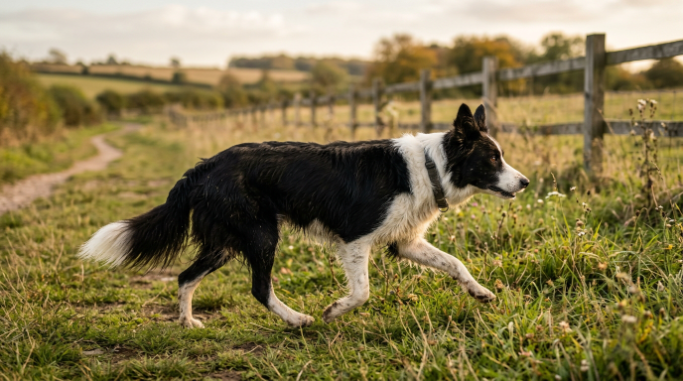
A typical Border Collie is a medium-sized, athletic, balanced dog built for fast changes of direction and sustained work. According to the breed standard, males are generally 19 to 22 inches tall, while females are about 18 to 21 inches.
Typical adult weight commonly falls around 30 to 55 pounds. Size outside that range can raise questions, but it still doesn’t prove mixed ancestry by itself.
Body and movement
A Border Collie should look athletic without appearing bulky. The body is slightly longer than its height, with moderate bone and a strong working build.
Movement is another useful clue. A well-built Border tends to cover ground efficiently instead of bouncing heavily with every stride.
- Build: Medium-sized, balanced, athletic, and muscular without excessive heaviness.
- Chest: Deep and moderately broad rather than barrel-shaped.
- Back: Generally level, with a slight muscular rise over the loin.
- Tail: Low set and long enough to reach around the hock area.
- Feet: Compact and oval, supporting quick turns and efficient movement.
Head, eyes, and ears
The expression usually looks alert and intensely interested in the environment. Many experienced owners recognize that watchful expression before noticing the dog’s markings.
The eyes are generally oval and set apart. Eye color can vary, so blue eyes do not automatically mean a dog is mixed.
Ears may stand erect, remain semi-erect, or fall somewhere between those positions. There is no single Border Collie ear shape you can use as a purity test.
Coat and color
Border Collies have dense, weather-resistant double coats. The two accepted coat types are commonly described as rough and smooth.
- Rough coat: Longer hair with feathering around areas such as the chest and legs.
- Smooth coat: Shorter hair over most of the body, sometimes with limited feathering.
- Color: Black and white is common, but many other colors and combinations occur.
- White markings: Their placement varies and should not be used as a purity test.
A purebred Border Collie does not have to resemble the dog on a bag of sheep feed. Variation is normal within this working breed.
Section Takeaway: Physical features can support your identification, but no coat, eye color, ear position, or body shape proves purebred ancestry on its own.
What Do Pedigree Papers and Registration Prove?
Pedigree records are usually the most useful evidence when you want to establish purebred ancestry. They let you trace your dog’s family rather than guessing from appearance.
An AKC certified pedigree, for example, can show registered names and registration numbers through several generations. That creates a documented family tree.
Check that the paperwork matches the dog
Don’t stop after seeing a certificate. Compare names, registration numbers, sex, date of birth, breeder details, and any permanent identification available.
If you bought a puppy, the breeder should also be able to explain the sire and dam clearly. Vague stories about missing papers deserve caution.
Registration has limits
Registration documents ancestry. They should not be treated as a guarantee that the dog has ideal structure, excellent temperament, strong working ability, or perfect health.
I’ve always separated those questions. First I establish who the dog’s ancestors are, then I evaluate the dog standing in front of me.
For an adult dog with no papers, recovering documented ancestry may be difficult. In that situation, physical assessment and commercial breed-ancestry testing can provide clues, but certainty may remain limited.
Can a DNA Test Prove a Border Collie Is Purebred?
Not in the same way as a documented pedigree. This is an important distinction because several different types of canine DNA testing get grouped together.
The AKC DNA program uses genetic profiles mainly for identity and parentage verification. AKC specifically explains that its DNA profile does not determine a dog’s breed or prove that the dog is purebred.
Breed ancestry tests are different
Commercial ancestry tests compare portions of your dog’s DNA with reference populations. Results may indicate that your dog strongly resembles Border Collie genetic reference groups.
That information is useful. It still isn’t identical to having a documented chain of registered ancestors.
Current dog DNA testing guidance from PetMD also treats breed identification as one of several possible uses for these tests. Results can be helpful for breed ancestry, traits, and some health-related information.
When I would use a DNA test
- Unknown rescue history: An ancestry test may provide useful breed clues when paperwork does not exist.
- Suspected mix: Testing can help investigate whether other breeds contributed to the dog’s ancestry.
- Parentage question: Proper parentage testing can compare a dog directly with suspected parents.
- Health planning: Some genetic panels screen for inherited variants, although results should be discussed with a veterinarian.
A result showing a strong Border Collie ancestry signal can support what you already suspect. For official purebred status, documented pedigree remains the more meaningful evidence.
Vet note: Genetic health results are not a diagnosis. Discuss concerning findings with your veterinarian before making medical or breeding decisions.
Does Border Collie Behavior Reveal Breed Purity?
No single behavior proves that a dog is purebred. However, several working traits commonly associated with Border Collies can strengthen the overall picture.
Border Collies were developed to control livestock with intelligence, speed, responsiveness, and intense concentration. That history still shows clearly in many modern dogs.
The famous Border Collie “eye”
The term eye describes the intense gaze a Border Collie may use while controlling livestock. Some dogs also crouch or stalk while concentrating on movement.
I notice the same mental pattern away from sheep. A Border may suddenly become motionless while studying a ball, another dog, or something moving across the yard.
- Strong focus: The dog may lock onto movement with remarkable concentration.
- Fast learning: Many Borders pick up patterns and cues after only short training sessions.
- High responsiveness: They often notice small changes in human movement or voice.
- Herding tendencies: Some circle, stalk, gather, or attempt to control moving animals and people.
- Work drive: Many seem happiest when solving a problem or performing a task.
None of these traits belongs exclusively to Border Collies. Australian Shepherds, Kelpies, cattle dogs, and other working breeds can show similar behavior.
A calm Border Collie is also still a Border Collie. Temperament varies with genetics, age, training, environment, health, and individual personality.
Border Collie vs Australian Shepherd: Why Are They Often Confused?
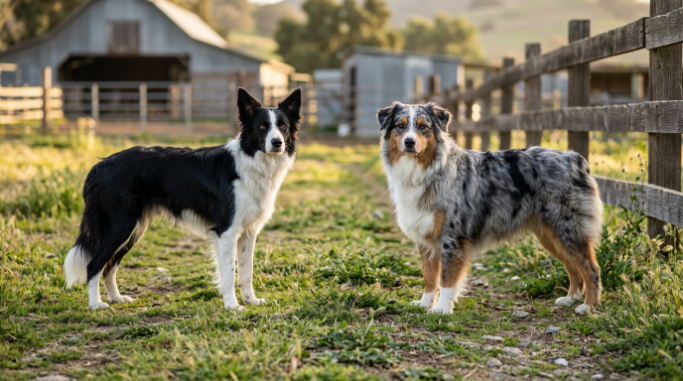
Border Collies and Australian Shepherds can look surprisingly similar, especially to someone meeting either breed for the first time. Both are intelligent, athletic herding dogs with several overlapping coat colors.
The measurements and physical tendencies below can help with identification. They still should not replace pedigree evidence.
| Feature | Border Collie | Australian Shepherd |
|---|---|---|
| Typical height | Males 19–22 in.; females 18–21 in. | Males 20–23 in.; females 18–21 in. |
| Typical weight | About 30–55 lb. | About 40–65 lb. |
| General build | Lean, agile, moderate bone, built for efficient movement. | Often somewhat heavier and more substantial in build. |
| Coat | Rough or smooth double coat. | Moderate-length double coat. |
| Tail | Naturally long, low-set tail is typical. | Natural bobtails and traditionally docked tails are associated with the breed. |
| Working style | Often associated with strong eye, gathering, crouching, and stalking. | Strong herding drive, generally with a different working style. |
The overlap is large enough that I would never identify either breed solely from a photograph. A Border Collie–Australian Shepherd mix can make visual identification even harder.
What Should You Check Before Buying or Adopting a Border Collie?
If purebred status matters to you, investigate it before money changes hands. It is much easier to verify ancestry while you still have direct access to the breeder and records.
- Ask to see the parents. If that is impossible, request clear information and records for both sire and dam.
- Request registration details. Match the names and numbers against the paperwork supplied with the puppy.
- Review the pedigree. Look beyond the parents and examine several generations where possible.
- Ask about permanent identification. A microchip can help connect the physical dog with its records.
- Discuss health testing. Responsible breeding involves more than producing puppies with registration papers.
- Read the sales contract. Understand registration restrictions, return terms, and health guarantees before signing.
- Be cautious with appearance-only claims. “Looks purebred” is not meaningful documentation.
Purebred and responsibly bred are not the same thing
This point deserves emphasis. Two purebred Border Collies can produce purebred puppies even when the breeding decision itself was poorly planned.
Responsible breeders pay attention to health, temperament, structure, pedigree, and suitability for breeding. The AKC lists hip and ophthalmologist evaluations among the recommended health checks for Border Collies within its Herding Group health testing guidance.
I would rather see thoughtful health information and transparent records than a breeder who talks constantly about “100% pure blood” while avoiding basic questions.
Once the dog is home, breed purity should not overshadow good ownership. Proper exercise, training, mental enrichment, grooming, and preventive veterinary care matter far more to your dog’s daily quality of life.
The ASPCA dog care resources provide a useful general reference for ongoing care and responsible ownership.
Vet note: Ask your own veterinarian about appropriate screenings and preventive care for your individual dog, especially if you plan to breed.
Section Takeaway: When choosing a puppy, verify ancestry through records, then evaluate health testing, temperament, and breeder practices separately. Purebred status alone is not a quality guarantee.
Frequently Asked Questions About Purebred Border Collies
How can I tell if my Border Collie is mixed?
Look at ancestry records first. Physical traits such as unusual size or structure may suggest mixed ancestry, but they cannot prove it. If no pedigree exists, a reputable breed-ancestry DNA test may provide additional clues about possible breeds in your dog’s background.
Are all purebred Border Collies black and white?
No. Black and white is one of the most familiar color combinations, but purebred Border Collies can appear in many colors and patterns. Coat color alone is a poor way to decide whether a Border Collie is purebred.
Can a purebred Border Collie have blue eyes?
Yes. Border Collies can have different eye colors, including blue. Blue eyes are particularly familiar in merle dogs, although eye color by itself cannot confirm or disprove ancestry.
Can a purebred Border Collie have short hair?
Yes. The Border Collie breed includes both rough-coated and smooth-coated dogs. A short, smooth coat does not mean the dog is mixed, and smooth-coated working Border Collies are common enough to surprise people familiar only with fluffy examples.
Does an AKC DNA test tell me if my dog is purebred?
No. AKC states that its DNA profiling program is designed for genetic identity and parentage verification. It does not determine a dog’s breed or certify that a dog is purebred. Pedigree documentation serves a different purpose.
Is an AKC-registered Border Collie automatically healthy?
No. Registration documents ancestry and identity within the registry. It does not guarantee excellent health. Ask about breed-relevant health screening, veterinary history, temperament, and the health of close relatives when evaluating a puppy or breeding dog.
What is the most reliable way to know if a Border Collie is purebred?
A documented pedigree from a recognized registry is generally the strongest evidence because it traces known ancestry. Parentage DNA testing can help verify family relationships, while commercial breed-ancestry tests can provide supporting information when formal records are unavailable.
Final takeaway: Start with paperwork, not appearance. Use physical traits and behavior as supporting clues, and use DNA testing according to what that particular test can genuinely establish.
If your Border Collie has no records, that does not change the dog you share your life with. Learn the dog’s individual temperament, provide enough mental and physical work, and focus on building the kind of partnership this remarkable herding breed thrives on
None. The outbound URLs used above were checked during research.
