

Quick Answer
Yes, you can use leave-in conditioner on a Border Collie when the product is specifically formulated for dogs. A light leave-in spray can help with tangles, static, dryness, and brushing, especially on rough-coated Border Collies, but it should never leave the double coat greasy or saturated. For general coat-care guidance, see the VCA pet bathing guidance.
What to remember
- Choose dog-specific: Human hair conditioner may not suit canine skin or coat needs.
- Use a light amount: A Border Collie’s dense double coat should feel soft, not oily or coated.
- Target tangles: Focus on feathering, the tail, chest, and other areas that knot easily.
- Avoid sensitive areas: Keep sprays away from the eyes, nose, mouth, ear canals, and irritated skin.
- Brush afterward: Gentle brushing distributes the product and prevents concentrated residue.
- Stop if irritation appears: Redness, itching, or increased licking means the product may not suit your dog.
Simple starting method
- Start with less product than you think you need, then add more only if the coat still feels dry or difficult to comb.
I’ve found that Border Collie coat care is often easier when you resist the urge to use too much product. Their rough or smooth coats may look different, but both have a dense double-coat structure that deserves a light touch.
In this guide, I’ll explain when a leave-in conditioner helps, how I apply it, what I avoid, and when skin problems need veterinary attention instead of another grooming product.
In This Guide
- Can You Use Leave-In Conditioner on a Border Collie?
- Why Does a Border Collie’s Double Coat Change Conditioner Needs?
- What Type of Leave-In Conditioner Is Best?
- How Do You Apply Leave-In Conditioner?
- Leave-In vs. Rinse-Out Conditioner
- When Should You Use Leave-In Conditioner?
- What Products Should You Avoid?
- What If Your Border Collie Has Sensitive Skin?
- Frequently Asked Questions
Can You Use Leave-In Conditioner on a Border Collie?
Yes, a dog-formulated leave-in conditioner can be used on a Border Collie. The key is choosing an appropriate formula and applying only enough to improve manageability.
A leave-in conditioner isn’t something every Border Collie needs every day. Think of it as an optional grooming aid rather than a required part of coat care.
Definition: A Border Collie’s leave-in conditioner is a dog-safe conditioning product designed to remain on the coat after application instead of being rinsed away.
I find it most useful on longer feathering after a bath or when small tangles start developing around the chest, rear legs, and tail.
It may provide several practical benefits:
- Easier brushing: Added slip can help a comb move through light tangles with less pulling.
- Static control: Conditioning sprays can make dry, flyaway fur easier to manage.
- Moisture support: Some formulas reduce the dry feel that follows bathing.
- Detangling help: Rough-coated dogs may benefit around their longer furnishings.
- Coat manageability: A small amount can make post-bath grooming quicker.
Conditioner doesn’t replace regular brushing. The American Kennel Club’s double-coat grooming guidance emphasizes regular grooming to remove loose hair and help prevent tangles.
Why Does a Border Collie’s Double Coat Change Conditioner Needs?
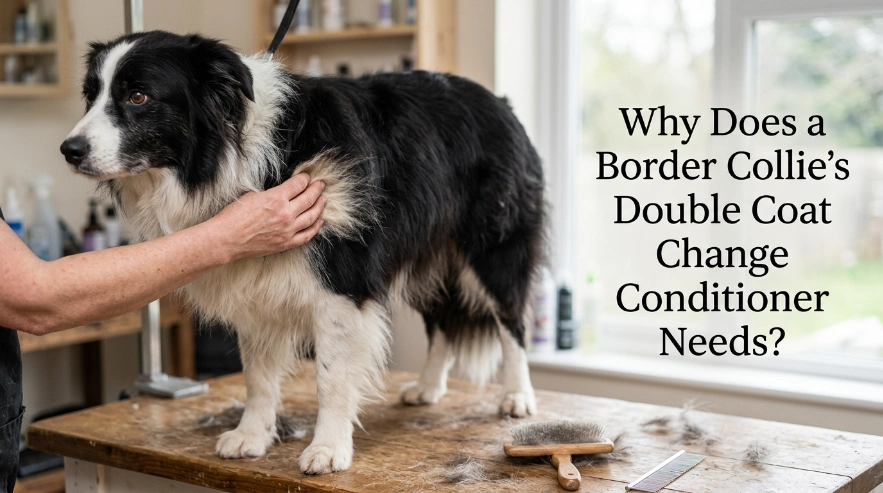
A Border Collie has both an outer coat and an undercoat, so heavy products can behave differently than they would on a thin, single coat. You want conditioning without coating the fur in residue.
The breed comes in both rough and smooth coat varieties. Both are double coated.
Rough-coated Border Collies
Rough coats have more visible length and feathering. Areas behind the ears, chest, legs, belly, and tail can catch debris or develop tangles.
A light detangling conditioner can be useful in these spots. I usually work on problem areas rather than spraying the entire dog heavily.
Smooth-coated Border Collies
Smooth Border Collies have shorter coats, so they often need less conditioning for tangles. Regular brushing may be enough for routine maintenance.
If the coat feels dry after bathing, a small amount of leave-in product can still help. Avoid turning a naturally practical coat into an oily one.
Why the undercoat matters
The undercoat shouldn’t remain damp or overloaded with grooming product. Dense fur can hold moisture close to the skin if drying is incomplete.
Brush and dry the coat thoroughly after bathing. This matters more than making the coat smell perfumed or feel artificially silky.
AKC describes Border Collies as medium double-coated dogs and recommends routine brushing to remove loose fur. As of 2026, that’s still the foundation I build the rest of my grooming routine around.
What Type of Leave-In Conditioner Is Best for a Border Collie?
Choose a lightweight conditioner specifically labeled for dogs and suitable for your Border Collie’s coat and skin. A simple formula is often easier to evaluate than one packed with fragrance.
I look for the following features:
- Dog-specific labeling: The product should clearly state that it’s intended for canine use.
- Leave-in directions: Don’t leave a rinse-out conditioner on the coat unless its label specifically permits it.
- Light texture: Sprays and fine mists are easier to distribute through a double coat.
- Detangling action: This is useful for rough coats and feathering.
- Gentle formulation: Sensitive dogs may do better with low-fragrance or fragrance-free choices.
- Clear instructions: The bottle should explain whether to apply to wet, damp, or dry fur.
According to PetMD’s veterinarian-reviewed grooming guidance, dogs with long hair or dry and sensitive skin may benefit from conditioning products. PetMD also advises choosing products intended for canine skin rather than human shampoos or conditioners.
Detangler versus conditioner
A detangling spray mainly helps knots release during brushing. A leave-in conditioner may offer detangling plus moisture and coat-softening benefits.
Some dog grooming products perform both jobs. Read the label instead of assuming two bottles with similar packaging do the same thing.
How Do You Apply Leave-In Conditioner to a Border Collie?
Apply a small amount to clean or brushable fur, distribute it with your hands or comb, and let the coat dry as directed. The manufacturer’s instructions should always take priority.
Here’s the routine I use for a typical rough-coated Border Collie after a bath:
- Brush before bathing. Remove loose fur, burrs, and obvious tangles before they become tighter when wet.
- Wash with dog shampoo. Rinse until no obvious shampoo residue remains.
- Towel-blot the coat. Press out excess water instead of aggressively rubbing the fur.
- Read the conditioner label. Confirm that the product is designed to stay in the coat.
- Start with a small amount. Mist lightly or apply the directed amount to your hands first.
- Focus on longer areas. Work through the chest, feathering, tail, and other tangle-prone sections.
- Comb gently. Use a suitable brush or wide-tooth comb to distribute the product.
- Dry thoroughly. Make sure the dense coat and undercoat aren’t left persistently damp.
When I use a spray, I prefer applying it to my hand before working close to the dog’s head. That gives me much better control around sensitive areas.
How much should you use?
There isn’t one universal number of sprays because formulas and bottle pumps vary. Follow the product instructions and begin at the low end of the recommended amount.
The finished coat shouldn’t feel wet, waxy, greasy, or sticky. If it does, you’ve probably used more than your dog needs.
Leave-In vs. Rinse-Out Conditioner: Which Is Better?
Neither type is automatically better. Rinse-out conditioner works well during a full bath, while leave-in products are convenient for detangling and between-bath coat management.
| Option | Rinse Required? | Best Use | Border Collie Consideration |
|---|---|---|---|
| Leave-in conditioner | No, when labeled leave-in | Light conditioning and easier brushing | Use sparingly to avoid coating the double coat |
| Rinse-out conditioner | Yes | Full bath and overall conditioning | Rinse thoroughly through the dense coat |
| Detangling spray | Usually no | Small knots and brushing sessions | Useful on rough-coat feathering |
| Medicated conditioner | Depends on prescription | Specific skin conditions | Use exactly as your veterinarian directs |
For a normal healthy coat, I wouldn’t automatically use both a heavy rinse-out conditioner and a leave-in product at every bath. Start simple and add another product only when there’s a clear grooming reason.
When Should You Use Leave-In Conditioner?
Use it when there’s a specific coat-care problem you want to solve. Dry-feeling hair, static, light tangles, and difficult brushing are more meaningful reasons than simply adding another grooming step.
Situations where I find it most useful include:
- After bathing: A small amount may restore manageability after shampooing.
- During dry weather: Fur can become more static-prone in low humidity.
- After outdoor adventures: Rough-coated dogs may develop small tangles from grass and debris.
- During shedding periods: Detangling support can make careful brushing easier.
- Before working through light knots: Added slip may reduce pulling on the hair.
For my own grooming routine, a mist on the feathering after muddy field play is far more useful than covering the entire dog. The goal is easier brushing, not a perfumed coat.
A healthy Border Collie still needs regular brushing whether you use conditioner or not. The breed’s active lifestyle means checking the coat after fields, trails, training sessions, or wet weather is especially useful.
What Products Should You Avoid?
Avoid assuming that a product is safe merely because humans use it on hair. Dogs have different skin and grooming needs.
I would avoid these common mistakes:
- Human leave-in conditioner: Human products aren’t formulated around canine skin and coat needs.
- Heavy application: Excess conditioner can leave a double coat greasy and harder to keep clean.
- Strong fragrance for its own sake: A powerful scent doesn’t make a product more effective.
- Products without canine directions: You should know whether the product is meant to stay on the coat.
- Spraying the face directly: Protect the eyes, nose, mouth, and ear canals.
- Using grooming products over sores: Broken, inflamed, or infected-looking skin needs proper evaluation.
VCA’s dog grooming and coat-care guidance recommends products formulated for dogs and notes that conditioning after shampooing can help restore moisture to the skin and coat.
Don’t use conditioner to hide a grooming problem
A mat won’t disappear because you spray more detangler on it. Severe mats can pull painfully on the skin and may require professional grooming.
Likewise, persistent odor, greasy skin, flakes, hair loss, or nonstop scratching shouldn’t simply be covered with scented grooming products.
What If Your Border Collie Has Itchy or Sensitive Skin?
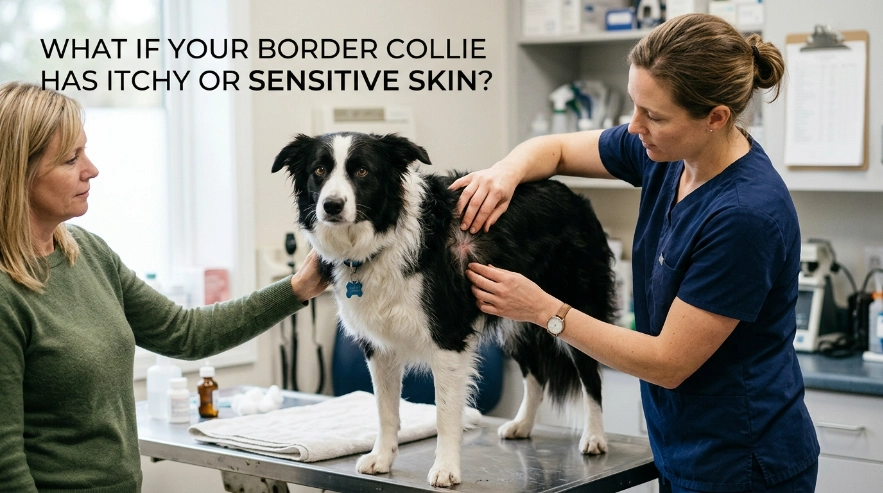
Stop experimenting with cosmetic products when your Border Collie has persistent redness, itching, sores, hair loss, or obvious discomfort. Those signs can have many causes, and conditioner can’t diagnose them.
Check the skin whenever you groom. Part the coat in several areas so you’re looking at the skin rather than only the outer hair.
Watch for:
- Red or inflamed patches
- Flaking or unusual scaling
- Moist or weeping areas
- Strong or unusual odor
- Repeated scratching or chewing
- Hair thinning or bald areas
- Swelling, bumps, or sores
Vet note: Persistent skin changes deserve advice from your own veterinarian, particularly when your dog is uncomfortable or the problem is worsening.
Dogs with diagnosed skin disease may need medicated shampoo, a prescribed conditioner, or another treatment plan. Don’t replace veterinary directions with an ordinary grooming spray.
When a veterinarian does recommend a leave-in treatment, follow the prescribed amount and application method closely. Some veterinary topical conditioners are intentionally left on the coat, while other products must be rinsed.
Frequently Asked Questions
Can I use human leave-in conditioner on my Border Collie?
I wouldn’t use human leave-in conditioner as a routine substitute for a canine product. Choose a conditioner specifically formulated and labeled for dogs so its directions and intended use match canine skin and coat care.
Does a Border Collie actually need conditioner?
No. Many Border Collies maintain healthy coats with good nutrition, regular brushing, occasional bathing, and proper drying.
Conditioner becomes useful when you need extra detangling, moisture, or brushing support.
Can I put leave-in conditioner on a dry Border Collie coat?
Yes, if the product label says it can be used on dry fur. Some sprays are designed for between-bath brushing, while others work best on towel-dried coats.
How often can I use leave-in conditioner?
Follow the manufacturer’s directions rather than using it on a fixed schedule. If the coat becomes greasy, sticky, dull, or attracts dirt quickly, reduce the amount or frequency.
Will leave-in conditioner stop my Border Collie from shedding?
No. Shedding is a normal part of maintaining a double coat.
Conditioner may make brushing easier, but regular brushing remains the main way to collect loose undercoat before it reaches your furniture.
Can leave-in conditioner remove mats?
It can help loosen small tangles, but it won’t safely solve every mat. Tight mats close to the skin should be handled carefully by an experienced groomer or veterinarian rather than pulled aggressively.
Should I use leave-in conditioner on a Border Collie puppy?
Only use a product that is clearly appropriate for your puppy’s age and species. Puppies with normal coats often need little beyond gentle brushing and puppy-appropriate bathing products.
My takeaway: A leave-in conditioner for a Border Collie can be useful, but less is usually better. Choose a dog-specific formula, target areas that need help, brush regularly, and pay attention to what your dog’s skin and coat are telling you.
If you’re building a grooming kit, start with a good brush and comb before adding extra coat products. Those basic tools will do more for most Border Collies than a shelf full of sprays.
