
Raw Diet for Border Collies: A Practical Guide to Feeding Safely and Well

Border Collies are athletic, lean, and often food-motivated, which is one reason raw feeding comes up so often in owner discussions. But a raw diet is not automatically the best fit just because a dog is active or “natural” foods sound appealing. The real question is simpler: can you feed raw in a way that is complete, safe, and realistic for your household?
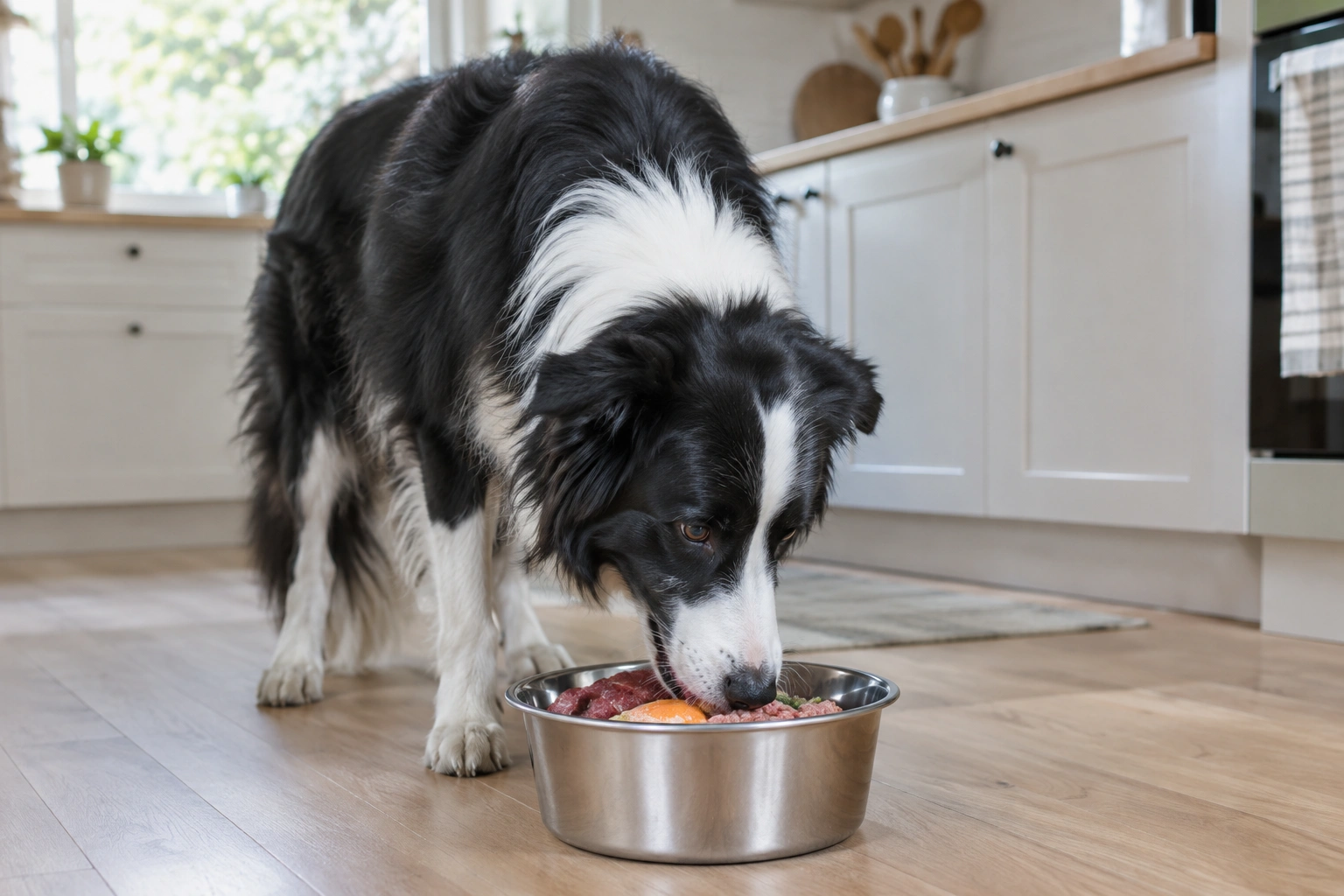
This guide walks through the trade-offs, the basics of building a balanced raw diet, and the practical checks that matter most for Border Collies: body condition, stool quality, energy, and digestive tolerance.
Is a Raw Diet a Good Fit for a Border Collie?
A raw diet can work for some Border Collies, but it is not a universal upgrade from kibble. The best case for raw feeding is usually an owner who can commit to careful food handling, wants control over ingredients, and is willing to follow a complete formulation rather than guessing.
A raw diet may be a reasonable option if your Border Collie:
– has a healthy digestive tract and no special medical restrictions
– maintains weight easily or needs a calorie-dense diet
– does well with routine feeding and measured portions
– lives in a home where raw meat handling is practical and hygienic
It may be a poor fit if your dog:
– is a puppy and you are not using a professionally balanced recipe
– has a history of pancreatitis, significant gastrointestinal disease, or other conditions that require a vet-directed diet
– lives with people who are immunocompromised, very young, or unable to avoid cross-contamination
– tends to gulp food, chew aggressively, or swallow pieces without enough chewing
For many Border Collies, the deciding factor is not whether raw is “better,” but whether the diet can be made complete and handled safely every day.
Raw vs. kibble or cooked homemade: what’s actually better?
There is no blanket answer that raw is safer or healthier for every Border Collie. A well-formulated cooked homemade diet or a complete commercial kibble can also meet nutritional needs and may be easier to manage in many homes.
In practical terms:
– Raw may appeal if you want ingredient control and your household can manage hygiene carefully.
– Cooked homemade can be a good choice if you want fresh ingredients but prefer to reduce pathogen risk.
– Kibble is often the most convenient and consistent option, especially for busy households or dogs with special medical needs.
The best diet is the one that is nutritionally complete, safe for your home, and sustainable long term.
What a Border Collie Raw Diet Actually Includes
A real raw diet is more than meat in a bowl. If the plan is unbalanced, the dog may get enough calories but still miss essential nutrients over time.
A complete raw diet usually includes:
– muscle meat for protein and calories
– raw meaty bones or another calcium source
– organ meat, especially liver and another secreting organ
– optional produce in BARF-style diets
– fat and sometimes fish oil depending on the recipe
– supplements only when needed to fill known gaps
The biggest mistake is assuming “raw” automatically means “complete.” Muscle meat alone is not enough. It can be too low in calcium and certain micronutrients, and long-term imbalance is the kind of problem you often do not notice until body condition, stool, or bloodwork starts to drift.
Ratios vary by formulation, life stage, and whether the diet is BARF-style, prey-model, or commercially complete. As a rough concept, many raw plans are built around a mix of muscle meat, bone, and organ meat, but that mix is not automatically balanced just because the ingredients are present. Puppies, seniors, and highly active dogs may need different formulations than a typical adult maintenance diet.
Border Collie Rescue notes that it mainly feeds complete dried foods, but also varies the diet with fresh or cooked meats, raw or cooked vegetables, wet foods, and supplementary treats, while adjusting the amount of complete food to account for those extras. That same principle applies to raw feeding: every addition changes the nutritional math, even small treats. You can see that approach in their diet guidance here: Border Collie Rescue’s diet and feeding notes.
Border Collie Nutrition Needs: What Matters Most
Border Collies do not need a breed-specific magical formula. They do need the right balance of calories, protein, fat, minerals, and digestibility for their life stage and workload.
Calories come before theory
A lean, active Border Collie often needs more food than a similar-sized couch-potato dog. Working dogs, agility dogs, and highly active pets may need noticeably more calories than a quieter adult. That does not mean “feed more raw meat” by default; it means the total ration has to rise while keeping the balance intact.
Protein matters, but balance matters more
Raw diets are often praised for protein, but protein alone is not the goal. A Border Collie needs enough amino acids for muscle maintenance and recovery, yet the diet also has to supply fat for energy and minerals for bone and nerve function.
Calcium and phosphorus are non-negotiable
This is where homemade raw diets often go wrong. Too little bone or calcium risks deficiency; too much bone can lead to constipation and an overly dry stool. Puppies need especially careful calcium-phosphorus balance because they are building skeletons.
Activity level changes the ration
A Border Collie that hikes, herds, or trains daily will usually need more food than one that gets a couple of neighborhood walks. The key is to adjust the amount based on body condition, not just the number on the scale.
Fat tolerance and meal frequency matter for active dogs
Very active Border Collies often do better with calorie-dense meals that include enough fat to support energy demands. But fat should be increased thoughtfully, especially in dogs with sensitive stomachs or a history of digestive upset. Some dogs also do better with two or more smaller meals rather than one large feeding, particularly if they work, train, or exercise hard.
BARF vs Prey-Model Raw Feeding: Which Approach Makes More Sense?
There are two common raw-feeding styles, and they solve the diet in different ways.
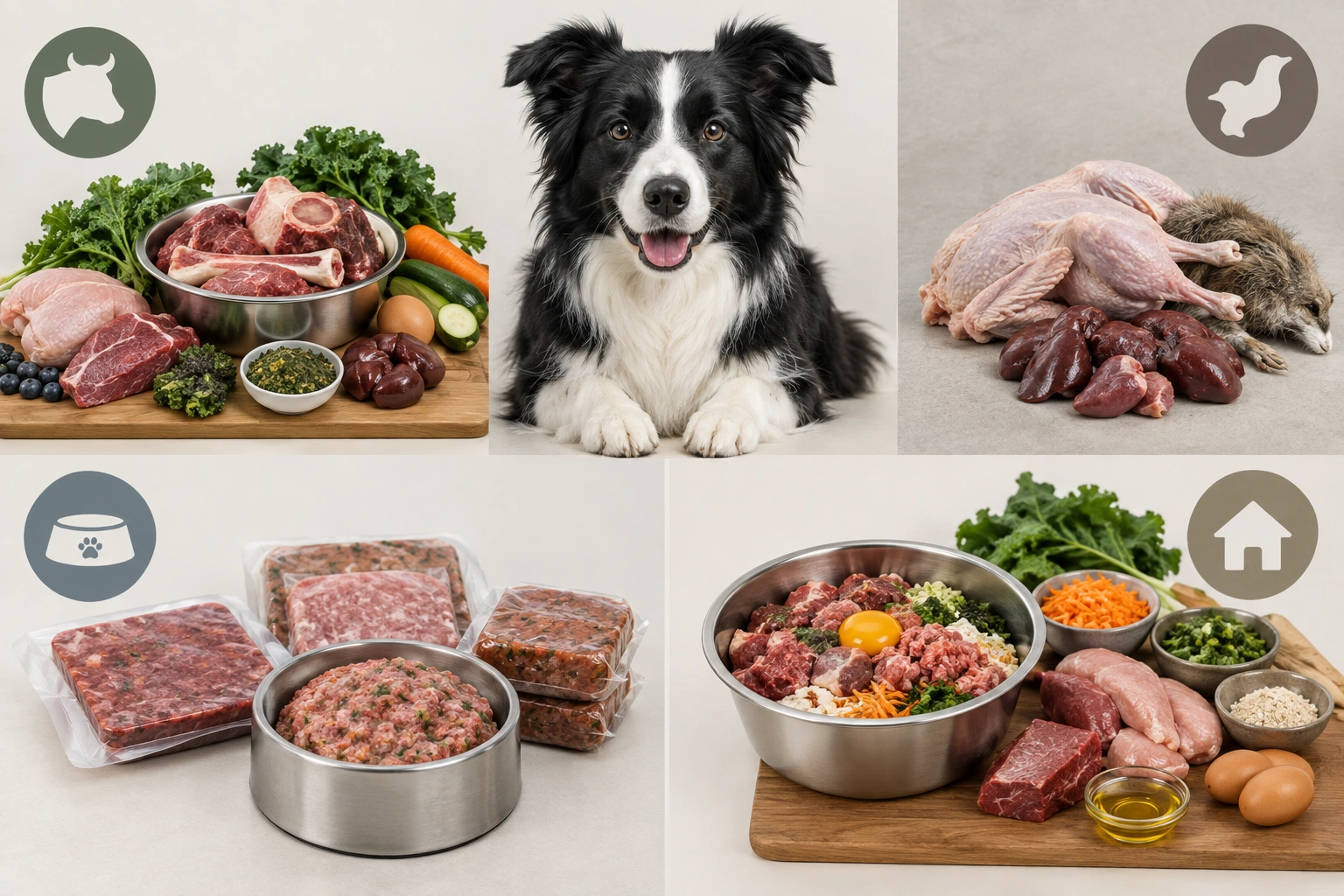
| Approach | What it includes | Strengths | Trade-offs |
|---|---|---|---|
| BARF | Meat, bones, organs, and usually some vegetables or fruit | More flexible; easier to add fiber and micronutrient variety | More moving parts; easier to overcomplicate or unbalance |
| Prey-model raw | Meat, edible bone, and organs, usually without produce | Simpler framework; easier to understand at a glance | Can be hard to balance if you rely on rough ratios alone |
BARF can appeal to owners who want a broader ingredient mix and are comfortable using vegetables as part of the ration. Prey-model raw is attractive if you want a simpler structure and are less interested in produce.
Neither approach is automatically superior. The practical question is whether you can keep the diet complete and repeatable. A simple, well-balanced plan beats a fancy one that changes every few days.
A practical decision framework
If you are choosing between commercial raw, homemade raw, BARF, and prey-model, start with the dog and the household:
- Puppy: choose a professionally balanced commercial raw or a vet-formulated homemade plan. Avoid DIY raw unless a nutrition professional has built the recipe.
- Healthy adult with a stable routine: commercial complete raw is usually the easiest raw option. BARF or prey-model can work if the recipe is balanced and you can measure consistently.
- Highly active dog: prioritize calorie density, digestibility, and a feeding schedule you can maintain. Commercial complete raw or a carefully formulated homemade plan is usually safer than improvising.
- High household risk tolerance? If you live with children, older adults, immunocompromised people, or anyone who cannot easily avoid cross-contamination, commercial raw may still be a concern, and cooked or kibble may be the better fit.
- Low tolerance for guesswork: choose commercial complete raw over homemade.
- Willing to follow a recipe exactly: BARF or prey-model can be workable, but only if the formulation is complete and appropriate for life stage.
How Much Raw Food to Feed a Border Collie
There is no single correct number for every Border Collie, but a useful starting point for many adult dogs is to feed based on body weight and then adjust by body condition and stool quality.
A common starting range for adult dogs is around 2% to 3% of body weight per day, with active dogs sometimes needing more and less active dogs needing less. That is only a starting point, not a rule.
Examples:
– a 35 lb Border Collie may start around 0.7 to 1.0 lb of food daily
– a 45 lb Border Collie may start around 0.9 to 1.35 lb daily
– a very active working dog may need more than the usual starting range
– a dog gaining too much weight may need less, even if the formula looked right on paper
Use these three checks to adjust:
1. Body condition: you should be able to feel ribs easily without seeing them sharply.
2. Stool quality: firm stool usually suggests the ration is close; very hard stool can point to too much bone.
3. Energy and satiety: a dog that seems hungry all the time or loses weight may need more food, not just “better” food.
Puppies, seniors, and very active dogs can fall outside the 2% to 3% rule. Puppies in particular should not be fed by adult percentages alone because growth changes nutrient needs quickly. Body condition score should be your primary adjustment tool, with weight used as a supporting check rather than the only guide.
Safe Foods, Bones, and Organ Meats for Border Collies
The safest raw ingredients are the ones you can source consistently and portion correctly.
Common raw ingredients that are usually used
- chicken, turkey, beef, lamb, duck, rabbit, or fish
- liver
- kidney, spleen, or another secreting organ
- raw meaty bones appropriate to the dog’s size and chewing style
- small amounts of vegetables in BARF-style plans
Safe bones vs. bones to avoid
Raw meaty bones can be part of a raw diet, but not every bone is appropriate. Safer options are typically softer, edible bones that the dog can chew and break down, such as chicken necks, wings, or turkey necks, depending on the dog’s size and chewing style.
Avoid or use extreme caution with:
– cooked bones of any kind because they can splinter
– weight-bearing bones from large animals such as femurs or marrow bones that are too hard and can crack teeth
– very small bones that may be swallowed whole or create choking risk
– bones that are too large, dense, or hard for your dog to chew safely
– round, slippery pieces that may be gulped instead of chewed
Border Collies are often enthusiastic eaters, which is great for palatability and not so great for gulping. If your dog tends to swallow pieces fast, choose larger, safer cuts and supervise closely. If a dog is a fast chewer or “vacuum cleaner” eater, bone-in meals may need to be avoided or fed only with close supervision, because choking and tooth injury become more likely.
Fish needs extra care
Fish can be used in some raw diets, but it needs careful sourcing because of parasite concerns and the presence of fine bones. If you use fish, buy from a reputable source, handle it carefully, and avoid relying on fish as a casual add-on without checking whether it fits the overall recipe.
For owners who want to use produce as part of a broader feeding plan, our guides on can Border Collies eat carrots and can Border Collies eat eggs can help you decide what fits safely into the diet.
Commercial Raw Food vs Homemade Raw Diet
This is one of the most important decisions you will make.
| Option | Pros | Cons |
|---|---|---|
| Commercial complete raw | More convenient; usually formulated to be complete and balanced; easier for busy households | More expensive; less control over ingredients |
| Homemade raw | Full control over ingredients and texture; can suit picky dogs | Highest risk of nutrient imbalance unless professionally formulated |
If you want raw feeding but do not want to build recipes from scratch, a commercial complete raw food is usually the safer starting point. ProDog Raw, for example, says its feeding advice is for dogs eating a complete, balanced raw diet and that its meals are FEDIAF-compliant, with ratios of meat, bone, offal, salmon oil, and vegetables. That kind of formulation support matters because it reduces the guesswork. You can review their approach here: ProDog Raw’s Border Collie feeding guide.
Homemade raw can work, but it should be treated like a recipe project, not a “meat plus extras” improvisation.
Supplements: when they are needed and why not to add them casually
Supplements are not automatically part of a raw diet. In fact, adding them casually can create new problems instead of solving old ones.
Supplements may be needed when:
– the recipe is missing a known nutrient
– the dog is on a homemade plan that a nutrition professional has identified as incomplete
– the diet needs help meeting fat-soluble vitamin, omega-3, or mineral targets
– a specific medical issue requires vet-directed support
Common supplements in raw diets can include fish oil, vitamin E, iodine, or a vitamin-mineral premix, but only when the recipe calls for them. Do not “stack” supplements just because they sound healthy. Too much calcium, vitamin D, vitamin A, or iodine can be harmful, and excess supplementation can upset the balance of an otherwise complete diet.
If you buy a commercial complete raw food, adding extras without guidance can also unbalance a diet that was already formulated to be complete. If you are unsure, ask your veterinarian or a board-certified veterinary nutritionist before adding anything.
How to Check Whether a Raw Diet Is Complete and Balanced
Before switching, use this simple checklist:
- Does the food state that it is complete and balanced for your dog’s life stage?
- If homemade, is the recipe formulated by a qualified veterinary nutrition professional?
- Are calcium and phosphorus accounted for, not guessed at?
- Does the diet include the right organ meats in the right amount?
- Are supplements included only because the recipe requires them?
- Does the feeding plan match your dog’s age, activity level, and body condition?
- Can you feed it consistently without frequent substitutions?
- Have you confirmed it is appropriate for puppies, adults, or seniors specifically?
If you cannot answer “yes” to most of those questions, the diet is not ready.
How to Transition a Border Collie from Kibble to Raw
A slow switch is usually easier on the stomach than a sudden one.
A practical transition plan:
1. Choose one protein first if your dog has a sensitive stomach.
2. Introduce a small raw meal at one feeding, while keeping the rest of the diet familiar.
3. Increase the raw portion gradually over several days to a week or more.
4. Watch stool quality, appetite, and vomiting rather than assuming all loose stool is “normal.”
5. Hold steady once the dog is tolerating the new diet well.
Some dogs adjust quickly; others need a slower pace. If your Border Collie has a history of digestive sensitivity, keep the first transition boring and simple. This is not the time to test five proteins, three organs, and a new supplement at once.
Raw Feeding Safety: Hygiene, Storage, and Pathogen Risks
Raw feeding raises food-safety responsibilities in the home. That is not a reason to panic, but it is a reason to be disciplined.
Use these habits:
– store raw food frozen until needed
– thaw in the refrigerator, not on the counter
– use separate cutting boards, knives, and prep areas for raw pet food and human food
– wash hands thoroughly after handling raw meat or bowls
– disinfect counters, sinks, and other contact surfaces after prep
– keep raw meat separate from human food
– discard leftovers that have sat out too long
– clean up after feeding so the dog does not drag raw residue around the house
The main risks are cross-contamination, bacterial exposure, and bone-related injury. Dogs can sometimes handle bacteria better than humans, but that does not make the kitchen safe by default. If your household includes infants, older adults, immunocompromised people, or anyone else at higher risk, raw feeding should be approached very cautiously and only with veterinary guidance. If your home cannot reliably manage food hygiene, raw feeding becomes much less practical.
Common Raw Feeding Mistakes to Avoid
The most common mistakes are surprisingly basic:
– feeding muscle meat without enough calcium
– using too much bone and causing constipation
– changing proteins too quickly
– assuming supplements are always helpful
– feeding a puppy like an adult dog
– not tracking body condition after the switch
A dog with hard, chalky stool is often telling you the ration is too bony. A dog that is losing weight may need more food, not just “better” food. Raw feeding works best when you treat the dog’s body as feedback, not the internet.
Raw Diets for Border Collie Puppies, Adults, and Highly Active Dogs
Puppies
Puppies need the most caution. Growth is when mistakes matter most, especially with calcium and overall nutrient balance. A homemade raw plan for a puppy should be professionally formulated.
Do not feed a puppy an unbalanced DIY raw diet. Growth-related calcium and phosphorus errors can affect bone development, joint health, and overall skeletal growth, and those mistakes can be harder to fix later. In practice, “professionally balanced” means a recipe created or reviewed by a qualified veterinary nutrition professional for the puppy’s age, expected size, and growth rate. If you are not using a complete commercial raw food labeled for growth or a vet-formulated recipe, do not guess.
Adults
Healthy adults are the easiest group to feed raw successfully, provided the diet is balanced and the portions are adjusted over time.
Highly active dogs
Working or sport Border Collies may need more calories than a quiet household pet, but that does not automatically make raw the best choice. The real advantage is that a complete raw diet can be calorie-dense and easy to portion for dogs that train or exercise often. The challenge is not just energy supply; it is keeping the dog lean, recovered, and consistent without overfeeding bone or fat.
When to Ask Your Veterinarian
Ask your veterinarian, and ideally a canine nutritionist, before feeding raw if your Border Collie is:
– a puppy
– pregnant or nursing
– elderly with multiple health issues
– prone to pancreatitis
– immunocompromised
– dealing with chronic GI problems
– living in a household where raw handling is difficult
Professional input is also worth it if you want to make your own recipes rather than buy a complete raw food. That is the point where nutrient balancing becomes a technical job, not a casual one.
Bottom Line: Should You Feed Raw?
A raw diet for Border Collies can be done well, but “done well” is the whole story. The right decision depends less on ideology and more on whether you can feed a complete diet, handle raw food safely, and adjust portions based on the dog in front of you.
If you want the simplest path, a complete commercial raw food is easier to manage than a homemade plan. If you want full control, get a properly balanced recipe and follow it exactly. Either way, the same basics apply: watch body condition, keep the diet complete, and make changes slowly.
FAQ
Is raw food safe for Border Collie puppies?
Only if it is complete and balanced for growth. Puppies should not be fed an unbalanced DIY raw diet because calcium, phosphorus, and overall nutrient mistakes can affect skeletal development.
How much raw food should a Border Collie eat?
A common starting point for many adult Border Collies is around 2% to 3% of body weight per day, then adjusted based on body condition, activity, and stool quality. Puppies and very active dogs often need different amounts.
Is BARF better than prey-model raw for Border Collies?
Neither is automatically better. BARF includes produce and may offer more flexibility, while prey-model is simpler. The better choice is the one you can keep complete, consistent, and appropriate for your dog’s life stage.
Do Border Collies need supplements on raw?
Not always. Supplements are only needed when the recipe is missing something or a professional has recommended them. Adding supplements casually can throw off an otherwise balanced diet.
Are raw bones safe for Border Collies?
Some raw meaty bones can be used, but hard weight-bearing bones, cooked bones, and small bones that may be swallowed whole are risky. Choose bone sizes and textures that match your dog’s chewing style, and supervise closely.
Can a raw diet be better than kibble?
It can be, but not automatically. A complete kibble, a cooked homemade diet, and a complete raw diet can all be appropriate depending on the dog and the household. Safety, completeness, and consistency matter more than the label.