
What Does an Unaltered Dog Mean? A Clear Guide for Owners

An unaltered dog is a dog that has not been spayed or neutered. In plain English, the dog still has the reproductive organs needed to breed. You may also hear this described as intact or entire.
Should you keep your dog unaltered or spay/neuter? The practical answer depends on your dog’s age, breed, health, and how well you can manage the risk of accidental breeding. For some dogs, staying intact is a reasonable short-term choice; for others, altering the dog may be the safer, simpler option. A veterinarian can help you weigh those trade-offs for your individual dog.
That definition sounds simple, but the everyday meaning matters. If your Border Collie is unaltered, you are not just making a medical choice about surgery. You are also taking on extra responsibility around supervision, training around distractions, and preventing accidental breeding.
For many owners, the question is not “What does the term mean?” but “What changes in real life if my dog stays this way?” That is where the practical side of the topic begins.
Learn more about Border Collie health and care
What an unaltered dog means in plain English
An unaltered dog is simply a dog whose reproductive system has not been surgically removed or disabled.
- In a male, that means the testicles are still present.
- In a female, that means the ovaries and usually the uterus are still present.
That status matters because the dog can still go through normal reproductive cycles and can still reproduce. A female can come into heat. A male can respond strongly to a female in heat. Neither of those facts means the dog is “bad” or “untrained.” It means the dog is biologically intact.
The term is used in shelters, licensing rules, veterinary discussions, and adoption listings. If you hear it, think: not spayed, not neutered.
Unaltered, intact, and entire: are these the same thing?
In everyday dog care, these terms are usually used the same way.
- Unaltered = not surgically sterilized
- Intact = reproductive organs are still present
- Entire = another common way to say the dog has not been altered
You may see slight differences in how a shelter, clinic, or local law defines the term. Some local rules also treat unaltered dogs differently for licensing or microchipping. So in conversation, the terms are close enough to treat as synonyms. In legal or licensing paperwork, always read the local definition.
How unaltered differs from spayed and neutered dogs
The easiest way to understand the difference is to compare the reproductive status and the surgery involved.
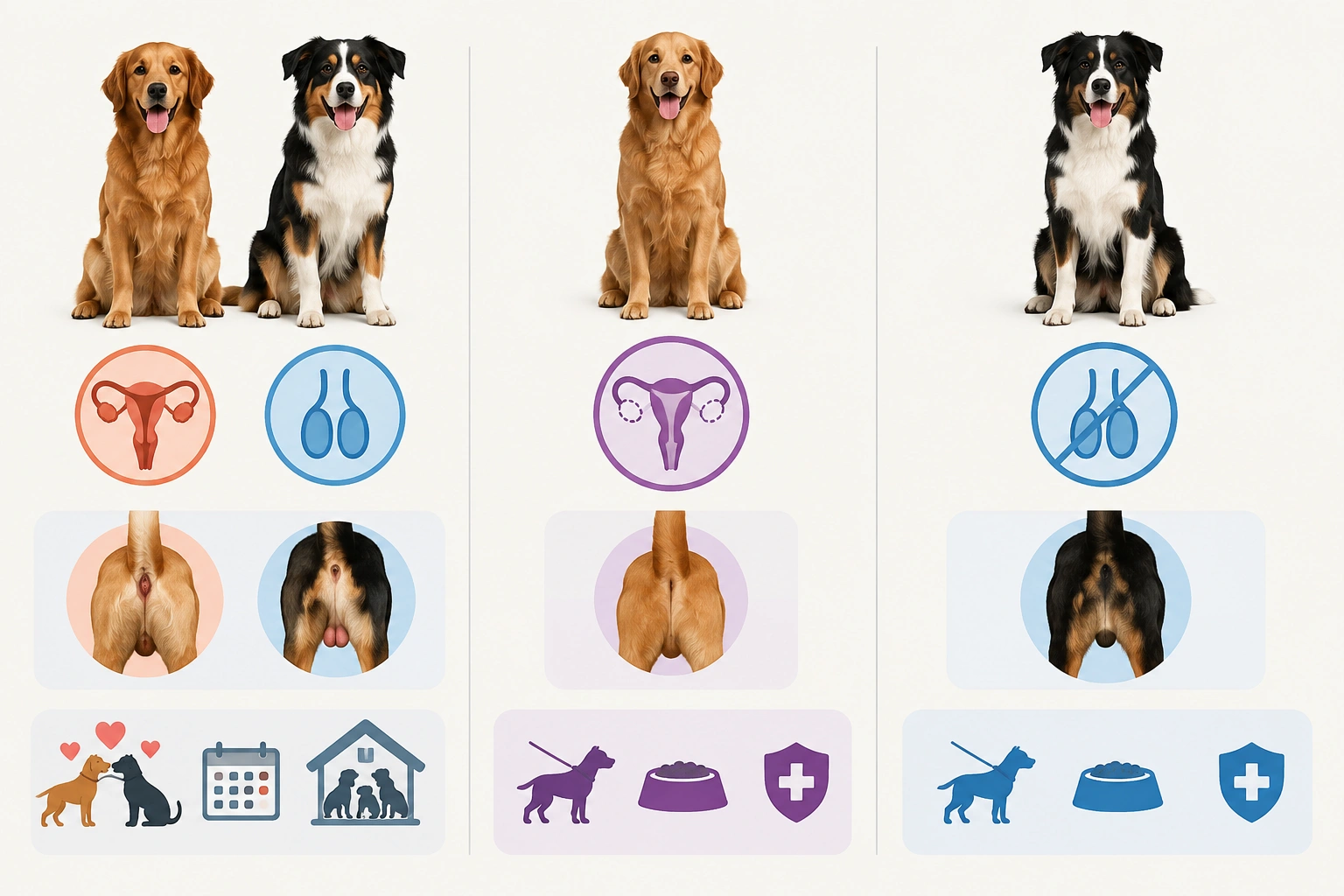
| Status | What it means | What happens medically | Can the dog reproduce? | Common practical effect |
|---|---|---|---|---|
| Unaltered / intact / entire | Reproductive organs are still present | No sterilization surgery | Yes | Must manage heat cycles, mating risk, and hormone-driven behavior |
| Spayed female | Female reproductive organs are removed or disabled | Ovaries are removed; the uterus is usually removed too | No | No heat cycles, no pregnancy risk |
| Neutered male | Male reproductive organs are removed | Testicles are removed | No | No sperm production, no breeding ability |
The big practical difference is not just anatomy. It is management. An altered dog cannot get pregnant or impregnate another dog. An unaltered dog can, which changes how you handle doors, fences, dog parks, boarding, and off-leash time.
Spaying or neutering also changes day-to-day ownership in a simple way: you no longer need to plan around heat cycles or mating risk. With an unaltered dog, that planning becomes part of routine care.
What changes, and what does not, in an unaltered dog
A common mistake is assuming hormones completely determine behavior. They do not.
An unaltered dog may show more interest in other dogs, especially when a female is in heat, but that does not automatically mean the dog is aggressive, difficult, or impossible to train. Temperament, early learning, environment, and daily management still matter.
What hormones can influence:
- roaming or escape attempts
- marking
- mounting
- vocalizing around other dogs
- distraction near a female in heat
- persistence when seeking a mate
What hormones do not decide by themselves:
- whether the dog is obedient
- whether the dog has a stable temperament
- whether the dog is safe around people
- whether the dog will become aggressive
For a Border Collie, this distinction is especially important. A highly driven dog may already be intense, watchful, and easily stimulated. If you add reproductive hormones to the mix, the dog may become harder to manage in some situations, but the core training picture is still shaped by structure, reinforcement, and routine.
Male vs female unaltered dogs: important differences
Male and female intact dogs create different management problems, so it helps to separate them.
Unaltered male dogs
An intact male can still be perfectly trainable, but he may become more motivated by scent and proximity to females in heat. In practical terms, that can look like:
- pulling harder on leash near other dogs
- trying to get through fences or doors
- marking in new places
- losing focus outdoors when there is a strong scent trail
If your male Border Collie is already alert and fast to respond to movement, an intact status can make outdoor management more demanding. You are not fighting the dog’s personality; you are working against a stronger biological distraction.
Unaltered female dogs
A female dog goes through estrus, or heat, which is the fertile part of her cycle. During this time, she can attract males from a distance and may behave differently herself.
Common signs include:
- swollen vulva
- bloody or straw-colored discharge
- increased interest from male dogs
- restlessness or clinginess
- attempts to escape or seek contact
The biggest risk here is accidental pregnancy. A female in heat needs tighter supervision than many owners expect. A secure yard is not enough if there is any chance of contact with an intact male through a gap, a gate, or a rushed door opening.
Behavioral and training implications of leaving a dog intact
An unaltered dog can absolutely be trained. The question is not whether training works, but whether the dog’s environment is set up to make training succeed.
Hormones can raise the “background noise” in the dog’s brain. That means cues may need more repetition in distracting settings. A dog that responds well in the house may struggle more in the park if a female in heat is nearby. That is not disobedience in the simple sense; it is competing motivation.
Practical training implications include:
- using stronger leash habits before the dog leaves the house
- reinforcing recall in low-distraction settings before testing it outdoors
- avoiding off-leash freedom in unfenced or high-traffic areas
- expecting more management during adolescence, when impulse control is already a work in progress
A useful rule: if your dog only behaves when the environment is easy, the dog is not fully trained for an intact-dog lifestyle. You need proof in the real world, not just in the living room.
Health considerations, risks, and possible benefits
Health discussions around spaying and neutering are not one-size-fits-all, and the timing can matter.
Keeping a dog unaltered avoids surgery and preserves normal reproductive function. That may be part of the reason some breeders and conformation competitors keep dogs intact. But intact status also leaves the dog exposed to reproductive risks, including accidental pregnancy and conditions such as uterine infection in females, testicular disease in males, and other reproductive-tract problems.
Here are a few concrete examples of the trade-off in plain English:
- A female dog in heat can be bred unexpectedly if she slips out a door or meets an intact male.
- An intact male may be more likely to wander or try to escape when he smells a female in heat nearby.
- An unspayed female can develop serious uterine disease later in life, and an unneutered male can develop testicular problems.
- On the benefit side, staying unaltered avoids surgery and preserves reproductive function, which may matter for breeding plans or specific veterinary reasons.
Here is the practical trade-off:
- Stay unaltered now: avoids surgery, but requires ongoing management and does not remove reproductive risks.
- Spay or neuter: removes breeding ability and simplifies some management, but is still a medical decision that should be discussed with a veterinarian.
The right choice can vary by breed, age, size, and health. For Border Collies, the discussion may differ depending on sex, age, and the dog’s overall development. A veterinarian may also consider the dog’s activity level and any orthopedic or medical concerns before recommending timing.
If you want a broad evidence-based overview of the trade-offs, the veterinary discussion in VCA Hospitals’ guide to intact dogs is a useful place to start, but your own vet should make the final call for your dog.
How to manage an unaltered dog safely in everyday life
If you keep a dog intact, management has to be deliberate. That does not mean complicated. It means removing the easy opportunities for mistakes.
Use containment that assumes the dog may try to escape
Check fences, gates, latches, and doors as if your dog is more determined than usual. A dog that has never jumped a fence before may still try it when hormones and scent are involved.
Control the first and last five minutes of the day
Many accidents happen when a dog is excited, rushed, or half-supervised. Use leash control at the door, in the yard, and when visitors arrive. Those transition moments are where intact dogs often slip out.
Keep a close eye on dog-to-dog interactions
Do not assume every dog park, daycare, or boarding facility accepts unaltered dogs. Policies vary, and some places exclude unneutered dogs or females in heat. Call ahead instead of discovering the rule at drop-off.
Treat unknown male-female combinations as a risk
If you own a female in heat, do not rely on “they seemed fine together yesterday.” That is how accidental breeding happens. Separate dogs physically, not just verbally.
What to do if a female dog is in heat
This is the highest-risk scenario for an unaltered dog household.
A female in heat should be managed as if pregnancy is possible every time she is around an intact male. That means:
- no off-leash access in shared spaces
- no unsupervised yard time
- no casual greetings with unknown dogs
- extra caution at doors, fences, and car parks
A dog in heat may attract males even when the female is indoors or behind a fence. If you live in a neighborhood with many intact dogs, your margin for error is small.
If you are unsure whether the discharge or behavior you are seeing is normal, call your veterinarian. Heat is normal; unusual pain, heavy bleeding, or illness is not something to guess about.
When spaying or neutering may be recommended
A veterinarian may recommend spaying or neutering when the benefits outweigh the downsides for that individual dog. Common factors include:
- the dog’s age and maturity
- breed and size
- reproductive health
- household ability to prevent mating
- lifestyle, such as daycare, sports, or travel
- whether the dog will live around other intact dogs
There is no universal age that fits every dog. A young, active Border Collie may need a different discussion than a small mixed-breed companion or a dog intended for breeding. The decision should be practical, not ideological.
A good decision rule is this: if you cannot reliably prevent contact with the opposite sex during fertile periods, leaving the dog unaltered creates avoidable risk.
When to See a Veterinarian or Certified Trainer
See a veterinarian if:
- you are unsure whether your dog is in heat
- your dog has discharge, swelling, or unusual behavior
- you want breed- and age-specific advice on spay/neuter timing
- your intact dog has sudden behavior changes
- you are trying to manage a male-female pair in the same home
See a certified trainer if:
- your intact dog is becoming harder to recall outdoors
- roaming, mounting, or marking is getting worse
- your dog loses focus around other dogs
- you need help building a prevention plan for door bolting, fence-line reactivity, or managing a female in heat
A trainer can help with structure and impulse control. A veterinarian can help with the medical decision. Those are related, but not the same.
Quick decision framework for owners
If you are still deciding, use this short checklist:
-
Is accidental breeding a real risk in your home or neighborhood?
If yes, management burden is high. -
Can you supervise consistently during heat cycles?
If not, intact status is harder to maintain safely. -
Does your vet want to delay alteration for a breed- or health-related reason?
If yes, follow that guidance and build a management plan. -
Will your dog be around daycare, parks, or boarding facilities with restrictions?
If yes, check those rules before making the decision. -
Can you train around distraction, not just in easy settings?
If not, work on that before expecting an intact dog to behave reliably in high-stimulation environments.
FAQ
Is an unaltered dog the same as intact?
Yes, in normal dog-care use, those terms mean the dog has not been spayed or neutered.
Does unaltered mean the dog is sexually mature?
Not always. A young dog can be unaltered before sexual maturity. Some local codes define the term by age, such as six months or older, but the core meaning is still “not sterilized.”
Can an unaltered dog live safely with my family?
Yes, if you manage the dog well. The main risks are accidental breeding, roaming, and behavior changes around other dogs, not living with people.
Do unaltered dogs always act more aggressive?
No. Hormones can affect behavior, but aggression is not guaranteed and should not be assumed to come from intact status alone.
Should I spay or neuter my Border Collie?
That is a veterinary decision, not a one-size-fits-all rule. Breed, age, health, and your ability to manage an intact dog all matter.
Why do some places charge more for unaltered dogs?
Some licensing programs charge higher fees for unaltered dogs, and some require extra steps. Check your local licensing rules for the current requirements.
Final take
If you remember only one thing, make it this: an unaltered dog is simply a dog that has not been spayed or neutered. The label is about reproductive status, but the practical impact is about management. If you are deciding whether to keep your Border Collie intact, the next step is a vet conversation focused on age, breed, health, and your ability to prevent breeding.
