
Why Does My Dog Have a Lump? A Practical Guide to What It Could Mean

Finding a lump on your dog is one of those moments that can make your stomach drop. The good news is that many lumps are not emergencies. The less comfortable truth is that you cannot tell what a lump is just by looking at it.
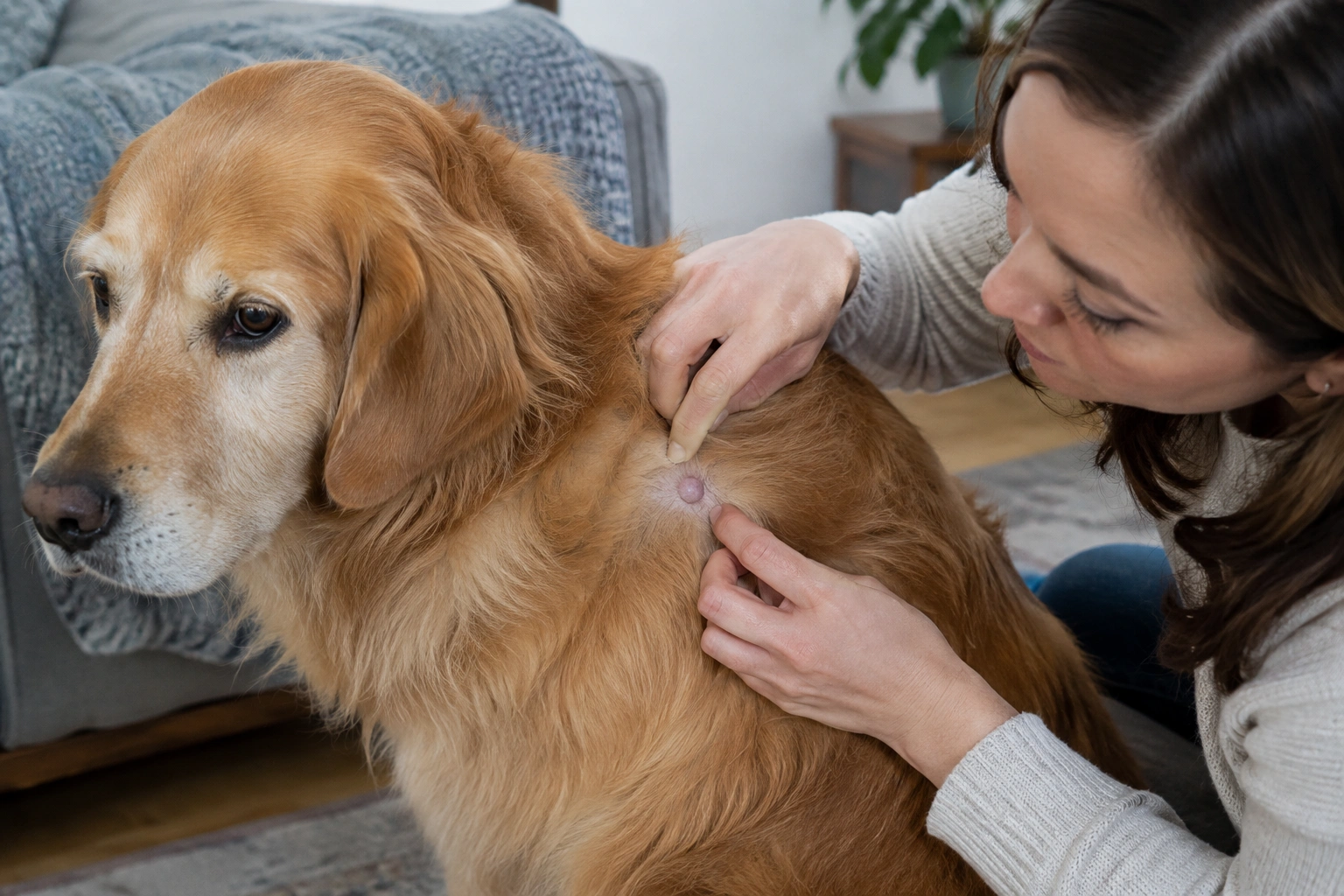
Some lumps are harmless fatty growths. Some are cysts or warts. Some are infections, abscesses, or reactions to irritation. And some are tumors that need prompt testing. The job is not to guess—it is to sort the lump into the right urgency level so you know what to do next.
If you want a second opinion on what “normal” skin changes can look like, this guide on black spots on a dog’s skin is useful for comparison, especially when you are trying to tell pigment changes from something more suspicious.
What a lump on your dog could be
A lump is a description, not a diagnosis. That matters because the same word can cover everything from a harmless fatty mass to a cancerous tumor.
Common possibilities include:
- Lipoma: a soft fatty lump, often found under the skin
- Sebaceous cyst: a fluid-filled lump linked to blocked or overactive oil glands
- Wart: often small and cauliflower-like in texture
- Abscess: a swollen, painful pocket of infection
- Benign tumor: a growth that is not cancerous but may still need removal
- Malignant tumor: a cancerous growth that needs veterinary evaluation
There are also lumps caused by allergic reactions, hives, skin infection, bug bites, foreign material in the skin, or trauma. In other words, a lump does not automatically mean cancer—but it also does not automatically mean harmless.
Many new lumps cannot be diagnosed by appearance alone, and a lump that persists beyond a short period should be examined by a veterinarian even if it does not seem painful. A useful mental shortcut is this: the more a lump changes, hurts, or affects your dog’s normal function, the more seriously you should treat it.
What appearance can and cannot tell you
Owners often want to know whether a lump “looks cancerous.” The problem is that appearance alone is unreliable. Some cancerous lumps look small and ordinary at first. Some non-cancerous lumps look angry or dramatic because they are inflamed or infected.
So instead of asking only, “What does it look like?” ask:
- How fast did it appear?
- Is it growing?
- Is it soft or firm?
- Does it move under the skin?
- Is it painful, red, hot, or draining?
- Is my dog acting normally?
Those details are far more useful than shape alone.
When a dog lump is an urgent vet visit
Some lumps can wait a few days for an appointment. Others should be checked much sooner.
Book a prompt veterinary visit if the lump is:
- Rapidly growing
- Painful or tender
- Red, hot, or swollen
- Bleeding or ulcerated
- Draining fluid or pus
- Firm and fixed in place
- Interfering with walking, eating, or toileting
- Accompanied by lethargy or appetite loss
If your dog suddenly develops small red itchy bumps, with or without facial swelling, an allergic reaction is one possible concern and can be life-threatening, so that is not a “wait and see” situation.
A lump near the eyes, mouth, anus, or joints deserves faster attention because even a non-dangerous growth can become a practical problem in those spots. A small mass in the armpit or groin can also be harder to ignore if it affects movement.
A simple urgency rule
Use this decision rule at home:
- Monitor if the lump is small, soft, movable, not painful, and unchanged
- Book an appointment soon if it is new, growing, or uncertain
- Go sooner if it is painful, red, hot, draining, bleeding, or affecting your dog’s behavior or function
That framework is more useful than trying to decide whether the lump is “big enough” to matter. Growth rate and symptoms matter more than size alone.
How to judge a lump at home without guessing
Before you panic or dismiss it, collect a few facts. That gives your veterinarian something concrete to work with and helps you spot change over time.
Check five things:
1) Size
Use a ruler or tape measure and record the widest point. A photo with a coin or ruler beside the lump can help later.
2) Location
Note whether it is on the skin, under the skin, near a joint, on the belly, around the mouth, or near the rear end. Location changes the urgency.
3) Texture
Is it soft like a grape, rubbery, firm, or hard? Soft and movable is often less concerning than firm and fixed, but not always.
4) Mobility
Gently try to move it under the skin. A lump that slides around is often less worrisome than one that feels attached to deeper tissue.
5) Comfort and change
Does your dog flinch when you touch it? Has it changed in the last few days or weeks?
A useful home note might look like this:
- April 4: 1 cm, soft, movable, not painful
- April 11: 1.5 cm, still soft, dog licks at it
- April 18: 2 cm, slightly red, vet appointment booked
That kind of record is far better than “it seems bigger.”
Common benign causes of dog lumps
Many dog lumps turn out to be non-cancerous, but “benign” does not always mean “ignore it forever.”
Lipomas
Lipomas are soft, fatty lumps often found in older dogs. They are usually harmless, but they should still be monitored because a lump that seems like a lipoma can sometimes be something else.
Typical feel: soft, squishy, and movable
Typical behavior: slow change or no change
Common next step: vet exam and monitoring, especially if the lump is new
Sebaceous cysts
Sebaceous cysts are common in dogs and form when an oil gland becomes blocked or overactive, creating a lump under the skin. They may appear suddenly and can stay quiet for a while.
Watch for heat, redness, or discharge. Those signs suggest the cyst may be infected or irritated and needs veterinary care.
Warts
Warts are often small bumps with a cauliflower-like texture. They can be harmless, but if they bleed, multiply, or appear in a sensitive area, they still deserve a vet check.
Calluses
Dogs can develop lumpy buildup of skin over elbows or other pressure points. These are often normal, especially in dogs that lie on hard surfaces. The trade-off is simple: if it is clearly on a pressure point and behaves like a callus, it may be less urgent; if it is changing, sore, or ulcerated, it should be examined.
Perianal adenomas
These are benign growths more common in older, unneutered male dogs. Even when a growth is benign, the location matters because it can interfere with toileting or become irritated.
For broader context on skin and coat changes, the ASPCA has helpful general pet-care resources, though a lump still needs a veterinarian’s hands-on exam for diagnosis.
Concerning causes: abscesses and tumors
This is the part many owners worry about, and rightly so. Some lumps are infections; some are tumors; some are both inflamed and hard to interpret without testing.
Abscesses
An abscess is a swollen, painful lump caused by infection or injury. It may feel warm and may eventually drain. If your dog has recently been scratched, bitten, or injured, an abscess becomes more likely.
The practical issue with abscesses is that they can worsen quickly and become painful. They also often need proper drainage and treatment rather than home handling.
Tumors
Tumors can be benign or malignant, and you cannot reliably sort them out by appearance alone. Some malignant tumors can look deceptively ordinary in the early stages.
One example is a mast cell tumor, which can vary a lot in how it looks and feels. That variability is exactly why veterinary testing matters.
A firm, fixed, enlarging lump should be taken seriously even if your dog seems fine otherwise. Dogs are good at hiding discomfort, and a normal appetite or mood does not rule out a problem.
Benign vs malignant: what actually matters
People often ask, “Is it soft or hard?” That helps, but it is not enough.
Here is a more useful comparison:
| Feature | More reassuring pattern | More concerning pattern | What to do |
|---|---|---|---|
| Feel | Soft, movable | Firm, fixed, irregular | Vet exam sooner |
| Growth | Stable for weeks or months | Rapidly enlarging | Prompt appointment |
| Skin surface | Normal skin | Red, hot, ulcerated, bleeding | Faster evaluation |
| Comfort | Not painful | Painful or itchy | Vet check |
| Behavior | Dog acts normal | Lethargy, appetite loss | Do not delay |
The big trade-off is this: a stable, soft lump may be reasonable to monitor, but a changing lump should not be “watched” for too long just because it does not look dramatic.
What the vet will do to check the lump
A veterinary visit usually begins with a physical exam. The vet will feel the lump, check nearby lymph nodes, and ask how long it has been there and whether it has changed.
From there, the next step may be one or more of the following:
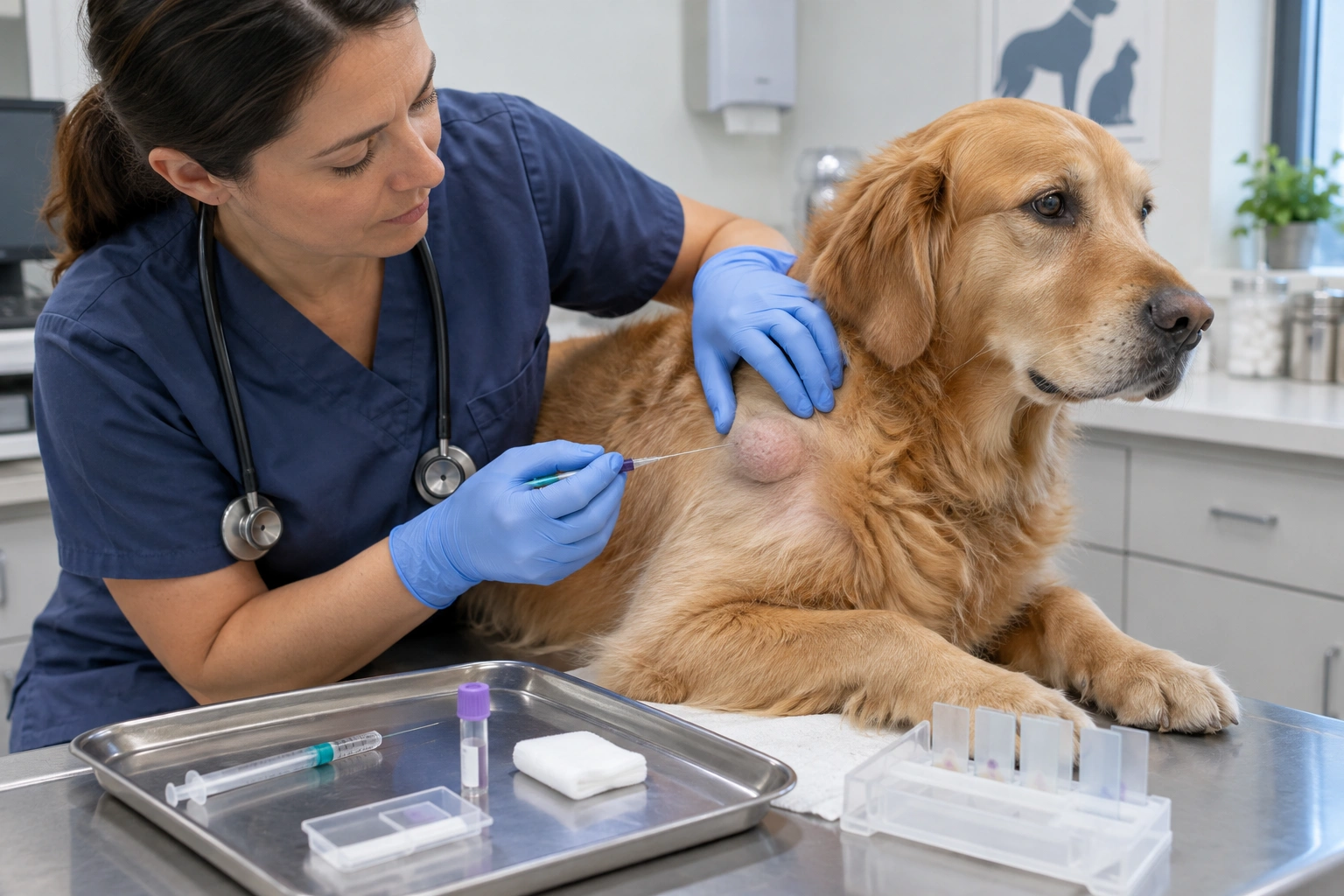
Fine needle aspirate
This is often a quick first test. A small needle is used to collect cells from the lump. It may give a useful answer right away, especially for fatty masses or obvious inflammation.
Why it is helpful:
– Usually fast
– Often minimally invasive
– Can guide next steps without surgery
Its limit:
– It does not always give a full answer, especially if the sample is not representative of the whole lump
Depending on what the sample shows, the vet may recommend monitoring, biopsy, or removal.
Biopsy
A biopsy takes a tissue sample for a more definitive diagnosis.
Why it is helpful:
– Gives more detailed information than a needle sample
– Better when the lump is suspicious or the aspirate is inconclusive
Its trade-off:
– More invasive than a needle sample
– Usually requires more planning
Imaging
Sometimes the vet may recommend imaging if the lump seems deep, large, or connected to surrounding structures.
The point of all these tests is the same: not to guess, but to identify what the lump actually is so treatment can match the problem.
If your dog also has dental issues, you may find our guide on how many teeth a dog has useful when deciding whether a lump near the mouth could be affecting eating or oral comfort.
Fine needle aspirate vs biopsy: which test gives what answer
Think of a fine needle aspirate as a quick first look and a biopsy as the more detailed follow-up.
Fine needle aspirate
Best when the vet wants a fast, low-stress sample and the lump seems straightforward. It can be enough to identify some benign lumps or obvious infections.
Biopsy
Best when the first test is unclear, the lump behaves suspiciously, or a more exact tissue diagnosis is needed before deciding on treatment.
The trade-off is speed versus certainty. Needle samples are quicker and less invasive, but biopsies usually provide a more complete answer.
What not to do at home
Do not squeeze, puncture, cut, or pop an unknown lump.
That can:
– Spread infection
– Cause bleeding
– Make the lump harder to diagnose
– Delay proper treatment
– Increase pain for your dog
Also avoid using human creams, antibiotics, or home remedies unless your vet specifically told you to. A product that seems harmless can irritate the skin or make the lesion harder to assess.
If the lump is open or draining, resist the urge to keep picking at it. Clean hands, a calm dog, and a veterinary plan are safer than improvising.
How to monitor a lump safely if the vet says to watch it
If your vet recommends monitoring, make it structured.
Use this system:
- Take a clear photo every 1 to 2 weeks
- Measure the lump at the widest point
- Write down symptoms such as licking, redness, heat, discharge, or pain
- Note behavior changes like lethargy, appetite loss, or trouble moving
- Compare the same angle and lighting each time if possible
The goal is to detect change early enough to act, not to stare at the lump every day and wonder if it “feels different.” Human memory is unreliable here. Photos and measurements are not.
When removal or treatment is considered
A vet may recommend treatment or removal if the lump is:
- Suspicious on exam
- Growing
- Painful
- Infected
- In a location that causes friction or limits movement
- Interfering with eating, toileting, or comfort
Sometimes the best choice is removal even if the lump is not definitely cancerous, simply because it is irritating or likely to keep causing trouble. Other times, monitoring is the better trade-off if the lump is stable and low risk.
The key is not whether the lump is “annoying enough” to you. It is whether the lump is changing, risky, or affecting your dog’s quality of life.
What to ask your veterinarian
These questions help you leave the appointment with a clear plan:
- What do you think this lump most likely is?
- Does it need testing now, or can it be monitored?
- Would a fine needle aspirate be enough, or do we need a biopsy?
- What changes should make me come back sooner?
- Is this lump in a location that makes it more urgent?
- If we watch it, how often should I measure it?
Those questions turn a vague worry into a practical plan.
Final thoughts
If you are asking, “Why does my dog have a lump?” the honest answer is that there are many possibilities, and appearance alone cannot sort them out. Some lumps are harmless. Some are infections. Some need testing because early cancer can look ordinary.
The safest approach is straightforward: note the size, feel, and location; watch for red flags; and get veterinary help sooner if the lump is painful, growing, red, hot, bleeding, draining, or changing your dog’s behavior.
FAQ
Can I wait a few weeks if the lump doesn’t seem to bother my dog?
Only if it is small, soft, movable, and unchanged. If it is new or growing, book an exam sooner rather than later.
Is a soft lump always harmless?
No. Soft lumps are often less concerning, but softness does not guarantee safety.
Should I try to pop a cyst myself?
No. That can cause infection, pain, and diagnostic problems.
What if the lump comes and goes?
That can happen with some inflammatory or allergic problems, but a recurring lump still deserves a veterinary opinion.
Do all dog lumps need surgery?
No. Some are monitored, some are treated medically, and some are removed. The best choice depends on what the lump is and how it behaves.
