
What Blood Sugar Level Is Dangerous for a Dog? A Practical Emergency Guide

If your dog is weak, shaky, wobbly, vomiting, or not acting right, blood sugar may be the reason—and timing matters.
Here’s the fastest rule of thumb:
- Under 80 mg/dL is a practical hypoglycemia warning line and can be dangerous, especially if your dog has symptoms.
- Around 80–120 mg/dL is the normal range for healthy dogs.
- Over 250 mg/dL is a context-dependent high reading that can be concerning in a diabetic dog, especially if it is persistent or paired with illness.
- Over 200 mg/dL can mean glucose starts showing up in urine.
- If your dog is collapsing, having a seizure, or unconscious, treat it as an emergency immediately—no matter the number.
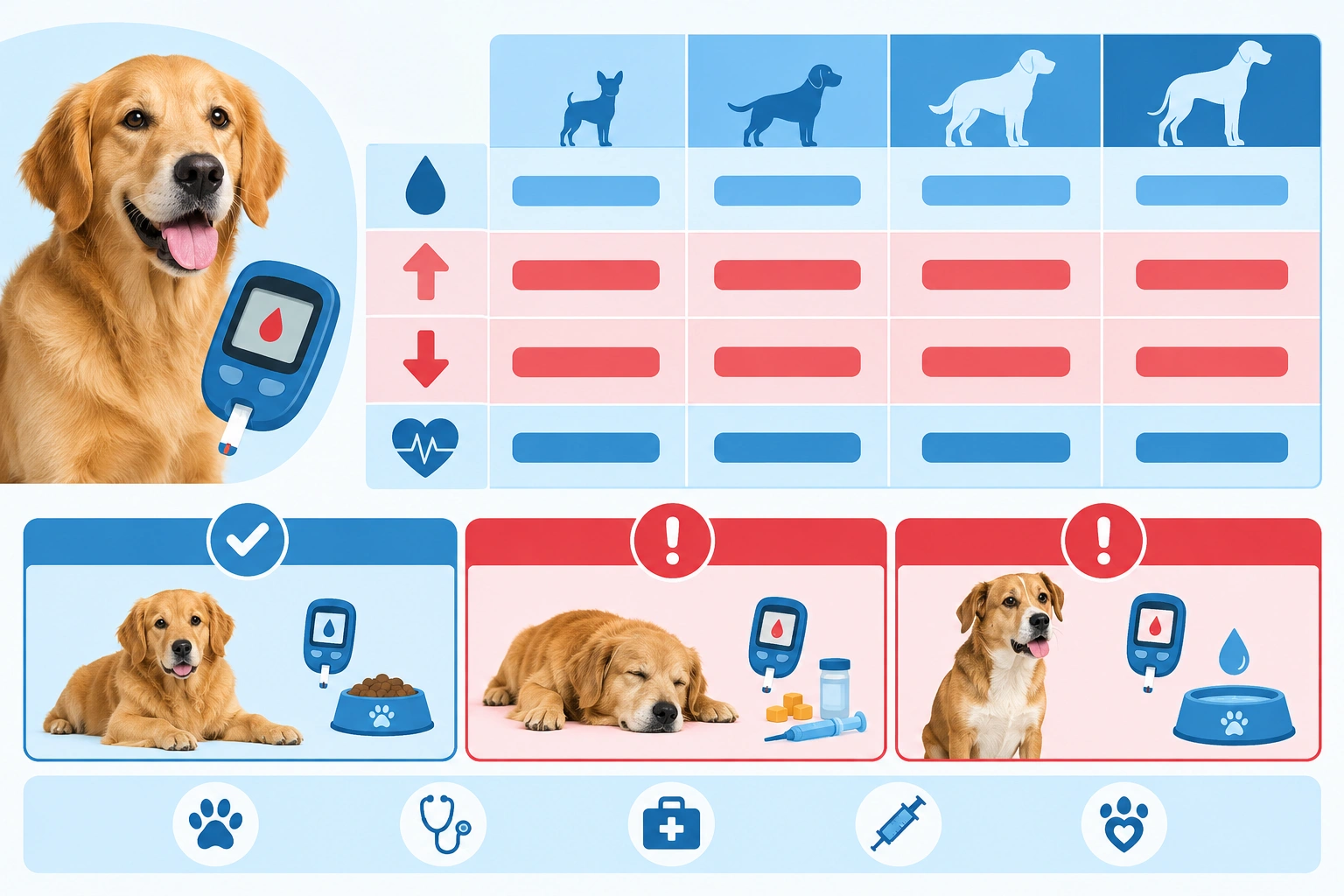
For a healthy dog, a single high reading is not always the same kind of emergency as a low one. For a diabetic dog, the management target can be different from a healthy dog’s normal range, so those numbers should not be conflated. Low blood sugar can turn critical fast. High blood sugar can also become urgent, especially if it comes with vomiting, dehydration, or signs of diabetic ketoacidosis.
If your dog has diabetes and you want the broader picture of urgent high-blood-sugar care, see our guide on how to lower a dog’s blood sugar quickly.
Quick comparison: normal, low, high, and emergency levels
| Blood glucose level | What it usually means in dogs | Common signs | What to do |
|---|---|---|---|
| 80–120 mg/dL | Normal for healthy dogs | No symptoms expected | Routine care |
| Under 80 mg/dL | Hypoglycemia | Shaking, weakness, wobbliness, confusion, collapse | Give quick sugar if the dog is awake, then contact a vet urgently |
| Around 200 mg/dL and up | Glucose may spill into urine | Increased thirst and urination may appear | Call your vet for guidance, especially if diabetic |
| Over 250 mg/dL | High for many dogs; common in poorly controlled diabetes | Excess thirst, urination, hunger, lethargy | Same-day vet advice is wise |
| Very high plus vomiting, dehydration, or lethargy | Possible diabetic emergency | Weakness, vomiting, rapid decline | Emergency vet care |
| Collapse, seizures, unconsciousness | Emergency regardless of number | Severe neurologic signs | Go to the ER now |
The reason this table matters is simple: the number alone does not tell the whole story. A mildly elevated reading in a stable dog is not the same as a collapsing dog with a lower reading. Symptoms decide urgency.
Normal blood glucose in dogs vs. dangerous ranges
Cornell’s veterinary guidance puts the normal blood glucose range in healthy dogs at 80–120 mg/dL. That is the reference point worth remembering, because many owners only hear “high” or “low” without context.
A dog can run above that range for several reasons. Stress, meals, and diabetes can all push glucose upward. Cornell notes that some dogs may have temporary post-meal spikes that can reach 250 mg/dL or higher, and in certain context-dependent situations, values may rise even higher for a short time. That temporary spike is not automatically the same as uncontrolled diabetes.
The key distinction is persistence. A brief post-meal rise is one thing. Repeated high readings, especially fasting highs, are another. MSD Animal Health notes that repeated fasting glucose above 135 mg/dL suggests diabetes mellitus, and glucose can appear in urine once blood glucose exceeds the renal threshold of about 180 mg/dL.
That gives you a practical framework:
- Normal: 80–120 mg/dL
- Concerning if persistent: above 135–180 mg/dL, depending on the context
- Clearly high in many diabetic dogs: above 250 mg/dL
- Potentially severe: much higher readings, especially with symptoms
If you only remember one thing, remember this: a dog can be “high” without being in immediate danger, but a dog that is low and symptomatic can crash quickly.
What low blood sugar looks like in dogs
Low blood sugar, or hypoglycemia, is the emergency most likely to move fast.
PetMD defines hypoglycemia in dogs as under 80 mg/dL, and that is a useful warning line. Some dogs show signs before they fall below that number, especially if the drop is rapid.
Watch for:
- Shaking or trembling
- Weakness
- Wobbliness or poor coordination
- Unusual sleepiness
- Confusion or staring
- Glassy eyes
- Disorientation
- Collapse
- Seizures
- Unresponsiveness
The pattern often starts subtly. A dog may seem “off,” slow to rise, or less steady on stairs. Then the signs can progress quickly to stumbling or collapse.
This is where owners sometimes misread the situation. A sleepy dog after exercise might just be tired. A sleepy dog after insulin, a missed meal, or vomiting is different. In that setting, weakness is a warning sign, not a personality quirk.
Small dogs, puppies, and diabetic dogs are at higher risk because they have less reserve. A Border Collie that has been exercising hard, skipped food, or received insulin and then refused a meal can become symptomatic faster than you expect.
What high blood sugar looks like in dogs
High blood sugar, or hyperglycemia, usually develops more gradually than hypoglycemia. That can make it easier to miss.
Common signs include:
- Drinking more than usual
- Urinating more than usual
- Accidents in the house
- Increased appetite, sometimes with weight loss
- Lethargy
- Poor coat condition over time
- Dehydration if the problem is severe
These signs are especially important in dogs with diabetes mellitus. If a dog is persistently thirsty and urinating more, the issue may be more than “just drinking a lot.” It can be the body trying to flush excess glucose.
Cornell notes that once glucose goes over 200 mg/dL, it can be detectable in urine. That is one reason diabetic dogs often urinate more: the kidneys start spilling glucose, and water follows it.
High blood sugar becomes more urgent when you see:
- Vomiting
- Marked lethargy
- Dehydration
- Weakness
- Not eating
- Rapid worsening over hours
- A sick diabetic dog that may have ketones
Those signs raise concern for diabetic ketoacidosis (DKA), which is a serious emergency. High blood sugar alone may be manageable with veterinary guidance. High blood sugar plus vomiting or dehydration is a different situation.
What to do right now if you suspect low blood sugar
If your dog seems hypoglycemic and is awake enough to swallow safely, give a quick source of sugar right away.
Practical options include:
- A small amount of corn syrup, honey, or glucose gel on the gums
- Then, once the dog is alert enough, offer food
Do not pour liquid into the mouth of a dog that is unconscious, seizing, or unable to swallow normally. That can lead to aspiration.
Here is the safest sequence:
- Check whether your dog is conscious and able to swallow.
- If awake but weak or shaky, rub a fast sugar source on the gums.
- Get to a veterinarian or ER immediately.
- If your dog improves, still get urgent veterinary advice.
The sugar can buy time. It is not the finish line.
If your dog is a diabetic and you suspect the problem happened after insulin, a missed meal, or vomiting, do not “wait and see.” That combination is one of the clearest paths to a dangerous low.
When to call the vet vs. go straight to the ER
Use symptoms first, then numbers.
Call your regular vet the same day if:
- Your dog is alert and stable
- A home glucose reading is mildly high but not extreme
- Your diabetic dog is drinking and urinating more, but otherwise seems okay
- You need help interpreting a glucose curve or home readings
Go to the emergency clinic now if:
- Your dog collapses
- Your dog has a seizure
- Your dog is unconscious or hard to wake
- Your dog is too weak to stand
- Your dog is vomiting repeatedly
- Your dog seems dehydrated and worsening
- Your diabetic dog has very high glucose plus illness signs
- You suspect a severe insulin overdose
The most important decision point is whether your dog can safely eat, drink, and remain alert. If the answer is no, home monitoring stops being the right tool.
If you own a diabetic dog, keep the ER number saved in your phone before you need it. In a true emergency, you will not want to waste time searching.
Why diabetic dogs are at highest risk
Diabetes mellitus changes the risk profile because insulin can push glucose down too far if the dose, meal, or timing is off.
Common triggers for dangerous lows or highs include:
- Too much insulin
- A missed or delayed meal
- Vomiting after insulin
- Illness
- Stress
- Dental disease
- Certain medications
- Poorly matched insulin timing
PetMD specifically notes that giving too much insulin can be a medical emergency requiring immediate veterinary contact. That is not a situation to “adjust and monitor” on your own.
The trade-off with insulin is this: it is essential for control, but it also creates a narrow margin for error. A dog that eats reliably and stays on schedule may do well. A dog that skips breakfast or gets sick can drop into trouble fast.
That is why diabetic routines need consistency. If your dog’s meal pattern changes, or if they vomit after a dose, the safest move is to call the vet rather than guessing.
How blood sugar is measured and monitored
Blood sugar can be checked in different ways:
- Veterinary blood testing
- Home glucose meters
- Continuous glucose monitors (CGMs)
Veterinary testing is the most controlled option, especially when your dog is sick or unstable. Home meters and CGMs are useful for routine monitoring and trend tracking, but they work best when you and your vet already have a plan for what to do with the numbers. These devices can also differ from laboratory or blood gas testing, so follow your vet’s preferred meter and action thresholds.
A glucose curve, where readings are taken over several hours, helps show how insulin is working through the day. Merck notes that the goal is not to force every reading into the normal range, but to create a curve that approaches normal while avoiding dangerous hypoglycemia.
That matters because a “good” diabetic curve is not identical to a healthy dog’s curve. Merck gives an example of a stable diabetic dog spending most of a 24-hour period in the 100–250 mg/dL range, but that is a vet-specific example, not a one-size-fits-all target.
In practice, vets may also confirm concerning readings with repeat testing, check for ketones, and look at the dog’s overall clinical picture, including appetite, hydration, vomiting, and possible concurrent illness.
So if you are looking at home numbers, ask two questions:
- Is the dog clinically well?
- Is the pattern improving or worsening?
A single reading matters, but the trend matters more. If a home meter or CGM reading seems off, your vet may want to confirm it in clinic before making major treatment changes.
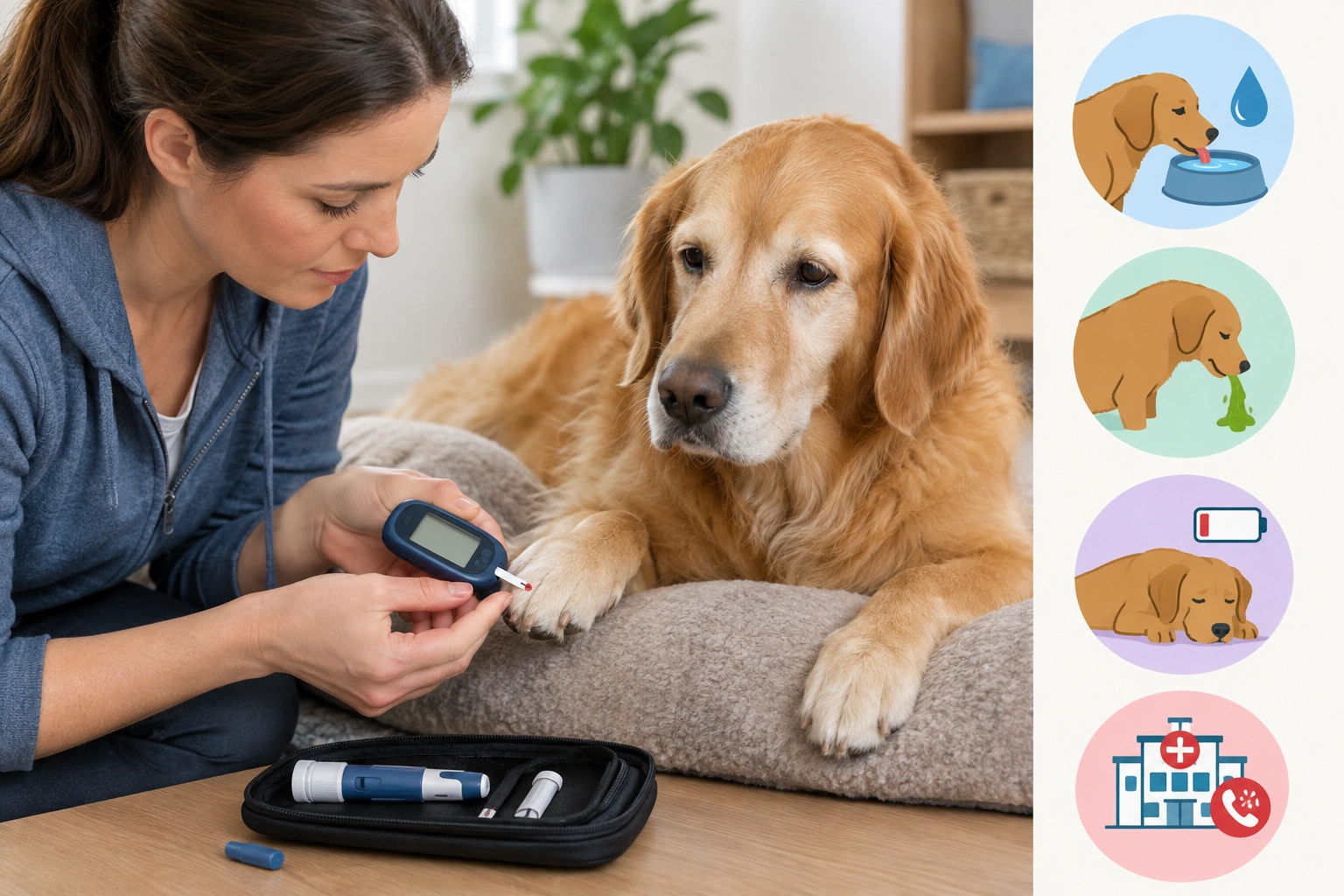
Emergency red flags that mean immediate veterinary care
Treat these as immediate action signs:
- Collapse
- Seizures
- Unresponsiveness
- Severe weakness
- Inability to stand
- Repeated vomiting
- Marked dehydration
- Rapid decline in a diabetic dog
- Suspected insulin overdose
These signs override the meter reading. A dog with a “not too bad” number but severe neurologic signs still needs emergency care.
This is also where waiting becomes costly. Hypoglycemia can damage the brain if it is not corrected quickly. Severe hyperglycemia can progress to dehydration and ketoacidosis. In both cases, the dog can worsen while the owner is still deciding what to do.
What not to do when blood sugar seems dangerous
A few mistakes make emergencies worse:
- Do not give insulin after a missed meal without veterinary guidance.
- Do not force food or liquid into an unconscious dog.
- Do not assume weakness will pass on its own.
- Do not delay emergency care because the dog perked up briefly after sugar.
- Do not change insulin doses on your own.
- Do not use human diabetes rules as if they apply directly to dogs.
That last point matters more than people realize. Dogs are not small humans with the same thresholds and response patterns. The safest response is to use dog-specific veterinary guidance and your own vet’s plan.
When to See a Veterinarian or Certified Trainer
For this topic, the veterinarian is the professional you need. A certified trainer is not the right resource for blood sugar emergencies.
See a veterinarian promptly if your dog:
- Has repeated thirst and urination
- Has unexplained weight loss
- Has frequent vomiting
- Has a known diabetes diagnosis and changing readings
- May have missed insulin or food
- Needs help setting up home glucose monitoring
If your dog is unstable, unresponsive, or seizing, go straight to emergency care rather than waiting for a regular appointment.
FAQs about dangerous blood sugar levels in dogs
What blood sugar level is too low for a dog?
PetMD identifies under 80 mg/dL as hypoglycemia. If your dog has symptoms, that is low enough to take seriously.
What blood sugar level is too high for a dog?
There is no single universal cutoff, but over 250 mg/dL is clearly high in many diabetic dogs, and over 200 mg/dL may cause glucose to appear in urine. Context and symptoms matter.
Can a dog die from low blood sugar?
Yes. Severe hypoglycemia can become life-threatening, especially if the dog collapses, seizes, or becomes unconscious.
Can a dog die from high blood sugar?
Yes, especially if high blood sugar progresses to dehydration or diabetic ketoacidosis. Vomiting, lethargy, and weakness make it more urgent.
My dog missed a meal after insulin. What should I do?
If your dog is diabetic and has had insulin without eating, contact your veterinarian or emergency clinic right away. If your dog is weak, shaky, or disoriented, treat it as urgent.
How fast can blood sugar emergencies worsen?
Low blood sugar can worsen quickly, sometimes within minutes to hours. High blood sugar usually develops more gradually, but it can still become dangerous fast if the dog is sick or dehydrated.
Should I monitor blood sugar at home?
Home monitoring can be very helpful for diabetic dogs, but it should be part of a vet-guided plan. It does not replace emergency care when your dog is collapsing, seizing, or unable to swallow.
What if my dog seems normal but the reading is high?
A single high reading is not always an emergency. If the dog is otherwise stable, call your vet for advice and keep tracking the trend. If vomiting, dehydration, or lethargy appear, escalate quickly.
Can stress raise a dog’s blood sugar?
Yes. Stress can push glucose up, which is one reason a single reading should be interpreted with the dog’s overall condition in mind.
What is the safest first step if I think my dog’s blood sugar is low?
If your dog is awake and able to swallow, give a quick sugar source on the gums and head to a veterinarian right away.
If you are dealing with this right now, trust the symptoms first. Numbers help, but a collapsing dog does not need a debate—your dog needs urgent care.
