
What to Do During a Dog Seizure: A Calm, Practical Guide for Owners

If your dog suddenly collapses, stiffens, paddles, drools, or seems “not there,” the first job is not to diagnose it in the moment. The first job is to keep the dog safe, avoid making the episode worse, and capture enough information for your veterinarian to work with later.
That matters because a seizure can look dramatic but still pass in under a few minutes, while a different episode can become a true emergency fast. The difference is usually not how frightening it looks — it’s how long it lasts, whether it repeats, and how the dog recovers afterward.
What to do in the first 5 minutes of a dog seizure
The moment the seizure starts, think in this order: protect, time, observe.
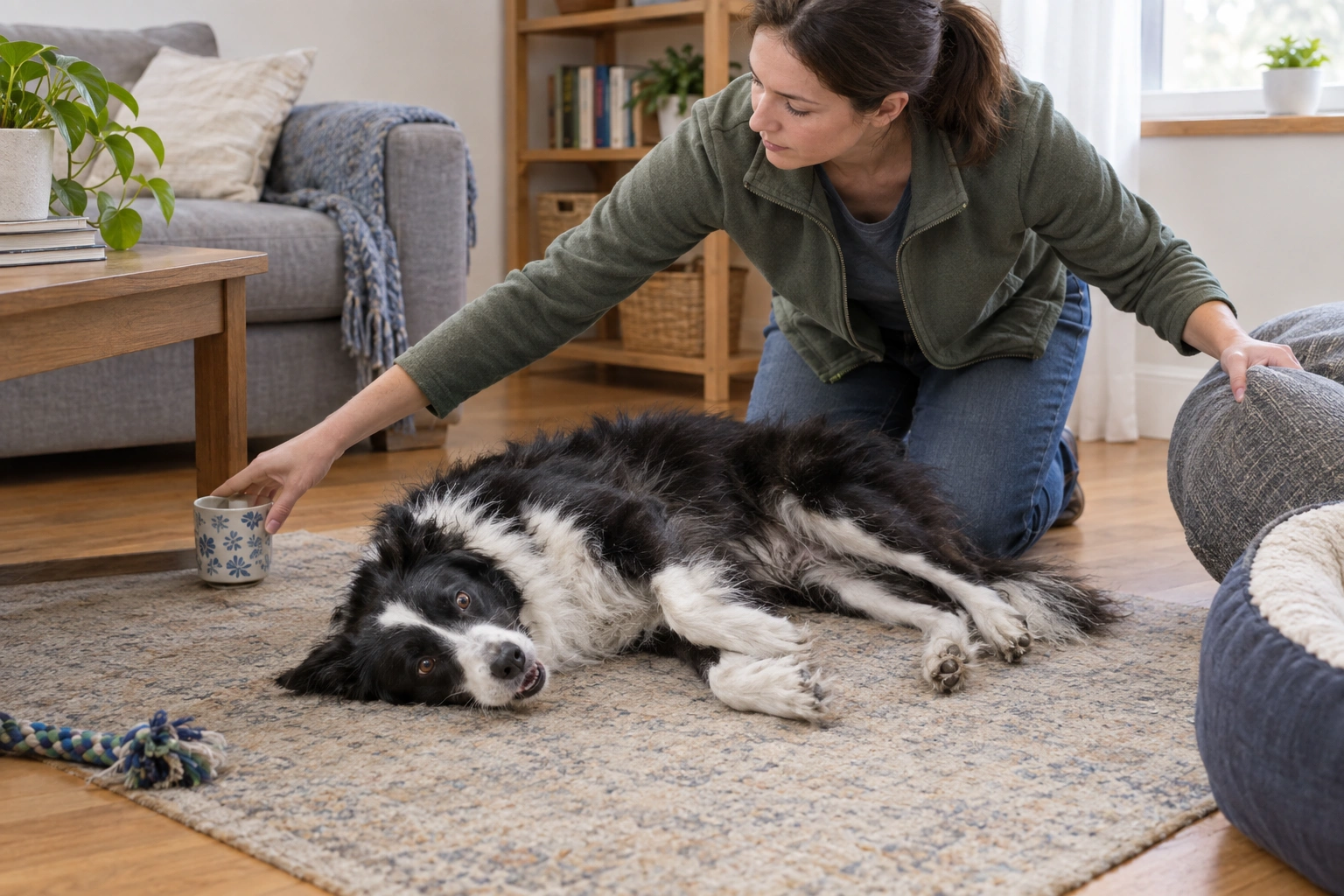
1) Move hazards away, not the dog
Clear the space around your dog if you can do it safely. Slide away chairs, coffee tables, sharp objects, lamps, and anything the dog could strike. If the dog is near stairs or a pool, block access immediately.
Do not try to drag or hold the dog unless there is an immediate danger like fire, water, or a stair edge you cannot block. Sudden handling can put both of you at risk.
2) Time the seizure
Use your phone timer, watch, or a clock. Start timing as soon as you notice the seizure and stop when the convulsions end. That number is one of the most useful details you can give a veterinarian later.
Many veterinary sources note that seizures often last about one to three minutes, and a seizure that continues longer than five minutes needs urgent care. That threshold matters because prolonged seizure activity can become life-threatening.
3) Keep your hands away from the mouth
Do not put your fingers, a spoon, a towel, or any object into the dog’s mouth. A seizing dog cannot control its jaw movements, and you can be bitten accidentally. The dog is not “swallowing its tongue,” so there is nothing to pull out.
4) Speak calmly and stay near enough to monitor
Use a soft voice. Your dog may not process what you are saying, but your calm presence helps you stay focused and helps you avoid panicking into a bad decision. Stay close enough to watch the body movements, but not so close that you get in the way.
5) Watch what the seizure looks like
Take mental notes while the episode is happening:
– Did the dog stiffen, paddle, or twitch?
– Was there drooling, urination, or defecation?
– Did the eyes roll, stare, or stay fixed?
– Did the dog lose consciousness or seem unaware?
Those details help your vet decide whether this was likely a seizure and what type of workup is needed.
What not to do during a seizure
The biggest mistakes are usually made out of panic.
Don’t restrain the dog
Holding the dog down does not stop the seizure. It can increase stress, make injuries more likely, and put your hands close to the mouth or limbs at the wrong moment. Your role is protection, not control.
Don’t put anything in the mouth
This is one of the most persistent myths in pet first aid. A dog cannot “choke on the tongue” during a seizure, and an object in the mouth can break teeth, injure the jaw, or bite your fingers.
Don’t shout, shake, or flood the dog with stimulation
Bright lights, loud voices, and frantic movement add chaos. Keep the room quiet and simple.
Don’t assume the seizure is “over” the second the paddling stops
The convulsions may end before the dog is fully recovered. Confusion, wobbliness, and temporary blindness can follow. That recovery period is part of the event, not a separate concern to ignore.
For a broader owner-facing overview of seizure aftercare and follow-up, see our guide on what to do after a dog has a seizure.
How to tell whether it is a seizure, fainting, or collapse
Not every collapse is a seizure, and that distinction matters because the next steps can differ.
| Episode type | Common clues | What to do |
|---|---|---|
| Seizure | Stiffening, paddling, twitching, drooling, loss of awareness, possible urination/defecation | Protect from injury, time it, do not restrain |
| Fainting/collapse | Sudden drop, then usually quick return of awareness, often linked to exertion or excitement | Keep safe and seek veterinary evaluation promptly |
| Cluster seizures | Two or more seizures in 24 hours | Emergency veterinary contact |
| Prolonged seizure | Lasts longer than five minutes | Emergency veterinary care now |
A key practical clue: a seizure often includes rhythmic or repeated muscle activity and a period afterward where the dog is confused. Fainting usually looks more like a sudden shut-off, with faster recovery once the dog is upright again. If you are unsure whether it was a seizure or a fainting/collapse episode, treat it as a seizure first and call your veterinarian or an emergency vet if the dog is unresponsive, has trouble breathing, or does not return close to normal within a short recovery window.
When a dog seizure is an emergency
Some seizures can be monitored briefly at home after they end. Others need immediate veterinary care.
Seek urgent help right away if any of the following apply:
- The seizure lasts longer than five minutes
- The dog has more than one seizure in a short period
- The dog does not recover normally afterward
- Breathing looks abnormal or the dog seems unable to breathe well
- The dog is overheating, especially after prolonged convulsions
- The dog was injured during the episode
- This is the dog’s first seizure
- The cause is unknown and the dog also seems sick, weak, or unwell
If you are unsure whether what you saw was a seizure, fainting, or collapse, err on the side of caution and contact an emergency vet if the dog is unresponsive, struggling to breathe, or not getting close to normal within a short recovery period.
Current veterinary guidance cited by MedVet, referencing ACVIM recommendations, says long-term antiseizure medication should be considered when a pet has more than two seizures in six months, cluster seizures, status epilepticus, a single severe or prolonged seizure longer than five minutes, significant post-ictal dysfunction, or underlying structural brain disease. That does not mean every dog with one seizure needs lifelong medication. It does mean repeated or severe events deserve prompt veterinary planning.
If you want a simple rule for the moment:
One brief seizure that ends and the dog fully returns to normal still needs a vet appointment soon. A seizure that lasts too long, repeats, or leaves the dog abnormal needs emergency care now.
What to do right after the seizure stops
The seizure ending is not the finish line. Many dogs enter a post-seizure recovery phase and may be disoriented, tired, restless, or temporarily unable to see clearly. Cornell also notes that some dogs can seem confused or even aggressive in the minutes to hours after a seizure, so give the dog space and avoid sudden handling.
If the seizure was prolonged or the dog seems overheated, check the rectal temperature if you can do so safely; if it is elevated, seek veterinary help promptly.
Make the recovery area simple
Move the dog to a quiet, dim place if it is safe to do so. Keep other pets and children away. Use a leash only if the dog is awake enough to walk and you need to guide it; do not try to force a shaky dog into movement.
Offer water only when the dog is coordinated
Some dogs want to drink right away, but if the dog is still unsteady or not fully aware, wait until it can swallow and stand normally. A confused dog can bump into bowls or choke if it is not ready.
Check for injury
Look for cuts, broken nails, or signs the dog hit furniture or stairs. If the dog seems sore, cannot stand, or is breathing strangely, that is not a “wait and see” situation.
Expect a temporary recovery phase
A dog may pace, seem clingy, appear blind, or act unsettled for a while. In many cases this improves gradually. What you are watching for is trend: the dog should be getting more oriented, not less.
How to document the episode for your veterinarian
A good seizure log can save time and sharpen the diagnosis.
Write down:
– Date and exact time
– How long the seizure lasted
– What the dog was doing right before it started
– What the body looked like during the seizure
– Whether there was drooling, urination, defecation, or vocalizing
– Whether the dog lost consciousness
– How long recovery took
– Any possible trigger, such as stress, excitement, missed medication, toxin exposure, recent illness, metabolic disease, infection, or head trauma
If you can film safely, do it only if it does not delay first aid or put you at risk. A short clip from a safe distance is often more useful than a full video shot in panic. Try to capture the whole body if possible, not just the face.
A practical tip: save the video and your notes in the same place on your phone so you can show both to the vet quickly.
Possible causes of seizures in dogs
A seizure is a symptom, not a diagnosis.
Some dogs have epilepsy, which means recurrent seizures without a clear structural cause. Others seize because of an underlying problem such as toxin exposure, missed medication, metabolic disease, infection, inflammation, or head trauma. That is why even one unexplained seizure deserves a veterinary exam.
A vet may recommend bloodwork to look for systemic causes and a neurologic exam to assess the brain and nerves. Depending on the dog’s age, history, and exam findings, the next step could be monitoring, medication, or more advanced testing.
The important owner takeaway is simple: do not assume “it was just a one-off” and move on forever. One event can be the first clue.
Border Collies and seizure risk: what owners should know
Border Collies can have seizures just like other dogs. Breed awareness matters, but not because every Border Collie is high-risk by default. It matters because active, intelligent dogs can be hard to observe when they are otherwise healthy, and owners may dismiss a first event as exhaustion, clumsiness, or a strange episode.
If you live with a Border Collie, focus on pattern recognition:
– Was the dog normal before the event?
– Did the episode include loss of awareness or rhythmic muscle movement?
– Was recovery slow or abnormal?
– Has anything similar happened before?
That practical record is more useful than worrying about breed labels alone. If your Border Collie has a seizure, the response is the same: protect, time, observe, and call the vet with details.
What the vet may do next
After the immediate event, your veterinarian will usually try to answer two questions: Was this truly a seizure? and Why did it happen?
That may involve:
– A neurologic exam
– Bloodwork
– Review of the seizure log and video
– Discussion of possible toxin exposure, medication changes, or recent illness
If the dog has repeated seizures, prolonged seizures, or abnormal recovery, your vet may discuss antiseizure treatment sooner rather than later. If the dog has a single brief event and then returns fully to normal, the plan may be watchful monitoring plus diagnostic testing.
The exact next step depends on the pattern, not just the dramatic look of the episode.
Seizure response checklist
Save this on your phone:
- Move hazards away from the dog
- Do not restrain the dog
- Keep hands away from the mouth
- Time the seizure
- Stay calm and speak softly
- Watch for paddling, stiffening, drooling, urination, or loss of awareness
- After it ends, keep the area quiet and dim
- Watch for confusion, wobbliness, or temporary blindness
- Call an emergency vet if it lasts longer than five minutes, repeats, or recovery is abnormal
- Record details and save any safe video for your vet
If you need a practical follow-up plan after the episode, our guide to what to do for a dog seizure walks through the decision points in more detail.
For general canine seizure education, the Cornell Riney Canine Health Center and AKC’s seizure overview are also useful references.
Frequently Asked Questions
Can I hold my dog during a seizure?
No. Hold the space safe, not the dog. Restraining increases injury risk and can put your hands close to the mouth.
How long is too long for a dog seizure?
Many veterinarians consider a seizure longer than five minutes an emergency. Repeated seizures in a short period are also urgent.
Should I put something in my dog’s mouth?
No. Do not put fingers or objects in the mouth.
Is it normal for my dog to act strange afterward?
Yes, many dogs are confused, tired, or temporarily disoriented after a seizure. If that does not improve, call a vet.
Do I need to see a vet after one seizure?
Yes, even one unexplained seizure should be discussed with a veterinarian, especially if it is your dog’s first episode.
