
Why Dogs Tear Up Their Beds: Causes, Fixes, and When to Worry

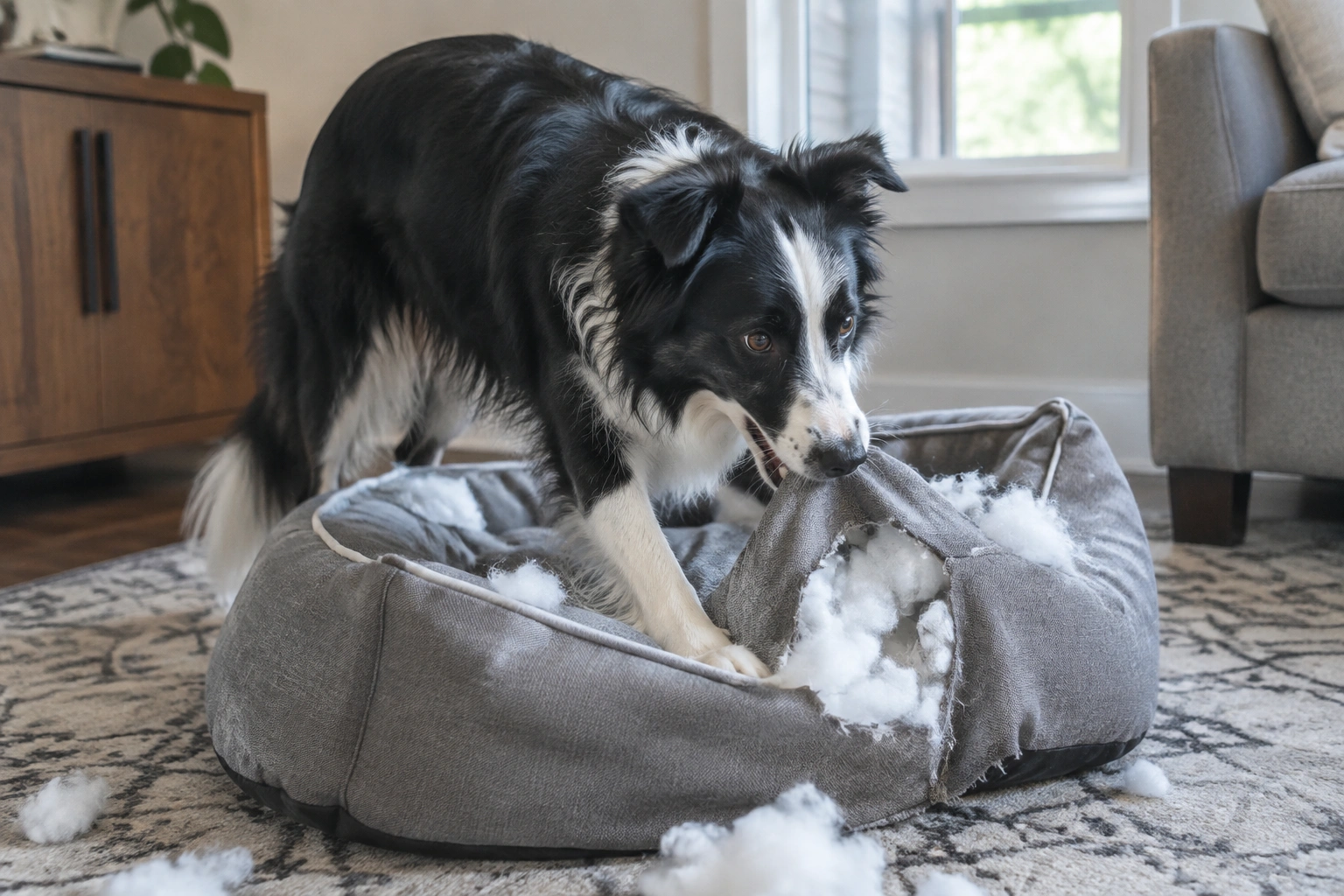
If your dog keeps turning bedding into confetti, the behavior is usually trying to tell you something. If you’re wondering, “why is my dog tearing up its bed?” the answer is usually a mix of energy, instinct, stress, habit, or a need that isn’t being met. In Border Collies especially, bed destruction often comes down to a combination of those factors. The job is not to label the dog “bad.” The job is to figure out what the dog is getting from the behavior, then change the setup so the dog has a better option.
A torn bed can mean simple chewing, but it can also point to boredom, nesting, teething, anxiety, or pain. That matters because the fix changes depending on the cause. A dog who shreds a bed when left alone needs a different plan from a puppy who mouths everything during teething, and both need a different plan from a dog who digs and circles before settling.
Quick check: what is most likely causing the bed tearing?
Use this fast checklist before you dive deeper:
- Boredom/under-stimulation: the dog tears the bed after being idle, under-exercised, or alone with little to do.
- Nesting: the dog circles, paws, digs, or scratches briefly, then settles.
- Teething: the dog is a puppy, chews more in general, and targets soft items.
- Anxiety/stress: the dog tears the bed mainly when left alone or during noisy, stressful moments.
- Pain/illness: the behavior is new, sudden, or paired with restlessness, stiffness, sensitivity, or swallowing bedding.
Quick rule of thumb: brief pawing or rearranging is often normal nesting; repeated shredding, swallowing fabric, or destruction when alone is more likely a behavior problem that needs management.
The good news: once you identify the pattern, this is usually manageable. In many cases, the solution is a combination of better supervision, smarter bed choices, more enrichment, and, when needed, help from a veterinarian or certified trainer.
Why Dogs Tear Up Their Beds: The Most Likely Causes
Dogs do not usually destroy bedding for one reason only. More often, the behavior is a blend of several things.
1) Boredom and under-stimulation
Boredom is one of the most common reasons dogs tear up their beds. Dogs are naturally active animals and need regular physical and mental stimulation. When that outlet is missing, a soft bed becomes an easy target.
This is especially true for high-drive dogs like Border Collies. A Border Collie that gets a quick walk but no real work may still have plenty of energy left over. That leftover energy often shows up as digging, chewing, or shredding.
2) Nesting and digging instincts
Some dogs tear at bedding as part of a nesting routine. They may circle, paw, dig, or scratch at the bed before lying down. In that case, the behavior can be more about making the sleeping spot feel right than about true destruction.
That distinction matters. A dog that paws at a blanket once or twice and settles is different from a dog that rips the fabric open and swallows pieces.
3) Stress or separation anxiety
Some dogs destroy beds when they are anxious, overstimulated, or left alone. You may see pacing, whining, drooling, escape attempts, or destruction that happens only during absences. If the bed is being attacked when the dog is alone, anxiety becomes a stronger possibility.
The behavior can also show up when the home is noisy or chaotic. One practical suggestion from K9 Ballistics is to move the bed to a quieter location or give the dog a safer space if household activity seems to trigger stress.
4) Teething or oral discomfort
Puppies often chew more during teething. Bedding can become an easy chew target because it is soft, accessible, and satisfying to shred. This phase usually improves as the puppy matures, but it still needs management so the puppy does not rehearse the habit.
5) Unmet chewing needs
Some dogs need more appropriate chewing outlets than they are getting. If a dog has no acceptable chew item, the bed may become the substitute. That does not mean the dog is being stubborn; it means the environment is not making the right behavior easy enough.
6) Pain, illness, or compulsive behavior
Chewing and bed destruction can sometimes be linked to underlying issues. A dog that suddenly starts tearing bedding, especially if the behavior comes with restlessness, sensitivity, or changes in movement, should be checked by a veterinarian. Chewing can sometimes be an indicator of stress, discomfort, or a medical problem, so sudden change matters.
Normal Behavior vs. a Behavior Problem: How to Tell the Difference
Not every dog that paws at a bed has a behavior problem. The key is to look at the pattern and the intensity.
More likely normal or low-risk behavior
- The dog paws, circles, or rearranges bedding before lying down.
- The dog mouths the bed briefly, then settles.
- The dog does not swallow fabric, foam, or stuffing.
- The behavior happens during bedtime rituals, not only when alone.
This is often nesting or settling behavior. It can be annoying, but it is not automatically a training emergency.
More likely a behavior problem
- The dog tears holes in the bed repeatedly.
- The dog shreds stuffing, zippers, or foam.
- The dog destroys the bed only when left alone.
- The dog shows pacing, whining, drooling, or escape behavior.
- The dog keeps doing it despite better exercise and supervision.
A useful rule: if the dog is using the bed as a chew toy, treat it as a management and training issue. If the dog is using the bed as a nesting surface and then settling, the problem may be milder, though still worth monitoring.
Border Collies and Other High-Energy Dogs: Why Breed Tendencies Matter
Border Collies are not uniquely “bad” with beds. They are simply more likely to expose weak spots in your routine.
These dogs are intelligent, fast to learn, and built for work. If their day is too empty, they often create their own project. A plush bed is easy to dig into, shake, and dismantle. That is especially true if the dog has learned that bed destruction brings attention, movement, or a change in the environment.
Here is the practical takeaway: with a Border Collie, bed tearing is often less about the bed itself and more about the dog’s overall outlet plan. If the dog gets physical exercise but no problem-solving, no training, and no structured decompression, the bed may still become the release valve.
A short walk alone may not change much for every dog, but it can help some dogs when it is paired with other management and enrichment. A better mix is:
– a real walk or run,
– a short training session,
– a food puzzle or sniffing game,
– and then supervised rest.
That combination usually does more than just buying a tougher bed.
Boredom, Under-Exercise, and Mental Stimulation Gaps
If bed tearing happens when your dog has too much unstructured time, boredom is a strong suspect.
Signs boredom is part of the picture
- The dog is destructive after being alone for a while.
- The dog gets into the bed after little exercise.
- The dog calms down after a training session or enrichment activity.
- The dog is generally restless, vocal, or hard to settle.
What helps
Use the dog’s day to reduce the chance of “invented entertainment.” That means:
– more sniffing walks instead of only fast-paced walks,
– short training bursts,
– food puzzles,
– scatter feeding,
– and chew items that are allowed and supervised.
If the dog is a Border Collie, mental work is not optional decoration. It is part of the exercise budget.
What will not be enough
If the dog tears up the bed only when anxious, more exercise alone may not fix it. Likewise, if the dog is teething or in pain, more activity will not solve the root problem. That is why timing matters as much as activity level.
Separation Anxiety and Stress-Driven Bed Destruction
When bed tearing happens mainly during absences, look closely at the bigger picture.
Clues that point to anxiety
- The destruction starts soon after you leave.
- The dog whines, paces, pants, or drools.
- The dog tries to escape the room, crate, or house.
- The dog ignores toys and focuses on the bed.
- The dog is calmer when people are present.
This is not the same as a dog being “naughty.” It is often distress behavior.
What to do first
Do not keep giving the dog free access to the bed when it is being destroyed during absences. That only lets the habit rehearse itself. Instead:
– remove the bed when unsupervised if the dog is shredding it,
– use a safe, simpler resting setup,
– and rebuild alone-time comfort gradually.
If the dog cannot relax alone without panicking, that is a professional case, not a willpower problem.
For general veterinary guidance on anxiety and behavior concerns, the ASPCA has useful owner resources, and your veterinarian can help decide whether this looks like separation anxiety.
Puppies, Teething, and Oral Discomfort
Puppies chew because their mouths hurt and because they are learning about the world with their teeth. Bedding is soft, movable, and easy to shred, so it often gets picked.
What usually helps
- Offer approved teething chews.
- Supervise bed access.
- Keep the sleeping setup simple.
- Remove bedding if the puppy keeps ripping and swallowing pieces.
A puppy chewing the corner of a bed during teething is not unusual. A puppy repeatedly destroying bedding beyond the teething phase needs more structure and possibly a better sleep setup.
If you want to think about the chewing side of the problem more broadly, it can also help to review your dog’s dental care routine. Our guide on how often dogs should get their teeth cleaned explains why oral comfort matters more than many owners realize.
When Bed Tearing May Signal Pain, Illness, or Compulsive Behavior
A sudden change is the red flag.
Call your veterinarian if you notice:
- new or sudden bed destruction in an adult dog,
- restlessness that seems unusual,
- sensitivity when touched,
- limping or stiffness,
- changes in appetite or sleep,
- repeated chewing that looks hard to interrupt,
- or any sign the dog may be swallowing bedding.
If your dog is swallowing fabric, foam, or stuffing, that is more urgent than simple chewing. Swallowed bedding can create a blockage risk, so contact your veterinarian promptly or seek urgent care if the dog is vomiting, retching, bloated, lethargic, or unable to keep food down.
Pain can make dogs unable to settle. Some dogs chew, dig, or shred because they are uncomfortable and cannot rest. Others develop repetitive habits that become hard to stop without help.
The VCA Hospitals pet health library is a reliable place to review common medical and behavioral issues, but a direct veterinary exam is the right move when the behavior changes suddenly.
How to Stop the Behavior Safely: Management, Supervision, and Redirection
This is the part most owners want: what to do today.
1) Remove the opportunity to rehearse the habit
If your dog destroys beds when unsupervised, stop giving access to that bed for now. Repetition strengthens the behavior. If the dog keeps practicing shredding, the habit gets easier to repeat.
That may mean:
– taking the bed away during alone time,
– using a crate only if the dog is already comfortable there,
– or confining the dog to a safer room with minimal bedding.
2) Use supervised access first
Give the bed back only when you can watch the dog. A practical starting point is 10 to 20 minutes of close supervision at a time, then longer periods only if the dog stays calm. If the dog lies down calmly, reward that. If the dog starts pawing, mouthing, or digging, interrupt early and redirect before the bed is damaged.
3) Reward calm, settled behavior
Positive reinforcement works best when the dog is doing the right thing, not after the bed is already shredded. Calm lying on the bed, choosing a chew toy instead, or settling after a cue should all earn praise or a small reward.
4) Redirect to the right outlet
If the dog wants to chew, give a legal chew. If the dog wants to dig, create a digging outlet. If the dog wants to settle, make the resting area less tempting to destroy.
In practice, redirection should be immediate and simple: interrupt the bed chewing, hand the dog an approved chew, and then praise calm engagement with that item. If the dog returns to the bed, the bed is still too available for the moment.
5) Match the setup to the cause
- Boredom: add enrichment.
- Anxiety: reduce stress and get professional help if needed.
- Teething: use puppy-safe chews and supervision.
- Nesting: provide a simpler, safer bed setup.
Punishment usually makes this worse. It may stop the dog in the moment, but it does not teach what to do instead.
6) Phase access back in gradually
Once the dog has gone several days to a couple of weeks without trying to shred bedding, you can slowly reintroduce access:
– start with short, supervised bed time,
– then leave the dog alone for very brief periods,
– then extend the time only if the dog stays calm,
– and pull back immediately if the chewing starts again.
If the dog relapses, step back to the last successful level rather than assuming the dog is “fixed.”
Choosing a More Durable Dog Bed: What Actually Helps
A tougher bed can help, but only if the cause is also being addressed.
Features that matter
- Tough outer material: denser, more abrasion-resistant fabrics such as heavy-duty canvas, ripstop-style fabric, ballistic-style nylon, or tightly woven polyester blends are generally harder to shred than soft fleece or loose knits.
- Reinforced seams and hidden zippers: double stitching, boxed seams, and covered zipper tracks reduce weak points that dogs can grab and open.
- Simple construction: fewer loose flaps, straps, tags, piping, and decorative corners means fewer places to start digging or chewing.
- Replaceable covers or modular parts: useful if the outer layer gets damaged before the whole bed is ruined.
- Low-profile design: flatter mats, cot-style beds, or beds without thick stuffing can be harder for a dog to “open up” and scatter.
- Raised or elevated frames: some destructive dogs do better with cot-style beds because there is less fabric to grab and less stuffing to pull out.
Trade-offs to think through
A very plush bed may be more comfortable, but it can also be easier to dig into. A tougher bed may last longer, but it may not feel as cozy for a dog that likes softness. Some owners do better with a simple resting mat, a cot, or a bed with a removable cover and minimal stuffing, especially for dogs that shred foam or pull out filling.
If your dog is a determined chewer, no bed is truly chew-proof. The goal is to reduce damage while you work on the behavior.
Replace the Bed or Change the Plan? A Decision Framework
Use this simple decision guide.
Replace the bed if:
- the current bed is already damaged,
- the dog has a history of chewing soft bedding,
- and the dog is otherwise calm, supervised, and improving.
Choose a sturdier design, but keep supervision in place.
Remove the bed temporarily if:
- the dog tears it up when alone,
- the dog swallows fabric or foam,
- or the dog is still practicing the habit.
This is often the safest short-term move.
Focus on training and enrichment first if:
- the dog is under-stimulated,
- the dog settles better after work,
- or the problem seems tied to excess energy.
Get professional help if:
- the dog shows clear anxiety signs,
- the behavior is sudden,
- or the dog keeps destroying bedding despite your changes.
The bed is not always the real problem. Sometimes it is just the first thing the dog can successfully destroy.
When to See a Veterinarian or Certified Trainer
See a veterinarian if the behavior is new, severe, or paired with pain, restlessness, or swallowing of bedding.
See a certified trainer or behavior professional if:
– the dog destroys bedding only when alone,
– the dog shows panic behaviors,
– the dog cannot settle even with better routines,
– or the problem keeps returning after management changes.
If you are dealing with a Border Collie, professional guidance can be especially useful because these dogs often need more than basic obedience. They often do better with a plan that respects their drive.
FAQs
Is tearing up a bed always a sign of bad behavior?
No. It can be normal nesting, teething, boredom, stress, or a medical issue. The context tells you what is most likely.
Should I let my dog keep a bed if it tears it up?
Only if the dog can use it safely and you are confident it will not be shredded or swallowed. If the dog is destroying it, remove access until you have a better plan.
Will a tougher bed solve the problem?
Not by itself. A durable bed may buy you time, but it will not fix boredom, anxiety, or pain.
Why does my dog only tear up the bed when I leave?
That pattern often points to separation-related stress. Watch for whining, pacing, drooling, or escape attempts, and talk to your veterinarian or a certified trainer.
Do Border Collies do this more often?
They can be more prone to it because they are energetic, intelligent, and easily under-stimulated. That does not mean the breed is doomed to destroy beds; it means the routine has to be better matched to the dog.
The pattern is the clue. Once you know whether you are dealing with boredom, nesting, teething, anxiety, or pain, the fix becomes much clearer.
