
How to Get Rid of a Dog’s Ear Infection Safely: What Actually Works

Ear problems can move from annoying to painful quickly, and dogs often hide discomfort until the ear is already quite inflamed. If your Border Collie is shaking their head, scratching at one ear, or giving off that unmistakable sour smell, the goal is not to “treat everything at home.” The goal is to figure out whether you’re dealing with mild irritation, wax buildup, mites, or a true infection—and then choose the safest next step.
A dog ear infection is often otitis externa when it affects the outer ear canal. More serious cases can involve the middle or inner ear, and those need veterinary care. The practical difference matters: a mildly dirty ear may improve with gentle cleaning and drying, while an infected ear often needs prescription treatment to fully clear.
For Border Collie owners, this can be especially frustrating because active dogs pick up moisture, debris, and pollen during exercise. If your dog swims, runs through wet grass, or has seasonal allergies, ear trouble can show up even if the rest of the dog seems healthy.
If you want a broader look at yeast-related ear problems, our guide on how to get rid of a yeast infection in dogs may help you compare symptoms.
How to Tell If Your Dog Has an Ear Infection or Just Irritated Ears
Not every itchy ear is infected. Some dogs simply have trapped moisture, extra wax, or mild irritation after swimming or a bath. The challenge is that early infection and simple irritation can look similar at first.
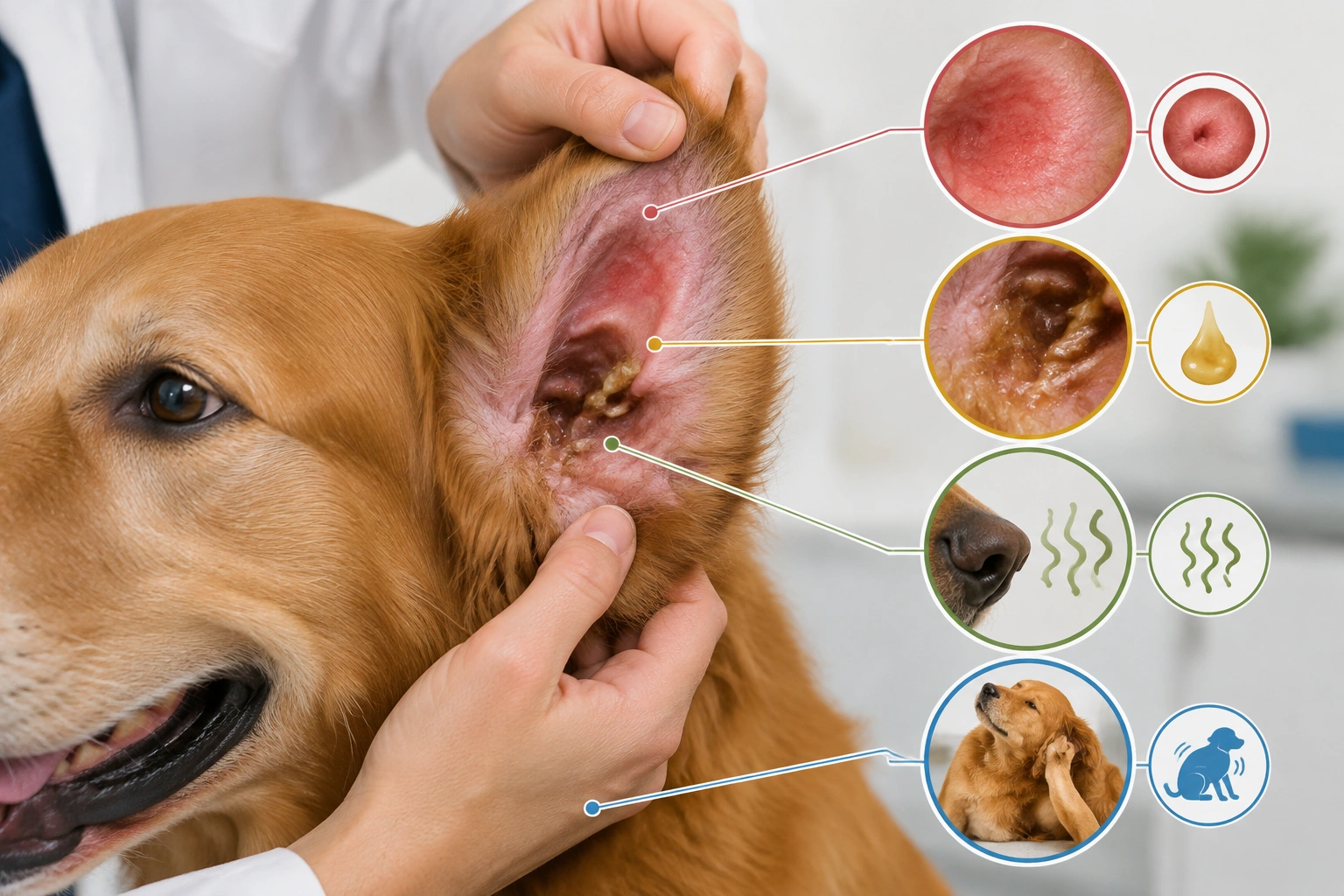
A true ear infection is more likely when you see several signs together:
- frequent head shaking
- repeated scratching at one or both ears
- redness inside the ear flap or canal
- swelling
- odor from the ear
- discharge, especially brown, yellow, or pus-like material
- pain when the ear is touched
- a dog that tilts the head or avoids having the ear handled
Mild irritation usually looks softer and less dramatic. You may see a little scratchiness or temporary head shaking after water gets into the ear, but the dog still lets you touch the ear, and there is no strong smell or discharge.
Other lookalikes: ear mites, wax buildup, and foreign bodies
Some ear problems are not infections at all, or they start as something else and then become infected.
- Ear mites: Often cause intense itching, dark coffee-ground debris, and frequent head shaking. They’re more common in puppies and in multi-pet households where parasites can spread.
- Wax buildup: Usually looks like dark wax or flaky debris without much odor or pain. The ear may seem dirty, but the dog is often less uncomfortable than with an infection.
- Foreign body: A grass awn, seed, or other debris can cause a sudden problem, especially after outdoor play. Signs often include abrupt head shaking, one-sided scratching, and pain that starts quickly.
A quick comparison that helps with triage
| What you notice | More like irritation | More like infection |
|---|---|---|
| Odor | Usually absent | Often present |
| Discharge | None or a little wax | Brown, yellow, or thick debris |
| Pain | Mild or none | Common |
| Scratching/head shaking | Occasional | Frequent or persistent |
| Redness/swelling | Minimal | Often obvious |
| Response to touch | Tolerates handling | Pulls away, cries, or resists |
One useful rule: if the ear looks dirty but not painful, you may be dealing with wax or debris. If the ear smells bad, looks inflamed, or the dog acts sore, assume it may be infected until a veterinarian says otherwise.
Yeast Infection vs Bacterial Ear Infection: What’s the Difference?
Yeast and bacteria are both common causes of canine ear infections, but they do not always look the same.
A yeast infection often produces:
– a musty or sweet smell
– brown, waxy, or greasy discharge
– redness and itchiness
– recurring irritation, especially in dogs with allergies
A bacterial infection is more likely to cause:
– more intense pain
– yellow or pus-like discharge
– swelling
– a hotter, angrier-looking ear
– a dog that seems very uncomfortable when the ear is touched
That said, you cannot reliably diagnose the cause just by looking. Many dogs have a mixed infection, and some have an underlying trigger such as allergies, moisture, or ear mites. A vet can examine the ear and often use a microscope sample, called cytology, to see what’s actually there.
If you’re trying to sort out whether the problem is more likely yeast-related, our related guide on how to get rid of a yeast infection in dogs goes deeper into that pattern.
Can You Use OTC Ear Drops or Human Medicine?
Usually not unless your veterinarian specifically recommends a product.
Over-the-counter ear drops and human medicines can be the wrong choice for a dog ear problem, especially if the ear is infected, painful, or the eardrum may be damaged. Some products sting, some can worsen inflammation, and some are simply not appropriate for canine ears.
Home treatment is only reasonable for mild, vet-cleared cases where your veterinarian has already said cleaning or a specific product is appropriate. If you suspect a real infection and do not yet have a diagnosis, do not try to self-treat with human medicine or random OTC drops.
When a Dog Ear Infection Needs a Vet Right Away
Some ear problems are not safe to manage at home. The red flags are the ones that suggest deeper infection, severe inflammation, or a foreign body.
See a veterinarian promptly if your dog has:
- a head tilt
- balance problems
- obvious pain when opening the mouth or touching the ear
- bleeding
- marked swelling
- worsening discharge
- a bad smell that keeps getting stronger
- signs affecting both ears at once
- repeated infections that keep coming back
- a sudden onset after outdoor play, grooming, or swimming
A head tilt or balance issue can point to middle or inner ear involvement, which is more serious than a simple outer ear infection. If the dog is crying, snapping, or refusing to let you touch the ear, that is another reason to stop home care and get checked.
Same-day veterinary care is a good idea if the ear problem comes on suddenly and the dog seems very painful, if you suspect a foreign body after outdoor activity, or if you notice head tilt, balance trouble, or bleeding. Those signs deserve prompt evaluation, not a wait-and-see approach.
For general dog health guidance, VCA Hospitals has useful veterinary articles on ear infections and related conditions.
What Causes Ear Infections to Keep Coming Back?
If your dog keeps getting ear infections, the ear itself may not be the real problem. Recurrence usually means something is feeding the cycle.
Common drivers include:
– allergies, especially environmental or food-related allergies
– moisture trapped in the ear after swimming or bathing
– ear mites
– foreign material such as grass awns or debris
– chronic wax buildup
– skin disease that also affects the ear canal
– ear shape or anatomy that traps heat and moisture
This matters because repeated treatment without finding the trigger often leads to the same problem over and over. For example, a dog may improve on prescription drops, then flare again a few weeks later because the ears are still exposed to the same allergy or moisture pattern.
That’s why recurrent ear infections deserve a full veterinary conversation, not just another bottle of drops. If the ear keeps relapsing, the cause may need to be managed as carefully as the infection itself.
Can You Treat a Dog Ear Infection at Home?
Sometimes, but only in a narrow set of situations.
Home care may be reasonable when:
– the ear looks mildly dirty or irritated
– there is no strong odor
– there is no significant pain
– your dog allows gentle handling
– symptoms are mild and recent
– your veterinarian has already told you the ear can be cleaned at home
Home care is not a substitute for treatment when the ear is clearly infected. Prescription medication is often needed because infection involves living organisms, inflammation, and sometimes deeper ear damage.
A practical way to think about it:
– Mild irritation: gentle cleaning, drying, and observation may help
– True infection: vet evaluation is usually the safer and faster route
The temptation is to “try something first” and hope the ear clears. The risk is that the wrong product can sting, worsen inflammation, or mask the problem long enough for it to get worse.
How to Clean a Dog’s Ears Safely
If your vet says cleaning is appropriate, keep the process gentle and simple.
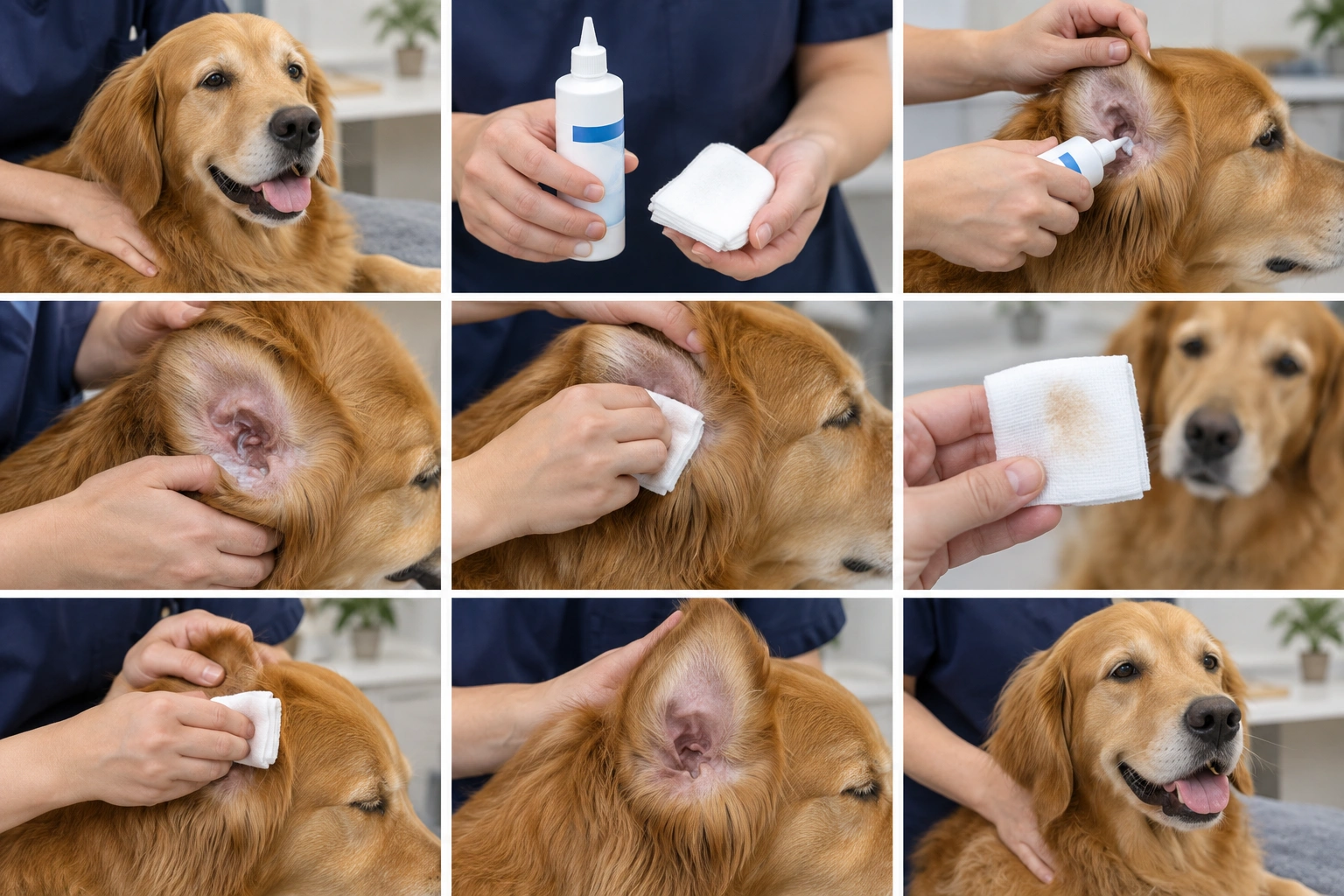
Safe cleaning approach
- Hold the ear flap up and look for obvious redness, swelling, odor, or discharge.
- Use only a vet-recommended ear cleaner unless your vet gave you different instructions.
- Apply the cleaner as directed on the product label or by your veterinarian.
- Massage the base of the ear lightly so the cleaner can loosen debris.
- Let your dog shake their head.
- Wipe away loosened debris from the visible part of the ear with gauze or a soft pad.
What not to do
- do not push cotton swabs deep into the canal
- do not scrub hard
- do not force cleaning if the ear is painful
- do not pour in random liquids “just to see if it helps”
The goal is to remove loose material, not to dig around inside the canal. Deep cleaning with swabs often pushes debris farther in and can injure the ear.
If the ear is very painful, heavily swollen, or your dog resists strongly, stop. That is a sign the ear needs a veterinary exam before more cleaning.
What Not to Put in a Dog’s Ear
This is where many well-meaning owners make the problem worse.
Avoid putting these into a dog’s ear unless a veterinarian specifically tells you to:
– human ear drops
– alcohol
– hydrogen peroxide
– vinegar mixtures
– oils
– random OTC “infection” drops
– anything that burns, stings, or dries the skin aggressively
These products may seem harmless, but an inflamed ear canal is sensitive. Some substances sting immediately; others can worsen irritation or be unsafe if the eardrum is damaged.
The same caution applies to “natural” remedies. Natural does not automatically mean safe for an infected ear.
How Veterinarians Diagnose and Treat Dog Ear Infections
A veterinarian usually starts by looking into the ear with an otoscope and checking for swelling, debris, foreign material, parasites, or signs of eardrum involvement. They may also take a sample from the ear and examine it under a microscope to look for yeast, bacteria, or mites.
Treatment depends on what they find. Common options may include:
– prescription ear drops
– topical anti-inflammatory medication
– oral medication if the infection is severe or deeper
– parasite treatment if ear mites are involved
– a vet-directed ear cleaner
– follow-up exams if the ear is not improving
This is one reason guessing can be risky. A dog with yeast, bacteria, mites, or a foreign body may need a different treatment approach, and the wrong medication may delay recovery.
If your dog also has eye irritation or discharge, it may be worth reviewing our guide on do dogs get pink eye? so you can tell separate issues apart.
For a broader owner-focused reference on dog care and ear health, the AKC also offers practical guidance on common canine conditions.
How Long Treatment Usually Takes and How to Know It’s Working
In many typical cases, you should start to see some improvement within a few days of the right treatment. Head shaking, scratching, odor, redness, and discharge often begin to ease before the ear is completely back to normal.
Full resolution can take longer, often depending on the cause and severity. Mild cases may clear relatively quickly, while more inflamed, chronic, or recurrent infections can take longer and may need rechecks or a change in treatment.
If symptoms are not improving, or they improve and then rebound, the diagnosis or treatment may need to be reassessed. That can mean the infection is more severe than it looked, the ear cleaner is irritating the canal, or an underlying trigger is still active.
Do not stop medication early just because the ear looks better. Ear infections often calm down before they are fully resolved, and stopping too soon can set up a relapse.
How to Prevent Dog Ear Infections From Coming Back
Prevention is mostly about reducing the conditions that let infection flourish.
Practical prevention habits
- dry the ears after swimming or bathing if your dog is prone to moisture-related problems
- use only the cleaning frequency your veterinarian recommends
- manage allergies with your vet’s help if infections keep returning
- watch for early signs such as head shaking or odor
- bring repeated cases back for recheck instead of assuming they are the same as last time
If ear trouble appears after rainy hikes, swimming, or a seasonal allergy flare, that clue matters. It can help you and your vet reduce future episodes instead of chasing each one separately.
The best long-term plan is usually not “clean more.” It is “clean appropriately, treat the cause, and recheck when the pattern changes.”
When to See a Veterinarian
For ear infections, a veterinarian is the right professional. A certified trainer is not the person to diagnose or treat an ear problem, but a trainer can help if pain or discomfort has started affecting handling or grooming.
See a veterinarian if:
– the ear smells bad, looks swollen, or has discharge
– your dog seems painful
– symptoms are getting worse
– the dog has a head tilt or balance issue
– the problem keeps returning
– you are unsure whether cleaning is safe
If your dog becomes difficult to examine because of fear or pain, a calm, low-pressure handling plan can help future ear care go more smoothly. That is especially useful for Border Collies, who are often sensitive, observant, and quick to remember unpleasant experiences.
FAQ
Can I use human ear drops on my dog?
No, not unless your veterinarian specifically tells you to use a certain product. Human ear drops may irritate the ear or be unsafe for dogs.
How do I know if it’s ear mites instead of an infection?
Ear mites often cause intense itching and dark, coffee-ground-like debris. They’re also more common in puppies and in homes with multiple pets.
What should I do if I think something is stuck in my dog’s ear?
If the problem started suddenly after outdoor play or swimming, stop home treatment and have a veterinarian check the ear. A foreign body should not be dug out at home.
How long until ear infection treatment starts working?
Many dogs show some improvement within a few days, but full recovery can take longer. Chronic or recurrent infections often need more time and follow-up care.
Final Takeaway
If you are trying to figure out how to get rid of a dog’s ear infection, the safest answer is this: mild irritation may settle with gentle, vet-approved cleaning, but a true infection usually needs a veterinarian to identify the cause and prescribe the right treatment. The faster you sort out odor, discharge, pain, or balance changes, the less likely the problem is to become chronic.