
How to Potty Train a Puppy When You Work Full-Time: A Practical Border Collie Owner’s Guide

Bringing a puppy home while you work outside the house is absolutely possible, but only if you treat house-training like a logistics problem, not a wishful one. A young puppy cannot “hold it” through a full workday just because you need them to. They need a routine, a confinement plan, and usually some midday help until bladder control improves.
That matters even more with a Border Collie puppy. Border Collies are quick learners, but they are also active, alert, and sensitive to routine changes. If their day is chaotic, they often become more restless, not less. A calm schedule, clear potty breaks, and enough mental engagement make the whole process smoother.
Can You Potty Train a Puppy While Working Full-Time?
Yes, but the age of the puppy and the amount of help available determine whether it is realistic.
If you work away from home, the main question is not “Can I train this puppy?” It is “Can I prevent accidents often enough for training to stick?” For a very young puppy, the answer is usually only if someone can break up the day.
House-training can take days to weeks, and it goes more smoothly when the puppy has a predictable routine, according to Best Friends Animal Society. That predictable routine is the backbone of a working owner’s plan.
A full-time work schedule is usually workable when:
– the puppy is old enough to hold it for short stretches,
– you can get home at lunch or hire a midday potty break,
– the puppy is confined safely when you are gone,
– and you are consistent before work, after work, and at bedtime.
For most full-time workers, the best default setup is a crate plus a playpen or gated area, plus midday potty help. Use the crate for sleep and short absences, and use the playpen or pen when the puppy needs a little more room but still should not have access to the whole house. If you can arrange a lunch visit, dog walker, or other midday potty break, that combination is usually more realistic than expecting the puppy to handle a full workday alone.
Choose puppy pads instead when the puppy is still too young for your schedule, when no reliable midday help is available yet, or when you need a temporary bridge before you can switch to outdoor-only training. Pads can be practical short term, but if your long-term goal is outdoor potty training, treat them as a transition tool rather than the main plan.
It becomes much harder when the puppy is very young, your commute is long, or your job includes unpredictable meetings and overtime. In that case, you need backup help, not just better intentions.
How Long Puppies Can Hold Their Bladder by Age
There is no perfect stopwatch for bladder control, but age gives you a useful decision guide. Puppies cannot hold their bladders and bowels as long as adult dogs, as Best Friends Animal Society notes, so the younger the puppy, the shorter the safe gap between potty breaks.
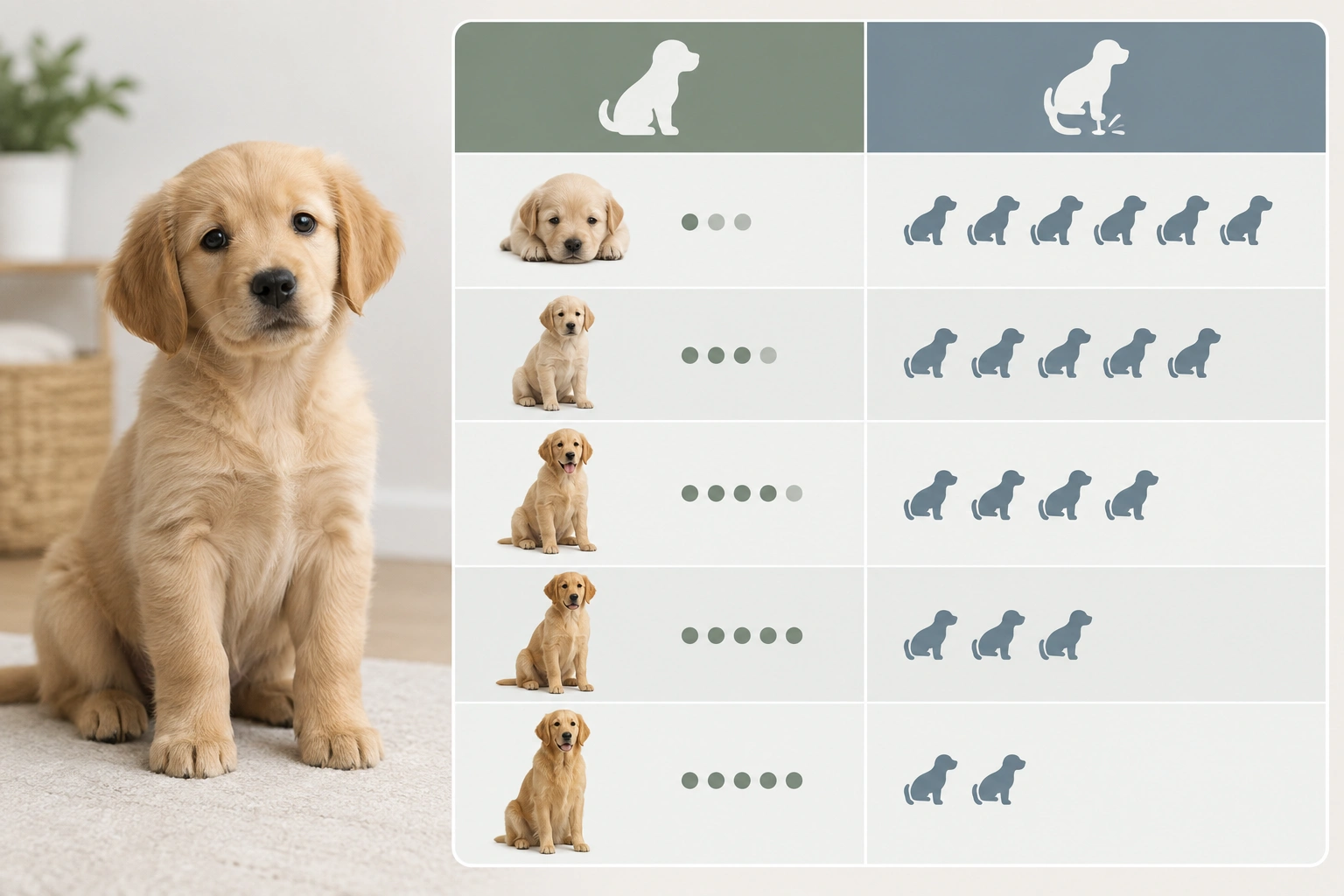
| Puppy age | Practical bladder-control expectation | Workday reality |
|---|---|---|
| 8 weeks | Very short stretches; frequent trips needed | Not suitable for a full workday without help |
| 10–12 weeks | Still limited; accidents are common if left too long | Needs midday coverage |
| 3–4 months | Better control, but still not a full-day dog | Lunch break or walker still recommended |
| 5–6 months | Often much more manageable | May handle longer gaps, but not every puppy |
| 6+ months | Closer to reliable bladder control | Many can handle a workday better, with routine |
Use that table as a planning tool, not a promise. A puppy’s age, size, water intake, excitement level, and activity all affect how long they can last. A Border Collie puppy who is mentally stimulated, overstimulated, or anxious may need more frequent breaks than the age chart suggests.
A simple rule: if you are guessing whether the puppy can make it, assume they cannot.
Also, bladder control and “can stay calm in a crate” are not the same thing. A puppy may be able to relax in a crate for a longer stretch than they can comfortably avoid needing a potty break. For example, a 12-week-old puppy might settle in a crate for part of a work morning, but that does not mean they can safely stay alone for a full workday plus commute time. When you plan, count the entire time away from the puppy, including your commute, not just the hours you are physically at work.
Practical examples:
– 8–10 weeks: usually not realistic for more than a very short stretch alone, even if the puppy seems calm.
– 10–12 weeks: often needs a midday potty break plus your commute time counted on both ends.
– 3–4 months: may handle a longer block, but a full workday is still too much for many puppies without help.
– 5–6 months: some puppies can manage closer to a work shift, but you should still plan for a break if the total alone time is long.
– 6+ months: many puppies are more workable for full-time owners, but reliability still depends on the individual puppy and the routine.
Choose the Right House-Training Strategy: Outdoor-Only, Puppy Pads, or a Temporary Hybrid
This is the first real decision point. You are not just choosing a potty method; you are choosing what the puppy will learn is acceptable.
Outdoor-only training
This is the cleanest long-term option if you can provide enough breaks. The puppy learns one clear rule: potty happens outside, in the same place, with praise right after.
This method is best when:
– you can get the puppy out often enough,
– you have a yard or easy access to outdoors,
– and you want the fewest long-term mixed signals.
The trade-off is obvious: outdoor-only training is simpler in the long run, but it demands more management in the short run.
Puppy pads
Puppy pads can help when a puppy is too young for your work schedule or when there is no reliable midday help. They can also be useful for a temporary transition.
The downside is that pads teach an indoor potty habit. That can be fine if your long-term plan is indoor toileting, but if your goal is outdoor-only house-training, pads can slow the transition because the puppy learns that peeing inside is sometimes correct.
Temporary hybrid
A hybrid plan means the puppy uses pads or an indoor potty area only when truly necessary, while most training happens outdoors. This can be the most practical option for people who work full-time and cannot yet provide enough midday breaks.
Use a hybrid only with a clear exit plan:
– set a target age or bladder-control milestone,
– reduce indoor potty use gradually,
– and keep outdoor trips rewarding and consistent.
If you choose a hybrid, be deliberate. A vague “we’ll see” approach often turns into long-term confusion.
Crate, Playpen, or Both? Set Up Safe Daytime Confinement
For working owners, freedom is the enemy of house-training. The puppy should not have run of the house while you are gone.
Crate training
A crate is useful because most puppies avoid soiling where they sleep. Used properly, it helps prevent accidents and teaches the puppy to settle. But the crate must be the right size: large enough to stand, turn, and lie down comfortably, but not so large that the puppy can use one corner as a bathroom.
A crate is best for:
– short absences,
– naps,
– and overnight sleeping.
Do not use a crate as a punishment box. That creates stress, and stressed puppies often struggle more with house-training.
Playpen
A playpen gives more room than a crate and can be a better choice for longer daytime periods if the puppy cannot physically stay clean in a crate for that stretch. You can pair the pen with a bed on one side and a potty option on the other side only if you are using a temporary indoor potty system.
A playpen is best when:
– the puppy needs a little more space than a crate allows,
– you want to limit access to the house,
– and you need a safer setup for longer work blocks.
Using both
For many working owners, the best setup is a crate for sleep and short absences, plus a playpen or gated area for supervised time. That gives structure without expecting the puppy to be “good” with too much freedom too soon.
If your workday is long and your puppy is still very young, the crate-plus-playpen setup is usually more realistic than crate-only confinement. The crate helps with sleeping and settling, while the playpen gives a little more room during supervised breaks or when the puppy is awake but still not ready for the whole house.
Build a Workday Potty Schedule That Actually Fits Your Life
The best schedule is the one you can repeat on your worst ordinary day, not just on a perfect one.
Chewy recommends taking a puppy to a potty area on leash at least once every 30 minutes while you are home and awake, and says that at night, one or two outings are enough for most puppies. It also recommends praising and treating the puppy as soon as they pee or poop outside, and if nothing happens, returning them to an indoor confinement area for 10 to 20 minutes before trying again. You can see that guidance here: Chewy’s puppy potty training guide.
For a working owner, that becomes a practical rhythm like this:
Example 1: Short commute with a lunch break
- 6:00 a.m. Wake up, immediate potty trip
- 6:10 a.m. Breakfast
- 6:25 a.m. Potty again after eating
- 6:30–7:15 a.m. Short play, training, and calm exercise
- Right before leaving Potty trip, then crate or pen
- Midday lunch break Potty trip, short reset, then back to confinement
- Immediately after work Potty trip before anything else
- Evening Potty after play, after dinner, and before bed
This is the easiest workday version because the puppy gets a true midday break. If your commute is short, that can make the whole plan much more realistic.
Example 2: Longer commute with a dog walker
- 6:00 a.m. Wake up, potty
- 6:10 a.m. Breakfast
- 6:25 a.m. Potty again
- 6:30–7:15 a.m. Brief training and calm activity
- Before leaving Potty, then crate or pen
- Midday dog walker visit Potty break and a few minutes of attention
- After work, plus commute home Potty immediately on arrival
- Evening Potty after dinner and before bed
This version works better when your total time away from the puppy is long. The commute matters: a 45-minute commute each way can turn an 8-hour shift into a much longer alone stretch for the puppy.
Example 3: No midday help with temporary hybrid training
- 6:00 a.m. Wake up, potty
- 6:10 a.m. Breakfast
- 6:25 a.m. Potty again
- 6:30–7:15 a.m. Training, play, and a calm reset
- Before leaving Potty, then crate or pen
- Midday Puppy pad or indoor potty area only if needed and only as a temporary bridge
- Immediately after work Outdoor potty trip
- Evening Outdoor potty after play, after dinner, and before bed
This is the fallback when you do not have lunch coverage yet. It is not the ideal long-term setup, but it can prevent accidents while you arrange better help.
For Border Collie puppies, the morning and evening windows matter just as much for behavior as they do for potty training. A puppy who gets some movement and a little brain work is usually easier to settle.
If your commute is long, add that time into the puppy’s “alone” window. A 30-minute commute plus an 8-hour shift is not the same as an 8-hour shift.
Midday Coverage Options: Dog Walker, Neighbor, Family, Daycare, or Coming Home at Lunch
This is where most working owners either make the plan workable or break it.
Coming home at lunch
This is ideal if your schedule allows it. It gives you control, keeps the routine consistent, and avoids introducing another person into the training process.
The downside is obvious: not every job makes it possible, and travel time can eat the entire break.
Dog walker
A dog walker is usually the best house-training tool for a young puppy when you cannot be home at lunch. You can ask for a short potty visit, a brief walk, and a simple report on whether the puppy went.
This is often better than daycare for potty training because it gives one-on-one attention and keeps the day calmer.
Neighbor or family
This can work well if the person is reliable and willing to follow your routine. The risk is inconsistency. If the person forgets the leash, skips the reward, or changes the potty spot every day, the training slows down.
Daycare
Daycare can be useful for social puppies or owners with irregular schedules, but it is not always the best potty-training tool for a very young puppy. A busy daycare environment can make it harder to enforce a precise potty routine.
For a young Border Collie puppy, daycare may also be too stimulating if the goal is calm house-training and confidence-building. In general, choose daycare when your puppy is old enough, social enough, and your main need is supervision and enrichment. Choose a dog walker when your puppy still needs a predictable potty break more than group play.
My practical rule: if the puppy is still having frequent accidents, prioritize the most predictable midday potty break you can arrange.
How Much Freedom Your Puppy Can Safely Have at Home
Too much freedom too early is one of the fastest ways to stall house-training.
A puppy who can wander from room to room will usually find a place to eliminate before you notice the signals. That does not mean the puppy is stubborn. It means the environment is too big for the current level of training.
Use this progression:
1. Crate or pen only when unsupervised
2. One small puppy-proof room during short supervised periods
3. A larger area only after several accident-free weeks
4. Full access only when the puppy is truly reliable
That gradual expansion matters because every clean success helps the puppy understand the pattern. Every unnoticed accident teaches the opposite.
Accident Prevention and Cleanup That Stops Repeat Soiling
If accidents happen, the first job is prevention. The second is cleanup.
Watch the puppy more closely after:
– waking up,
– eating,
– drinking,
– playing,
– and coming out of the crate.
If you catch the puppy starting to go in the wrong place, interrupt calmly and without punishment. The RSPCA advises calling the puppy’s name, then taking them to the correct place and praising them when they toilet there. It also recommends taking them to the same place each time and using a verbal cue like “toilet” as they begin to go. See the guidance here: RSPCA toilet training advice.
For cleanup, use an enzymatic cleaner. Regular household cleaners may remove the visible mess but leave scent behind, and scent can pull the puppy back to the same spot.
Never scold a puppy for eliminating in front of you. Punishment can make potty training harder and may teach the puppy to hide when they need to go, which is the opposite of what you want.
Signs Your Puppy Needs to Go Out—And What to Do If You Miss Them
Most puppies show some version of the same signals:
– circling
– sniffing the floor intensely
– wandering away from play
– sudden restlessness
– heading toward a corner or doorway
If you notice those signs, move quickly and calmly. Do not wait to “see what happens.” The window is usually short.
If you miss the signal and the puppy starts to go:
– interrupt gently,
– take them to the correct potty spot,
– and reward them if they finish there.
If they already finished inside, clean thoroughly and adjust the schedule. A mistake usually means the plan was too loose, not that the puppy is incapable.
Border Collie Puppy Considerations: Energy, Stimulation, and Separation Frustration
Border Collie puppies often make house-training harder in a specific way: not because they are less intelligent, but because they are more likely to become frustrated when under-stimulated.
A Border Collie puppy who has no mental outlet may:
– pace in the crate,
– whine more,
– struggle to settle,
– or become overexcited during potty trips.
That does not mean you need to exhaust the puppy. It means you need to give the puppy a job that fits the day: short training sessions, food puzzles, sniffing time, and calm handling. The goal is not to tire the puppy out until they collapse. The goal is to help them regulate.
If your Border Collie puppy is bouncing off the walls before you leave, the potty plan may be fine but the routine around it is not.
Troubleshooting Setbacks: Crying in the Crate, Regression, and Inconsistent Progress
Setbacks usually point to one of three problems: the schedule is too hard, the confinement is too long, or the puppy has not had enough repetition.
If the puppy cries in the crate
Check three things:
– Has the puppy been pottyed recently?
– Is the crate size appropriate?
– Is the puppy getting enough calm exercise and mental work outside the crate?
A puppy that cries for long periods may need a shorter confinement window and a more gradual build-up.
If progress suddenly gets worse
This often happens when owners relax too soon. One good week does not mean the puppy is ready for free roam.
Go back to tighter supervision for several days:
– more frequent potty trips,
– less freedom,
– and more predictable timing.
If work demands keep changing
If meetings, overtime, or travel keep breaking the routine, the problem is not training technique. It is the schedule. Add outside help rather than trying to “train through” constant inconsistency.
When Your Puppy Is Too Young for Your Work Schedule
Sometimes the honest answer is that the current setup is not realistic yet.
You need a temporary solution or professional help if:
– the puppy is still very young and cannot make it to a midday break,
– accidents happen repeatedly despite a strict schedule,
– the puppy is confined for longer than they can reasonably hold it,
– or your workday is too unpredictable to provide reliable potty trips.
If your puppy is too young for the current work schedule, do not force full-time alone time yet. Instead, use a temporary plan such as:
– a few days or weeks of adjusted work hours if possible,
– a dog walker or midday sitter,
– help from a trusted neighbor or family member,
– in-home pet sitting,
– or a temporary hybrid potty setup while you build toward outdoor-only training.
If none of those options are available, it is better to delay full-time alone time than to let the puppy rehearse accidents all day. A puppy that keeps failing at the current schedule is telling you the schedule needs to change.
If you are also planning spay or neuter timing, it can help to coordinate with broader puppy-care planning. I cover that in this Border Collie puppy timing guide.
A Simple Decision Rule for Busy Owners
If your puppy is under 12 weeks old, assume they need midday help. If they are 3 to 4 months old, plan for help unless your schedule is unusually flexible. If they are older, you can gradually test longer gaps, but only after several clean weeks.
That is the heart of working-owner potty training: don’t ask the puppy to be more mature than they are.
With the right routine, a crate or pen, a reliable midday plan, and calm repetition, a Border Collie puppy can absolutely learn to be clean in a home where people work outside it. The process is less about perfection and more about building a day the puppy can actually succeed in.
For more on how Border Collies mature and settle, you may also find this guide to when dogs calm down useful as your puppy grows.
FAQ
Can I potty train a puppy if I work 8 hours a day?
Yes, but most young puppies need help during the day. For many full-time workers, the most realistic setup is a crate plus a playpen or gated area, plus a midday potty break from a dog walker, neighbor, family member, or lunch visit.
Are puppy pads a good long-term solution?
Usually not if your goal is outdoor potty training. Puppy pads are better as a temporary bridge when your puppy is too young for your current schedule or when you do not yet have midday coverage.
Is a crate or playpen better for a working owner?
Use both if you can. A crate is best for sleep and short absences. A playpen or gated area is usually better for longer supervised stretches when the puppy needs a little more room.
How long can a Border Collie puppy be alone?
It depends on age, routine, and help available. Younger puppies usually need much shorter alone stretches, and you should count commute time as part of the total. A Border Collie puppy may also need more mental engagement to stay calm, but calmness is not the same as bladder control.
Should I choose daycare or a dog walker?
For potty training, a dog walker is usually the better choice because it gives a predictable one-on-one potty break. Daycare can be helpful for older, social puppies, but it is not always the best tool for a very young puppy that still needs a calm, consistent routine.
What if my puppy cries when crated?
First make sure the puppy has been pottyed, the crate is the right size, and the puppy is not being left too long. If crying continues, shorten the confinement window and build up more gradually.
What should I do if my puppy is too young for my work schedule?
Use temporary help or a temporary schedule change. A dog walker, sitter, neighbor, family member, or short period of adjusted work hours is better than forcing full-time alone time too early.