
How Dogs Know You Love Them: What Your Dog Actually Understands

If you have ever wondered whether your dog knows you love them, the short answer is: not in the human, language-based way you mean it. Dogs do not sit there translating the word “love” into a dictionary definition. They read something more practical and more useful to them: safety, predictability, tone, body language, scent, and the pattern of how you treat them over time.
That matters because it changes the question. Instead of asking, “Did my dog understand my words?” ask, “Did my dog feel safe, relaxed, and valued around me?” That is the language dogs actually live in.
For Border Collies, this is especially important. They are often highly observant, intensely tuned in, and quick to notice changes in your mood or routine. A Border Collie may not need dramatic affection to feel bonded. Often, calm consistency does more than big gestures ever will.
How Dogs Actually Perceive Love
Dogs do not experience love as a speech act. They experience it as a pattern.
If your dog is fed, handled fairly, spoken to calmly, and rewarded predictably, they may begin to associate you with good outcomes and emotional safety. That association is the foundation of attachment. Over time, your dog learns that your presence usually means comfort, guidance, access to resources, and reduced uncertainty.
That is why dogs often respond so strongly to tone and routine. A cheerful voice can signal something pleasant is coming. A steady voice can lower tension. A familiar sequence of events — leash, walk, meal, rest — tells a dog that the world is organized and therefore less threatening.
Dogs also pay attention to the details people often overlook: how fast you move, whether you lean over them, whether your hands approach gently or grabby, and whether your face looks relaxed or tense. In practice, your dog may understand “I love you” less through the words and more through the way your body behaves around them.
For example, if your dog walks over and leans into you after a walk, then settles beside you while you sit quietly, that often reflects comfort and trust. If your dog chooses to nap in the same room while you move around, that can also be a typical sign they feel safe enough to relax near you.
Learn more about showing affection in dog-friendly ways
The Science Behind the Human-Dog Bond
The bond between dogs and humans is not just sentimental language. It has a biological side too.
Veterinary and behavior sources describe oxytocin as part of the connection between dogs and people. Oxytocin is often discussed as a bonding hormone, and some sources note that mutual eye contact can be associated with oxytocin release in both dogs and humans. That does not mean every stare is a love story, but it does help explain why calm eye contact can feel meaningful between a dog and their person.
Dogs also recognize more than one channel of human communication. VCA Hospitals notes that dogs recognize our scent, respond to our smiles, and react to our emotional states. That is a useful reminder: your dog is not only watching your face. They are reading your whole presence.
The practical takeaway is simple. A dog that experiences you as predictable and safe may be more likely to relax around you, seek you out voluntarily, and recover quickly after small stresses. That is what secure bonding tends to look like in daily life.
Signs Your Dog Feels Loved and Secure
The strongest signs are usually not dramatic. They are relaxed, ordinary, and easy to miss if you expect constant enthusiasm.
Relaxed body language
A dog who feels secure often looks loose in the body rather than braced. Their muscles are not rigid. Their face is soft. Their mouth may be slightly open and neutral. Their ears may rest in their natural position instead of staying pinned back or sharply forward the whole time.
This matters because relaxation is hard to fake. Excitement can look intense, but relaxation tells you your dog does not feel the need to stay on guard around you.
Voluntary proximity
Many dogs choose to lie near their person, follow them from room to room, or settle where they can keep track of them. That can be a sign of attachment. Company of Animals notes that following you everywhere can reflect love and attachment and may also help a dog feel secure and protected.
The key word is voluntary. A dog who chooses to be near you is giving you information. A dog who seems unable to detach even for a moment may be showing anxiety instead, which is a different issue.
Soft, comfortable eye contact
Long gazes are often reserved for people the dog feels comfortable with. Hallie Hill Animal Sanctuary notes that long gazes are usually for people dogs feel very comfortable with. In the right context, soft eye contact can be a sign of trust and connection.
The context matters. Soft eyes plus loose posture and a relaxed mouth is one thing. Fixed staring with a tense body is something else entirely.
Healthy tail language
A wagging tail does not always mean pure happiness, but a loose, natural wag often goes with positive engagement. Some dogs wag in broad sweeps when they greet a trusted person. Others use smaller, subtler movements. The important part is the whole body, not the tail alone.
Easy re-engagement after independence
A dog that explores, sniffs, or rests away from you and then returns calmly often has a healthier attachment than a dog that never leaves your side. That return suggests trust. Your dog does not need to monitor you every second to feel safe with you.
Settling near you
Sleeping near you can be a strong sign of comfort. Hallie Hill also notes that sleeping near you may reflect that a dog sees you as part of the family. In real homes, this often looks like a dog choosing the couch beside you, the bed nearby, or the floor at your feet.
How to Tell Affection Apart From Anxiety or Dependency
This is where many owners get misled.
A dog that follows you constantly is not automatically deeply loved and secure. Sometimes that behavior is attachment. Sometimes it is anxiety. The difference is in the emotional quality behind the behavior.
Secure attachment looks calm
A securely attached dog can follow you, check in with you, and still relax when nothing is happening. They can settle when you sit down. They can nap while you move around. They can be near you without seeming frantic.
Anxiety-driven dependence looks tense
A dog with separation distress or overdependence may shadow you with a tight body, struggle to relax, panic when you leave, or become unusually reactive to small changes. They are not choosing closeness out of comfort; they are trying to prevent discomfort.
For example, a dog that watches you, checks in, and then lies down again when you sit on the couch is often showing calm attachment. A dog that paces, whines, and cannot settle when you leave the room may be showing separation anxiety instead.
Here is a useful rule: if the behavior looks like relief, it may be attachment. If it looks like vigilance, it may be anxiety.
Quick comparison table
| What you see | Secure attachment | Anxiety or overdependence |
|---|---|---|
| Following you | Calm, occasional, easy to interrupt | Persistent, tense, hard to interrupt |
| Eye contact | Soft, brief, relaxed | Fixed, watchful, uneasy |
| Settling near you | Loose body, can nap | Restless, pacing, hard to relax |
| Separation | Mild interest, then recovery | Distress, whining, panic, destructive behavior |
| Greeting | Happy but regulated | Overly intense, frantic, unable to settle |
If your dog’s closeness comes with stress signals, do not mistake that for proof of love. It may mean they need help feeling safe.
Which Human Affection Behaviors Dogs Understand Best
Some human gestures translate well into dog language. Others are well-meant but can feel intrusive.
Usually dog-friendly
A calm voice, predictable routine, side-by-side contact, gentle petting on areas your dog enjoys, and reward-based interaction are generally easier for dogs to understand than emotional speeches or intense physical affection.
PetMD notes that for dogs who enjoy touch, a gentle pat, ear scratch, or belly rub can be a meaningful way to show affection. That “for dogs who enjoy touch” part matters. Not every dog does.
Sometimes uncomfortable
Hugs, face-to-face kissing, and prolonged restraint can feel awkward or stressful to many dogs, especially if they cannot move away. Some dogs tolerate these gestures. Tolerating is not the same as enjoying.
Watch for the dog’s response. If your dog turns their head, stiffens, licks their lips, freezes, or leans away, the message is probably not “I love this.” It is more likely “I want this to stop.”
Trade-off to keep in mind
Human-style affection feels emotionally satisfying to people. Dog-comfortable affection often looks less dramatic. That can feel disappointing if you expect a movie version of bonding. But dogs usually trust calm, respectful contact more than enthusiastic pressure.
What Dogs Notice Most: Tone, Body Language, Scent, and Routine
A dog’s understanding of affection is built from the signals they can reliably read.
Tone of voice
Dogs are sensitive to tone. A soft, steady voice can lower arousal. A sharp or unpredictable tone can create tension even if the words are affectionate. You can say “good dog” a hundred times, but if your tone is clipped and your body is tense, the message may not land the way you think it does.
Body language
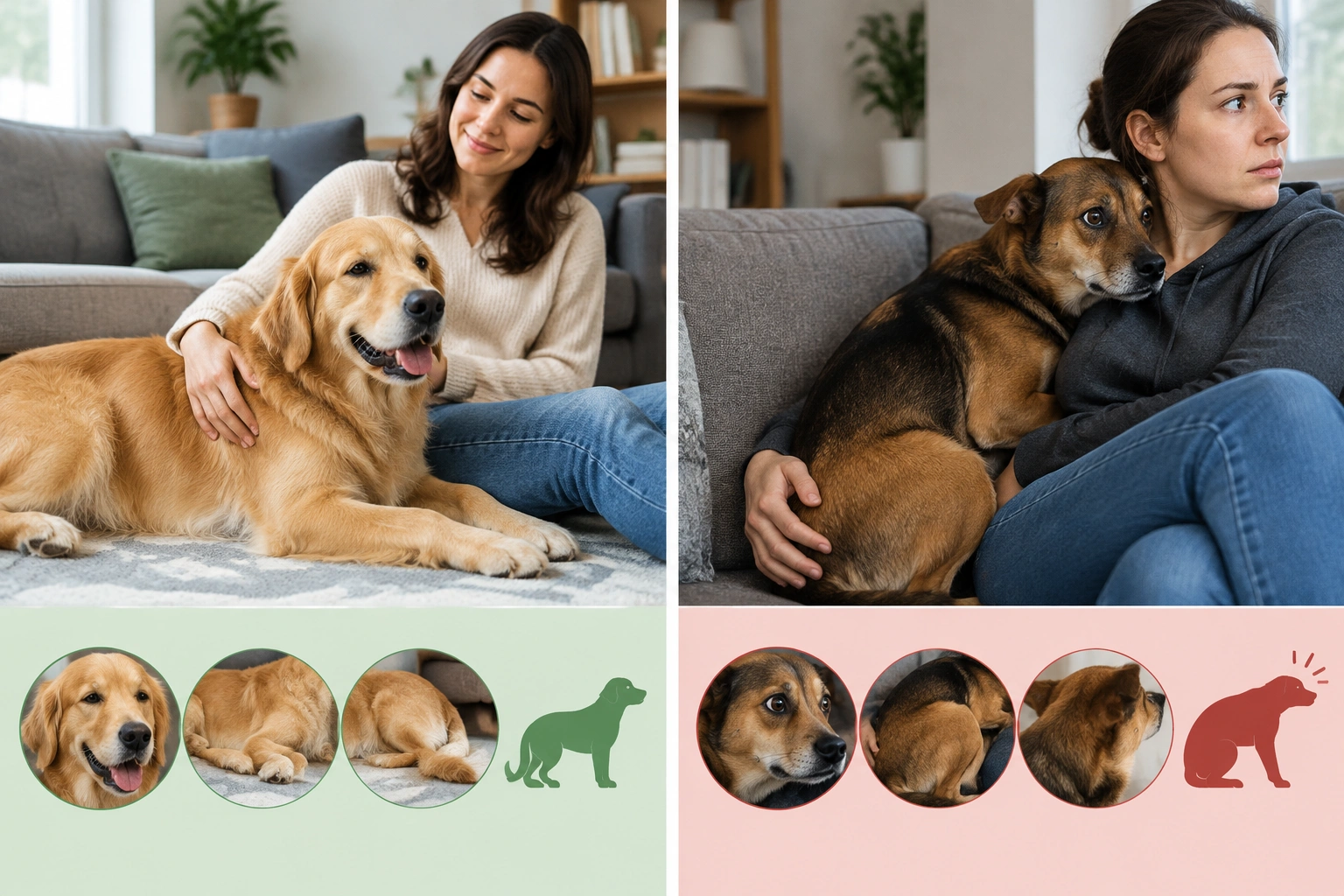
Your posture matters. Leaning over a dog can feel confrontational. Turning sideways often feels less threatening. Slow movements help nervous dogs. Direct, fast reaching can make even friendly dogs brace.
Scent
Dogs live in a scent-rich world. They know you by smell in a way humans usually never think about. Familiar scent is part of why your presence can be calming.
Routine
Routine tells a dog what happens next. That reduces uncertainty, and reduced uncertainty often looks like confidence.
The AKC has a helpful overview of canine behavior and communication if you want a broader look at how dogs read the world.
How to Make Your Dog Feel More Loved in Everyday Life
The best way to communicate love is to make your dog’s life more legible.
Use predictable rituals
A short greeting, a calm leash routine, a consistent bedtime pattern, or a familiar cue before petting can make your interactions feel safer. Dogs do not need elaborate rituals. They need repeatable ones.
Reward the behaviors you want more of
Positive reinforcement does more than teach manners. It also teaches your dog that engaging with you leads to good outcomes. That builds trust. A dog that expects fairness tends to be more willing to try, stay close, and recover from mistakes.
Offer choice where possible
Let your dog opt in to contact. Hold out a hand and wait. Sit nearby and let them come to you. If they lean in, continue. If they move away, respect that. Choice is a powerful trust builder because it tells the dog they are not trapped.
Match your energy to the moment
A Border Collie may love engagement, but constant stimulation is not the same as feeling loved. Some of the most reassuring moments are quiet ones: sitting together after a walk, letting the dog settle at your feet, or calmly brushing them if they enjoy it.
Use touch as feedback, not pressure
Touch should feel like a reward, not a demand. Short, gentle contact often works better than prolonged handling. If your dog melts into it, great. If they stay stiff, reduce the intensity.
Do this today
- Greet your dog calmly before doing anything else.
- Give one short, predictable routine they can recognize, like leash, walk, meal, rest.
- Offer one choice-based interaction, such as holding out a hand and waiting.
- Reward one calm behavior you want repeated.
- Spend two minutes sitting quietly near your dog without asking for anything.
Border Collies and Other High-Attunement Dogs
Border Collies often bond intensely with their people, but their version of closeness can be very specific.
Many Border Collies are highly attentive, quick to monitor movement, and eager to work with their person. That can look like devotion. It can also look like hypervigilance if the dog never truly switches off.
Here is the distinction that matters:
- A Border Collie that watches you, checks in, and then settles is likely showing healthy attachment.
- A Border Collie that shadows you with tension, startles easily, or cannot relax when you stop moving may be showing stress or under-stimulation.
These dogs often do best when affection is paired with structure and purposeful engagement. A calm training session, a sniff walk, or a short problem-solving game may do more for the bond than endless petting. For many Border Collies, being included in a shared task feels more meaningful than being fussed over.
Common Mistakes That Can Undermine Trust
A few habits can quietly make affection harder for dogs to trust.
Ignoring stress signals
If your dog turns away, licks their lips, freezes, or shows the whites of their eyes, do not push through it. Respecting those signals teaches your dog that you listen.
Overdoing physical affection
Too much grabbing, hugging, or face contact can make a dog feel cornered. Even a friendly dog can become less comfortable if affection becomes something they cannot avoid.
Being inconsistent
If your mood, voice, or rules change constantly, your dog has to work harder to predict you. That reduces security. Consistency is not coldness; it is clarity.
Confusing excitement with connection
A dog bouncing off the walls when you come home may be thrilled, but that alone does not prove deep security. Look for the settling afterward. Can the dog come down from excitement and relax with you? That is the better sign.
When a Dog’s Behavior Suggests More Than Bonding Is Going On
Sometimes the issue is bigger than affection.
If your dog panics when left alone, cannot settle unless touching you, becomes destructive when you leave, or seems chronically on edge, separation anxiety or another stress issue may be involved. In that case, the goal is not simply “more love.” It is better emotional regulation, clearer routines, and sometimes professional support.
You should also pay attention if a dog who used to enjoy contact suddenly avoids touch, stiffens when approached, or seems unusually withdrawn. That can reflect pain, fear, or a change in comfort level, and it deserves a closer look.
When to See a Veterinarian or Certified Trainer
See a veterinarian or qualified certified trainer if:
- your dog shows intense distress when you leave
- following behavior looks compulsive rather than calm
- your dog freezes, flinches, or avoids touch that used to be fine
- your dog cannot settle even in quiet, familiar settings
- affection seems to trigger stress instead of comfort
That is not a failure of bonding. It is information. And information is useful.
FAQ
Do dogs understand when you say “I love you”?
They may not understand the words themselves, but they can learn the tone, context, and pattern that usually come with them. The phrase matters less than the delivery and the history behind it.
Why does my dog follow me everywhere?
It can be a sign of attachment, curiosity, habit, or anxiety. The difference is whether your dog looks relaxed and can settle when you stop moving.
Do dogs like hugs?
Some do, many tolerate them, and some clearly do not. Watch for soft, willing body language rather than assuming all dogs enjoy being held tightly.
Can my Border Collie know I love them?
A Border Collie can absolutely learn that you are safe, predictable, and worth trusting. In dog terms, that is very close to feeling loved.
What is the best way to show love to a dog?
The best approach is usually calm consistency: predictable routines, fair reinforcement, respectful touch, and interaction that lets the dog choose closeness.
Dogs may not “know love” in the human way, but they are very good at knowing who makes life feel safe. That is the bond worth building.